As We Know It

The end of the world, as we know it, is really more recent than we think.  Yes, Christians of a certain stripe have been looking for the second coming since the first leaving, but that detailed map of how we’re living in the end times, courtesy Hal Lindsey, is a new thing.  Here are the fast facts.

First and second centuries, Common Era: early Christians tended to think Jesus would “be right back.”  When that didn’t happen they began to look in the Bible for reasons why and started to develop theologies to cover the bases.

Late Antiquity to the Middle Ages: settled in for the long haul, theologians developed eschatology.  Although that sounds like a disease, it’s actually a system for thinking about how the end of the world will come down.  There were conflicting theories.  The two main flavors were premillennialism and amillennialism.

Early Modernism: Protestants came along and searched the Bible for minute clues to make into a system.  In response, postmillennialism became a thing.  Now there were three options.  Various phases were discussed: tribulation, resurrection of the dead, and the already-met millennium.

1820s: William Miller, a Baptist minister, began number-crunching and figured the end of the world would take place by 1843.  His followers, “the Millerites,” continued on after what was called “the Great Disappointment.” 

1830s: John Nelson Darby, a Plymouth Brethren leader, came up with Dispensationalism, a scheme that divides history into eras, or “dispensations.”  He thought we were living near the end of that scheme about 200 years ago.  The idea of “the rapture” was added to the other phases.

1917: Cyrus I. Scofield, published the Scofield Reference Bible.  A man with little formal education (and a “colorful” background), he applied Darby’s dispensations in his Bible, giving the United States a road map to the end times.

1970: Hal Lindsey, a seminary educated evangelical, published The Late, Great Planet Earth.  It became the best selling book (classified as nonfiction) for the entire decade.  New ideas, such as “the Rapture” and “the Antichrist” began to be read back into the Bible.  The book was made into a movie.

1976: David Seltzer, a Jewish screenwriter, penned The Omen.  The movie made use of Lindsey’s adaptation of Scofield’s adaptation of Darby’s ideas.  The wider public, seeing it on the big screen, believed it was about to happen.

2000: the world still didn’t end, either with a second coming or Y2K, as many predicted.  Round numbers will do that to people.  It didn’t stop predictions of the end of the world.

2012: the Mayan calendar gave out.  A movie was made.  People believed. Apocalypse averted.

2024: you fill in the blanks.

Image credit: Albrecht Dürer

Direct Address

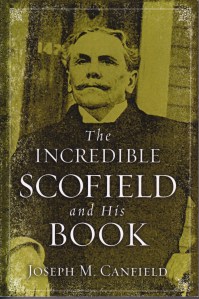
For a man as amazingly influential as he was, Cyrus I. Scofield hasn’t been the object of much curiosity. In the venerable academic tradition of ignoring those you disagree with, serious scholars dismiss Scofield as some kind of evangelical aberration, a theological leper, if you will. It’s difficult to locate book-length treatments of the man, although he may claim considerable credit for the elections of Ronald Reagan, George W. Bush, and the current incumbent. Somewhat skeptical of the obviously polemical The Incredible Scofield and His Book by Joseph M. Canfield, curiosity drove me to read it as an accessible and thoroughly researched account. Now, one evangelical going after another isn’t a pretty sight, but if you can get past the “this is what the Bible really means” oneupmanship, there is clear evidence of a sharp mind with legitimate historical accuracy as its priority in Canfield. This is especially clear where he demonstrates that scholars shown the evidence will choose to ignore it to preserve the sanctity of a man hardly a saint.

The strange religion that has developed from the Scofield Reference Bible has had an astoundingly long reach. If you know what “the Rapture” is, it’s probably because those who took their cues from Scofield’s Bible ensured that it became a standard American trope. It generally doesn’t have to be explained, even though the idea doesn’t occur in the Bible. It’s based on a set of “dispensations” developed among the Plymouth Brethren, a fairly small British and Irish sect that influenced the world through its prophet Scofield. (Scofield himself was not a member of the Brethren, but he learned his system of “history” from them.) Although the Scofield Reference Bible wasn’t technically the first study Bible, it was the first widely influential one. It is, in a sense, America’s Bible.

Scofield himself was hardly clergy material. Canfield documents this clearly and doggedly. Among the evangelicals, however, an admission of guilt—no matter how insincere—has to be taken at face value. If you’re caught “backsliding” after that, all you have to do is admit that too. They’re obligated to forgive you 490 times, if they’re truly literalists. We can see this at work in the bizarre evangelical backing of Trump, a Christian only by the loosest possible definition. If you say you’ve accepted Jesus they have to believe you. It’s the ultimate scam. Scofield himself seems to have been aware of this. Particularly wrenching was the account of how, after he was making a respectable income from his Bible, he refused to give money to one of his daughters from his first marriage when she wanted to buy a house. His will left no money to any charitable organization at all. You can take it with you, apparently. And so, we’re left with a world devised by such a man with no theological training. Since he’s so obviously low brow, however, we lack scholarly biographies that take the care of Canfield in exposing information readily available to those with open eyes.