Becoming Biblical

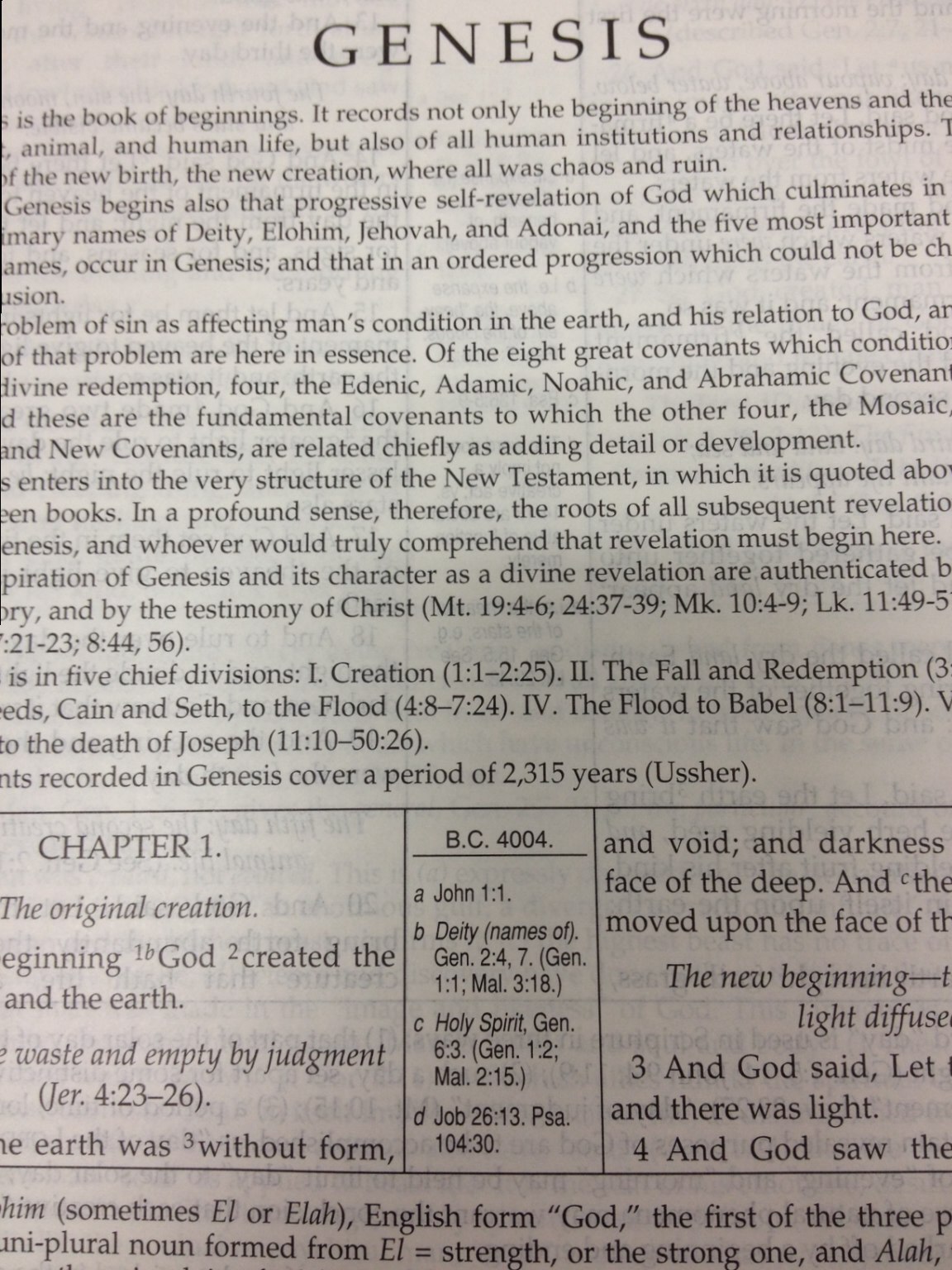
The average reader has difficulty sorting out what’s biblical or not. For example, when Cyrus Scofield began putting 4004 BC [sic] as the date of creation in his annotated Bibles, people thought the date was biblical. It was, literally, “in the Bible.” I used to tell my students that there’s a cultural belief that everything bound between the covers of a Bible is biblical. If so, I’ve just become biblical myself. I must say, it comes with mixed feelings. For the many people with whom I’ve worked on the New Oxford Annotated Bible, having their names inside is an expectation. Employees, however, sometimes make it in, too, in a prefatory way. I was touched to see my moniker there, on Bible paper, amid Holy Writ. Almost life-changing. A little scary.

Imagine a post-apocalyptic world. (I know, it’s easier now than it was just a few short months ago.) What if all books were wiped out except a copy of the book fondly abbreviated NOAB? Some Leibowitzian monk might come across it, and, recognizing that it’s sacred dare to open it, not comprehending the language but eager to begin again. Am I ready to be in such a book? Nobody reads prefaces, I know, but this is the widest circulation my humble family name has ever achieved. In there with Joseph, Job, and Jesus. It’s heady stuff. I’ll be on the shelves of used bookstores from now on. For a guy who’s books have been printed only in the 300 run range, this is dizzying. And not too bad for being only an administrator. None of my deans ever made it into the Good Book.
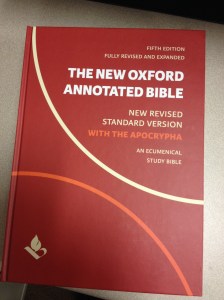
Surely there’s some grim responsibility that accompanies becoming biblical? Some consummation devoutly to be wished? Looking around at my fellow biblical characters, I’m not so sure. Many cases of men behaving badly surround me. None of them, I expect, had intended to be biblical either. Time and circumstance led to their elevated status. Modern biblical people tend to be famous only among their own guild. Some gain wider recognition, to be sure, but none share the name recognition of those recalled by the unknown recorders of sacred scripture. I’ve written books of my own, and been acknowledged as a scholar and editor in other peoples’ books, but never before have I found myself in such exalted, if accidental company. Where does one go from here? A Herostratus of Holy Writ? I can’t help but wondering if Jeremiah started off working in a cubicle.
The Scofield Connection

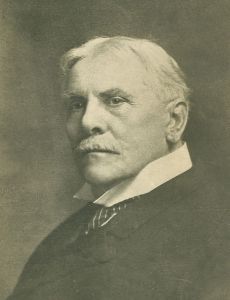
While reading about Cyrus Scofield recently—and that book has stayed on and played with my mind for some reason—I ran across the conferences that he held in preparing his famous reference Bible. Although he claimed the sobriquet “Doctor,” placing D.D. after his name, like many a self-puffer Scofield has no university that will support the claim. (It’s amazing how many high-level CEOs and “important” businessmen pad their résumés with false degrees. Even some government wannabes do it, and then they want to defund education after they get into office.) Perhaps because he had no seminary training, and likely didn’t even graduate from college, Scofield might’ve felt a sense of insecurity when it came to a very large book originally written in languages he couldn’t read. There’s a reason “King James Only” Christians exist. In any case, he set up meetings in a couple of conspicuous places to go over his work. One of those places was Grove City College.

Now, like many small, Christian colleges, Grove City isn’t widely known. Most of the student population—at least when I was there—was fairly local. Pennsylvania, Ohio, and New York, for the most part. Still on the (admittedly rare) occasion when someone asks me where I went for my undergraduate work, they generally haven’t heard of Grove City at all. Even though I spent four years of my life there, I had no idea about the Scofield connection until I read Joseph Canfield’s book. That’s because not all Fundamentalists grow up with Scofield. I’m sure I heard about the Scofield Reference Bible but I didn’t own one and I wondered what the big fuss was all about. After all, the annotations were the work of a man, and I was interested in the words of God. Far more popular was the revision of Scofield known as the Ryrie Study Bible, but I never read that either.

The end result is that many people think that Scofield’s words are “the Bible.” As I used to tell my students, binding pages together within a book makes a statement. If you’re saying “this is the word of God” and part of “this” is Scofield’s annotations, most people can’t distinguish between text and commentary. I eventually acquired a Scofield Bible, not for valid information, but simply for information. I was amazed at how poorly executed it was. Nevertheless, a true believer reading through the first chapters of 1 Chronicles is ready to accept even minimal narrative as divine. So it is that many Americans have come to believe in a Bible that’s not biblical. Religion is full of paradoxes and in this case I’d shared sleeping quarters with one in my more formative years although the connection was unknown at the time.


Eleventh Hour

Religion, as many a charlatan knows, makes a very good investment. History has demonstrated time and again that the confident huckster can easily siphon the money from the gullible in the name of God. What follows does not make any assertions about the character of the people involved. It is, however, a fascinating story.

Cyrus Ingerson Scofield did not have an exactly stellar career. He was raised Episcopalian (which may explain some of it), but upon being drafted into the Confederacy during the Civil War, deserted to become a lawyer in St. Louis. Scofield was forced to resign from his law post because of “questionable financial transactions” which may have included forgery. He was a heavy drinker and abandoned his wife and two daughters. The year of his divorce he remarried. Then he had a conversion experience. Conversion is the ultimate clean wiping of the slate. Any life of dissipation may be excused following a religious experience, eh, Augustine? And furthermore, in the sanctified state the motives of the former reprobate are never questioned.

Scofield went on to join the Congregational Church and to grow wealthy from his Scofield Reference Bible, still a perennial seller, despite his lack of formal theological training. This notoriety was largely because Scofield had adopted another unlikely scheme, dispensational premillennialism. This end-time scheme grew out of the work of John Nelson Darby and later evolved into what would be called Fundamentalism. The idea was that the Bible contained an esoteric roadmap to the future, culminating in the book of Revelation, whereby the blessed could figure out exactly how the end of the world would unfold. As a child I bought a literal roadmap to the end of the world, but having survived several such putative apocalypses, I have grown a tad skeptical about the efficacy of my chart.

Any number of religious leaders have a background of self-promotion and more than a whiff of Phineas Taylor Barnum about them. A converted soul, however, is never to be questioned. Cyrus Scofield adopted Archbishop James Ussher’s dating scheme for the creation of the world in 4004 “BC” and placed it in his reference Bible, forever putting the cast of scriptural authority to a date that would come up in court cases even through the twenty-first century in Dayton, Tennessee, Little Rock, Arkansas, Dover, Pennsylvania, and Washington, DC, wasting tax-payers’ money on a myth of biblical proportions. Often creationists use “stealth candidates” who don’t exactly tell the truth before school board elections. I don’t doubt the depth of the convert’s belief, but I smell money here. And once upon a time literalists believed that it was the root of all evil.

The reason most Creationists cite 4004 is Scofield...

The reason most Creationists cite 4004 is Scofield…