More Curtis

Dan Curtis was the mind behind Dark Shadows, an important part of my childhood.  Reading about his work in film and television, I learned that he produced a lot more than Barnabas Collins, and was an influence in horror in his own right.  A friend recommended that I find The Norliss Tapes, which I did.  This made for television movie was cut from the same cloth as The Night Stalker, which Curtis also produced.  The ending of the movie makes clear that The Norliss Tapes was a pilot for an intended series that never materialized and is a good representation of religion and horror, which is likely why it was recommended to me.  Here’s the story.   David Norliss was given a large advance by a publisher to write a book debunking the supernatural.  Before he can, he goes missing, leaving behind a set of tapes explaining what happened.  The first tape is the pilot episode.
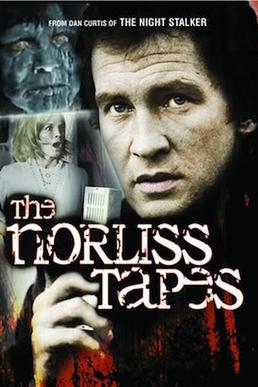
Norliss is contacted by Ellen Sterns Cort, a widow who claims to have had a supernatural episode.  Upon following her dog to her late husband’s studio one night, she encounters her undead husband.  She shoots him, but the police can find no evidence of any body.  It’s revealed that he purchased an occult scarab ring that permits him to return to life to raise a demon who will, in turn, bring him back to real life.  To get the raw materials he needs (such as blood) he has to kill a few people and this again alerts the authorities but they insist on covering it all up.  Removing the ring from his finger will stop him, but that’s easier said than done.  At the end the demon is stopped but this is just the end of the first tape.  His publisher starts to play the second tape.

Dan Curtis productions have a certain feel to them.  I’m not sure how directors and producers do that—I’m not sure of all the tools they have in their box.  What is obvious is that watching The Norliss Tapes brings back echoes of Dark Shadows.  That’s not surprising since Dark Shadows wound down just two years before the Norliss Tapes came out.  The Night Stalker was sandwiched between them, but Kolchak: The Night Stalker was not a Curtis production and doesn’t have a Curtis feel to it.  Even though I’d never seen Norliss before, it was nostalgic watching the movie for the first time.  There’s a trick to it, I just don’t know what it is.

One out of Three

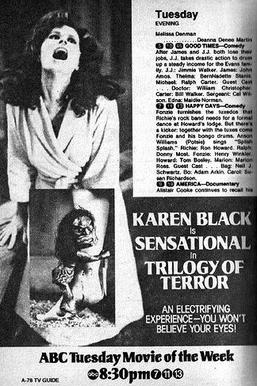
While reading about Dan Curtis, I became curious about Trilogy of Terror.  As a child subject to nightmares, my “horror” watching was limited to Saturday afternoon movies on television and Dark Shadows (also a Dan Curtis production).  In other words, I didn’t see Trilogy.  While we were allowed to watch The Twilight Zone from time to time, I understand my mother’s reluctance to let us watch scary content.  She was trying to raise three kids on her own, one of whom (yours truly) was plagued with bad dreams.  Why would you let them watch scary stuff, particularly before bed?  In any case, Trilogy was a made for television movie; Curtis did some theatrical films, but mostly stayed with television.  It consists of three segments starring Karen Black, based on stories by Richard Matheson.  Only the third one was scary.

Poster, from TV Guide, courtesy of Wikimedia Commons, copyright: TV Guide

The first two segments feature Black as either the apparent victim of blackmail or being controlled by a drug-addicted sister.  The stories, being Matheson, have twist endings, but they don’t really scare.  The final segment, for which the movie is remembered, involves the trope of the animated creepy doll.  That made people sit up and pay attention.  This wasn’t the first creepy doll exploited by horror, but it did predate Child’s Play and, of course, all those Annabelle movies.  The doll here was a Zuni fetish.  Its purpose is to enhance hunting skills and, of course, it comes with a warning.  Don’t take off its golden belt or the spirit trapped inside will be released.  The belt comes off, of course.  The doll naturally attacks Black and, not being really alive, can’t be killed.  The movie made an impression back in the day and is difficult to locate now without shelling out a lot for a Blu-ray disc.  (Diligent searching will lead to streaming options, however; trust me.)

Having inherited more realistic scary dolls in the franchises mentioned above, it takes a bit of imagination to realize how frightening this would’ve been in the mid-seventies.  Although a Zuni fetish isn’t a toy, killer toys had appeared before and would appear again.  They all seem to rely on the uncanny valley where things resemble people but we know they’re actually not.  We survive by being able to read other people and getting an idea of their intentions.  The fetish here has pretty clear violent intensions, being a hunter with pointy teeth.  We all know that there are some people like that.  Such television movies aren’t always easily found, and if they’ve become cult classics like Trilogy of Terror, discs are priced pretty outrageously.  If you’re unrelenting in your searching, you might just find your possessed doll.  And an early example of what’s still a pretty scary idea.


More Than Dark Shadows

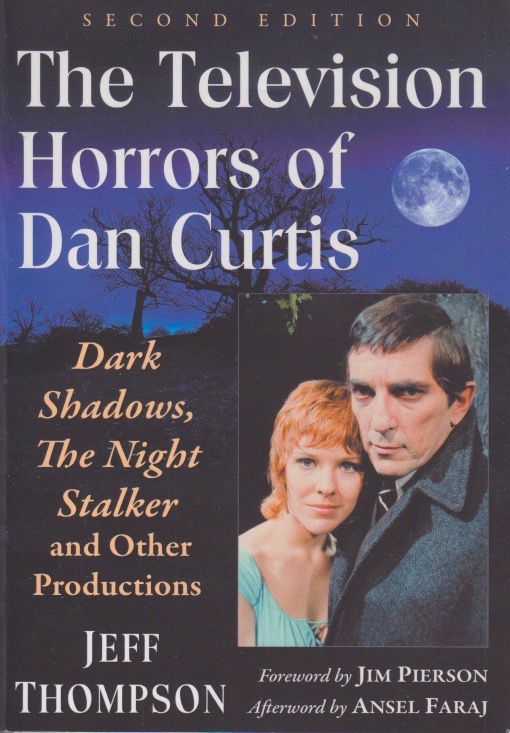
The Television Horrors of Dan Curtis is one of those books that makes me feel less alone.  Jeff Thompson is not only a true fan of Curtis’ voluminous quality output, but he knows more about Dark Shadows than might seem possible.  I knew I wanted to read this book as soon as I learned of it.  As I’ve confessed many times before, although Dark Shadows was formative for me, I’m a mere dabbler.  I saw a fair number of the original run on afterschool television, I read the novels, but I never dove in.  I was more of a wader.  Still, this book demonstrates that many people were influenced by Dark Shadows, some that you might not expect.  But the book is about Dan Curtis and his horror work (mostly).

Dan Curtis went on to a kind of fame for his war epics (considered “serious” work), The Winds of War and War and Remembrance.  Although he directed some theatrical movies (all of which I’ve seen), he mostly stuck to work in television.  One of the results of this is that he never attained the level of appreciation of a number of auteurs who focused on Hollywood.  And it’s also clear that Curtis was interested in more than just monsters.  I personally dislike gangster and war movies (although my great-uncle Melvin Purvis was one of his interests).  Curtis found them worth of his considerable talents.  As Thompson makes clear, however, even as his own death was approaching, Curtis knew that, like Washington Irving, his early work would be that for which he was remembered.  That’s because Dark Shadows went where nobody else dared to go, and it’s memorable even today.

I learned a lot from this book.  Enough to know that Curtis was an enigma.  He remains less recognized as a director and producer than many Hollywood personalities that are household names.  Still, if pressed, a number of people even today would recognize some of Curtis’ work, whether or not they associate it with him.  Dark Shadows went through a short television reboot, for instance, and a second reboot attempt before being made into a movie by Tim Burton.  This book, however, made me watch some movies I had only known vaguely before.  And it has inspired me to watch others as well.  Curtis was an incredibly hard worker, and a man with definite opinions.  It’s perhaps a bit surprising that he never really attained the kind of fame that other “content producers” did.  Even his Wikipedia article is brief.  This book helps uncover a large amount of information behind a person who influenced many people without the glamour associated with that level of impact.


Who’s Stalking?

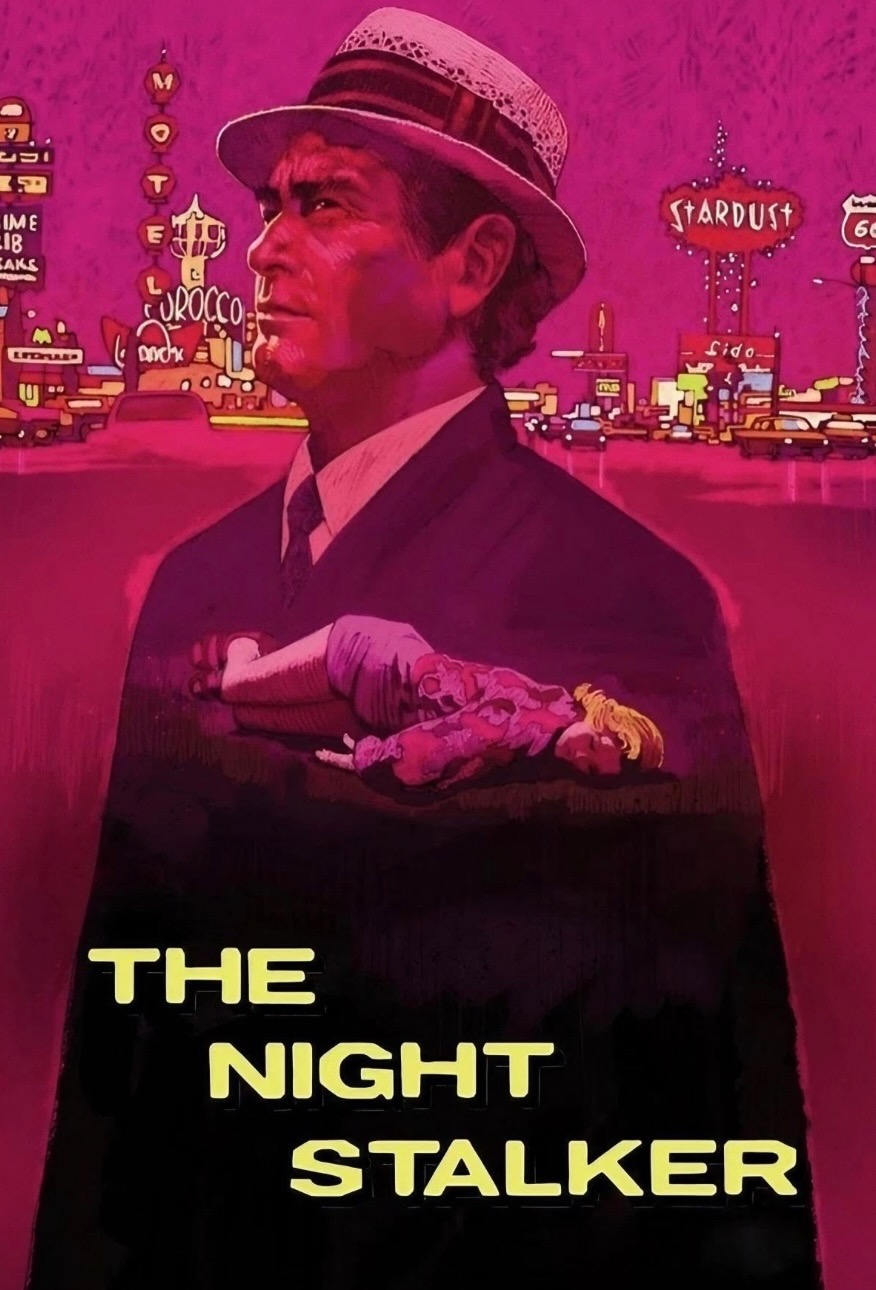
Television is a hungry beast.  Back before the internet it was probably less hungry, but still the desire for content was constant.  A few individuals worked the monster side of the tube, one of them being Dan Curtis.  Dark Shadows was Curtis’ idea, and it was in that context that he began to have an influence over my life.  I wouldn’t have recognized his name in those days, of course—do we ever really recognize those who become part of the arc of life’s direction when we’re kids?  Curtis produced a television movie that I’d never seen, taking on the vampire tale again.  The Night Stalker isn’t a great film—it was produced for television, after all—but it started something.  That something was the weekly series Kolchak: The Night Stalker.

I’ve been watching episodes of Kolchak and realized that I was missing something—the origin story.  As an historian I really like to keep things in order.  Since my research is conducted on my limited free time and limited budget, I still discover things others probably knew long ago.  In any case, I decided to hunt down and watch The Night Stalker.  It introduces, of course, the character of Kolchak.  In a way that seems unnecessary for 1972, it narrates quite a bit of vampire lore.  It even frames some scenes from Bela Lugosi’s 1931 Dracula.  As I watched this period piece for the first time, I realized that the actual night stalker wasn’t originally Kolchak.  In this movie it’s clearly Janos Skorzeny, the vampire.  The movie was based on an (at the time) unpublished novel by Jeff Rice.  And so began a number of cascading things.

I didn’t watch Kolchak as a child.  I do remember other kids talking about it, but it never made its way into our evening television watching.  (My mother was concerned that I had nightmares as a child and didn’t encourage scary things before bed.  Decades on I’m still prone to nightmares, but as I said, arcs get set early on.)  Kolchak is kind of a hapless character, rubbing people the wrong way.  The movie leaves many unanswered questions, but it was good fare for unreflective television monster purposes.  There had been monsters before—I think we all owe a great debt of gratitude to Rod Serling’s Twilight Zone—but Kolchak made the horror element, always laced with comedy, central.  The television movie received the highest ratings of any television movie to that point.  And we all know that such things lead to sequels.  Television is ever hungry.