From the Grave

“Macabre” is a word of uncertain etymological origin.  One of the most convincing arguments that I’ve read is that it derives from Hebrew qbr, a root associated with graves.  The “m” prefix would be the preposition “from,” making the phrase miqqeber, or “from the grave.”  It has been decades so I don’t remember where I read that, but it made sense to me.  In any case, this is a fairly common word for titles, it would seem.  I recalled Stephen King noting Macabre among the scariest films up to 1980, so I thought I’d try to find it.  A simple IMDb search showed it streaming for free on a couple of platforms, so I clicked on one of them.  At about halfway through, I paused the movie to see if maybe I’d got the wrong one (I had).  But I decided to finish it out in any case.  There will be spoilers below.
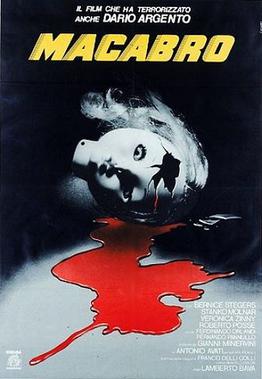
What I’d found was the 1980 Lamberto Bava movie.  Bava’s name was familiar to me from his famous father, Mario Bava, an Italian horror movie innovator.  There was a family resemblance.  So, what’s it about?  A woman with two children is having an affair.  Her somewhat unstable daughter decides to drown her brother to get her mother to come home.  On the way, her paramour, who is driving, runs into a guardrail and is decapitated.  After being released from the mental hospital, the woman moves into the apartment where the affair had been taking place.  The house is owned by a blind man who knew about the affair.  It sounds like, however, the affair is still continuing although said man is dead.  

When the daughter, who is trying to get her parents back together, confesses that she drowned her brother, the woman drowns her—echoes of Medea here—but the blind man kills the woman when he tries to save the daughter.  What makes this even more macabre, is that both the blind man and the daughter had learned that the woman was keeping the head of her lover in the freezer—echoes of Alice Cooper as well—to stimulate her as she continues the affair without her former lover.  It’s not a horror classic.  Titles can’t be copyrighted, so some repetition is bound to occur.  The Macabre I should’ve watched was the one from either 1958 or 1969.  Apparently this is a popular film title, as there was another released in 2009.  I can rule out the last one, but to find out what I should be looking out for, I’ll need to dig out my copy of, well, Danse Macabre.

Scary Things

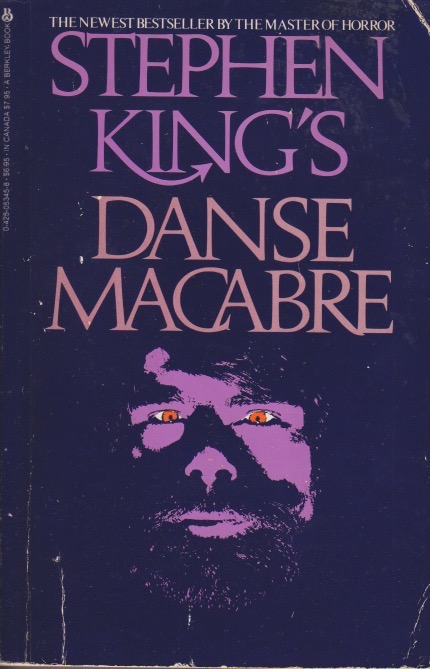
I recently set myself the challenge to come up with the scariest movies I’ve seen, up to 1979.  The date is the publication date (I think) of Stephen King’s Danse Macabre, which gave me the idea.  Book publication dates can be difficult to decipher; I have the Berkley Trade paperback edition, which is copyrighted 1981 and published in ’82.  So, let’s just say 1980.  Now, I would never challenge Mr. King, who is older, and wiser (not to mention much better known) than me.  And I suspect, if I understand writers at all, his views may have changed since then.  Several of the films he discusses are thrillers.  And, of course, each person’s viewing history is unique as their thumbprint.  So let’s give it a try.  First, I need to say there are different kinds of scary.  We all have our triggers, and I’m going for things that frightened me.

Photo by Stefano Pollio on Unsplash

Since we’re using 1980 as the cutoff, The Shining has to be on the list (of course King wrote the novel).  Like most of these movies, I saw it at home and the theatrical experience would’ve made an even bigger impact.  The Exorcist also has to be on this list as well.  For older fare, Eyes Without a Face certainly qualifies.  The Haunting, based on Shirley Jackson’s The Haunting of Hill House is among those in this period but it isn’t terribly scary.  I watched a number of King’s movies—many of which I’d never seen—and found some frightening ones among them.  Night of the Hunter, which makes me add the original Cape Fear, should be included.  So is The Bad Seed.  Something all of these have in common, apart from perhaps The Exorcist, is that they derive their terror from psychology.  There may be some supernatural involved, but the mind is the truly scary part.

Growing up—and even in the present—I’m not really looking to be scared.  I have no trouble getting to that state all by myself, thank you.  The monster movies of childhood thrilled with the unusual, and the realm beyond the everyday.  The haunted house movie held its own frisson for a similar reason.  Of course, children are often not developed enough to understand the nuances of psychological horror.  The more I ponder it, the more it seems that “horror” is the wrong name for what I’m after.   We gain bragging rights by watching scary movies.  And I don’t count jump startles as truly frightening.  I’m more of an existential dread kind of guy.  But I do love monsters.  Even this little exercise made me realize how difficult ranking such movies can be.  Perhaps I should bow to the King.


Dancing with King

There are books you wait too late to read, but which you read at just the right time for you.  That’s how I feel about Stephen King’s Danse Macabre.  This book is endlessly cited in more academic treatments of horror and I knew I should read it.  And one thing I immediately appreciated is that even early in the eighties King expressed my long-term concern: many genres fall into horror.  He, perhaps rightly, considers horror a subspecies of fantasy.  Or course, fantasy has come to mean something quite different in the intervening half-century.  Still, the reader is treated to thrillers, sci-fi, and weird fiction.  There’s also a dose of the gothic and speculative as well.  King sets his four classes of monsters early: the vampire, the werewolf, the thing without a name (Frankenstein’s creature), and ghosts.  These are all very broadly conceived.

It will become clear in coming weeks, for anyone who’s interested, that the movies I “review” here have been influenced by King’s list.  And in the longer term, the books as well.  And I tend to agree with King’s antipathy toward television, although I disagree with his assessment of The Twilight ZoneDanse Macabre is a book of its time, of course.  I would be curious as to the master’s reaction to such more recent classics as The X-Files.  I loved that he treated Ray Bradbury as a sometime horror author and it becomes clear that each of us finds different things scary.  The thing was, I found myself anticipating my too scarce reading time each day for the month it took me to read the book.  I often start books that I soon find myself approaching with a kind of duty to finish.  Love him or not, King is a talented writer and will keep you coming back, just like birds to a feeder.

I learned that King, too, appreciates bad movies.  He grew up about a decade and a half before I did, but the small-town culture I experienced as a child was not so different, although Sputnik was already up and the Cold War already on.  I guess what I find so engaging here is that this is a guy who speaks my language.  My tastes differ, of course, but there’s something comforting about whiling away the pre-dawn hours with a guy who can say “The Thing” and you know immediately what that vague phrase means.  And it was strangely reassuring to be reminded that the world of the seventies, which I experienced as a teenager, was just as scary as the world is right now.  And if King ever looked me in the eyes, I think he’d recognize something about me, although a sometimes critical fan.