No Ordinary Picnic

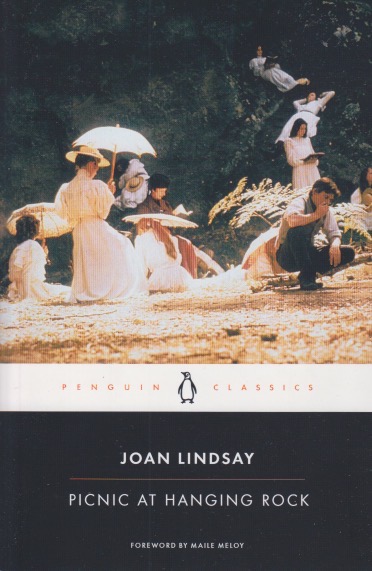
I will be including spoilers in this review, so please be advised!  Joan Lindsay’s Picnic at Hanging Rock is a novel that began as speculative but then turned naturalistic.  Mostly, anyway.  Born in 1896, Lindsay published the novel just after she turned 70.  Since she was Australian, it stands to reason that the story is set there.  Hanging Rock is an actual place and, according to multiple sources, Lindsay ended the book with a speculative chapter that explained the mystery.  What is the mystery?  On Valentines Day 1900, the girls at Appleyard College set out for a picnic at, well, Hanging Rock.  While there, three of the girls and one of their chaperones disappear.  Since everyone travels by literal horse power, getting back and forth from the scene of the mystery takes hours.  The head mistress of the college is frantic, mostly because she’ll be losing tuition because of this.

Eventually one of the girls is found, somewhat mystically, by a young Englishman with whom a romance starts and seems to end abruptly.  The found girl remembers nothing of what happened that day.  Further investigations are held, but the mystery is never solved.  Meanwhile, Mrs. Appleyard, the mistress of the college, takes a strong dislike to one of the girls who was devoted to one of the missing.  After one of the girls’ governesses, recently dismissed, burns to death, the headmistress appears to have murdered the girl she disliked (or she fell/jumped from a window; the novel isn’t explicit on the point).  Mrs. Appleyard, realizing she is ruined, goes to Hanging Rock where she dies by suicide, throwing herself down the rocky side of the outcropping.  The speculative ending—no longer part of the novel—had the missing girls disappear into a kind of time warp.  Lindsay’s editor had her remove that chapter.

The novel became quite well known in Australia, and to the wider world when a movie was made from it.  The interesting thing is that the novel presents itself as describing factual events, like the Blair Witch Project.  This is so much the case that the rumor grew that the events really did happen.  A book was even written, suggesting a solution regarding what happened to the missing girls.  Had the excised chapter been published with the book, it would’ve been clear that this was a fictional tale.  Lindsay had a savvy editor, however.  Nothing sells like a dramatic story that readers believe to be true.  Witness The Amityville Horror.  Even though naturalistic, a bit of the speculative still hangs about the story, making for a good gothic novel without a firm resolution.


Hop In

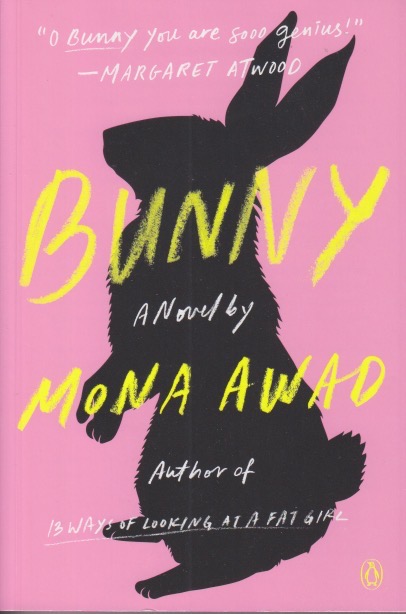
Especially the first part, of Mona Awad’s Bunny, is so well written I almost laid down my pen for good.  I really enjoyed this one.  Once the story gets deeper, into the second and third parts, questions begin to arise as to what’s going on.  One reason for this is the story becomes speculative in nature and Awad’s not about to give away what’s “really happening.”  Set among a set of five graduate students at the prestigious Warren University (the name is a hat-tip), the novel is often considered dark academia.  It starts out pretty light, and although Awad maintains her deft hand, it grows progressively darker as the tale goes on.  Samantha Heather Mackey is enrolled in the writing program with a cohort of four “perfect” women—the kind many guys go for.  Sam’s an outsider, though, writing dark and troubled stories while her classmates garner the professor’s praise.

The “perfect” women call each other “Bunny” and they eventually invite Sam into their clique.  This annoys Sam’s best friend and sometimes roommate, a local artist who isn’t a student.  But Sam is caught.  She learns that the Bunnies actually transform rabbits into their ideal boyfriends.  They haven’t got the process down pat, though, and the resultant hybrids often have various deformities.  Sam is the only one who can’t do this transformation.  Until she does.  But it doesn’t turn out like anyone expects.  I’d better draw my plot summation to a close there, otherwise I might hop into spoiler territory.  I wouldn’t want to do that because I recommend reading this one for yourself.  Awad’s writing is beautiful and compelling.  I did wonder if I’d interpreted everything correctly when I finally put the book down.

Dark academia comes in a rainbow of colors.  Here, although comi-tragic, there’s something seriously wrong at Warren University.  There are plenty of books and classes, as well as intrigues among ingenues.  And also some serious reflection on expectations and how they affect relationships.  Friendship and what it really means.  Loneliness, and how it creeps into the lives of creative people.  It’s also a story about writing and learning to write.  As noted above, it succeeds wildly in this.  There are definitely horror vibes about the tale, but it’s so well told that you might lose track of the fact that they’re there.  When Margaret Atwood praises a book, it’s worth paying attention.  While not dark and dreary, Bunny shows the sub-genre off as one of great potential.  It’s worth twitching your nose over.


Horror Time

In case anyone’s wondering (ha!), I haven’t lost interest in horror.  I’ve been discussing quite a few dark academia movies lately since that’s where I seem to be, but what’s really lost is time.  I’m no great consumer of social media.  I spend literally five minutes on Facebook daily.  Less than that on Bluesky and Twitter.  I don’t have time.  I love watching movies, but they take time.  I often discuss this with family—I’m not sure where the time goes.  In my case it’s not social media.  Much of it—the lion’s share—is work.  When a three-day weekend starts to feel like just enough time to get everything done before starting it all over again, I think there’s an elephant in the room.  If I can just squeeze past your trunk (pardon me) I would note that I spend as much time as I can writing and reading, but even that drains too quickly.

I read a lot.  And I read about writing.  Those who do it best have time to put into their craft.  If they’re working long hours, have a family, and weeds that love all the rain we get around here, they’re better than I am.  Home ownership (if you can’t afford to hire groundskeepers) is itself a full-time occupation.  As is writing.  And, of course, work.  What’s been suffering lately has been my time for watching horror.  Part of that’s money too.  I’m not sure if anybody else has noticed, but prices haven’t exactly gone down since January, and movies aren’t always free.  I have a long list of horror films I want to see (quite a long list), but tide, time, and money wait for no-one.  I even had a four-day weekend not long ago during which I had no time to watch horror.  Horrific, isn’t it?

I’m at a stage of life where the shortness of it all stares me in the face.  I was a late bloomer and my career never really took off.  It ended up taking time and not rewarding that time at the usual exchange rate.  I’m watching friends and family retire and some finding too much time on their hands.  Hey, brother, can you spare an hour?  I think of my farming ancestors where every minute was filled trying to stay alive in a world where leisure time really is a luxury.  I have no right to complain, but I do wonder where the time goes.  I suppose if I didn’t blog I’d have a little more time for horror, but I just can’t face giving up all this fame.


Bad Intensions

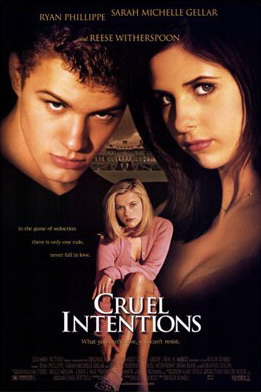
What, exactly, defines dark academia?  I ask myself that question a lot.  Looking for movies that might help answer that question sometimes brings about unexpected results.  A film that appears on several dark academia lists is Cruel Intentions.  I’d never seen it before and since it’s generally classified as a teen romantic drama, it isn’t exactly what I tend to go seeking.  Still, that definition is important to pin down, dark academia.  So I tried.  It presents itself, at least up front, as a teen sex comedy.  A rich playboy at a private school, and his scheming step-sister, enjoy destroying the innocence of new coeds.  She uses coke and he appears to be addicted to sex.  There’s not much to really like about either one.  Then the unexpected happens—he falls in love with one of his intended victims.

If the plot sounds a little familiar, it may be because it is a retelling of Dangerous Liaisons, a movie I’ve never seen based on a novel I’ve never read.  What makes it dark academia is that it takes place in a private school.  An exclusive private school (but aren’t they all?).  And it does take a dark turn toward the end.  The cad (Sebastian by name) is eventually caught in his relentless womanizing and although the woman he truly loves is a forgiving sort, it can’t save him in the end.  The movie has the fun of double-double crossing and certainly doesn’t paint a very flattering portrait of the rich.  Indeed, Dorian Gray comes to mind as well.

The movie, qua movie, is enjoyable enough.  The acting is pretty good.  I’d seen it described as a thriller as well, and there may be some junior-level thriller moments.  Dark academia, at its best, has some crossover with thrillers, or even horror.  Since the aesthetic appeals primarily to the young, it is perhaps inevitable that it goes gently into that dark night.  I’m trying to get a handle on it because it has captured my imagination.  In many ways dark academia has helped make sense of what has happened in my life.  I love the gothic aspect of the genre.  The few shots of the gothic architecture of Manchester Prep were appreciated, but the movie as a whole doesn’t have much of a gothic feel, beyond the monied privilege of kids who’ll probably never have to do a day’s work in their lives.  Dark indeed.


Finding Fossils

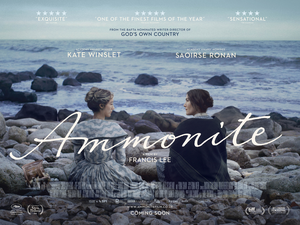
Mary Anning was a real woman.  She made valuable contributions to paleontology in the first half of the nineteenth century, although she wasn’t always credited for her work.  The movie Ammonite is a fictionalized account of her life at Lyme Regis, where she lived and discovered dinosaur fossils.  Being fiction, the movie focuses on how Mary “came out of her shell” by entering into a relationship with Charlotte Murchison (also an historical person, wife of the Scottish geologist Sir Roderick Impey Murchison) who was left in her care when she came down with a fever after trying to recover from melancholy by taking the sea air.  Mary had established a life of independence and wasn’t really seeking relationships; her mother still lived with her and, according to the movie, they had a distant but loving regard for each other.

I was anxious to see the film because it is sometimes classified as dark academia.  Since I’m trying to sharpen my sense of what that might mean, it’s helpful to watch what others think fits.  The academia part here comes from the intellectual pursuits of Anning and the academic nature of museum life (one of her fossils was displayed at the British Museum).  Anning, who had no formal academic training, tried to make a living in a “man’s world,” and in real life she did contribute significantly to paleontology.  The dark part seems to come in from her exclusion from the scientific community, and perhaps in her love for Charlotte, a forbidden relationship in that benighted time.  Of course, this relationship is entirely speculative.

Fictional movies made about factual people make me curious about the lives of those deemed movie-worthy.  Ammonite is a gentle movie and one which raises the question of why women were excluded from science for so long.  No records exist that address her sexuality—not surprisingly, since she lived during a period when such things weren’t discussed.  Indeed, she didn’t receive the acclaim that she might have, had she lived in the period of Jurassic Park.  She was noticed by Charles Dickens, who included a piece on her in his magazine All the Year Round, in 1865, several years after her death.  These days she is acknowledged and commemorated.  This movie is one such commemoration, although much of it likely never happened.  As with art house movies such as this, nonfiction isn’t to be assumed.  Nevertheless, it might still be dark academia.


Sunday Wednesday

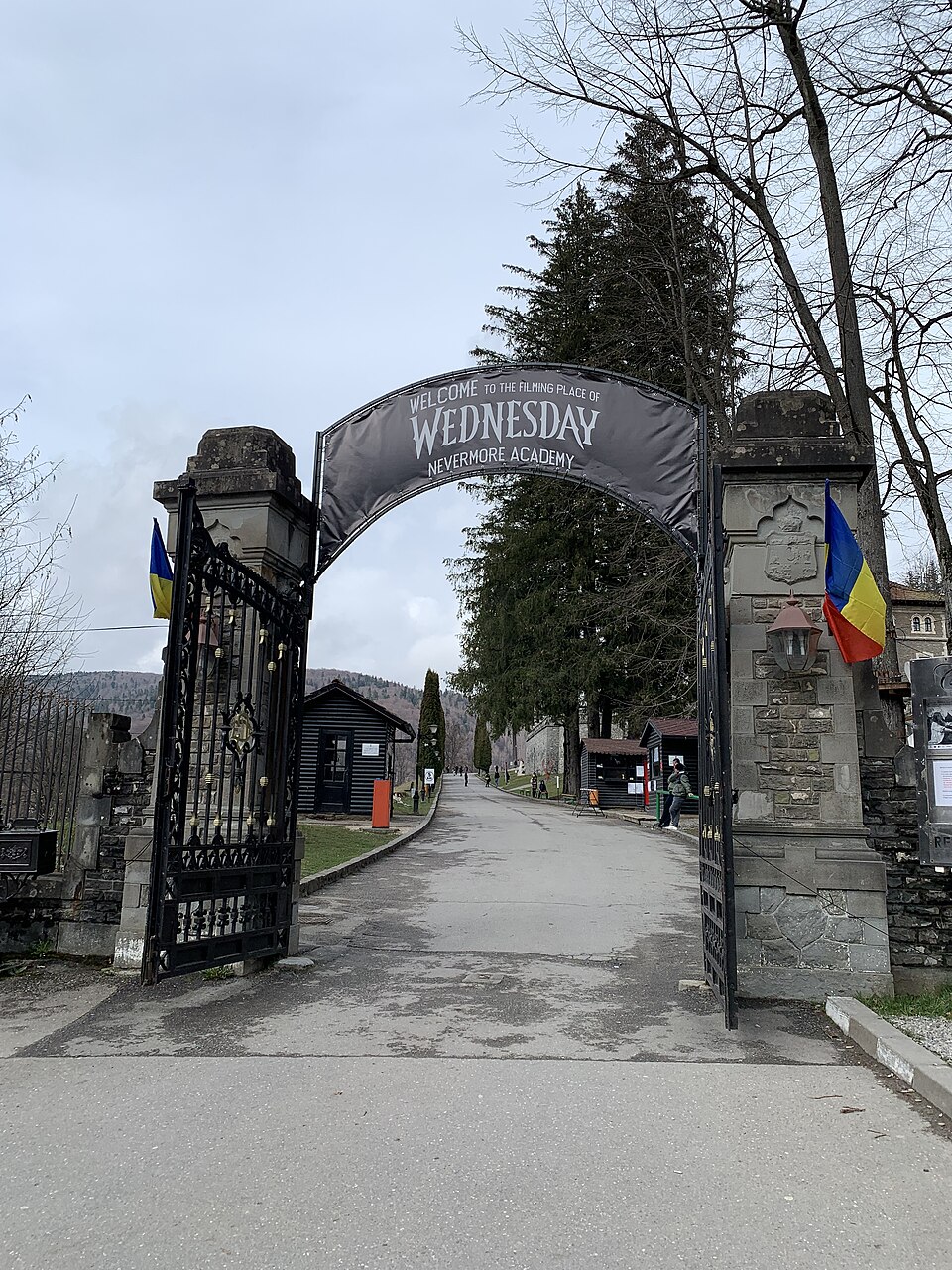
Being busy people, it took us a couple weeks to watch the eight episodes of Tim Burton’s Wednesday, and I think he’s really outdone himself.  As I mentioned before, I was never a great fan of The Addam’s Family, but I watched it often enough to know the characters and their quirks.   I wasn’t quite sure what to make of the television show.  It had monsters, but nothing really scary.  It was funny but some of the humor seemed beyond me.  I watched it anyway.  I didn’t bother with the movie when it came out.  Then on a rainy weekend afternoon I watched episode 1 of Wednesday and I was hooked.  For one thing, this is dark academia personified.  Exclusive, gothic, school, dark mysteries, secret societies.  It’s all there.  And for another thing, it’s well written and the acting is very good.  And then there’s Poe.

Image credit: Chainwit. This file is licensed under the Creative Commons Attribution-Share Alike 4.0 International license.

(On a side note: I recently found another review of Nightmares with the Bible.  It is my most reviewed and least successful book.  The reviewer agreed with other reviewers that the Poe angle didn’t convince them.  As I told one critic, the Poe angle is a personal one.  Poe was a man, a sin of which I’m also guilty.  And men of a particular stripe feel protective of women.  Maybe it’s one of those biological things we should just get over, but Poe felt that it was poetic and, being a far less intelligent experiencer of that same disposition, I feel it too.  I think Tim Burton might also, for Wednesday seems full of that as well.)

At Nevermore Academy, the morbid, anti-social loner Wednesday learns to accept a kind of friendship from other outcasts.  There’s a town vs. gown aspect as the residents of Jericho don’t exactly love the academy, but they appreciate the money it brings in.  The founding pilgrim, Joseph Crackstone, was a hater of those who were different and tried to rid the world of others not like him (this is important).  Over eight episodes this backstory interrupts into the present and threatens the very existence of Nevermore.  What ties it all together, of course, is Wednesday.  Nearly as gothic as Sleepy Hollow, this Netflix series showcases the aspects of Burton’s vision that I find most compelling.  And the first season was nominated for quite a few awards.  A second season has been approved and I’ll be watching that one, down the road.  I can’t get enough dark academia these days, no matter the day of the week.


Prior Memory

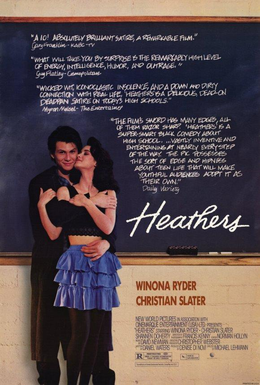
Sometimes I just don’t know where my mind is.  A few months back my wife and I decided to watch Heathers for the first time.  It got a bad rap when it came out but we finally gave in because there were so many cultural references to it that we felt we had to be informed.  Now none of that makes it worth comment.  What does, in what’s left of my mind, is that I was sure I’d written a blog post about it.  I hadn’t.  The thing is, I even thought I remembered some of what I wrote about it.  Uhn-uhn.  Didn’t happen.  So I guess I can trawl my memory and see if I can recollect what I thought I had already said.  Here goes.

The movie is a disturbing and funny look at growing up and its hard lessons.  Everyone said that it glorified suicide, but that wasn’t what I saw.  One person attempts it, and the others are all actually murdered and made to look as if they died by suicide.  Not a lighthearted topic, I know, but the students pretty much all want to live.  J. D. (read into that what you will) is the real criminal.  An outsider with a chip on his shoulder, and who has no problems being (or associating with) a criminal.  Or making others into criminals.  

As with many, perhaps most, adults, I remember the confusion of puberty quite well.  I wanted to be liked in school (I never had many friends) but I was quiet, bookish, and very religious.  Having grown up feeling generally unliked, I found acceptance, for a time, at church.   This movie captures that aspect well—the desire to fit in with a cohort that is particularly hostile (teenagers).

What brought Heathers back to mind after these few months was the fact that some classify it as a dark academia movie.  Dark academia generally has some schooling involved, sometimes directly, sometimes as implied.  There is a natural kind of darkness in high school and into college years.  This is something we may be in danger of losing with universities becoming glorified trade schools.  Not all of life is about finding a job.  The humanities suggest that being human is sometimes enough.  Heathers seems to have aged pretty well, being over thirty at this point.  Some of us took three decades to see it.  And if we feel like we’re losing our minds from time to time, at least now I’ll know I have indeed posted upon this movie.


University Death

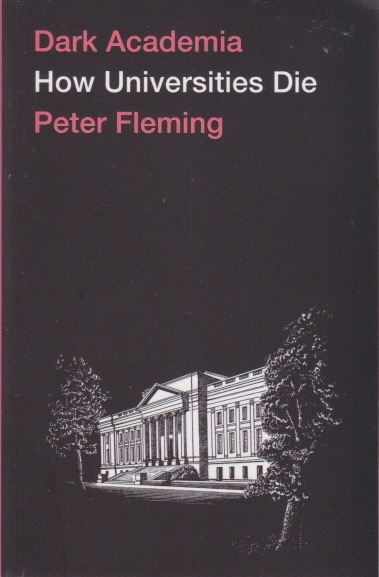
This is an important and thoroughly depressing book.  Despite globalization, I fear that a book from down under might fail to be readily found in the United States, where it’s also needed.  Peter Fleming’s thesis is spelled out in the subtitle.  Dark Academia: How Universities Die.  I’ve read a few other books like this, but I was attracted by the title of this one.  Fleming points out much of what I already knew, but with the stats to back it up, as well as compelling personal stories.  Few people worry about professors.  We’re conditioned to think their lives are easy and carefree.  I doubt they ever were, but since the eighties, when universities started to act like business ventures, the cracks showed in the foundations and their lives grew harder.  Capitalism ruins everything.  Fleming discusses the political maneuvering in the UK and Australia, as well as in the US.  We’re all facing the same nemesis.  Greed.

Politicians began attacking universities likely because they realized that educated individuals can see through the shenanigans that people like Trump, and Reagan and Bush before him, pulled.  They didn’t want alternative voices.  Debate is anathema.  The easiest solution was to make education a business because businesses always want more money.  Now, I’m shooting from the hip here, but Fleming pulls such things together with evidence.  I have witnessed firsthand some of what he describes—living as an adjunct instructor, barely making enough to cover the bills.  At the same time learning the university I was working for had been hiring “managers” (hundreds of deans, associate deans, etc.) but couldn’t afford to hire faculty.  That sports (something Fleming doesn’t address) were allocated far more money than teaching.  Yes, things were bad.

Fleming points, rightly, in my opinion, to neoliberalism as the culprit.  That’s the form of liberalism that’s wedded to free market capitalism while spouting the causes that traditional liberals support—care and concern for all people.  The older I get the more I see that neoliberalism is what the Republican Party used to be.  They’ve veered hard right and since, in America, liberals have never really had a chance to hold power since Roosevelt, they’ve become neoliberals.  Thus began the transformation of higher education before I ever started my doctorate, but I didn’t know it.  I’m no political scientist.  I’m a teacher interested in the past.  And religion.  Having grown up poor, I invested all my scant resources into getting qualified to teach, only to discover that the ivory tower was being sold to the highest bidder.  Dark academia indeed.


See Monsters

I have a soft spot for seventies movies, but I can’t decide if The Sailor Who Fell from Grace with the Sea is horror or not.  I found it on a horror list, and an oblique reference to Lord of the Flies got me interested.  It reminded me, in some ways, of The Wicker Man.  Although based on a Japanese novel, the movie’s set in England.  Two subplots seem unrelated except they happen to the same widowed mother and son.  The son is part of a group of five boys in a private school who have a secret society (echoes of dark academia here).  The leader, although not yet at puberty, is a sociopath who’s very bright and the others follow him.  He declares that a perfect balance (a very East Asian religious outlook) exists that adults simply cannot realize it.  Indeed, adults are bad.

At the same time, the boy’s mother meets and falls in love with a second-mate on a merchant ship.  The boy likes the mate too and feels that they have found a perfect balance.  Thus the two plots come together.  The boys in the club feel that the son has gone soft on their principles, and so to prove he hasn’t they arrange the vivisection of an anesthetized cat.  When the sailor returns, unexpectedly, to try to marry the widow, her son objects.  The perfect balance has been distorted.  The boys decide that the sailor must be treated “like the cat.”  They take him to a distant overlook on a pretense, and drug him.  In a long shot at the end, the boys gather around his unconscious body.  Now, the similarities to The Wicker Man may seem passing, but the idea of human sacrifice is there.

Is this horror or not?  Hard to say.  Most of the movie revolves around the mother’s relationship with the sailor (which the son watches, voyeuristically, through a knothole in his bedroom cupboard.  The secret society is always there, however, and when the plots come together you realize that the sailor will have to be killed.  Like Wicker Man, there’s nothing really explicit here, although Wicker Man does have a horrific ending.  The Sailor only has one by implication.  The leader of the secret society of boys is pretty scary and apart from the widow, parents are pretty scarce in the movie.  I was left wondering what it was that I’d just seen.  I can see why someone would list it as horror, but it had other echoes that I felt might fit better.  It was, however, free for the streaming.


Scholars and Villains

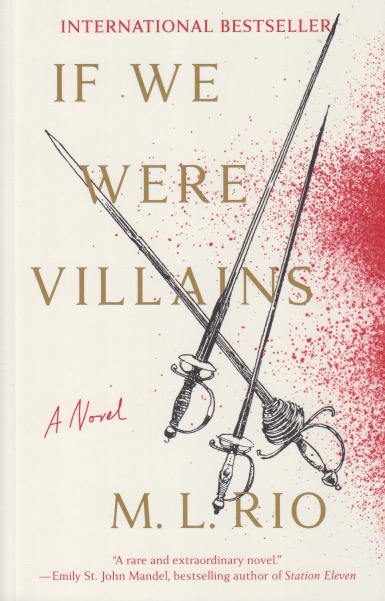
Having read M. L. Rio’s novella Graveyard Shift, I turned to her debut novel, If We Were Villains.  It must be a heady feeling having your first novel become a bestseller, but reading it confirms why.  Rio came to my attention because of dark academia.  This novel is written as realism, so there’s really no speculative material.  At least not directly.  It’s the story of seven friends at the Dellecher Classical Conservatory.  They are the fourth-year students majoring in acting and they are essentially a Shakespearean troupe.  Dellecher only puts on Shakespeare plays, so much of the story is built on the Bard.  There may be some plot give-aways below, and I think this is a book you might want to read—so be advised.  I’ve continued to read Shakespeare beyond high school, mostly sticking to his better-known plays, so this was enjoyable to me.

The crisis begins when the largest and strongest member of the troupe—the leading man—becomes offended by not getting assigned the role he feels entitled to.  He begins acting out against his classmates, bullying them onstage so they can’t call out his bad behavior.  To make things more interesting, one of the troupe is his girlfriend and another of the women is his cousin.  Since they all value what they do so much, and it’s their last year, nobody wants to challenge him.  Until it gets out of hand.  Although Dellecher is exclusive, there’s quite a lot of partying that takes place.  Drinking and drugs seem freely available.  One night when the leading man is drunk, he takes out his hostility on his troupe-mates but is found nearly dead in the lake by dawn’s first light.  And then things start to spiral.

Dark academia is a genre that explores the dark part of higher education (and sometimes secondary education).  I think that most people, even if they enjoyed college (as I did) saw there were tenebrous aspects to it.  This particular genre focuses on those negatives, but not to the exclusion of the very real draw of continued learning.  Since college is when many people receive their first taste of independence, and what passes for adulthood, many emotions come to the fore.  Love, jealousy, fear, and passion among them.  These are powerful motivators and much of our lives are spent learning to control them so that we can live together as a productive society.  This novel, like much dark academia, lingers in those places where unresolved emotions and unchecked bullying collide.  All with a Shakespearean touch.  Classic.


First Visit

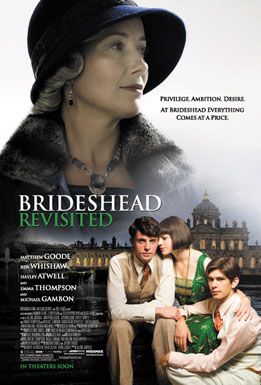
Dark academia prompted me to do it.  I have never read an Evelyn Waugh novel, but the title Brideshead Revisited is fairly ubiquitous.  I’d heard it many times but knew nothing about the story.  With tastes that tend toward horror, selecting a Friday-night movie that my wife will watch with me is sometimes tricky.  I’ve been discovering that films listed as dark academia often appeal to her taste, and Brideshead was one of them.  Interestingly, although we’d both heard the title many times, neither of us knew anything about the actual story.  So we found out.  The novel had been adapted into a successful television mini-series, and eventually became a cinematic version.  That’s the one we saw.  At the start it reminded me of E. M. Forster’s Maurice.  Two young men meet at Oxbridge and fall in love.  Only Charles Ryder is middle class, not aristocracy.  Lord Sebastian Flyte is.

Lord Flyte lives at Brideshead, a country house that any gothic dreamer would be glad to own.  While there, Charles meets Lady Julia, Sebastian’s sister.  Like Maurice’s Clive, he eventually prefers her company to his.  She’s already engaged to be married—you get the picture.  What I wasn’t expecting was just how much of this movie was about Catholicism.  The Flytes are Catholic, the mother demandingly so.  Charles is an atheist.  Agog at being welcomed into high society, he is nevertheless firm in his atheism.  This sets up the tension between the mother and Charles, but both Sebastian and Julia are okay with it.  Charles eventually becomes a successful painter with a society wife himself (the movie kind of just drops her), but still in love with Julia.  When her dying, atheist father accepts the last rites and crosses himself at his dying moment, Julia knows her Catholicism means she can’t run off with Charles.

The dark academia part derives from the Oxford part of the story, but also from aristocratic society.  It operates by its own rules and there are secrets and power struggles.  In the end, Brideshead is abandoned during the Second World War and is billeting soldiers.  Charles is now a captain in the army, in charge of the operation at Brideshead.  He has no wife or girlfriend, and Julia has left.  He goes into their private chapel and is about to extinguish the single burning candle, but decides not to.  Apparently Waugh himself converted to Catholicism, but movies adapted after successful mini-series based on the novel might distort things.  Overall, the film is a good reflection of that age-old English struggle with religion.  And dark academia.


Shadow off Campus

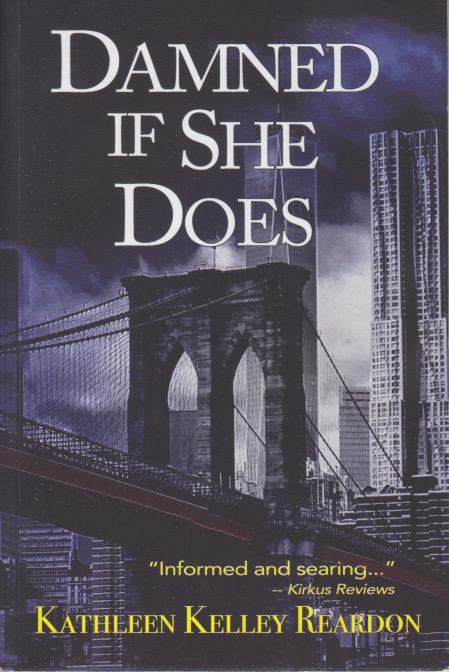
I’ve been to quite a few academic conferences in my life.  Some have been held in neighborhoods declared “unsafe.”  I even had a job interview in a hotel room (such can’t happen now) with a college that didn’t want to pay the fee for using the society’s services.  (A friend who’d also interviewed with the same school said to me afterwards, “I thought they were going to jump me!”)  (Neither one of us got the job.)  I even went to a conference where I had to drive through a crime-ridden neighborhood to get to an off-site hotel.  But I’ve never been to a conference where someone was murdered.  That’s the premise behind Kathleen Kelley Reardon’s Damned If She Does.  Reardon’s keenly aware of the kinds of issues women face in the professorate.  There are some unsavory guys in the profession and power is very difficult to wrest from those who hold it (generally white men).  In this follow-up to Shadow Campus, she tells Meg and Shamus Doherty’s experience with murder, and more, at an academic conference.

Academics are so necessary for studying things closely, opening up true understanding.  They are, however, people too.  And people can be petty, vindictive, and selfish.  They’re usually not inclined to murder, however.  I’ve been meaning to read that book about the murder of a religion professor at the University of Chicago several years ago precisely because such things are so unusual.  In dark academia, however, events like that are fairly common.  The thing is, many academics are also quite smart.  If someone were to put their mind to an undetectable murder, hmm.  The old gray matter starts churning.

In Damned If She Does, the apparent motive is publication in prestige journals.  In the end, it turns out that there’s more to it than that, but it’s somehow believable that a matter like publication could lead to homicide in academia.  As an editor, and writer, myself, I know how important publication with specific presses can be.  Even after doing this for over thirty years, an acceptance notice creates a sense of validation like no other.  Dark academia explores such territory.  I suspect that I’ve always been a bit naive when I’ve attended conferences.  I go, present papers, and keep interactions, well, academic.  I’ve heard whispers of them being places of temporary flings and I’ve seen colleagues use them as places to party.  On occasion I’ve seen established scholars very inebriated.  They’re people too, of course.  And as long as nobody is murdered, the code seems to be that what happens at a conference stays at the conference.


Seeing the Forster

The thing about exploring dark academia is that its recognition is fairly new.  It seems that the “concept” emerged only ten years ago and the longer that it’s around the more sources it gathers, like a dust bunny growing under the bed.  I’ve never read E. M. Forster before, although I’ve seen movies based on his novels.  He was an interesting chap, trying out sci-fi (or at least dystopian fiction) as well as his literary novels.  Maurice was not published during his life because it explored homosexuality.  Forster was gay when it was technically illegal, and this novel reveals much of the struggle faced by homosexuals during the early decades of the twentieth century.  The novel has been cited as an example of dark academia, I suspect because much of the early part takes place in Cambridge.  Although it has a happy ending it’s not an easy novel to read.

Quite apart from the hideous paranoia of society at the time towards any kind of homosexuality, Forster’s style was, for me, difficult to decipher.  I know this is my issue, and not his.  His use of British expressions underscored for me how difficult it is to understand idiom in another culture.  At more than one place I was unsure what the speaker meant because the British slang used was so different from what I encountered living in the UK in the early nineties.  Not that the story is difficult to follow.  It is movingly written, demonstrating the torment of those who realized their orientation as they faced in an intolerant society.  Maurice even tries to “cure” his homosexuality, but efforts fail.  There is a darkness here, appropriate for dark academia.

Forster died in 1970, just when homosexuality was beginning to be understood not as a sickness, but a disposition.  It’s not a choice, and as the animal kingdom tells us, it’s certainly not limited to human beings.  The novel makes note of the fact that Greece, the origin of much of western culture, approved and promoted homosexual relationships.  Maurice is told that he could move to France of Italy where such relationships were not illegal.  There’s no question that the societal stance toward homosexuality was based on particular understandings of biblical texts, some now thoroughly discredited by biblical scholars (Sodom was not destroyed for homosexuality as biblical intertexts clearly show).  Generations of people, including Forster, were put through lives of torment in order to keep a prejudice alive.  Academia may be dark indeed.


Dark Smile

Romance.  It’s not the same thing as Romanticism, but it’s often part of drama.  It can, and often does, feature in horror.  Tender feelings toward someone we really love seem to be a human universal, even if social structures don’t always support such feelings.  Maybe I’m trying to make excuses for why I watched Mona Lisa Smile, but there is an underlying reason.  More than one expert considers it an example of dark academia.  I was curious, and honestly, it’s easier to get my wife to watch dark academia than it is horror (for that I’m on my own).  This was a film I’d heard about many times, but hadn’t watched any trailers for, so I wondered what it was all about.  In short, Wellesley.  One of the seven sisters.  But more than that—women struggling for equality in the 1950s.

A fictional Katherine Ann Watson takes up a post teaching art history at Wellesley, back in the day when a doctorate wasn’t required.  In order to demonstrate her expertise to her very well prepared students (I never, in nearly 20 years teaching, had students show that level of eagerness for any subject) she introduces them to modern art.  Traditional Wellesley isn’t prepared for that.  Moreover, she encourages them to develop careers of their own in a period when the MRS degree was still a main reason for women to attend college.  Watson’s own life isn’t without romance; a boyfriend back home in California and another professor at Wellesley both vie for her affections.  Some powerful students, however, make her life difficult and despite her popularity as a teacher, the administration allows her to remain, but with severely clipped wings.  She decides to fly instead.

Amid all the social commentary, a darkness remains.  A large part of it is patriarchy, but academic politics—driven by money—is the main culprit.  As Watson is essentially forced out, her students see her off with a display of camaraderie, making this, in some ways, quite similar to Dead Poets Society.  There were a few triggers for me.  Years ago I was indeed called into the Dean’s office and handed a letter to read.  While not nearly as dramatic as either Dead Poets Society or Mona Lisa Smile, I had students demonstrate their support for me as I was forced out.  Katherine Ann Watson seems to have had better prospects than John Keating, but both movies remind us that academic politics are dark indeed.  Even if it’s couched in the genre of romance.


Late Shift

M. L. Rio is best known for If We Were Villains, a book I have on my shelf but haven’t read yet.  She’s one of those rare PhDs who can write, and her punchy, irreverent style has a way of drawing you in.  Graveyard Shift is actually a novella (a cynic would say a way to get you to pay a full novel price on a piece a bit too short to qualify), so it’s a quick read.  It’s a little difficult to classify, genre-wise.  The copyright page suggests thriller, which means not-quite-horror, but with elements of it.  Taking place over one night (and just over 100 pages), its the story of how a college student journalist and her friends crack the case of a mysterious shallow grave they discover one night at their usual hangout, behind an abandoned church, Saint Anthony the Anchorite.  Edie, the journalist, has to find a story to headline the next day’s edition, and the grave provides it.

The story involves mushrooms and rats, sleep deprivation, and lots of smoking.  Still, it’s a well-crafted tale that holds your interest.  Of course, I noticed the centrality of the church to the story.  It’s so much a part of things that the disparate group of friends identify themselves as Anchorites.  An anchorite is essentially a hermit—a monk who prefers not to live communally (cenobites, a name taken up by the Hellraiser franchise, are monks in community).  Of course, the friends aren’t monks, just young people in a college town who like to be out at night, and maybe solve mysteries.  The church is both a focal point and a kind of vector in this world where unusual activities take place after dark.  It shouldn’t be a spoiler to say the friends solve the mystery and begin to help address one another’s problems.

I like brief books.  I don’t mind moderately long novels—when they start getting over 400 pages I get a bit anxious.  I have to admit that Goodreads has made me conscious of how many books I read in a year.  And since I like to blog about books, it also helps to finish them in a timely way.  Besides, escapism is especially important at the moment.  If you like stories about college kids, under-employed professors, bartenders and others who manage to eke out a living before family and mortgage change everything in your life, you’ll probably like this one.  It’s not really a horror story, but it’ll keep you turning pages, which is what books of any size are meant to do.