Lessons from Sandy

While many are still without power and school is cancelled for an unprecedented sixth day in a row, the eastern Mid-Atlantic states are still recovering from Hurricane Sandy. As I noted in my first post-storm blog post, one of the largest disorientations I experienced was being cut off from the internet. An article in Friday’s New Jersey Star-Ledger gives a name to this phenomenon: “nomophobia,” the fear of being left without access to an internet-connected device (specifically a mobile device, but in a pinch even a desktop will do). An article by Allan Hoffman suggests that two-thirds of the population suffers from nomophobia and that there are actual treatment programs available. A decade ago no such phobia existed and some of us were only just beginning to hear about the World Wide Web. This is a fear born of our own engineering—the virtual world of our making has come to haunt us.

No doubt life is somewhat easier with the internet. One word will suffice to illustrate it: phonebook. When is the last time I looked something up in a phonebook? While pulling open a drawer beneath the accumulated phonebooks on the phone stand, I noticed how thick with dust they were. Even the cordless phone with its answering machine appeared just a little bit medieval to my cyber eyes. If this is evolution, we may be in trouble. Technology was envisioned as the liberator from labor, but we’ve clearly become its slaves. Don’t worry about the food spoiling in the refrigerator, get me back onto Facebook—now! My smartphone has a flashlight, several email apps, and can soothe me with its music. It is my rod and staff.

On a short drive to run an errand this weekend, I went by one of the few stores with power in the area. Their electronic marquee read “cell phones charged here.” The greatest service that could be offered to a cold, hungry population living in the dark.

One of the hallmarks said to have ended the Dark Ages was the printing press. Literature, on paper, could now be spread (mostly in the form of the Bible) from person to person until all of Europe would have access to sacred knowledge. That knowledge (and a great deal of nonsense) is now worshipfully cupped in the palm of my hand. As Hoffman notes, even the librarians were telling patrons not where to find books, but where to locate outlets. Robots fight our wars remotely, and wireless networks link us in a web far more valuable than that of the silk moth. And we have realized that even the creator of an entire universe can be held in a child’s hand.

In the valley of the shadow of death, I will fear
Where’s Waldo?

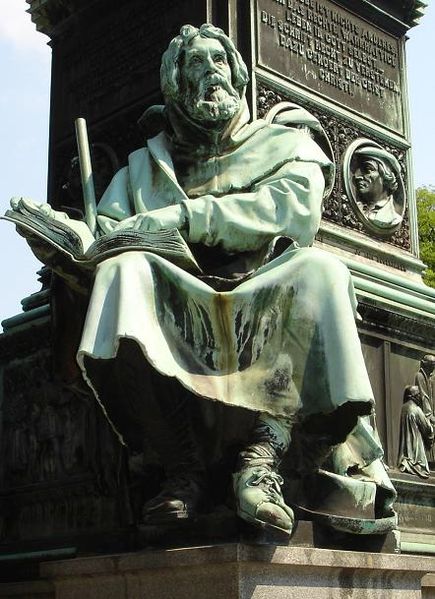
I first learned about Waldensians in a class on the Middle Ages. In the centuries before the Reformation took place, some Christians in Europe resented the wealth and ostentation of the Catholic Church—the only show in town. In response the Waldensians preached a radical simplicity, including poverty. The established church, enamored of plutocracy and power, didn’t appreciate this challenge. To the average peasant, I suspect, the sincerity of the Waldensians was a bit more obvious than those who represented an institution enamored of its stature. When Catholicism learned about Waldensians and their imitation of Jesus’ lifestyle they did what came naturally. They killed them. Accusing those who insisted on helping the poor and needy of heresy gave the justification to the church’s decision to eliminate them.

What occasioned the most surprise, as I was recently reading about them again, was the discovery that the Waldensians still exist. The church has often been thorough in its elimination of those who cross it (note the antics of Rick Santorum), but somehow some Waldensians managed to live on through the persecutions of the trials of heresy. Yet the church still likes to bluster and condemn many to Hell, even if just metaphorically. I must admit that such posturing worries me. It is not in vain that the church has frequently insinuated itself into politics. Anyone who has been awake in America since the 1980’s can’t have helped but to have noticed.

Ironically, the three major monotheistic traditions began as counter-cultural movements. Once the religions gained political power the oppression of others began, thus starting the cycle all over again. The Waldensians are an excellent paradigm of what occurs when a religious body attains too much power. Heresy is so dangerous because it highlights hypocrisy. Claiming divine sanction for human weakness is a charade easily understood by those who take the time to watch closely. The revisionist history of America that we hear presidential hopefuls espousing are warning signs. The church may not have reached all the Waldensians in the Dark Ages, but it still keeps on trying. Fortunately the followers of Peter Waldo are sometimes hard to find.


For God and For Gold

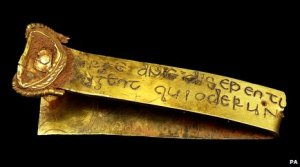
The Associated Press today released a story about an Anglo-Saxon treasure hoard discovered in England this summer. The trove, which likely contains at least 1500 items, many of silver and gold, is calculated to cause substantial reassessment of Dark Age England. Leslie Webster, a former curator at the British Museum, suggested that given the nature of the artifacts, new light could be cast on the relationship between warfare and Christianity.

Apart from the obvious deliria of daydreams of wealth that such finds always drag in their cloaks, this treasure once again underscores the connections between religion and violence. The Anglo-Saxons, Germanic invaders of England following the decline of the Roman Empire, had been early converts to Christianity. Even Alaric the Goth was a good Christian, although he had little patience with the oversight of Rome. The recently uncovered hoard contains mostly military trophies, but among the finds was a gold strip reading “Rise up, O Lord, and may thy enemies be dispersed and those who hate thee be driven from thy face” (Numbers 10.35). Already bloggers are drawing comparison with Jules’ quote from the fabricated Ezekiel 25.17 in Pulp Fiction, but the connection of Christianity and conquest is much more intimate than that. Once Christianity became the official Roman religion under Constantine, the imperial imperative took over. It became a religion of conquest. A similar phenomenon occurred after the advent of Islam. The zeal of the converted should never be underestimated.

I'm trying really hard to be the shepherd

I'm trying really hard to be the shepherd

So, what are we to make of this scriptural quote among sword knobs and doom sticks? Is it simply more evidence that religions, like the Roman Empire (according to Octavius) “must grow or die”? Those who believe carry a deep-seated fear that their religion might be proven false. On it ride serious (and often eternal) consequences. One way to ensure the quelling of that fear is to silence the heretics who decry the one true faith: take up your swords and nukes and threaten the infidel. The road less traveled, however, is to rise above our insecurities and simply enjoy the ride.