
In the last couple of weeks two large-scale news items caught my attention. One describes how a newly discovered galaxy is made up of mostly dark matter. The other tells how a new fossil find in Greenland may push the origins of life on earth back to 3.7 billion years ago. If you read my blog, you know that I’m a frustrated scientist. I’ve always tried to follow the developments in the field and even considered it as a profession until I ran into the wall of mathematics. Ran into the wall, banged up the car beyond repair, and was barely able to walk away. That’s the breaks in a world where ambition and ability aren’t the same thing. So I have to take my science like baby-food, mashed and strained before it makes its way to my brain. I know I’m not alone in this—the whole field of “humanities” proves that. (Originally science (astronomy) was one of the humanities, but oh how we’ve grown!)
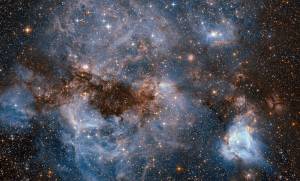
Such frightening things as mathematics aside, these are exciting stories. I’ve been looking around this galaxy quite a bit, and I can believe dark matter outweighs light matter and I’ve never even been off the earth. The story is encouraging because it shows just how much we have yet to learn. Nothing could be more exciting for an erstwhile educator. The opportunity to stretch one’s mind should never be taken lightly. At the same time as dark matter is growing, so is the age of life on earth. I have to admit that I’ve not even been to Greenland, but the idea that life began so soon after the earth formed has cosmic implications. If we were such fast starters, doesn’t that suggest that elsewhere in the universe the same may be true? Ironically, here on earth uniformitarianism is considered a foundation of science. But once you get off earth scientists are reluctant to say the same processes could have happened elsewhere. But what do I know? I’m still trying to figure out trigonometry.
Earthbound I may be. Humble humanities specialist from start to finish. Nevertheless it is an amazing time to be alive. Once we’ve figured out that human brains—products of evolution that they are—aren’t capable of ultimate comprehension, we’ll be able to bask in the light of billions and billions of suns and raise a glass with our cosmic neighbors, made of light matter or dark, and proudly say that we’ve made some real advances at last.
 Steve A. Wiggins