Absalom v. Occam

Getting a haircut is like going to confession.  You don’t go as often as you probably should, and you feel embarrassed and awkward when they ask how much you want taken off.  The penance of looking funny several days afterward ought to be punishment enough, without your head feeling cold once shorn of its natural covering.  At least in my experience.  The truth is I like long hair.  Biblical-length hair.  The truth is also that many people think it inappropriate for a guy my age.  I always eventually bow to peer pressure, but it can take a while.  Beautician forgive me, it has been six months since my last haircut.  Absalom, after all died because of his long hair. O Absalom!

This isn’t just idle musing on my part.  I grew up in the Evangelical tradition that is now ripping our nation apart.  One of the greatest markers of that faith is conformity.  In college I learned to call it the “Evangelical haircut.”  Any guy who had hair over his collar or ears was suspect of not being “Christian.”  I began to notice that this same mindset preferred well manicured lawns, cutting down trees and keeping outward appearances neat and tidy.  There’s no better way to mask what goes on internally than to present an outward look of a well-ordered world.  Getting a haircut always brings this back to me—it is a statement being made.  I’m not sure how to explain this to the poor girl standing there with scissors in her hand.  I don’t want to look Evangelical!

Of course, the beard helps.  Until recently Evangelicals didn’t permit beards.  The girls in college said they made men look unclean.  As if they were never washed.  And these days some Evangelicals have come to support the stubble beard—electric razors, those allies of Occam, can be purchased to keep the half-way bearded look fresh.  I prefer to get my money’s worth out of a haircut.  I also prefer to signal that I am not one of them.  Absalom may have been an overly ambitious young man, but despite Michelangelo’s famous statue, David the man was himself in all likelihood bearded and might’ve sported a mullet.  Samson wore dreds.  Uncomfortable with history, Evangelical illustrators in the ‘80s began portraying Jesus with a Roman haircut and neatly trimmed beard.  Perhaps I’m overthinking this, but now that I’ve got Samson’s fate in mind I find it difficult to open the door, knowing I’ll walk out after confession not feeling so much redeemed as just plain chilly.  Even Absalom, I remind myself, had his hair cut once a year.

Paying Goliath

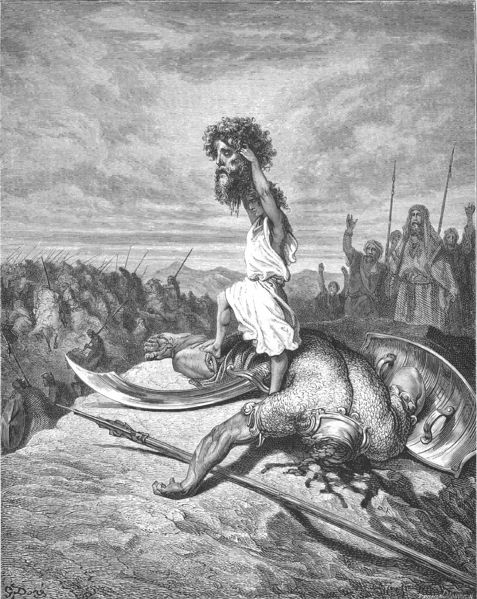
A friend pointed me to the story of David and Goliath. Well, actually, it was the Malcolm Gladwell story of David and Goliath. TED talks have become a regular part of public education and I was a little surprised to see one based on a Bible story. If you’d blink you’d miss it. I’d seen Gladwell’s new book on David and Goliath in the bookstore, and I had assumed it was about some hidden principle based on little boys challenging giants to single combat. Who knows. So when I turned on TED and heard Gladwell describing pretty much what I would do in class, and knowing that he was raking in the bucks for doing so, I gave it some thought. Yes, it is clear that he’s done some research into ancient warfare. Most of us who read the Hebrew Bible do, since ancient warfare is a large part of Holy Writ. (Yet the world seems surprised when religions turn violent.) Gladwell’s perspective is refreshing, but I can’t help think that the Bible does indeed view David as the underdog. Yes, slingers were always an important factor in warfare, just as archers were before guns were invented. I seriously doubt David was actually packing the firepower of a .45, however.

The interesting thing is that Gladwell takes the story so literally. Historically David’s existence is questionable, although I personally see the weight of tradition as bearing on the tipping point here. There were just too many stories of the boy who killed the giant in the Bible to say it was all made up. The fact that they don’t agree in details adds a hoary venerability to the tales. But can we take it to the level of seeing Goliath as having double vision because of his gigantism, and saying to David “why do you come at me with sticks” even though the lad is holding only one? Perhaps Goliath can be pardoned for using the plural instead of dual form (he is, after all, a Philistine), but the point here is that it is a taunt. David is what the dog saw, compared to the seriously shielded Goliath. Gladwell makes some good points, but, in my humble opinion, misses the giant.

Saul, the king of Israel, fears to send David into combat because the kid will be slaughtered and Israel will be enslaved. Yes, ancient armies relied on slingers, but, like archers, in great numbers. Perhaps it was David’s accuracy that was in doubt. According to the Bible, however, Israel boasted slingers who could hit a hair at distance, and these from the tribe of Benjamin, Saul’s own people. So the point of the story is that David’s victory is a miracle. Miracles no longer fly, of course. Those who write bestsellers know best. It stands to reason. Okay, so I’ll buy Gladwell’s book now, but I somehow feel that those of us who have spent a life studying the Bible really deserve something more that jobless obscurity. I come at the giant with a tiny blog, but then, I’ve alway been an underdog. An outlier, you might say.

477px-071A.David_Slays_Goliath


A Walk Around the Watchtower

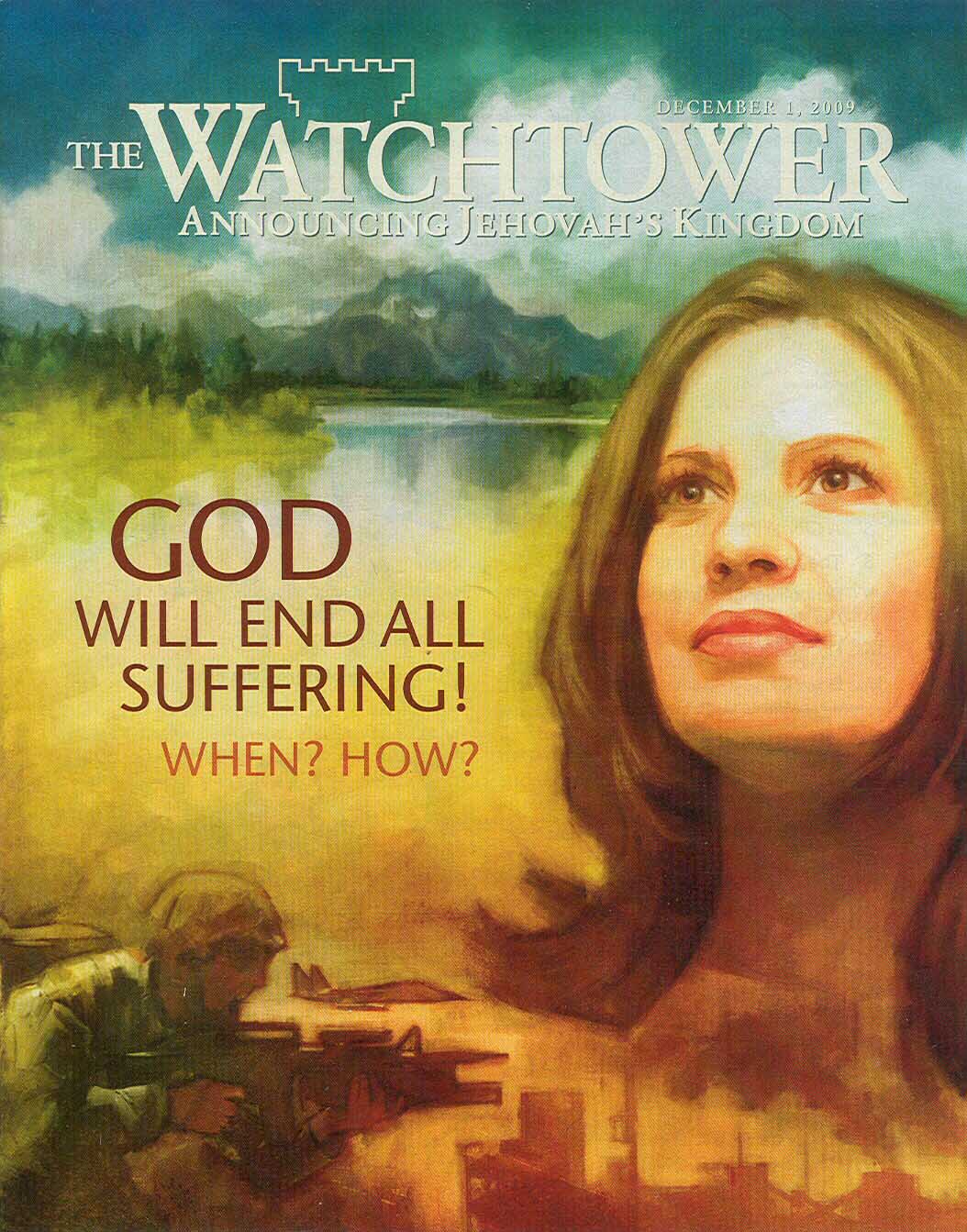
The Jehovah’s Witnesses stopped by yesterday. I never pretend not to be home, and when I’m less stressed out I like to engage them in terms of biblical exegesis — religion is all about conflict. Yesterday I was still recovering from the disappointment of not getting a job I really wanted, so I simply answered their questions and accepted their Watchtower magazine. Thumbing through it, I ran into some hermeneutical obstacles — an occupational hazard for those of us who’ve spent a little too much time with the Bible, I suppose. A story about Joshua informed me that “Jehovah wants you to succeed.” It tasted a little too much like prosperity gospel and not much like life in the present. So I flipped a few more pages.

An article on Lunar New Year (Chinese New Year, as it is traditionally called), warned against Christians celebrating it, in part because of ancestor veneration. The Watchtower declares, “the Bible show that the ‘ghosts’ and deceased ‘spirits’ are really wicked spirit creatures pretending to be the deceased. For what purpose? To mislead people and bring them under their evil control!” Now, I admit to being drawn into the Ghost Hunter fan-base, but I do recall the story of Saul summoning Samuel from the dead. The Bible doesn’t indicate that he’s evil; in fact, it is Samuel himself! If ghosts want to deceive then they need to show up a little more clearly and give more direct messages.

I then learned about King David’s remarkable musical prowess in the story about music in the Bible. It is truly amazing what can be extrapolated from a literal reading of the Psalms. The magazine informs us that King Sennacherib, emperor of Assyria, demanded male and female musicians from Hezekiah. “It seems that they were first-class performers.” This seemed a little too much like the stereotype of Jewish entertainers, and since it was extra-biblical I couldn’t accept it. The story concludes by indicating that music is not a human invention. “The Bible describes music and singing in the heavens themselves, where spirit creatures play figurative harps and sing praises around Jehovah’s throne.” As I pondered what a figurative harp would sound like, I could swear I heard the sound of one hand clapping.

Being that time of year, the issue has an Epiphany story. Well, most Christians associate the wise men with Christmas, so I’ll call it a Christmas story. Eager to be honest, the author notes that the wise men were really foreign astrologers. And although they were into witchcraft, the angel announced Jesus’ birth to them to lead them away from this abhorrent practice. Then a divine revelation came to them in a dream in order that they could avoid Herod and his wicked plan. So the astrology that led them to Jesus was bad, but the end result was good.

When the Jehovah’s Witnesses ask me if I know about the Bible, I look at my feet and kick at an invisible speck of mud on the floor as I admit that I have taught Bible for nearly twenty years. But when they ask what I believe about the Bible I tell them the same thing I tell my students — what I believe is personal and I choose not to share it. I don’t begrudge any person of their religion. I even share the Jehovah Witnesses’ hope that the future may be brighter than the present. If you want to convert a religion professor, even an adjunct one, however, it will take more than a Watchtower to do it.