Existing Stance

You know, I’ve referenced eXistenZ several times on this blog without really writing about it.  How rude of me!  Well, the fact is eXistenZ is one of my “old movies”—those that I knew from the days before I started this blog.  I have watched it since 2009, but early on I didn’t review movies unless they had religious elements.  Having recently referenced eXistenZ yet again, I figured it was time to look directly at it.  When I first watched this movie I had no idea who David Cronenberg was.  The film was recommended to me by one of my students at Nashotah House.  In those days there was no streaming so I had to purchase the DVD.  The movie is a science fiction horror film, primarily body horror, which is kind of Cronenberg’s shtick.  It’s also about gaming and I’m not a video gamer at all.  Still, I really like this film.
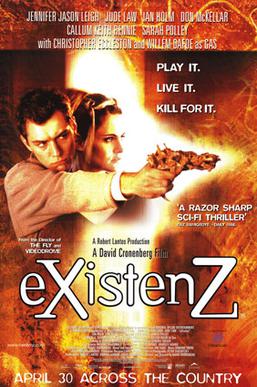
Perhaps presciently, Cronenberg set the movie in 2030.  Computer gaming has become biological with organic ports that have to be punctured into players’ spines so they can use an “UmbiCord” to connect to the pod.  Rewatching it, this seems almost too plausible.  In any case, as the movie goes on it becomes less and less clear what is real and what is part of the game.  Reality becomes distorted.  eXistenZ came out about the same time as The Matrix (probably why my student suggested it to me).  Given the very high profile of the latter film, eXistenZ never really broke out.  Cronenberg seldom breaks through to the mainstream, but I know a lot of people were talking about his remake of The Fly in 1986.  I even saw that one in the theater with some seminary friends.  In those days I didn’t know enough about horror to know what to expect from a Cronenberg film, which may be why it had such an impact on me.

In any case, eXistenZ remains underrated.  I see more recent films that appear to nod to it.  The horror aspects tend to be the slimy, gooey aspects of the game world which—spoiler alert—is, diegetically, the one in which the viewer resides.  There are indeed a few parallels to The Matrix, but eXistenZ has creatures and horror themes.  Sci-fi horror is a sub-genre that often works.  Critics tend to refer to such things by the older category of “science fiction,” but it is close kin to horror, a genre only separated out in the early 1930s.  Now as AI takes over the world, it might be a good opportunity to watch eXistenZ and ponder just how far you want to let it go.

Not Yet Illegal

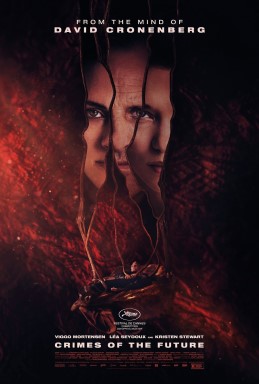
David Cronenberg’s name suggests a certain kind of body horror as unique as it is unsettling.  Crimes of the Future (2022) immediately reminded me of Existenz, which I watched many years ago.  Crimes of the Future is more difficult to understand, however, in part because it is shot dark and quite a lot of the dialogue is indistinct.  I happen to be reading a hard-to-follow book and my overwhelmed brain was hoping for a more straightforward narrative.  In any case, in the eponymous future, human evolution is such that it has to be regulated.  A performance artist couple puts on shows of surgery since he (Tenser) is constantly growing new organs.  They’re harvested as part of the performance.  Humans have evolved out of pain by this point, so surgery is done as art.

Meanwhile, a group has evolved to the point that they can eat plastic and toxic waste.  They demonstrate that physical modifications can be inherited, which puts them on the government’s wanted list.  Tenser and his partner, Caprice, own an automated autopsy table (who doesn’t?) that performs the autopsy while letting others watch.  The radical group wants to use this device to autopsy, as art, the child born with the ability to eat plastic (he’s killed at the beginning of the movie).  Also in the mix are a couple of crooked bureaucrats and a detective who seems sincere, but who has been working with an insider among the criminal group.  Eventually the autopsy occurs but it seems the boy’s insides had been surgically altered.  The leader of the radical group is assassinated and Tenser eats a toxic waste bar and dies.

If you’re saying “How’s that make sense?” you’re not alone.  Body horror isn’t my favorite.  Many of Cronenberg’s favorite themes are present here, but the film lacks a strong narrative.  Or at least one that I could follow.  Art house cinema often requires quite a bit of work from the viewer.  The atmosphere of this film, like Existenz, isn’t really horror, but it breezes into that territory.  Just when the horror—the surgeries—appears the social commentary kicks in.  That’s often true of body horror, a genre Cronenberg is credited with developing.  But I watch for the story as well as the mood.  Some movies are more about the images, I know.  And the future orientation makes some classify the film as science fiction.  It has more of a Blade Runner, dystopian feeling atmosphere, but without replicants.  Crimes of the Future, it seems, may require a better detective than yours truly to solve them.


A Different Zone

I haven’t read Stephen King’s The Dead Zone yet, but it’s on my list.  That’s why I was a little reluctant to watch the movie.  It was free on Amazon Prime, however, and I reasoned to myself that I’d seen The Shining and Carrie before reading the books.  Indeed, my earliest introduction to Stephen King was through movies.  (Well, I did read one of his short stories in high school, but the novel side of things came later.)  When the opening credits revealed it was directed by David Cronenberg I wondered what I was in for.  I didn’t know the story, but I hadn’t heard of this as a Cronenberg body horror spectacle either.  It was quite cold outside and I was nodding off, so why not.

The thing is, it’s not always listed as horror.  That’s a faulty genre designation, as is sci-fi.  There’s one futuristic scene in the movie and it lasts for just over a minute.  Does that make it sci-fi?  Also, I  realized, it deals with clairvoyance and for similar reasons the X-Files are also listed as science fiction.  Paranormal, it seems, is permanently ruled out of the realm of possibility by assigning it an improbable genre.  Well, back to the zone.  I figure the title will be better explained by King, but there is a brief scene explaining what a dead zone is.  The story follows Johnny Smith, a schoolteacher who becomes clairvoyant, although it manifests itself only after a car accident and a coma.  The main purpose of this, at least through the movie lens, is to prevent a Trump-like populist from being elected president.  That is the horror part, I guess.  And it’s becoming clear to me that writers were warning about these things since the seventies.

Unlike many of my weekend movies, I’d actually heard of The Dead Zone before.  There are some horror tropes present.  It begins with Edgar Allan Poe’s “The Raven,” and has a few other horror references tossed in.  Still, it’s a very human story.  The movie probes the difficulties of a life with special abilities.  Johnny never gets over the woman he was going to marry before his coma, and he feels for those whose futures he sees.  The movie is fairly slowly paced and it drops a few threads, again, likely found in the novel.  In the book or movie debate I generally go for book first, but that often leads to disappointment on the silver screen.  Maybe this was the right order to go this time around.  Once I read the novel I guess I’ll know.  Or at least have an opinion.


Double the Trouble

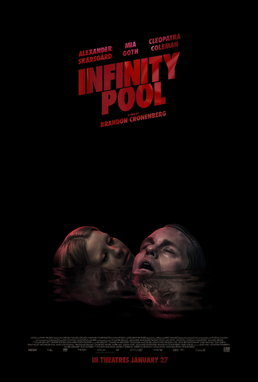
A down-on-his-luck writer (I’m with you so far) vacations on his wealthy wife’s money in a resort in La Tolqa.  La Tolqa is a brutal, very religious, but poor country.  They need tourists.  As the writer, James, discovers, their laws are very strict for a reason.  If a tourist commits a crime they are executed.  However, if they have enough money they can buy a “double,” essentially a clone of themselves, that can be executed for them.  Needless to say, this happens to James.  The name David Cronenberg evokes body horror.  Infinity Pool is the work of his son Brandon Cronenberg and although body horror’s part of it, there’s an even deeper existential fear at work.  Once James’ double dies, his wife insists they leave this horrid place immediately.  James isn’t so sure.

The trouble is that he’s befriended another couple, and the wife, Gabi, has been making no-so-subtle advances on James and he’s intrigued.  This couple sets him up so that he’s likely to break a law, which leads to the killing.  But they’re not finished.  Along with another group of Americans, they travel to La Tolqa every year to commit crimes so they can watch their doubles being killed.  “Murder tourism,” as one reviewer calls it.  They want James to become one of them.  They start putting him into positions where he has to kill his own double.  You can see the existential horror pretty clearly from this vantage point.  Finally realizing that they’ve been mocking him, James tries to escape, but can’t.  As long as the penalty for a crime can be payed by buying a double, they can commit outrageous crimes with impunity.

I have to admit that I envy those who have a family business.  (Mine was alcoholism, so I chose a different career path, such as it is.)  If your father is a well-known, even if often castigated, horror director, you have some guidance on how to get started in the business.  My sense of Infinity Pool is that it’s quite effective, almost at art film at some points.  Like some of his father’s films, it involves both sci-fi elements and horror.  Budapest and Croatia are evocative shooting locations.  The story, while not entirely satisfying, intrigues.  It raises too early the question of whether the double, which has all the memories and thoughts of the original, is really watching the death of the person who actually committed the crime.  Are these copies their own death sentence?  This isn’t resolved, but it’s strongly implied that they’re not.  Still, I’m not inclined to vacation in La Tolqa, which is no place for struggling writers.


Feeling Chilly?

David Cronenberg perhaps defies the tame image we tend to have of Canadians.  I know that’s a parochial thing to say, perhaps reflecting my lifelong admiration of those north of the border.  I even have Canadian family members, from back when it was possible to cross over without a passport.  In any case, David Cronenberg has always been a controversial director.  As the progenitor of “body horror,” his films are often not for the squeamish.  I nevertheless find him one of the more intellectual auteurs, and his movies leave me thoughtful.  One of his early films, Shivers, has long been on my syllabus of “must see movies.”  If you read my pieces regularly you also know that living on an Ed Wood budget, I can’t afford to pay for frequent films and have to wait for a free venue.  Thank you, Tubi, for obliging.

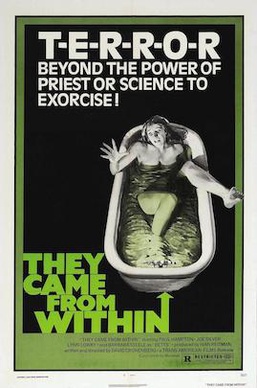
By the way, the poster here shows one of several alternative titles for the movie: “They Came from Within” (aka “The Parasite Murders”).  The film is pretty graphic body horror, but as scholars now focus on embodiment, it seems like this should be explored.  Set in an almost utopian island community, Starliner Towers, the movie opens by touting its perks.  Intercut with that is a graphic murder-suicide taking place within the paradisiacal apartment tower.  A parasite, as one of the alternative titles suggest, has been unleashed by what might be called a mad scientist.  And that parasite has two main effects—prompting orgies and violence.  (Hey, the official title of this blog is Sects and Violence in the Ancient World, after all.)

Religions, Christianity in particular, in the west, are often uncomfortable with the body.  In religious studies approaches to embodiment, it’s stressed that everyone has to reconcile themselves with what it means to be a physical being.  So much so that the mad scientist developed this parasite because he believed people thought too much.  They’d forgotten the mindless reality of bodies.  We’re sometimes uncomfortable being reminded of our bodily existence—at least those who perhaps think too much are—and that comes with both good and bad.  The interesting thing about the film is that it refuses to condemn the results of this experiment gone awry.  Everyone eventually falls victim to it (sorry if that’s a spoiler, but the film was released nearly half-a-century years ago).   Cronenberg is difficult to pin down, but his films, perhaps despite the message, always give me things to think about.


Learning to Fly

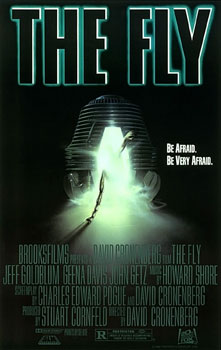
“Be afraid.  Be very afraid.” This quote originates with David Cronenberg’s The Fly.  Of course, after watching the original, how could I not watch its successful remake?  I initially saw this one upon its 1986 release in a Boston theater.  I hadn’t seen it in some 35 years but some of the scenes were as fresh in my memory as if I’d seen it last year.  It’s safe to say that it made an impression on me.  Even usual critics of horror gave the film high marks.  Both it and its predecessor with the same title were quite successful in the financial department and became part of popular culture.  The remake ends without the philosophical statement of Vincent Price in the original, choosing despair instead.  I’ve never seen the sequel.

I picked this up as a used DVD many years ago.  Mainly I wanted to have it on hand in case the mood struck to see it again.  I did recall that, as a Cronenberg film, it was a gross-out of body horror.  So much so that it’s difficult to classify it as science fiction.  It, along with its near contemporary Alien, demonstrated that the fusion of the genres was possible.  Perhaps inevitable.  At the same time, movies, like most other media, have proliferated to the point that such standouts are rare.  Yes, there are still Academy Awards and Golden Globes, but who but a professional can see all the offerings out there?  It feels like we’ve moved beyond the time when a movie could define a generation.  But on a deeper level, that’s why The Fly is about.

We, on the far end from the white male oligarchs, are blending.  We’re no longer simply accepting what we’re told.  We’re becoming more global and more people are starting to break into the power structures.  Even if they sometimes transform if they do.  I saw a recent newspaper article about what to do with your second home, as in decorating it.  Second home?  The majority of us are having trouble up keeping our one home, and that’s if we’re even owners.  Society needs a telepod.  The end results may be messy, for sure, but we need to stop thinking in exclusive terms.  Cronenberg indicated back in the eighties that the movie was about disease and aging and letting those we love go.  That gives the film its poignancy, in a kafkaesque way.  At the same time it may be a teaching tool.  Yes, we can be afraid, very afraid, and still learn.


Original Fly

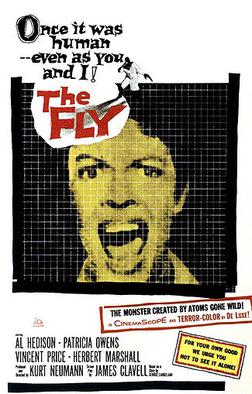
Thinking about it made me do it, I suppose.  Watch The Fly, that is.  This is a movie I grew up knowing about.  I knew the basic plot but somehow was never in the right place at the right time to see it.  Until now.  For a movie from 1958 it remains strangely affecting.  I was wondering whether religion would enter into it, and indeed, in a moment drawn from Frankenstein, André Delambre expresses that he knows what it feels like to be God.  No thunder to drown it out this time.  A short while later his wife Hélène asks him what he’s doing as he is relaxing in the back yard.  He says he’s looking at the sky, or maybe looking at God.  In the light of other mad scientist movies this is a somewhat self-aware moment.

The Fly is one of those movies that had great influence on popular culture.  Although critics at the time thought of it as a gross-out (they obviously had no idea what David Cronenberg would do!) it nevertheless managed to find its way into dialogue with other movies.  The correlation to Willie Wonka and the Chocolate Factory’s Mike Teevee’s scene is remarkably close.  (Adult’s who’ve read Roald Dahl and who’ve paid attention to the movie know that this is kid-friendly horror.)  I’m also pretty sure some of the writers from The X-Files knew The Fly as well.  The Fly, coming during the atomic age, is clearly a warning about using technology that we don’t understand.  Although the movie made a great return on investment for the time, the message still hasn’t been received.

In many ways The Fly set Vincent Price’s trajectory toward being a horror star.  After all, just two years earlier he’d been in The Ten Commandments.  Isn’t he another connection between religion and horror?  Although not the lead in The Fly, as André’s brother François, Price has the most philosophical line: “The search for the truth is the most important work in the whole world and the most dangerous.”  Like the warning about technology, this is a bit of information that might have usefully been heeded.  The political events of 2016 to 2020 demonstrated just how important the search for truth is (and demonstrated religion and horror).  Even with a partial fly brain, André Delambre destroys his notes after making Hélène promise never to reveal what happened.  The truth gets out, of course, leading to the observation behind many mad scientists’ ravings: what is really being sought is the rush of knowing what it feels like to be God. 


Brooding

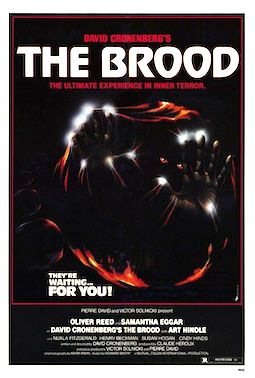
Horror was undergoing a serious development beginning in 1968.  Into the seventies many boundaries were being crossed and new areas of fear were opened.  David Cronenberg is known for his body horror.  Being the squeamish sort, I don’t always seek out his films, but I’d been curious about The Brood for several years.  A holiday weekend afforded the opportunity to see it and, in a strange way I’m glad I did.  The story concerns a psychiatrist who helps his patients embody their neuroses physically in order to deal with them.  The patients manifest in their bodies their deep-seated rage, generally from childhood parental issues.  Those of us who grew up in broken families may seem to wear them on our sleeves, but I suspect most people have issues that were unresolved from that complex parent-child relationship.

The interesting thing here is that there is really no antagonist in the film.  Dr. Hal Raglan isn’t evil, but he does have secrets.  He tries to help his patients, but one of them, Nola Carveth, has major, well, issues.  Abused by her mother, she enters Dr. Raglan’s institute while her husband cares for their five-year old daughter.  Nola’s rage, however, bears a brood of small, gargoyle-like children who, when she focuses her anger on one person, attack and kill them.  Her parents, their daughter’s school teacher, and even Dr. Raglan receive her rage, all murdered by these children born purely from herself.  This strange kind of parthenogenesis makes for a distinct form of body horror.

It’s pretty clear that there is a critique of therapy going on here, but also a kind of therapy is being offered.  I’ve had people ask me if I watch horror as therapy and I freely admit that I do.  The movies I watch are often self-care, or even a spiritual practice.  Many people suggest that horror portrays a negative view of life.  Others of us tend to think of it as more metaphorical.  And besides, the message is often an upholding of conservative social values.  This particular film is difficult to interpret in that regard.  It was written after Cronenberg had gone through a divorce and that makes sense of the central conflict of the movie.  Parenting is as difficult as it is life-changing.  While The Brood may not give solid parenting advice, it may offer a way of understanding ourselves.  If a film does that, it can’t, in my opinion, be all bad.


Inception of Theseus

Never the first for new cultural memes, but often among the last, I finally took my family to see Inception over the holiday weekend. The Internet has been buzzing with comments about the movie for the last couple months, so it was difficult not to have preconceived notions of what to expect. Nevertheless, I found the film utterly engrossing. At one point I realized that I hadn’t blinked in so long that my eyes had begun to dry out. Having just finished Mark Danielewski’s House of Leaves at the end of June, and having begun my Mythology class on Friday, the Theseus myth has been on my mind anyway. Inception takes the hero’s journey through the labyrinth of the subconscious.

The first hint that Inception was the Theseus story, for me, was the introduction of Ariadne. The daughter of King Minos, Ariadne informs Theseus how to escape the labyrinth, and her first task in Inception is to draw a maze that takes a minute or longer to solve. Dom Cobb, like Theseus, is a deeply flawed hero. Part Theseus, part Daedalus, Cobb has trapped an unlikely Minotaur in the form of Mal, his wife, deep in his subconscious mind. She stalks him in his unsavory work, and when she threatens his very concept of reality, she is slain by Ariadne.

Coupled with classical mythology, the film also raises the unresolved question of the nature of reality. Is conscious existence any more real than the subconscious? This theme was explored in David Cronenberg’s eXistenZ back in 1999 with a similar ending that refuses to answer the question. Both films raise the troubling interference of technology with the most secret of human psychological repositories, the uninhibited subconscious. The closer the Internet comes to a global intelligence, the more the individual mind recoils into its own obscure and unexplored territory. Despite Freud and his disciples, we have not yet even begun to understand our own subconscious minds. Movies like Inception draw on classical sources to help us deal with the Minotaur that surely lurks there.

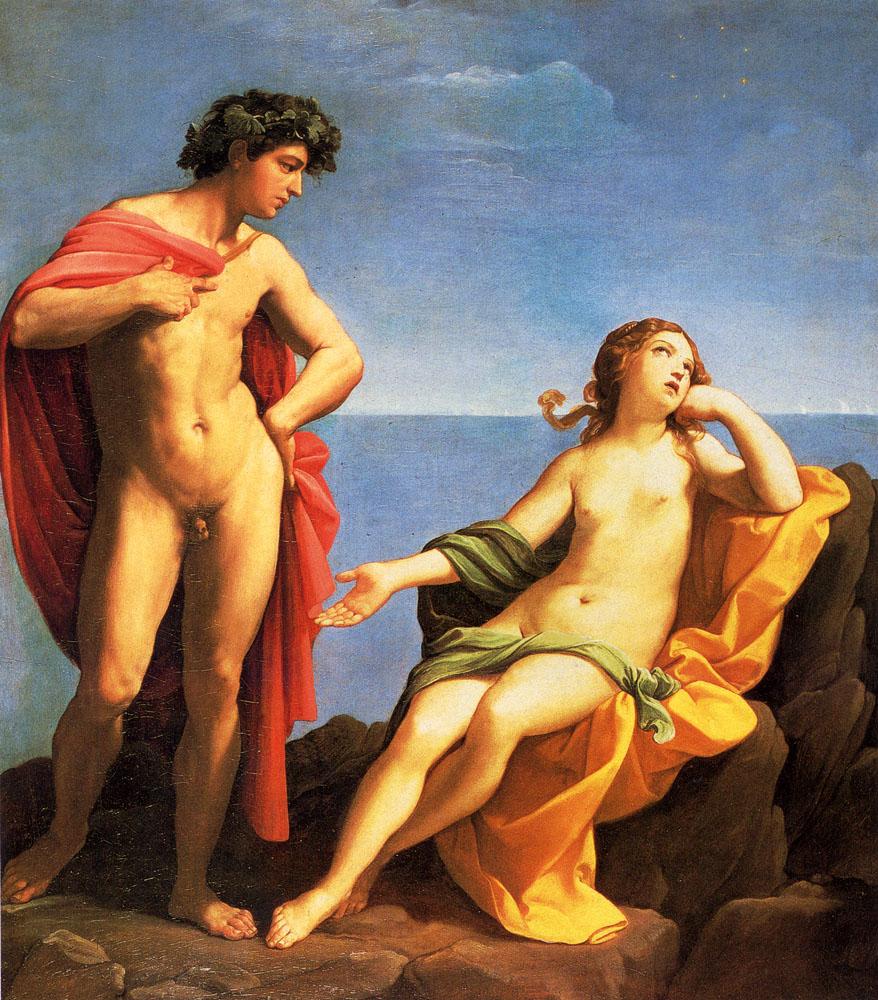
Ariadne explains her dream to Bacchus