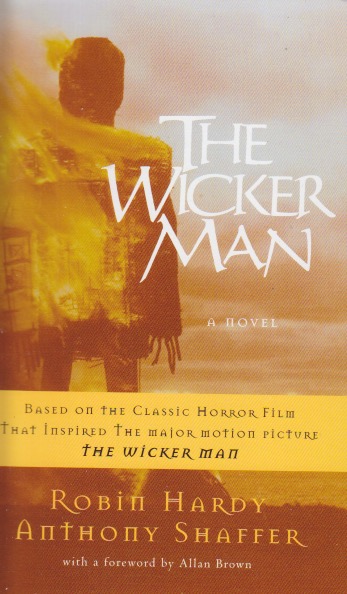
Wicker Redux

The Wicker Man (1973) is a cult classic.  If it had had proper distribution and promotion it might’ve become a more mainstream hit when it was released.  Instead it was a slow burn.  Once it reached cult status controversy grew.  The movie doesn’t acknowledge, but was clearly influenced by, the novel Ritual by David Pinner.  I reviewed the novel earlier, and it isn’t particularly great.  The movie changes so much that it maybe was “inspired by” rather than “based on” the novel.  Several years later the director, Robin Hardy, decided to novelize the film.  His The Wicker Man also credits Anthony Shaffer because a good deal of the dialogue is lifted straight from the screenplay Shaffer wrote.  But the novelization also changes things.  That means there really is no novel that gives the full story of the film.

The creative process is never-ending.  Anyone who’s had a story published knows the tinkering that goes on, even after it appears in print.  The last word’s never truly that.  It takes restraint to leave something alone.  So Hardy wrote one of the more important characters out of his novel and wrote in another who seems to have very little connection to the story itself.  I’m still not sure what the point of adding him might have been.  Incidents that seem to be bracing for a sequel are present, and indeed Hardy wrote a spiritual successor that became a less impressive movie some years later.  Sometimes you do get it right the first time around.

Not that the movie is perfect—none are—but it has held up considerably well, growing in stature over the years.  A novelist, however, tends to have a deft touch that seems to be lacking here.  There’s a great deal of telling instead of showing.  Hardy’s Howie almost becomes a Mary Sue.  Tying his love of birds into the plot of the novel would’ve been one such deft touch.  Instead we have here a serviceable novel with much that’s familiar and even some that is strange and provocative.  It does restore some of the famously edited footage from the first cut of the film.  It tries to make Howie’s religious conviction clearer.  Changing parts of a story comes with the territory of those who spin yarns.  Hardy never really rose again to the heights he achieved in directing The Wicker Man.  It’s no wonder, then, that he felt compelled to return to it in literary form.


Electronic Ritual

Religion and horror go naturally together.  Perhaps that’s something I instinctively knew as a child, or perhaps it’s something only mature eyes see.  It’s clearly true, however.  While reading about The Wicker Man lately I felt compelled to read David Pinner’s 1967 novel Ritual, upon which the movie is loosely based.  In many cases it is better to read the book before seeing the film.  In other cases the movie ends up being the superior project.  I had to keep on reminding myself as I read the novel that it couldn’t be measured against a superior vision of what it could have been.  Having written seven novels myself (all unpublished) I hope that I have a sense of the process.  Unless you’re into the commercial side of things you don’t write for the movie potential—you have a story to share and this is your way of telling it.

The novel isn’t bad.  It’s written in a punchy style that I don’t really enjoy, but the story drew me in.  It almost wasn’t to be.  Like many novels of this era, print copies are difficult to find.  Those available on used book websites, or even on Amazon, probably because of rights agreements, sell for over $200.  That’s a bit much, considering that over two dollars per page is excessive for a novel.  I finally had to cave and get a Kindle version.  I don’t have a Kindle, but I have the software on my computer.  Reading it again reminded me of how superior a print book is to an electronic one.  Reading ebooks tends to be faster but like eating snack food, doesn’t really satisfy you.  

At one point the navigation function stopped.  Confused, I couldn’t go any further in the story and wondered if I’d reached a sudden but unexpected end.  With a physical book I could’ve paged ahead to find out.  In this case, with the controls frozen with that obdurate computer attitude, I had to find another way to make the illusion of reading continue.  I eventually got it going again after clicking here and there, but reminded myself again that ebooks should only be the last resort.  As for the story itself, it was okay.  I read it as a parable about intolerant religion.  I’m not sure it was intended that way, but it certainly seems like a reasonable interpretation.  It ends differently than the movie does, so I won’t put any spoilers here in case you decide to spring $200 to get a used copy.