Dead Trilogy

When we lived in New Jersey our internet wasn’t fast enough for streaming.  I’d watched George Romero’s Night of the Living Dead and Dawn of the Dead, but I was never able to find a DVD of Day of the Dead.  Well, it finally came around to streaming (thanks, Freevee), so I was able to complete the trilogy.  It doesn’t get discussed as much as the previous two, and it’s clear that it doesn’t come up to their level.  Still, the discussions of larger issues—God, civilization, and military power—are worth pondering.  There are a few jump startles but less intensive gore than the previous two, until well into it.  So, here’s the story: a base of operations has been set up in Florida where the military is overseeing civilian scientific experiments on the animated dead.  The military guy in charge is a real jerk and threatens to shoot those who don’t comply.  Also, there’s just one woman among them (who made that decision?).
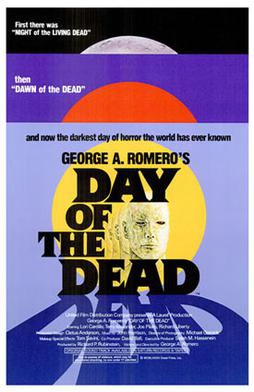
As might be expected, things go haywire.  The head scientist, “Frankenstein” to this crew, is trying to teach the dead not to eat the living—to coexist.  The living are hopelessly outnumbered, and despite the Jamaican civilian, John, suggesting they go to a deserted island and start all over, everyone seems content to hang out and fight each other.  In the end, military overreach leads to everyone being killed except John, Sarah (the woman scientist), and Bill, who seems to be Irish.  In the end the three of them fly to a deserted island and you kind of get the idea that this will be a bit more of an R-rated Gilligan situation.  The film is campy and there is a comic tone throughout despite the serious issues raised and the actual horror elements (blood and zombies lurching out of the dark).

It actually also attempts to explain how the dead continue to move and why they eat with no internal organs.  The brain, down to its reptilian base, retains the eating instinct.  Frankenstein, before being killed by the military, is training the promising dead, especially Bub.  In the end, Bub kills the military guy.  As far as the story goes, it seems to send mixed messages.  The good guys do prevail and the dead, at least Bub, is more righteous than the fascist military that holds sway via constant threat.  One does get the sense that Romero was having fun with his zombie movies and some of the special effects were quite good.  I’m glad to have finished the trilogy, but I don’t think I’ll bother watching the remake, which was, back in the day, fairly easy to find on DVD.  They’re never as good as the dead they try to reanimate.

Out of Season

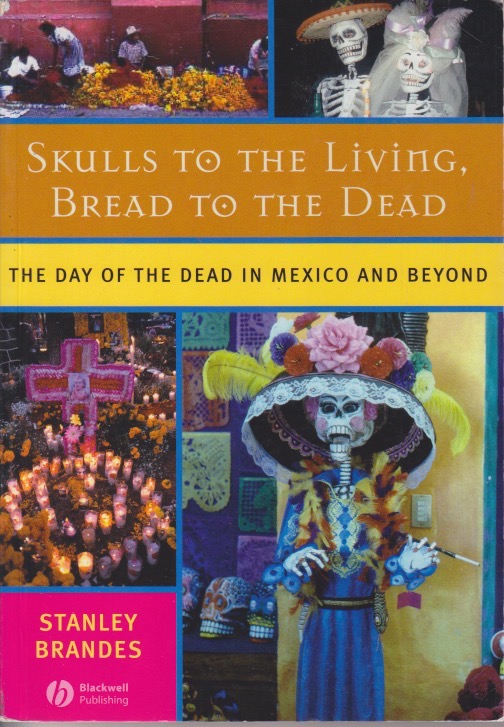
Culture fascinates me.  And one of my favorite aspects of culture is holidays.  I realize that’s a privileged thing to say but were we living among the hunter-gatherers I’d probably have ended up a shaman.  In any case, I had my eye on Stanley Brandes’ Skulls to the Living, Bread to the Dead: The Day of the Dead in Mexico and Beyond for some time now.  Like most observers of lugubrious culture, I’ve noticed the symbols of el Día de los Muertos creeping into Halloween displays in the United States for many years.  I knew that the Day (properly Days) of the Dead was connected in some way to All Saints and All Souls days.  I wanted to find out more, however.  Now, I know that one source doesn’t give you all the information, but time is limited and Brandes was recommended.

This book contains a lot of information.  I am, however, a worker in the publishing industry and that made me wonder a number of things.  The trim size (dimensions) and cover design suggest this is a textbook.  I suspect Blackwell (the publisher) wanted it so.  It is, however, written for ethnographers.  I’ve read enough anthropology over the years to have an idea of how this works, but inside the book it seemed that this was a toned-down academic monograph.  It doesn’t use a lot of technical terms, but the writing is geared toward other ethnographers, it seemed to me.  There is a bit of a dilemma here.  If you’re wanting an authoritative book you generally go to academic publishers, such as Blackwell.  On the other hand, sometimes you just want an overview that doesn’t get lost in the weeds.

The fault is entirely my own, I realize.  And I don’t mean to criticize since I learned an awful lot from this book.  Nothing is ever simple, not even holidays.  Especially holidays.  These are times we take from the ordinariness of daily living to find meaning, and often joy, in our lives.  A safe space where work can’t reach us and we can concentrate on celebrating the occasional, the unusual.  The Day of the Dead is, in the eyes of many, an unusual take on the late autumn holidays.  (Halloween is also unusual, but the two holidays are distinct.)  This book provides a lot of information on the culture of Mexico—information that derives from its most famous holiday.  You can tell a lot indeed from looking at what people celebrate.  There’s more going on than meets the eye.


Leftovers

It looks like I forgot to click “publish” yesterday, so my blog post never appeared.  With apologies for doubling up, I need to complete the trilogy today.  So here goes…

Unlike All Saints Day, which, we were told, was a day of obligation, All Souls Day, today, was not.  It was kind of a leftovers day.  Ironically, it developed into Día de Muertos—the Day of the Dead—along with Halloween and All Saints.  Yes, there are many who declare, and rightly so, that Día de Muertos is something different.  It is and it isn’t.  Cultures around the world have always felt that at this point in the year something odd was going on.  The carnal summer was becoming the spiritual autumn.  Thoughts of those who’d died come back.  So it is a three-day celebration—not officially recognized in the United States (it would interfere with business, which is, as we all know, a thing not to be imagined)—has become a commercial boon.

Still, not being among the saints, I have to wonder if the leftovers—All Souls—are somehow second-class citizens in the afterlife.  Does the social stratification we experience daily here carryover to there?  The view of Heaven among the poor is generally one of comfort and equality.  Fairness, which is in very short supply down here, will finally see the end of the moral arc of the universe, to borrow from a departed sage, bend toward justice.  And sharply.  The idea is ancient and powerful.  Primates of other species don’t object to having leaders.  They do, however, reject leaders who abuse power.  And so it is that we’ve evolved beyond that.  Civilization teaches us our place.

The Day of the Dead has become commercial, along with Halloween.  Why not stretch out the profits, which, after all, come from the leftovers?  There is a capitalist vision of Heaven, you see, and it is one we see working out on earth these days.  Those with money take power and use their money to buy more power that in turn leads to more money for them.  We call it “making a living.”  Those who are wise, however, recognize something deeper in Día de Muertos.  It is the time when we welcome family home, indeed, when family becomes more important than job, or status, or power.  It is a very human, if supernatural, holiday.  All Souls, it seems, has received less than its fair share of attention.  The Day of the Dead, in its own way, warms up those leftovers.


Southern Turn

In America’s ever roving commercial eye, Día de Muertos has become an extension of Halloween.  Retailers have realized that people will spend a lot on their fear, and the autumnal holidays delve into that primal territory.  Since the Day of the Dead, being a mix of indigenous Mexican religions and the Catholic celebration of All Souls’ Day, comes two days after Halloween why not blur them together with greenbacks?  So capitalist thinking goes.  While certainly not free of monied interests, the Disney/Pixar movie Coco has the virtue of addressing Día de Muertos as the separate holiday that it is.  A form of ancestor worship—a religion extremely common around the world—the thought-world of the film shares in common with Tim Burton’s Corpse Bride this idea that the afterlife is colorful, if not joyous.

I realize I’m jumping the gun here, but I just saw Coco for the first time over the weekend.  Not just a culturally sensitive treatment of an indigenous holiday, it is also a celebration of music.  In a very real sense, music is life in the film, and even the dead continue to thrive in its presence.  Again, the connection with Corpse Bride suggests itself.  The key difference, from a religionist’s point of view, is that Coco is based on, to an extent, actual religious traditions.  An irony of this is that, together with the worship of Santa Muerte, the focus on death sometimes makes the Catholic Church nervous.  Focus should be on resurrection, not death.  But what if death isn’t seen as evil?  Where is thy sting?  This can be a real challenge when your organization is offering escape from death.

The fear of death is natural enough.  It’s the ultimate unknown.  It fuels both religion and horror.  In that sense films like Coco that show a joyful aspect of the hereafter do an end-run around traditions that base their wares on ways to avoid the consequences of death.  Hell becomes a threat to be avoided—the forgotten dead in Coco face annihilation, a fate that Héctor notes comes to everyone eventually.  Eternal torment isn’t in the picture.  I have to wonder if this view doesn’t present a form of salvation that is unwelcome among rival religions.  Although Catholics don’t have the hostility toward Halloween that many Evangelicals display, there is a challenge of rival faiths here.  Stores have already begun offering this year’s Halloween wares, and increasingly among them are Day of the Dead decorations.  The holidays are quite distinct, although related, and movies like Coco suggest what we fear may be more a matter of perspective than of the decree of an angry deity.


By the Time I Get to Phoenix

I remember when flying involved going to a travel agent, explaining where and when you wanted to go, and how much you could afford. The agent would contact airlines, get you your best price, and you left knowing that you’d just have to show up at the airport maybe half an hour before your flight so you got there before they closed the door. For our vacation trip, my wife used priceline.com. I’ve used it for business travel myself, but when I am going for work, certain strictures apply. For this trip, expense was a major factor. We flew, outbound, to Spokane, Washington via Seattle, on Alaska Airlines. Since our final destination was Spokane (at least for the air portion of the trip), that involved a bit of back-tracking, but, being Alaska Airlines, who could really complain?

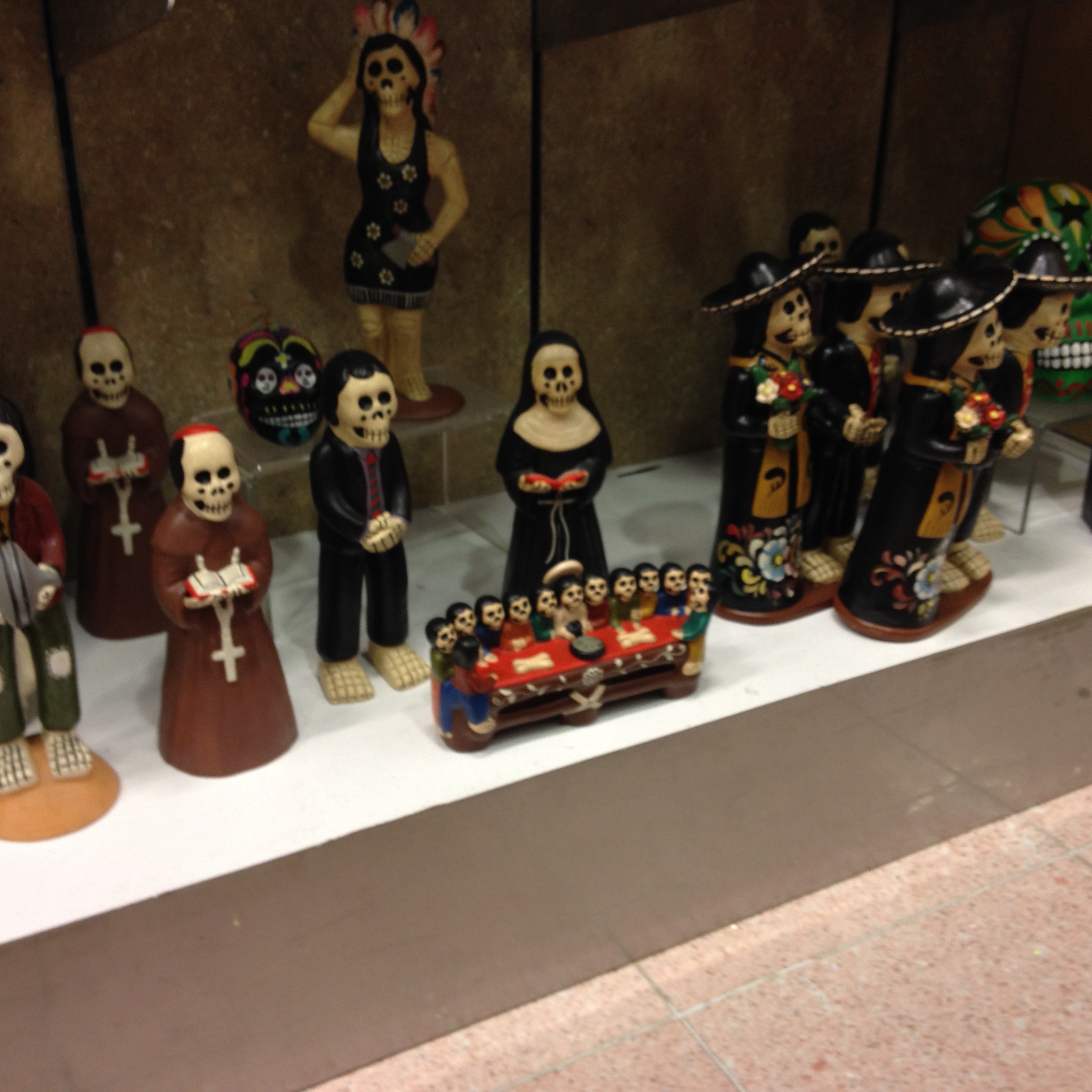
In order to make the trip affordable, we flew back on a different airline (I’m still not sure if it was American or U. S. Air; both reference the same entity, apparently) via an alternate route. Whichever airline it was had a hub in Phoenix, so we flew from Spokane to Phoenix before heading back to Newark. I’d visited Phoenix on Routledge business, but I didn’t spend much time in the airport. It became clear from this trip, however, that the Day of the Dead is a big deal for tourists. Given the popularity of Halloween, I suppose that’s not so surprising. Nevertheless, the sheer volume of Day of the Dead merchandise was stunning, considering that these were, for the most part, impulse, carry-on items. Figurines of various sorts comprised the most popular arrays. Skeletons, fully dressed, engaged in many quotidian activities, although deceased.

IMG_2394

Amid the many daily scenes, I spied a last supper tchotchke. Skeleton Jesus and twelve skeleton disciples gathered around a table for a final meal. Maybe just a little too late. While not a theologian, I couldn’t help but wonder about the implications of this. I know little about the Day of the Dead beyond its association with All Souls Day. The last supper is set up in the Gospels as the grounding, in some way, for a divine plan or redemption. In other words, it doesn’t work if the principals are dead. Already jet-lagged and fuzzy-headed, I couldn’t think to take out my wallet. I really can’t afford baubles in any case, yet there was something profound to think about here. For some reason the market will bear much more in an airport than it will in no-fly zones. Still, as I struggled to stay awake all the long way to Newark, I couldn’t help but think that this was an appropriate image to signal the end of a much needed vacation.


Allhallowtide

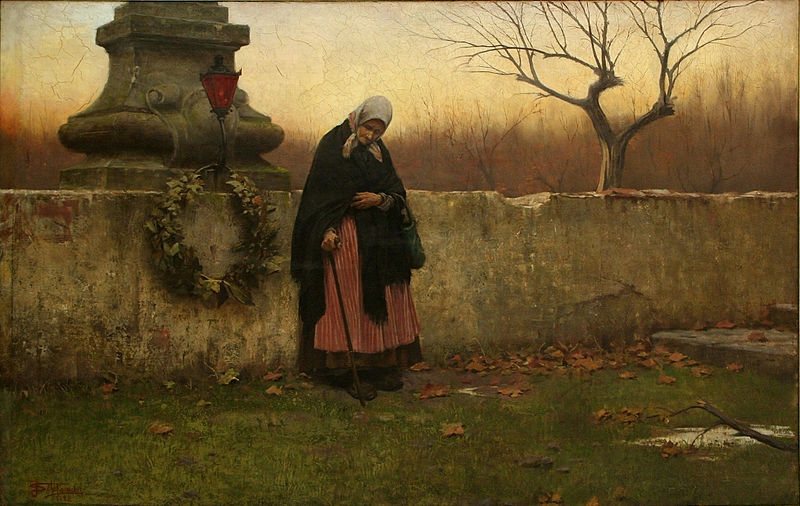
Allhallowtide is a triduum. No, I’m not writing in tongues. Ecclesiastical language can often be foreign to the secular world, and the fact that it’s All Souls’ Day for some has me thinking about feasts that come in threes. I first heard the word “triduum” at Nashotah House. There, of course, the great spring coalition of Maundy Thursday, Good Friday, and Easter made the holy triduum of required marathon chapel attendance. It was not unusual to spend a dozen hours in chapel during that stretch. Always considered less important, but perhaps far more human, was the autumnal triduum of Allhallowtide: All Hallow’s Eve (Halloween), All Hallows (All Saints, or Hallowmas), and All Souls’ Day. In Mexican tradition the three days make up the Day of the Dead. For people who live close to the economic edge of perpetual poverty, that makes perfectly good sense. Even for the liturgically literate, however, parsing the triduum of Allhallowtide takes some effort. We all know Halloween, and the title All Saints is self-explanatory. All Souls’ might require some thought.

All Souls’ commemorates the “faithful departed.” We can’t all be saints. (Well, in some traditions all Christians get to use the title, but alas, in the more Catholic world, no.) What about those who’ve died believing, but not earning a place among Ralph Vaughn Williams’ masterpiece? The ordinary, like us? All Souls’ is our day. Since the macabre is considered puerile, what with its possibilities of ghosties, and ghoulies, and one-eyed beasties, the church has continued to give a polite nod to Halloween (at Nashotah it used to be done up in great style) but doesn’t take it seriously. More evangelical denominations say it’s demonic, but in actuality, historically, it is the opposing triduum to that of the spring. Liturgical life holds an incipient balance for those who don’t take things too literally. Understanding our mythologies covers a multitude of sins.

Perhaps this chilly, rainy Allhallowtide in the northeast has me far from the hot and dry Day of the Dead, but I admire the Mexican acknowledgement that something should be done about those who’ve died never knowing affluence. Somewhere just to the north lies one of the most successful (until recent years) economies in the world. Social fragmentation, violence, and drugs (which draw big money from that self-same northern economy) bring many of our fellow North Americans to their knees at the feet of Santa Muerte. The light is fading fast at this time of year, and the wind is ripping the desiccated leaves from their skeletal branches, preparing us for the long chill that is to come. While work prevents too much investment in the liturgical year, I look with a peculiar longing over this triduum, and this soul, in any case, is grateful for a weekend to contemplate it all.

Jakub_Schikaneder_-_All_Souls'_Day