Spider Planet

Misnomers aren’t uncommon when it comes to click-bait.  I’ve fallen victim more than a few times.  But such misdirection is probably as old as humanity, and is perhaps part of consciousness itself.  (Some birds are known to practice deception, as are some other primates.)  Earth Vs. the Spider is drive-in-bait as a title.  In the 1958 horror-sci fi movie (also titled The Spider), the danger isn’t really to the earth but to one small town.  There is, however, a giant spider and somehow it’s not as scary as the real thing can be, writ small.  Occasionally, such as when a spider comes out into the open in the house, I ponder why this is such a deep-seated human fear.  I know spiders are beneficial to the ecosystem and that they pose very little danger, at least in places where I’ve lived.  So why are they so scary?

Scientists, including those of the mind, have proposed looking to our primate cousins for an answer.  They too are afraid of spiders, and it’s posited that since primates climb trees to escape danger and that spiders also climb, the phobia is hardwired.  For me it’s only certain body-plans that are scary.  I don’t mind the cute little jumping spiders that get in around the windows.  They don’t seem out to hurt anybody.  It’s the kind with long, grasping legs that bother me.  As a child I used to try to identify spiders with a picture book identification guide, but soon the guide started to scare me and I had to put it down.  I wasn’t cut out to be an arachnidologist, I guess.  The movie could’ve used one, however.  They kept calling the spider an insect.

The unblinking advocacy of DDT was the scariest part of the film.  Got a problem?  Spray chemicals all over it!  It gives me the same fear as when I see all those pallets of RoundUp every time I go to Lowes.  That stuff is deadly to the environment, and I’m kind of attached to the environment.  Spring arrived around here late this year, but it was spider season by the time I watched Earth Vs. the Spider as part of my minor quest to see the “so bad they’re good” movies.  They’re also part of the history of horror.  Apart from Psycho in 1960, horror was kind of on vacation for the fifties and into the late sixties.  Of course, movies kept being made.  It’s just that they couldn’t be taken seriously.  And even though drive-ins seem to be extinct, I still fall for drive-in bait from time to time. Even when watching alone.

Fall Silent

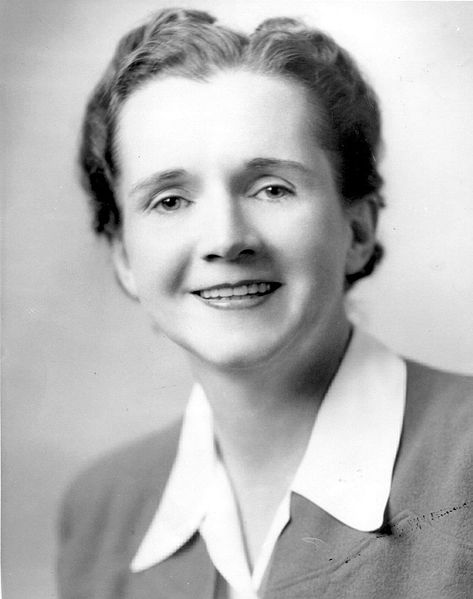
Some books impact an individual profoundly. Others are powerful enough to influence an entire society. Rachel Carson was the author of both. Tributes to the fifty year landmark of the publication of Silent Spring have appeared this month, and although the players have changed, the plot remains the same. Bryan Walsh’s tribute in Time a few weeks back captures the essence of the situation: an environmental danger is discovered, “industry” will at first deny it, then attack the science, and then try to frighten the population with the inevitable escalation of costs. Sometimes common sense wins, but only after a long tantrum by those whose main desire is personal enrichment.

Silent Spring is credited with starting the ecological movement. Until the early 1960s the world seemed vast enough to absorb our filthy, toxic run-off. We were only on the cusp of understanding that the world is much smaller than we had ever imagined. Disney had not yet published the theme song that would get through to the American imagination. We had yet to stand on the moon and look back at just how tiny our troubles were in an infinite universe. Using pseudo-religious backing, industries often claim the planet was made for us. In truth, we evolved to adapt to this planet. The sad story after sad story of those who’d figured out how to line their pockets at the expense of the health, and often the lives, of others constitutes an ignoble hall of shame. Rachel Carson, who truly deserves the title of prophet, was considered the enemy of progress. Better living through chemicals—who hasn’t heard the phrase?

The science behind DDT, which nearly drove the bald eagle to extinction, is not the culprit. The radium that rotted the teeth, mouths, and jaws of young women employed to paint it on watch hands, had always been radioactive. The coal still burning under Centralia suffers from properties properly discovered by science. In case after case we find greed running away with the science. Science unlocks the secrets of our universe, but it also gives ideas to those who are always looking to make a buck. It may be that Rachel Carson knew she was slinging stones at giants when Silent Spring was published. This one biblical metaphor might come in useful for those who are able to see the larger picture. We’ve only got one planet and if we want it to survive we’ve got to make it last. Giants should come to fear the disadvantaged who know how to use slings, whether with rocks or words.