First Stronghold

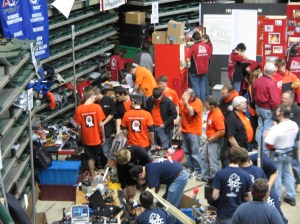
FIRST Robotics has a way of getting into your blood. Like many people of my generation, I learned about FIRST Robotics through my daughter. Our local high school has a robotics team and, as we quickly learned, the decision to join FIRST is a four-year family commitment. My wife and I were both involved at some level, despite being the world’s least likely engineers. I even served a term as the president of the foundation (responsible for funding the team). We made lasting friendships and grew in the lingo and odd humor that is FIRST. The founder and chief promoter of FIRST, Dean Kamen, is an unapologetic geek and has helped develop what some journalists are calling “the new cool.” Yesterday was launch. If you are a FIRST follower, I don’t have to explain that. In case you’re not, “launch” is the revelation of this year’s game. Teams now have six weeks to plan, design, and build their robots.
IMG_3125

Launch is a big deal. We haven’t been part of the competition for three years now and we still watch the live web-broadcast. The major players (Kamen, and Woodie Flowers) get in character and meet kids from various teams. They give inspirational talks. Dean Kamen told the kids “Don’t get stuck into today.” Technology changes too fast. What you learn in school are tools, because facts are available instantaneously on the internet. Those of us who retain facts are so yesterday that we’ve become the trivial pursuit generation. Any computer, let alone robot, could beat us. Woodie Flowers told the young audience thinking about careers that they must do what machines cannot do, otherwise their jobs will become obsolete. What could be more human than religion? What’s religion got to do with it? This is science and technology!

This year’s competition is FIRST Stronghold. The entire buildup of yesterday’s launch was a takeoff on Monty Python and the Holy Grail. What is this I see before me? History? The Middle Ages were nothing if not religion run wild. This was a world ruled by bishops, popes and nobility. It was a world where no matter who you were, God trumped all. Technology meant that a trebuchet was a pretty sexy device and long distance communication traveled at the speed of a horse or human runner. (Or, I suppose, a trebuchet missile.) Now that the humanities have fallen victim to science, we look back to them for inspiration. It reminds me of John Keating in Dead Poets Society: “And medicine, law, business, engineering, these are noble pursuits and necessary to sustain life. But poetry, beauty, romance, love, these are what we stay alive for.” This hasn’t changed since 1989. Or even 932 for that matter.

The Cost of Being Human

In last week’s Time magazine Joel Stein’s “The Awesome Column,” a humorous endnote for somber weekly news, spoke to me. Although Stein writes as light relief, when he addresses humanities education I have to sit up and take notice. Like being in class all over again. Although Stein is trying to be funny, I find the decline in the humanities to be no laughing matter. I don’t think Stein does either. As an uncle once said to a relative recovering from cancer—you might as well laugh about being bald, what else can you do? The humanities are so called because they are what makes us human. Perhaps it is no coincidence that Stein addresses this in the issue following that which commemorates Robin Williams. As I’ve written before, I don’t consider myself a Williams fan, but I can’t help but associate him with what I consider his best movie, Dead Poets Society. The humanities are what we live for.

I’m a little too nearsighted to claim to see the future clearly, but Stein makes the accurate assertion that our great ideas have tended to come from our humanities dreamers. Presidents and Popes, he notes, have not been drawn from the sciences, but from the arts. Herein, I suspect, many would suggest lies the problem. We are a schizophrenic society (with apologies to those who believe schizophrenic is a slur word). Who wants a warm puppy on your lap when you can have a warm laptop instead? Indeed, you can carry your computer under your arm, in your pocket or purse, or even around your wrist. Instant access to the internet and every other wired person all the time. Isn’t that what we really wanted? But then we come out of the movie theater complaining that the show was poorly written, if technologically flawless. We have just walked out of John Keating’s classroom, methinks.

Is this worth more than just money?

Is this worth more than just money?

“We live in a time,” Stein opines, “when smart people want to discuss only politics, technology, and economics.” Truth be told, the deeper you look behind any of these topics the more boring they become. Politics? Everyone wants to rule everyone else, what’s new there? Technology? Electrons dance better in some substrates, and if we can only get this confusing formula right… Economics? I want what you have, so why don’t we trade? How banal! Anyone who’s ever lost him or herself in a novel, a movie, or a song (even, dare I say, a prayer?) knows that transcendence trumps technology every time. As the weather begins its long decline into a bleak and icy winter, I’ll be sitting here with my laptop on my lap, but I can guarantee that this is one place where I can fully agree with the departed Charles Schultz. Happiness would actually be a warm puppy.


Anvil Chorus

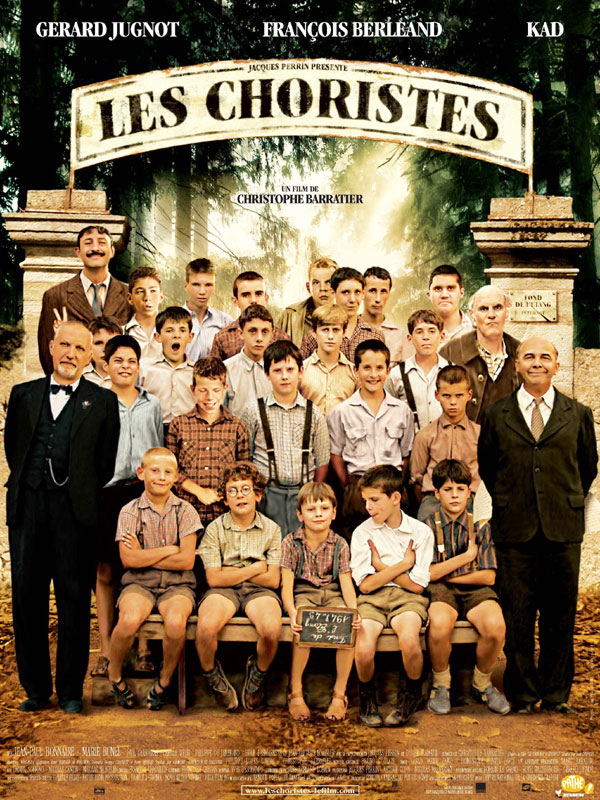
Last night I watched Les Choristes, the 2004 film that received two Academy Award nominations. The story, set in a school for troubled boys in France, felt eerily familiar. Not only did it resurrect the ghosts of Dead Poets Society, it felt like a page – or a substantial chapter – from my own life. The movie was recommended to my wife by one of my colleagues at Nashotah House, an institution that the film strangely resembles. The more I pondered the implications of a small school run by an authoritarian headmaster full of students with malevolent tendencies, the more I realized how much my Nashotah House experience has set the tone for much of my life. While I was at Nashotah, P. D. James’ murder-mystery novel, Death in Holy Orders came out. Immediately students and faculty began to speculate that James must have known of or have visited the seminary. Similarly, the Harry Potter novels led many to compare Nashotah to a decidedly less magical Hogwarts. Some of the students even honored me as the putative master of Ravenclaw.

My personal experience with religious institutions has led me to conclude that they indulge themselves in doling out the abuse that only religious sanction permits. I had attended the Presbyterian-affiliated Grove City College where chapel attendance was mandatory. My experience at Boston University School of Theology convinced me that seminaries were not a good fit for most people, particularly those like myself. I left declaring I would teach anywhere but a seminary. There is no balm in Gilead.

Forever after, any small, religious school with dark secrets would be my Nashotah House. But the problem is much wider than that. Religions seek to control. Some manage to do so benevolently, but too often the human element eclipses the divine. It is a temptation, when in positions of religious leadership, to insist that one’s personal outlook is correct. We all believe that our views are right. Those who receive the holy unction of an institution have the means to make it so. It is not Nashotah House, but human nature. When religious leaders confuse divinity and authority, that is when trouble inevitably begins.