Thinking about the Universe

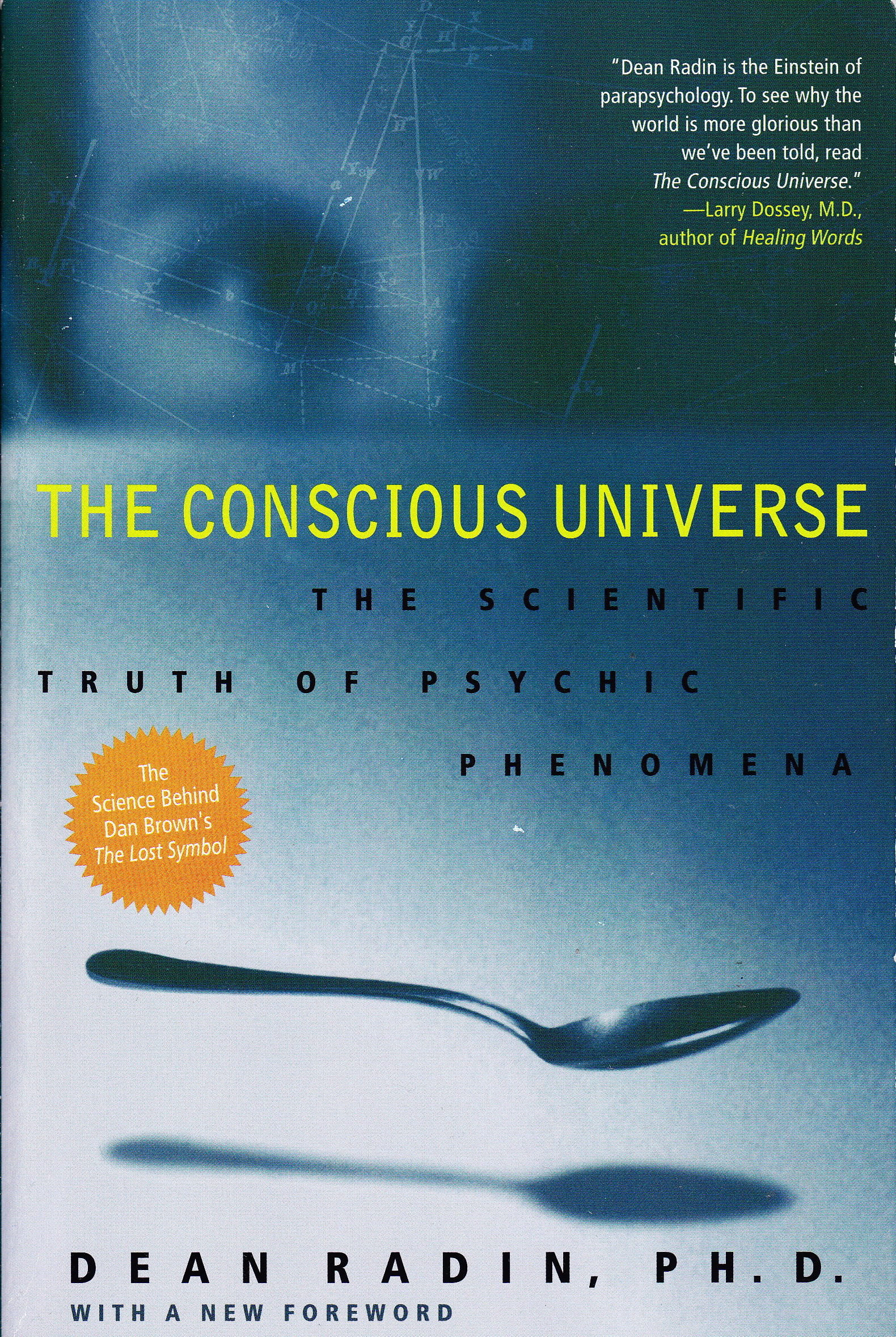
Conscious Universe Notwithstanding appearances, I have been reading. Despite the determination, disruptions to my commuting schedule always throw me off a bit. Having recently read The Holographic Universe, I decided to follow it up with The Conscious Universe. Subtitled The Scientific Truth of Psychic Phenomena, Dean Radin’s book is one of those that you don’t want other commuters examining too closely, although, however, they probably should. Radin is a fully credentialed scientist who has a rare trait: a willingness to follow where the evidence leads. Respectful of traditional scientific method and even mainstream science writing, Radin demonstrates in this book just how risky it is to go against the trends that are like deeply rutted wagon tracks over a sun-baked prairie. Science progresses by examining the evidence, but today science is, in some senses, over-reacting to the refusal of religious thought to, well, give up the spirit. Religion persists and rationalists can’t understand why. Investigating “spooky effects at a distance” is not entirely welcome in such a climate.

Radin, however, approaches psi with scientific rigor. Laboratory experiments, as he thoroughly demonstrates, have revealed with greater evidence than many readily accepted theories, that there is something behind psi. In fact, the government and private industry have invested, and continue to invest, in it. And in our more unguarded moments, most people will generally admit that sometimes coincidences are a little too odd, or that you might, from time to time, really be able to send a thought to someone else. The laboratory results, as Radin clearly shows, are simply dismissed as aberrations because they don’t fit into preconceived (frequently materialistic) worldviews. It is far easier to laugh than to sort out how all of this might actually work.

There is no triumphalism in this. It is simply the willingness to ask honest questions. Quantum mechanics, as physicists know, are not always as mechanistic as they seem. Even Einstein was willing to keep an open mind concerning the larger picture. The universe we envision today is not the same as that which Einstein knew. It isn’t easy to summarize what Radin is addressing in his book, but if I were to try I would say something like this: consciousness is essential. I know materialists dismiss essence, but I believe the evidence goes against them here. Consciousness is an integral part of the universe, and we can’t even define it yet so that all parties agree. If we don’t know what it is, how can we possibly know what it might not be able to do? Radin does what seems to be the only logical response in such a situation: he keeps an open mind.
Just Passing Through

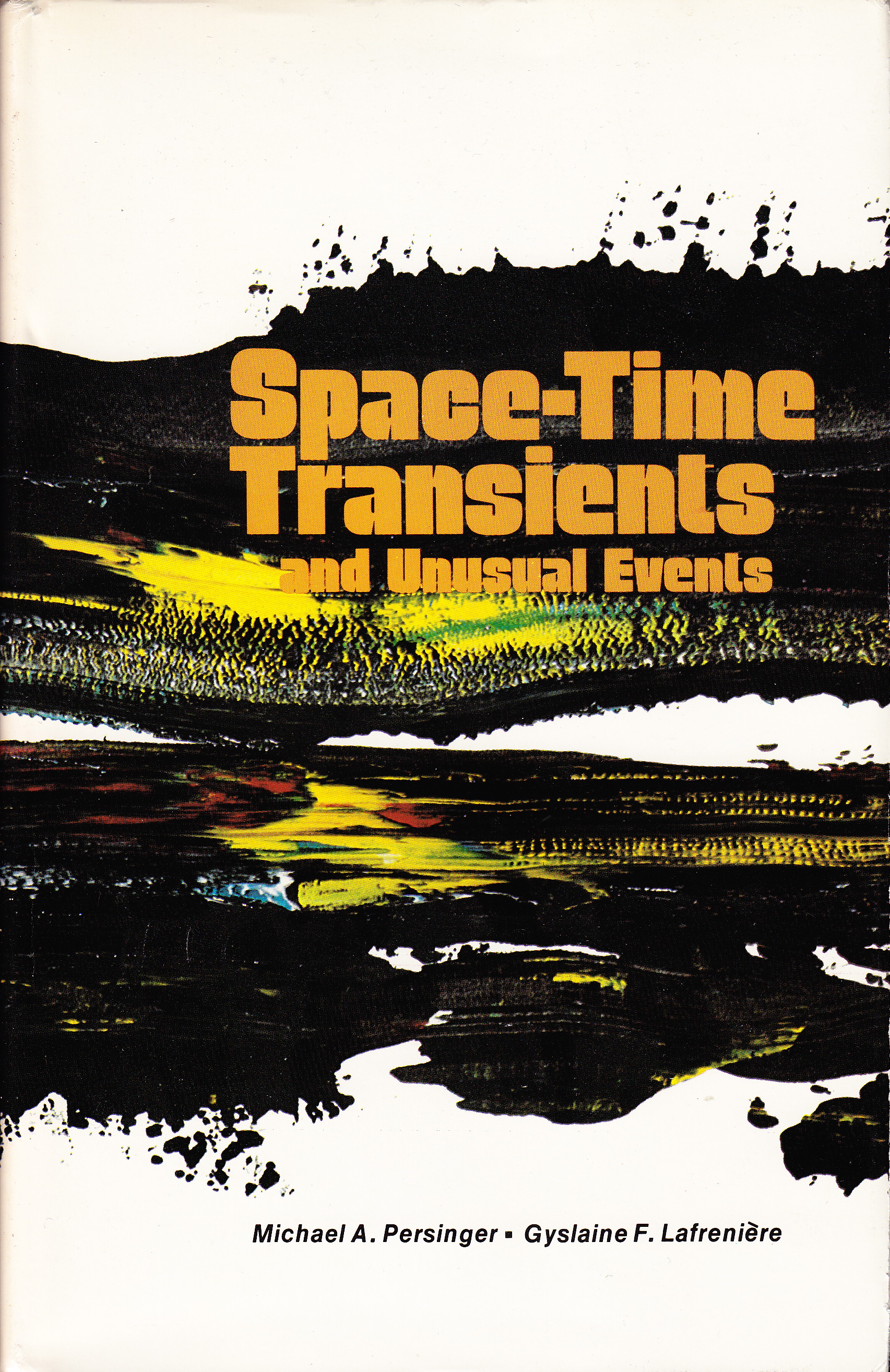
SpaceTimeTransientsMichael Persinger is a curious and rare scientist. Apart from occasionally making it onto Through the Wormhole episodes, he is also known for his somewhat unorthodox willingness to ask unfashionable questions. I just read his book, co-authored with Gyslanine Lafrenière, Space-Time Transients and Unusual Events. What makes Persinger (the lead author here) so unusual is that he is willing to admit that unusual events happen. Most scientific studies begin with the assumption that the uncanny is unreal, and that people who witness the unusual are unbalanced. Most of us, I would venture to say, have noticed that strange things do happen from time to time. Those who read all the way through Space-Time Transients may be surprised to discover that Persinger and Lafrenière offer an empirically-based hypothesis that places many unusual events squarely in the realm of scientific explanation. The acceptance of woo this is not.

For an old religious studies student, such as me, it is refreshing to see scientists at least asking the question rather than sweeping all the unorthodox evidence off the table. Not everyone who has experienced a fall of fish from the sky or a poltergeist in the bedroom is a deluded liar. Strange things do happen. Space-Time Transients, however, asks what seems to me the perfectly logical question: what’s going on here? Yes, some accounts are exaggerated. Others are fabricated. Still others clearly remain. Should we call names or should we try to figure out what is behind all this? One of my favorite unusual events is the coincidence. There may be nothing supernatural at work, but the oddity of the situation leaves us wondering. Shortly after being hired by Routledge, on my way home through a very crowded Times Square, I saw someone crossing Seventh Avenue drop a five-dollar bill. This person was hurrying in the opposite direction from me in the midst of a crowd, and was far enough away that calling out “you’ve dropped some money” would have only caused a feeding frenzy. It was only a fin. The next morning, coming to work over on Third Avenue, I found a five-dollar bill on the pavement. With the exception of pennies, just about all the dropped money in Manhattan is quickly scooped up by the needy. Could this have been the same dropped bill from over twelve hours before, on the other side of the island? Perhaps not. But why a fiver in both cases? Money does not grow on skyscrapers. The story gets even weirder, but you’re not here to read about that.

Scientists who are willing to admit that strange things happen (the names of Rupert Sheldrake and Dean Radin come immediately to mind) often face difficult times being taken seriously. They are, however, asking the big questions. Ironically, it is often the notice of strangeness that leads to advances in science. As one quip has it, science grows not because an observer says “Eureka!” but rather, “that’s strange.” In a world where strangeness is associated with religion, and religion is for the deluded, we have perhaps cut off an obvious avenue for learning about our strange universe. As Persinger and Lafrenière point out, we live in a very small habitation, viewed as a cross section of a planet that is itself not terribly massive, in an infinite yet expanding universe. To think that we’ve figured it all out by now is perhaps the strangest idea of all.


Making Sense

Science is more than meets the eye. Even since I was a child I’ve tried to follow what I can of science without a real microscope or telescope and a doctorate in some incomprehensible subject like chemistry. I guess that’s why I’m a fan of popular science—the kind that is written so a layperson might understand, or at least pretend to. Indeed, one of the complaints from scientists and others alike is that science has become so complex that only a specialist can really understand. I suspect that’s one reason religion continues to thrive; anybody can be an expert in religion, even a scientist. Nevertheless, science is based on empirical observation, now with instruments fine tuned to receive data better than human senses. So I sometimes watch Through the Wormhole to find out what is happening in the realm of pure knowledge. Although simplified to the digestibility level of the laity, Through the Wormhole tries to stay on base with interviews with mainstream scientists who are working at the cutting edge of what’s out there. I recently watched the episode entitled “Is There a Sixth Sense?”

I have no way of knowing what scientists think of such things, but I was glad to see the everyday experience of normal people addressed in this particular episode. Who hasn’t felt that weird pre-cognition from time-to-time, or felt like they were being stared at only to learn that they were? These might be the spooky effects at a distance that so unnerved Einstein, but they are part of human experience. We all go through it, but mainstream science comes up with a convoluted scheme whereby our brains project what actually happened back in memory before it happened so that it just seems like we knew something was about to transpire. Of they point to false positives—how many times did we think something was about to happen and it didn’t? We just don’t remember those. Still, this particular show brings together mainstream physicists and theorists usually considered outsiders, such as Dean Radin and Rupert Sheldrake (strangely omitted from the IMDB cast list). Several smart people, it seems, wonder if we are really all connected.

Mainstream science has grown terrified of metaphysics. The suggestion that anything might be remotely like the world of religion is frightening to those who believe we just need more precise calipers and higher resolution imagery to explain an entirely physical universe. This little universe we carry around in our skulls, however, is attuned to what we might just have to call the “spiritual” or some such moniker, just to differentiate it from the particles that we are told make up everything. Or is it strings? Don’t ask me; I couldn’t tell an up quark from a down quark. Interestingly, one is even called a “charm.” And then there’s the God particle, the Higgs’ boson that briefly reminded the world that Edinburgh is a top-rate university, although, as we all know, there’s no place like Harvard. For the rest of us, however, there’s the everyday business of work to face. And if I try to read a blog while on the clock, I definitely have a sense of being stared at, even when I’m alone in here.

One of the last fearless scientists

One of the last fearless scientists