Unanswered Questions

Attempting to write a blog post everyday on the single subject of religion can be a challenge when you don’t share the freedom of the Internet with most faculty. Once in a while a topic just drops in your lap like a gift from God. It helps that New York City is such a religious place. Despite the many critics who claim New York is godless and completely secular, it my experience there are a goodly number of the godly in it. It is not uncommon to see street preachers on a sunny day (apparently God has less need of saving on rainy days). On my way home from work today I was presented with a tract in which “God Answers Your Questions.” It was a little odd that the acolyte with the tracts knew what my questions were, but since the leaflet quotes extensively from the Bible it must be true. From this pamphlet I learned what my hidden question were.

The first question, rather flatteringly, states, “I am young yet, and likely to live for a long time.” Once I’ve been buttered up, the other shoe drops: “Why should I think of eternal things now?” Rather than the Bazooka Joe Bible verse, I thought I might field that one myself. I grew up thinking about eternal things on a nearly daily basis. By the time I was in high school I was somewhat creepy about it. In a college course on the psychology of death and dying, we were asked how often we thought of death. My honest answer was, “every day.” Now, a person with that kind of background may be overthinking this a bit. Death is a relatively simple matter: you need do nothing to achieve it eventually. I had been taught that if you worked to make sure you were honest and true, it would be rewarded. I was fired from my first job for being true to what I’d learned with intellectual honesty. I thought about death a lot.

Death, given its finality, is a universal religious concern. Some religions offer an afterlife—generally it is not an option—while others do not. The life well-lived is its own reward. Others suggest what seems to me a more insidious option: reincarnation. Those religions that take this approach are generally honest up front, stating outright that life is suffering. Reincarnation is goal-directed: break the cycle and achieve Nirvana. And there is no reason to flatter people with the long life yet ahead of them. The evangelist ignored my white whiskers and gave me an anonymous tip for salvation. Perhaps all I really needed was a sip of cold water. Having spent the better part of one life thinking about its end, reincarnation could be a cruel reprisal indeed. I don’t need to worry, however, because I’ve got the answers—along with the questions—right here in my pocket.

Zombies of Harare

In a tale that would have Edgar Allan Poe turning in his grave, a news article from Zimbabwe narrates the darker side of resurrection. In a July 26 story entitled “Schoolgirl ‘rises from the dead’News Day online reports that a sixth form girl, after falling into a coma (the article says she had “fallen into a comma”-embarrassing enough under any circumstances) was pronounced dead and taken to the morgue. Her coughing, possibly from the cold, caught the attention of an attendant and she was rescued. Her schoolmates feared her until school authorities “assured them it (the mishap) was normal.” Even more disturbing is the sentence, “Cases of people gaining consciousness in the morgue after being certified dead are quite common and in most cases doctors would have erred.” The story serves a grim reminder of how in many parts of the world what is taken for granted in developed nations is still a desideratum.

The fate of the dead is a major preoccupation of religion. Certainly among the most famous African outlooks on the subject, the Egyptians possessed a highly refined view of the life beyond. Having just covered Egyptian funerary beliefs in Ancient Near Eastern Religions class, the connection between this chilling story and an ancient optimism among the Egyptians is worth noting. Initially life after death was limited to the king in ancient Egypt. Over the centuries, a kind of democratization of the afterlife took hold and the chance for renewed life was open to us regular sorts as well. In a snapshot of how religions work, this transformation holds the keys for further religious developments. The benefits trickle down from the elite to the peasant. Those who awake in the morgue may count themselves lucky since Osiris demands their presence only at a later date.

When Anubis comes knocking, don't answer.

Modern ideas of resurrection are great motivators for religious belief. The fact that Paleolithic burials sometimes include grave goods demonstrates that some kind of afterlife hope predates civilization itself. It is one of the formative elements of religion. In a world where death may not be the worst possible fate, however, such an afterlife may eventually lose its drawing power. For Egyptian peasants, the afterlife was pretty much a continuation of peasant life. I suspect that those who wake up in a morgue have a new perspective on life after death that most of us, thankfully, never have to face.


Anubis Rising

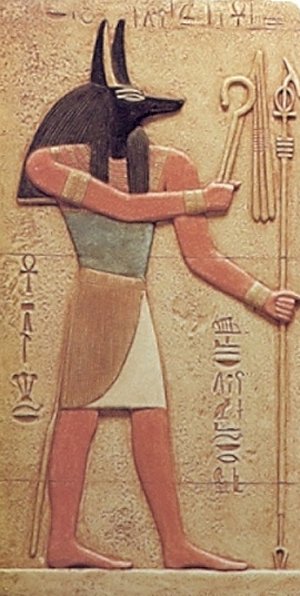
As if reality weren’t haunting enough, I’ve been continuing my quest to find the scariest fiction book written. I’ve borrowed suggestions from others, but it seems that the fear factor is a decidedly personal thing. Nevertheless, the suggestions are often enlightening as well as provocative. I recently finished Dan Simmons’s A Winter Haunting. Simmons’s work had previously been unexplored by me, so this was a foray into the unknown. Of course, I read horror with an eye toward the sacred and I’m seldom disappointed. In A Winter Haunting the sacred appears in the form of Egyptian religion. Simmons makes very effective use of hellhounds, tracing them back to Anubis.

Now Anubis lays me down to sleep

The religion of ancient Egypt had a morbid preoccupation with death – or maybe it was just a healthy recognition that it is inevitably coming. Many of their gods eventually ended up patronizing the dead in some way. Andjety, Ptah, Min, Osiris, Isis, Nephthys, Maat, and Thoth, as well as Anubis, regularly appear in the cult of the dead. And, of course, pyramids represented the stairway to heaven long before Page and Plant. Death and its psychological angst have been crucial to the development of religion from the beginning. The Egyptians honed it to a fine art.

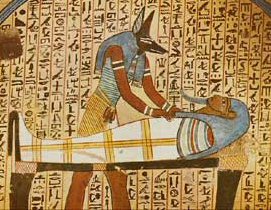
Anubis was likely associated with the dead because of the scavenging of wild canines at shallow graves. Magic, a phenomenon anthropologists have difficulty distinguishing from religion, dictates that the source of the problem should be appropriated as its cure. To protect the dead, the scavenger of the dead transformed into Anubis. Simmons did his homework, for this transformation is well represented in A Winter Haunting. Without knowing this particular plot device, I had been reading about Egyptian funerary cult independently of the novel and this coincidence proved entertaining as well as informative. I won’t be sleeping with the lights on, though. The search continues.


Memento Mori

This is the end, my friend, my only friend, the end

This is the end, my friend, my only friend, the end

Those of you who’ve listened to my podcasts have no doubt noticed my reference to George Pendle’s, Death: A Life (Three Rivers Press, 2008). This fictitious account of Death’s memoir, all things considered, is a fun read and a wild romp through various ancient religions. Postulating a loveable, if somewhat obtuse, God (no more obtuse, however, than the supreme being in Harold Bloom’s Book of J) Pendle populates his mythological world with a vast array of embodiments, personifications and supernatural beings, all slightly neurotic, and more or less on an equal playing field. Although the book is intended as fun, it does offer some serious consideration to the phenomenon of death.

One of the earliest intimations that Homo sapiens had begun to consider religious sensibilities is burial, the concomitant state to death. Burial serves an important biological function of preventing the diseases borne of putrefaction from infecting others, but it also serves as a condensed statement of a fledgling belief in an afterlife in some form. Even Neanderthal burials have been discovered with rudimentary grave goods. Concern for the wellbeing of the departed is surely a religious sentiment. Death and religion are never far from each other. Even the early Mesopotamians trembled at the etemmu, their version of a ghost, and marked it with the divine determinative on their clay tablets. Religion has been a fine-turned handle that humans have used to get a grip on death.

That is not to say, of course, that death is religion’s only concern, but there is some wisdom in that old saying that people seek out their religious leaders when they are “hatched, matched, and dispatched.” Mesopotamian (and Hebrew Bible, for that matter) afterlife was a gloomy prospect, yet it was certainly brighter than the alternative of the simple cessation of biological functions. Death as a concept inserts meaning into the all-too-natural act of dying. Not a religion exists that does not address itself to this great leveler of all human aspirations. If at times it seems that my posts tend toward the macabre, peopled with vampires, werewolves, zombies and Republicans, bear in mind that such creatures of the night are expressions of the essentially human and indisputably religious preoccupation with death. Its unbeating heart transfuses life to religion.