The Clairvoyant and the Demonologist

As a special bonus, here’s a post by a Guest Author. Enjoy!

For almost half a century, the couple known as a clairvoyant and a demonologist investigated thousands of paranormal cases that led to film franchises and book deals. You can find films based on their investigations wherever there are streaming horror movies.

Although the Warrens’ wider-known cases spent half a century splashing the headlines, there’s more to their legacy than how Hollywood portrays them.

Ed and Lorraine’s Spooky Origins

Even as children, the two were destined to unite over the supernatural. Ed grew up in a haunted house, witnessing apparitions of his deceased relatives while Lorraine experienced clairvoyant visions. 

After dating as teenagers, the two later married while Ed served in the Navy during World War II. They had a child, Judy. 

Despite Lorraine’s skills as a trance medium, she remained a skeptic until she witnessed more substantial first-hand accounts through their business.

Haunted House Hunters

The couple’s haunted house hunting began as a means for Ed to make a living as a landscape artist. The project quickly grew bigger as they traveled across New England painting potential haunted sites

Ed’s sketches became a friendly gesture to gain entry for tours and then investigations. Their novel networking attempts and cases eventually led to newspaper coverage and TV appearances.

Religious But Not Occultists

The Warrens’ religious beliefs as Catholics both hindered and aided their cause. As self-taught investigators, they aspired to balance their religious beliefs with scientific research.

“The Haunted” TV Series

Though much about The Warrens’ work is showcased in The Conjuring franchise and features spawned from their experiences at Amityville House, Hollywood also adapted an unsung investigation with a television show called The Haunted (1991). 

From the smell of rotting flesh to the sounds of anonymous screams, Jack and Janet Smurl experienced diabolical activity in their Pennsylvania house for years. After going public with their encounters, they gained national attention and then reached out to the Warrens. 

The Warrens confirmed a dark entity inhabiting the Smurls’ house and tried to expel it. Unfortunately, the evil presence refused to vacate.

The Warren’s Occult Museum

The couple founded the New England Society of Psychic Research (NESPR) in 1952, which solved thousands of cases over 50 years. They also opened their home to the public with a museum of the occult featuring artifacts such as the possessed Raggedy Ann doll that inspired Annabelle

Following their deaths over the past decade, their son-in-law now manages NESPR, but the museum closed in 2019.

Today, there is still more ground to cover learning about the supernatural and paranormal. Without the Warrens bridging the gap between the living and dead, vast mysteries about the afterlife could’ve been buried in the dark. 

Their legacy ultimately encourages believers and skeptics to continue searching for answers.

The Tell-Tale Telegraph

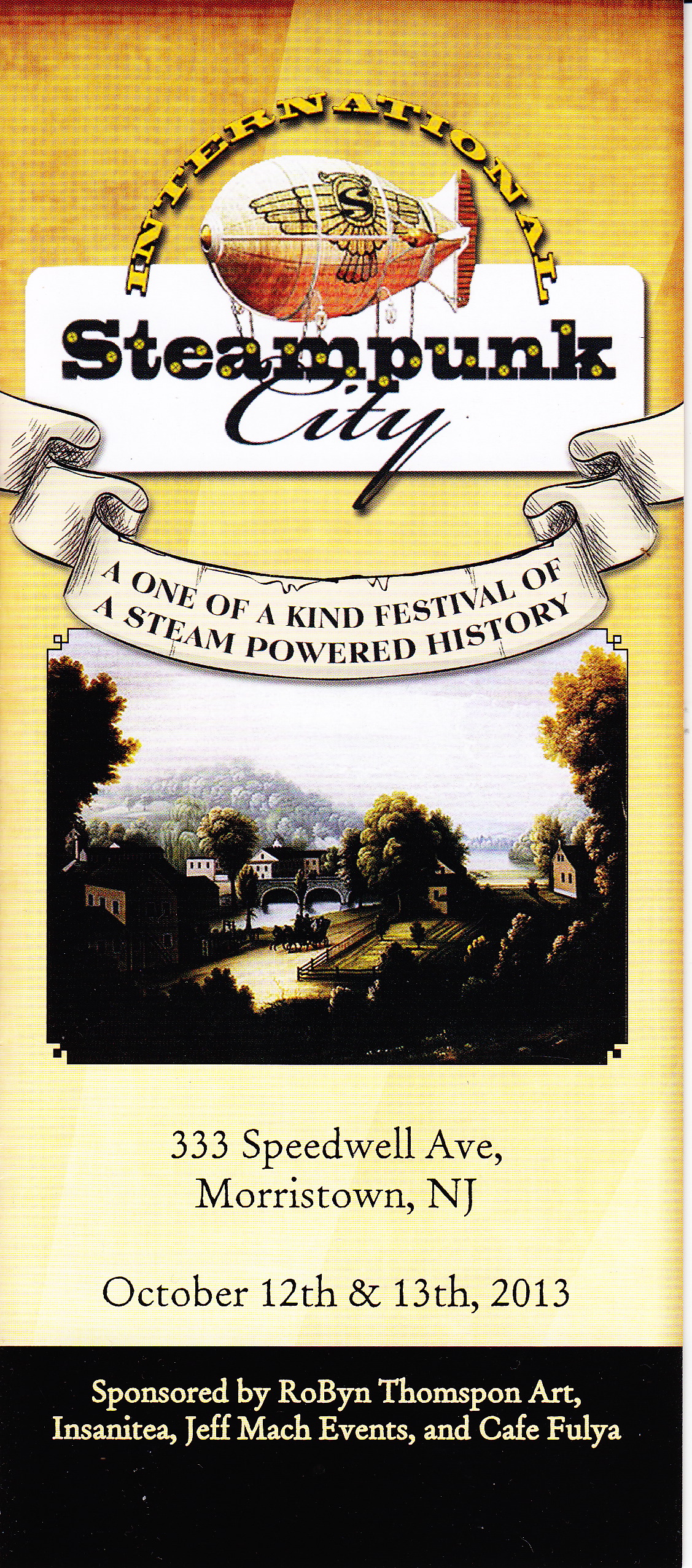
Steampunk CityThere’s a guy next to me with a robotic arm. Women with lace umbrellas and aviator googles walk by on the arms of Victorian gentlemen with walking sticks. A couple have an effervescing water-cooled device on their backpacks. I must be in Steampunk City. The forecast had predicted rain, but it is a beautiful October day in Speedwell, New Jersey. Steampunk City, an event dreamed up by Jeff Mach to make money for local museums, draws in a good crowd of the garishly bedecked, causing my wife and me to feel desperately underdressed. I’ve read my share of steampunk fiction, and I am really thrilled to see so many people taking an interest in such a literary event. I did wonder, however, what demonology had to do with it. Kevin Meares of Delaware Valley Demonology Research is giving a talk on demons, and it’s interesting to notice how the light laughter of customers from the booths outside wafts through the door where stories of possession are being told.

It is difficult to listen to Mr. Meares and believe that he hasn’t seen some pretty strange things. A practicing demonologist rather than the armchair variety, he has accompanied priests on exorcisms and is utterly convinced of the reality of the entities. When asked where demons come from, he relies on the Bible and Bible lore. Either they are fallen angels, remnants of a prior creation (thus the discrepancy between Genesis 1 and 2), or the offspring of the Nephilim of Genesis 6. Whatever they are, he has seen them in the dark, and people have died because of their activity. Being somewhat of a skeptic, I still find myself a little creeped out, kind of wishing I was outside with the laughing, costumed fiction readers.

Steampunk is often about alternate realities. A world where technology developed in the fog of steam rather than the neat circuitry of electricity. Speedwell, ironically, (and probably intentionally) is where the telegraph was invented and first demonstrated. It is a key site in the Industrial Revolution, the development that made the modern world what it is with smart phones, air-light laptops, and iCloud. I’m in the basement of an historic building having my rational worldview threatened by stories of demons. Although I’m wearing my nonplused face, I know that things will be different in the middle of the night. I’ve got brass gears in my pockets and supernatural entities in my head. I’ve met a watch maker outside who translates Aramaic manuscripts. What hath God wrought indeed, Mr. Morse? Yes, I’m in an alternate universe, and I may decide not to come back to the work-a-day one after all.


Dark Side of Religion

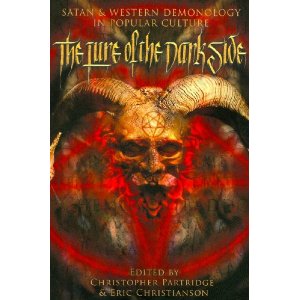
Back in August I received a book to review for Relegere, the new online journal for Studies in Religion and Reception. The volume I received was The Lure of the Dark Side: Satan and Western Demonology in Popular Culture, edited by Christopher Partridge and Eric Christianson. I found this assignment to be a felicitous one for many reasons: the book was very interesting, the topic is intriguing, the authors are scholars who take popular culture to be worth serious study, and it exposes the roots of many perceptions of Satan and the demonic in western society today. While I cannot present the whole review here – I would encourage interested readers to explore the appropriate issue of Relegere when it is published – I would feel remiss if I didn’t at least mention a few of the highlights here.

Scary cover

First of all, the book is a collection of essays that cover the media of music, film, and literature. Many of my students like to point out the propensity of death metal bands for choosing ancient Near Eastern gods and themes for their band names and songs. The first two essays in this book explore black metal and its self-proclaimed Satanic intent. What is interesting here is that what many black metal bands declare as their “religion” does not, in fact, fit with mainline Satanism at all. This aspect of the book is worth reading just to see how religious ideas, both unholy and holy, easily become distorted when transformed into an artistic medium. By far my favorite essays, however, were those that analyzed horror films according to religious themes and concepts. It was refreshing to see serious scholars discussing vampires without flinching, noting how they are part of the same fabric from which religion is cut.

One of the recurrent criticisms of academic writing is that it generally reaches only academic audiences. Certainly at the prices common at academic presses the average layperson would need to be exceptionally motivated to pay out the cost to read what are admittedly generally dry and technical books. Equinox has fortunately released an affordable paperback version of this volume, making the price less of an issue. The content is, for the most part, readily accessible to the general reader. The cover is a tad lurid; when I took it along to the DMV to renew my driver’s license I felt a bit self-conscious in the waiting room. Beyond that, this was a rare academic book that should find a wide readership. For me, the bibliographies and filmographies demonstrated my own deficiencies in keeping up with popular culture. I would recommend it for those with a sturdy constitution who want to know the correct way to dispatch a vampire in the twenty-first century.


Zoroastrian Odyssey

Clinton's Red Mill

Clinton’s Red Mill is a popular New Jersey attraction, but numerous reports of paranormal activity have thrown an additional lifeline to the museum in the form of much-needed revenue in the form of seasonal ghost tours. Last year about this time my family and I participated in one. Touring the old grounds at night can certainly lead to spooky experiences, even for those of us who sit on the fence about ghosts. We discovered that The Atlantic Paranormal Society, the “TAPS” of Ghost Hunters fame, had investigated the Mill the previous year. We watched several episodes of the popular show, and for a lark, my wife bought me a subscription to TAPS Paramagazine for my birthday. All in good fun. I always thumb through when it arrives, but it is hard to take much of it seriously.

The last issue (volume vi, issue 2), however, contained an article about Demonology. Now, I thought I had graduated from The Exorcist and the Exorcism of Emily Rose to a healthy skepticism, but I could not resist reading this article. The first statement declares, “A demon is a fallen Angel that rebelled against God along with Satan, refusing to be humble before, and serve, God” (Adam Blai). While I never make light of things I don’t understand, I did consider the fact that the concept of demons, which derives from a Judeo-Christian mythology, presupposes a mythic war between the powers of good and evil. At the same time, I have been reading up on the Zoroastrians, one of the oldest continuously practiced religions in the world. There can be no serious doubt that the Judeo-Christian tradition borrowed the concept of the demonic from their Iranian neighbors of the ancient Persian Empire.

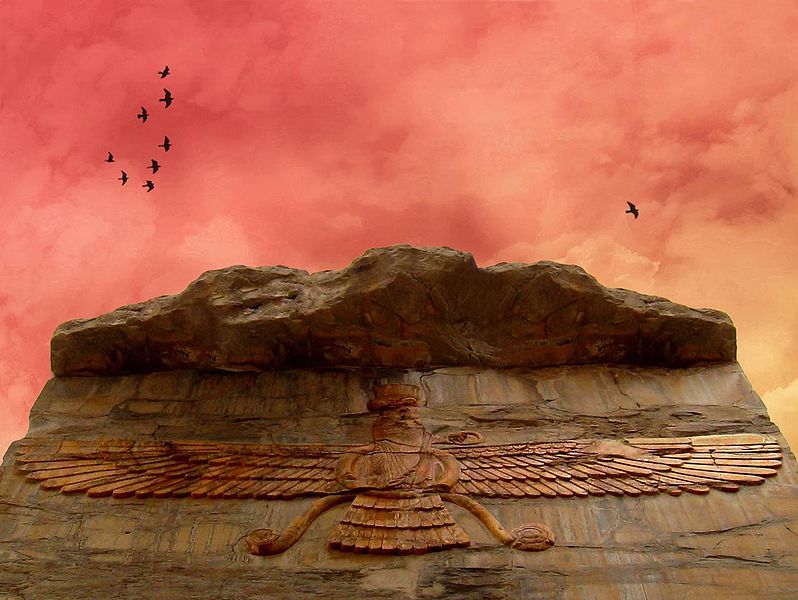
A Zoroastrian fravashi

The implications of the Zoroastrian connection are profound. If the ancient sage and Afghani priest Zarathustra was correct about the dualistic conflict of good and evil, was he not also right about Mithra and the Amesha Spentas as well? Zoroastrianism gave the Judeo-Christian tradition its base concept of Heaven and Hell, but the divinity of fire they did not accept. By picking and choosing what fit best into its experience, Judaism developed into a religion that allowed for Christian demons and angels and all the invisible hosts of the ethereal realms. Today many Christians accept demons as literal beings (less so jinns, although Clash of the Titans (2010) allowed for them). What does this say about the remainder of Zoroastrianism? Perhaps Ghost Hunters should begin with the Gathas and move on to the Avesta? As for me, I’ll be over here, sitting on the fence.