Panic Inducing

Many movies appreciate in value over time.  The Devil Rides Out (also known as The Devil’s Bride) was not well received initially, but has become a highly regarded horror classic.  One of the few with a G rating, no less.  It’s also hard to see in the US, due to lack of streaming (at least where I stream) and DVDs coded to Europeans viewers.  Anyway, taken from a Dennis Wheatley novel, and screen-written by Richard Matheson, it features Christopher Lee in an heroic role during the days just before public concern about Satanism would become downright panic.  The story itself, effective if long-winded, develops among the aristocracy in England during the 1920s.  It was released, by the way, the same year as Rosemary’s Baby, which helped play into the Satanic panic.  Movies do influence the way we view “reality.”
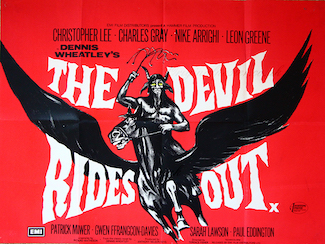
I’ve never read any Dennis Wheatley novels, but it’s safe to say the story is pretty Manichaean in its outlook.  A coven of Satanists wants a young man and woman to complete their number but the chosen young man has a couple of older friends who quickly comprehend what is happening and attempt to put an end to it.  The Satanists, however, control real power and the movie is pretty much a tug of war between the young man’s friends and the coven.  This is done in such a way that you see very little blood, no gore, and surprisingly for the subject matter, no nudity or sex.  The Satanists here are old school—they want to worship the Devil in exchange for personal power.  It’s pretty clear that some research was done before undertaking all of this, even if the paranoia born of such things was fueled by largely imaginary scenarios. 

I’d been wanting to see this film for some time because of its clear connection between religion and horror.  There’d be no Satan, as we know him, without Christianity.  Indeed, there’s heavy Christian imagery in the film, in keeping with Wheatley’s outlook.  Crosses cause demons to disappear in an exploding puff of smoke.  Interestingly, however, there’s no crucifixes or holy water.  This is a Protestant view of the Dark Lord.  The Satanists, however, are defeated by the spirit of one of their own who refuses to allow them to sacrifice a young girl.  The ending stretches credibility a bit more than the rest of the movie, but still, overall it isn’t bad.  A Hammer production, it never had the box-office draw of its contemporary Rosemary.  Still, The Devil Rides Out was influential in its own right.  Even if finding a viewing copy requires almost selling one’s soul.

Black Sabbath

I used to be afraid of them.  The band Black Sabbath, I mean.  I heard the songs from Paranoid wafting from my older brother’s room (separated from mine by only a curtain) and was secretly intrigued.  But the name of the band—wasn’t that satanic?  To a young Fundamentalist there was much to fear in the world.  More than once I bought Alice Cooper’s Welcome to My Nightmare only to replace the copy I’d thrown away in evangelical terror.  I recently learned, however, the the band name Black Sabbath was taken from a 1963 horror movie.  And I also learned that the film was, in part, based on a Russian vampire story by Leo Tolstoy’s second cousin Alexei, titled The Family of the Vourdalak.  And that this story was published decades after Tolstoy’s flop, The Vampire.  That novel was inspired, in turn, by John Polidori’s The Vampyre.

Polidori’s work was inspired by a fragment by Lord Byron, which he contributed to the ghost stories putatively told among friends a stormy night in Geneva that also led to Mary Shelley’s Frankenstein.  Connections such as this are immensely satisfying to me.  Although I taught mainly biblical studies, my training was in the history of religions—it just happened to focus on ancient semitic examples.  Finding the history of an idea is one of the great pleasures of life.  But we’ve left Black Sabbath hanging, haven’t we?  The band realized something that Cooper would run with, namely, horror themed songs and metal go naturally together.  Such dark things led evangelicals to condemn the whole enterprise, claiming the band name was satanically inspired.  (Michael Jackson, raised as a Jehovah’s Witness, was famously fond of horror, although Thriller is perhaps the least scary horror-inspired album ever.)

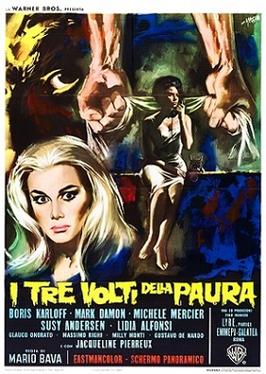
I’d never seen Black Sabbath before, so now I had to watch it.  Of course, there’s nothing satanic about it.  An Italian, French, American collaboration, it’s a set of three stories bound together by Boris Karloff’s narration, and it’s all in Italian.  One story is about a woman double-crossed but saved by an estranged friend.  The second, the one featuring Karloff, is the one based on Alexei Tolstoy’s Russian vampire tale.  The third is about a poor woman who steals from a dead patron and is haunted until the inevitable happens.  Not particularly scary, the film title was the inspiration for the band, not the content.  They were therefore labelled satanic because of a movie that has nothing to do with satanism.  The song “Black Sabbath” was actually inspired by Dennis Wheatley novels, which do, of course, deal with satanism.  The song itself isn’t satanic.  They decided to make songs like horror films in music.  And it all goes back to Lord Byron and the night near Geneva that inspired both Frankenstein and Dracula.


Seasonal Viewing

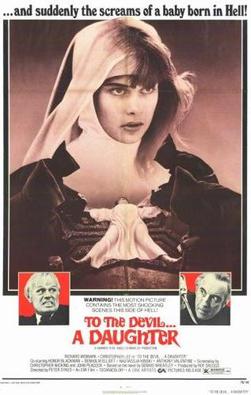
Any movie that begins with an excommunication ought to be good.  Especially with its list of stars you’d think To the Devil a Daughter might’ve turned out better.  Still, it is a good example of religion and horror mingling together.  I’ve never read any Dennis Wheatley novels, but reputedly he didn’t like this film adaptation of his book.  It certainly has a convoluted plot.  So an excommunicated priest has started a new religion that worships Ashtaroth.  He has to baptize a child, now 18 (three-times-six, don’t you see), with the blood of the demon so that she can become his (Ashtaroth’s) avatar.  This is apparently the eponymous daughter to the Devil.  She was baptized initially by her mother’s blood at her birth.

The girl’s father, who survived her birth—unlike his wife—has decided at the last moment to save his daughter.  He appears to be independently wealthy yet he talks an author of occult books into doing the saving for him.  The girl, it turns out, is a nun in this satanic religious order and is only too willing to do what she can to serve “our Lord.”  The way that all of this plays out is confusing and Byzantine, but it does raise a serious question: what if a child is reared in a bad religion?  (And there are some.)  Who has the right to decide if a religion is good or bad?  Children are easily indoctrinated and not too many question the faith in which they were raised.  Yes, we all think the religion we believe is the right one.  The problem is everyone else thinks the same thing.

One of the things this movie got right is that the “heretics” are portrayed as sincerely believing that their religion is for the improvement of the world.  Calling themselves Children of the Lord, they believe Ashtaroth is good.  And a good lord wants what is best for the world, right?  This is the dilemma of exclusive religions that teach only their own outlook can possibly be the correct one.  Otherwise you have to give adherents a choice and another religion may be more appealing.  Or worse, they may reason out that if you’re given a choice that means your own religion is also merely one of many.  Historically religions have gotten around this by valorizing true believers who never question anything.  To the Devil a Daughter isn’t a great movie.  It’s not even a very good one.  Nevertheless, it raises some questions that lie, of course, in the details.