Have It All

You can’t have it all.  I know, I know.  People are all the time saying, “I want it all.”  But you can’t have it.  This is where my Buddhist side kicks in, I guess.  It’s the constant desire that makes people unhappy.  And you don’t have to take my word for it.  About having it all, I mean.  The Catholic Church backs me up on this.  There are seven sacraments.  If you follow the rules most strictly, no one can receive all seven.  Holy orders and marriage, at least for much of church history, have been mutually exclusive.  As Paul was rattling on about spiritual gifts in one of his letters, he makes the point that nobody gets them all.  And you don’t even get to choose.  

Humans are acquisitive.  It’s probably an evolved trait.  Think of squirrels hoarding more acorns than they can ever eat.  (By the way, squirrels are the real heroes when it comes to planting trees, and they don’t even mean to do it.  It just comes naturally.)   Life gives us what we need for as long as we have time on this earth.  If you’re reading this you’re living proof.  We fear for the future, however.  What if tomorrow something I need goes away?  I’ve lost jobs and I know the desperation that immediately sets in.  So we want to store up more than we need.  But those sacraments.  Those spiritual gifts.  They remind us of something important.  Something a carpenter from Galilee once said.  It’s essentially the same as therapists have told me: be in the moment.  You have what you need right now.  As a coda: tomorrow will take care of itself.

Those of us who can’t stand incompletion (don’t show me a series of books with one missing!  Please don’t.) suffer from this quite a lot.  Here’s where we need to nod to Siddhartha again and take a deep breath.  Center yourself.  When I was a seminarian discovering Roman Catholicism for the first time, really, and that mostly through the Episcopal Church, I wondered about the sacraments and why, if they were things we should strive for, we couldn’t have them all.  By seminary I was pretty sure I wanted the matrimony route.  As my wife can attest, however, I still crave a monastic existence from time to time.  Torn between two sacraments and I’m not even a Catholic.  I guess I’ve known all along that you can’t have it all.  Those who try for it, if they’re lucky, end up under the Bodhi tree.
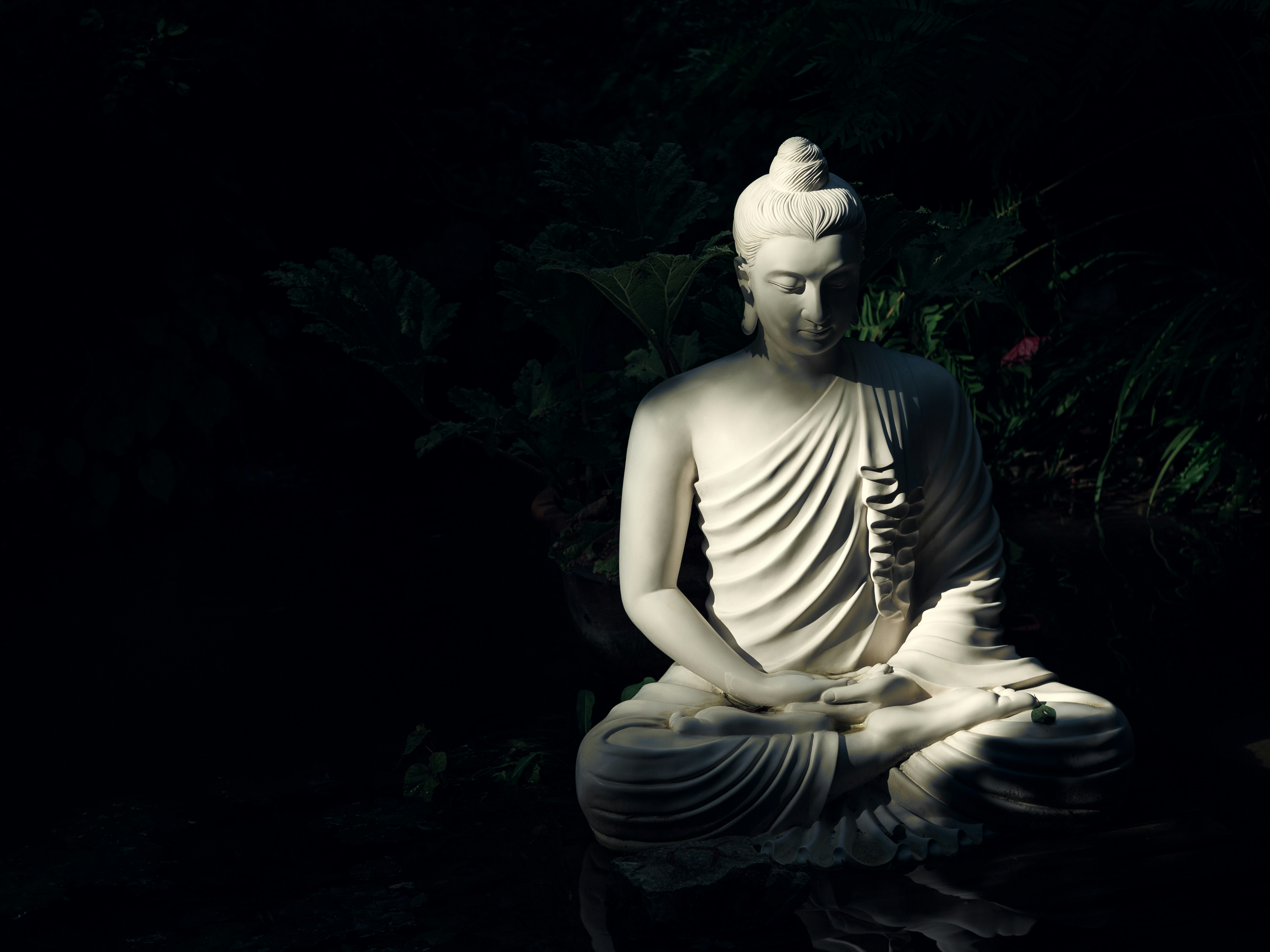
Photo by Mattia Faloretti on Unsplash

Water Bears

Since we should all be busy planning on alternatives to planet earth, my mind has turned to tardigrades. Known as “water bears” these very simple animals are amazingly complex. Don’t go looking for them in your drinking water, however. They’re microscopic. So why am I thinking about tardigrades at a time like this? Because they’re one of the few organisms that scientists believe could actually survive the destruction of the planet. Who knows? They might even be able to survive in Washington, DC. Maybe that’s why they’re in The Washington Post.

You have to look closely to see one.

Able to cling to life at the cusp of absolute zero, in conditions with no oxygen, and at doses of radiation that would leave the human race—among most other species—fried, these micro-organisms are truly remarkable. No wonder scientists are playing with thought-experiments as to how to wipe them out. Hey, scientists are only human after all. Don’t worry—nobody’s really trying to kill these little guys off. The question behind Ben Guarino’s story seems to be what makes these tiny creatures so amazingly resilient. It raises an issue that I often ponder. The will to survive. Evolution is, according to standard theory, without purpose. Natural selection works in a “logical” way: the most successful organism survives long enough to breed and its traits become standard options in the next generation. Nobody needs to want anything (except to mate) and chance takes care of the rest. But that doesn’t explain the will to survive. The “eye of the tiger,” if you will. I’m sure this wasn’t what the Washington Post was intending to trigger, but doesn’t it seem strange that even “non-conscious” micro-organisms “want” to survive?

The desire to exist is dangerous territory. It has a whiff of the divine about it. One of the characteristics of life, if my high school biology isn’t completely outdated, is the ability to reproduce. What it didn’t address, for fear of teenage snickers, I’m sure, is the desire to reproduce. Why does life insist on its own continuation? Is it truly just an eons’ long succession of one-night stands that results in creatures capable of even asking that question? Or is there something more to it? Tardigrades have segmented bodies, legs, and claws. All at less than 40,000 cells per individual. They lack a neocortex (which doesn’t necessarily disqualify an individual from being president). They can’t answer the questions we put to them. As individuals they are remarkably easy to kill. As a species, however, their resilience carries the answers to some very deep questions. If only we had the will to ask them.