
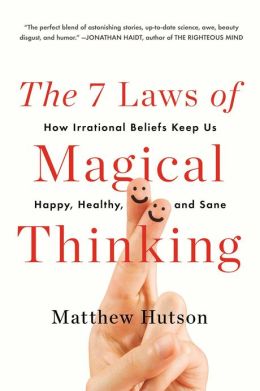
 Magic is everywhere. It may not be real (or it just might). There’s no doubt that Matthew Hutson believes the supernatural has nothing to do with it. The 7 Laws of Magical Thinking is a provocative book in that regard. An atheist who argues that we shouldn’t discourage magical thinking because it is so darned human, Hutson is a rare kind of treasure indeed. The 7 Laws of Magical Thinking begins by pointing out that we can’t psychologically accept what is really real. Reality always eludes us. Our brains are hardwired to accept what Hutson calls magic (including what I call religion). Those who enjoy provocation can take some satisfaction in knowing that either side can add another layer to the shell: physics explains everything, but maybe magic is responsible for making the universe conform to the laws of physics. And so it goes.
Although I enjoyed Hutson’s book–and he’s clearly a gifted writer—I couldn’t help but wonder at a very deep parity between the determinism he believes is really real and the magical view that is implied by such self-help manifestos as The Secret—the things that happen to you are meant to happen. I know, I know—Hutson’s point is that there’s no agency involved in determinism, but my point is that the end result is still the same. You end up where you are. I’m not so sure. Determinism has always left me cold. But since I’m no God I guess I can’t change that, yet I wonder if there might not be something outside this closed system after all. No one can peek and tell.
Neurology may tell us more than we want to know about the mechanics of the brain, but consciousness is reality. Science may some day lay its cold hands on consciousness, but it will always be someone else peering into my head wondering what I’m thinking. I’d have it no other way. I was strangely cheered to note that Hutson ends his whimsical study with a “stab at a secular spirituality” (a good stab, that is—not the malicious kind). I’m sure that many materialists will find such an a gesture as pandering to the masses. I think Hutson is sincere, however. Even the über-rationalists, as he points out in the book, slip into magical thinking and metaphors. It is the human condition. Those who watch Star Trek (original series, please!) know that the most tormented crew member of the Enterprise is Mr. Spock. The rationalist who can’t connect with emotion is a soul in torment. Even if that soul is a myth. The rest of the crew, I am certain, believes in the power of magic.
 Steve A. Wiggins