Getting Medieval

Who doesn’t have a devil of a time keeping up with technology? My day is divided in almost Manichaean terms between having internet access and not. Once I climb on that New Jersey Transit bus—they don’t have restrooms, let alone wifi—I enter radio silence for God knows how long. Once safely ensconced at work, I once again have the net but I can only use it for work. The even longer commute home spells the end to internet access for the day, since supper and sleep await at the other end of the line. So when websites change in the course of a day or two, it’s difficult to keep up. The other day, for instance, I noticed on Wikipedia, in an article about the Devil, that the dark lord has a coat of arms. “That,” I thought, “would make an interesting blog post.”

That idea, like most of mine these days, had to be put on hold until after work. And between after work and getting ready for work again, the delay lasted a week. Maybe two. Then I went back to the page and the reference was gone. I can still remember that the coat of arms had three frogs on it—somewhat unfairly to amphibians, I felt—and I even recall precisely where on the page it was. When I finally had time to look it up, it was no longer there. Cached pages used to be easy to find, but who has time any more? There’s a reason that people of my generation still prefer print books. Yes, there are times when it’s difficult to remember where you read something, but at least the reference is still there when you open the cover again. It hasn’t vanished in a pique of editing enthusiasm. The strangeness of it all was worthy of comment—a coat of arms was a sign of medieval prestige. There’s no doubt that the Devil had his day in the Middle Ages.

I hear about people being bored in retirement. I’m so busy, though, that I’m going to have to request a desk in the afterlife. Not that retirement’s anywhere within sight, but I have so many projects going that I don’t know when I’ll ever have time to finish them all. Even a holiday weekend’s too short to make much of a dent. I don’t need another technologically driven mystery to occupy any more of my waking hours. Looking for a Wikipedia factoid that was deleted doesn’t make it any easier. They say the Devil’s in the details, but that presumes you can find the details where you left them. And if you happen find the reference, can you please also keep an eye out for my car keys?


Deep Web Religion

The bases of truth are ever shifting, it seems. What was once decided by spiritual tests now finds technological solutions. A friend sent me a story from IFL Science (which, surprisingly, often focuses on religion) concerning a nun in seventeenth-century Italy. What makes this nun stand out is less than she had a mental disorder but more that she wrote that it came from the Devil. Her letter, however, was written in an indecipherable script and has only just been decoded. How? By using decoding software on the Deep Web. As someone who’s still lost on the surface web, I’m not sure whether diabolical possession or this mysterious sub-web is scarier. An even more profound question is why someone in this scientific age would resort to the Deep Web to diagnose the illness of a sequestered religious long dead.

Like Manhattan, which, I’m told, has many layers underground, the web has places you shouldn’t go. Computers linked promiscuously together have an amazing power, and apart from those of us who can while away hours looking at photos and videos of cats, there is a darker, more sinister area that can’t be accessed with Google. Down there, according to IFL Science, resides powerful code-cracking software that might be profitably turned to Linear A or Hurrian, but is used to decipher the centuries’ old note of a woman who believed she was possessed. I’m not knocking the achievement. Decades of research have apparently solved the conundrum of the Voynich Manuscript—we can’t stand having the ancient talk behind our backs—and yet try to get funding to hire an Assyriologist at your school. The vast majority of ancient Mesopotamian clay tablets remain untranslated in cellars as dark as the Deep Web.

There seems to be little doubt that Sister Maria Crocifissa della Concezione suffered from some form of mental illness. Even today some psychologists are starting to suggest that “possession” should be considered a viable option for diagnosing some cases that otherwise defy satisfactory resolution. This isn’t medieval superstition, but it is our understanding of a materialistic universe shoved up against a wall. We can’t stand not to know. Mental illness is as old as mentality. We can’t comprehend the vastness of this world, let alone this galaxy or this universe. Even very interesting stuff gets lost on the world-wide web. I don’t even want to think about what goes on in the infernal regions below it.


Flat Devils

Fiction is a framework to approach reality. People are drawn to stories because they help us to make sense of a bewildering world which wasn’t, in reality, custom made for us. Marta Figlerowicz’s Flat Protagonists: A Theory of Novel Character explores the types of characters that modern novelists are taught to avoid. She points out, however, that they occur in great novels beginning from the early stages of the category up through fairly contemporary classics. The flat protagonist, in short, isn’t believable. I’m not enough of a literary critic to judge her examples, but I have been thinking of one such character that occurs in popular culture all the time—the personification of evil. In my reading on writing I’ve learned this is to be avoided. Nobody is pure evil. Popular media begs to differ.

Being of working class sensibilities I can’t separate myself from the lowbrow crowd, I’m afraid. My fascination with Sleepy Hollow is pretty obvious on this blog. One of the recurring themes in the series is the antagonist that is indeed pure evil. Whether it’s Moloch, Death, Pandora, or the Hidden One, those who are evil represent the dark side of humanity, or the universe. They glory in destruction. Of course, in late Judaism and early Christianity this was a role taken by the Devil. As a child I was taught that it was wrong to feel sorry for Satan. This clashed in my head with the idea of forgiveness and with the love of all. Could God not love his (and he was masculine) own enemy? How could we hope to do the same, then?

In the most ancient of religions, as far as we know, evil wasn’t personified. Yes, evil happened, but it was simply part of the matrix of being. Some gods tended toward good while others tended the other direction, but a being of pure evil doesn’t seem to have existed. Even Tiamat loved her children, at least until they killed her consort. The stark black-and-white world of monotheism can’t explain evil without an divine enemy. A flat protagonist, to be sure, but one you can always count on to do the wrong thing. The closest we come to that in real life is the Republican Party. Insidious, sneaky, using every possible loophole to shove their agenda through, they are the perfect flat protagonists. No, I’m not inclined to believe in the Devil. Or at least I wasn’t until November of 2016.


Signs and Portents

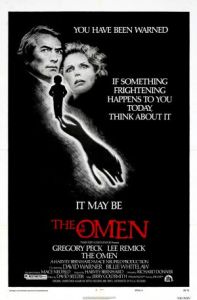
Horror movies are, of course, more than escapism. Although it’s taken many years academics are starting to pay some attention to them. Because of a conversation with a colleague this past week I felt compelled to watch The Omen again. The current political situation merits such viewing, in any case. Interestingly, the first time I saw The Omen—which was during a spate of unemployment—it didn’t scare me much. Like most classic horror, the scenes that had everybody talking in the mid-‘70s had been described so often that they failed to shock. All that was left was a dispensationalist tale of the end of the world—non-biblical, and the fright only came from belief. This time, however, I could see it as nothing but a film about a political takeover.

Omen_ver4

With the open admission on the part of Steve Bannon that his administration—let’s not kid ourselves here—intends to dismantle the government we’ve had in this country since around 1776, we can see that this election was only an excuse. Knowing that this dark side of human nature (some call it the Devil) won’t be given a chance again—they didn’t win the popular vote this time around and unless they silence the media they won’t win the next one—Bannon’s crew, like Damien, has to deconstruct quickly. The Republican establishment, unless it opens its eyes soon, will find itself locked outside as well. Ironically, it’s the public that can see this, not the elites. It’s as if George III were back from the grave. Power, as The Omen intimates, is incredibly seductive. The GOP, wrongly supposing it will share it, goes along with nominations that have now been openly declared agents of destruction. Where is Revelation when you need it?

The Omen is all about Satan getting a back-door entry to the White House. The politicians are all easily duped. Evangelical Christians have been brainwashed into thinking that only by voting Republican can they prevent abortion and gay marriage—two decidedly non-biblical issues. You see, the Devil works that way. Scripture says he can disguise himself as an angel of light. People who don’t educate themselves are very easily fooled. We’ve followed the script rather precisely. Satan’s greatest tool, it’s said, is that people don’t believe in him. So after you finish reading 1984—which we all should—watch The Omen. Ponder what inviting evil to take over the one remaining superpower might really mean.


Looking for Light

The one problem with Halloween is that most people suppose that when it’s over we need to wait another year for the scary stuff to come around again. Since we tend to skip from holiday to commercialized holiday, we have a capitalism-induced mindset of Halloween—brief pause for Thanksgiving—Black Friday—Christmas, spending money all along the way. Halloween, however, is a marker that stands near the beginning of half the year. The half with short days and long nights. Traditionally the holiday associated with ghost stories was Christmas, which falls near the shortest day of the year. Once the light starts creeping back, however, we tend to find reason to be optimistic that the chill can’t last forever and light follows darkness just as surely as life ends in death. All of this is prologue to say that a friend recently sent me a story about Irish witches which got me to thinking about origins once again.

The story, a piece called “Witches of Ireland,” by James Slaven, tells a few tales of Hibernian lore involving witches. As I read the article I was thinking about the origin of witches. Some of the phenomena associated with witches parallels that associated with demon possession—contortion, spitting up needles and nails, even levitating. There is a complex of ideas here that revolves around unseen forces that are categorized as evil. We tend to think the Enlightenment opened the door and shed strong sunlight into the closet, but that’s only true for half the year. The other half we’re mostly in the dark.

Pondering origins, I wonder where these associations began. We have no “histories” to tell us whence these ideas arose. Witches and demons both had, in Christianity, associations with the Devil. That connection doesn’t apply in other religions which, I suspect, is where the origin of many tales of witchcraft lie. You see, the Christian god is a jealous fellow—it says so right there in the Good Book—and displays of power over nature that most good monotheists lack will always be suspect. Perhaps we need to pay more attention to our pagan forebears.

Source: www.imagesfrombulgaria.com; perspective- and color-adjusted by Martha Forsyth (Wikimedia Commons)

Source: http://www.imagesfrombulgaria.com; perspective- and color-adjusted by Martha Forsyth (Wikimedia Commons)

These are merely nighttime thoughts, written in the dark. Already I begin to see the sun rise as I reluctantly trudge eastward across the island of Manhattan. I welcome the longer days, but somehow I strangely miss the comfort of the longer nights of yesteryear.


The Grammar of Evil

I stepped into a devil of a situation. Elevators are strange spaces. Given the choice, I’ll take the stairs any time. At work, however, as one of the many quirks of Manhattan, our elevators only stop on certain floors and we’re not able to use the stairs unless it’s an emergency. After a meeting on a floor where the only option was to elevate out, I stepped into a crowded elevator where a conversation was going. “You always capitalize Satan,” someone was saying. The usual questions among non-religion editorial staff ensued. Why is that? What about “devil”? “It’s never capitalized,” came the reply. My profile at work is about the same as it is on the streets of New York. Not many people know who I am or what I do. Although I’ve struggled with this very issue before, on a professional level, I kept silence and waited for my floor.

So, was the elevator authority right? “Satan” has become a name, rather along the lines of “Christ.” Both started out as titles. In the Hebrew Bible “satan” is “the satan.” The accuser, or the prosecuting attorney—something like that. As one of the council of gods, the satan’s job was to make sure the guilty were charged of their crimes. Diabolical work, but not evil. By the time of early Christianity, however, Satan had evolved into a name. It is therefore capitalized. It was specifically the name of another title, “the Devil.” Or is it “the devil?” Do we capitalize titles?

The Devil wears underpants.

The Devil wears underpants.

In seminary and college the received wisdom among those of my specialization was that there is only one Devil and the title should be capitalized. My elevator colleagues were discussing the number of devils when I stepped out. Traditional theology says there’s only one. Not that the Bible has much to say about the Devil—he’s surprisingly spare in sacred writ. Demons, however, are plentiful. Some people call demons devils, just as many believe that when good people die they become angels. The mythology behind demons seems to be pretty well developed in the biblical world, but again the Bible says little. Demons can be fallen angels or they can be malign spirits who cause illness. Either way they’re on the Devil’s side. But should we capitalize his title? The Oxford English Dictionary doesn’t help, giving examples of both minuscule and uncial. I suppose that’s the thing about the Devil; you never really know where you stand.


In the Details

To a certain mindset, nothing conveys a threat quite like Satanism. Many parts of the world witnessed this dynamic during the “Satanic scare” of the 1990’s. In reality, however, most groups identifying as Satanism do not believe in a Devil and, often enough, don’t engage in worship. These groups are a reaction against aggressive Fundamentalism. For example, a Washington Post article timed as parents (at least) are thinking of back-to-school worries, announces “An After School Satan Club could be coming to your kid’s elementary school.” News headlines are intended to make you want to read a piece, and this one worked in my case. It turns out that the Satanic Temple, the group behind this current initiative, is one of those rationalist groups that doesn’t believe in the Dark Lord. They object, however, to schools allowing Good News Clubs to meet after school hours and want to make a point by offering alternative programing. Devil-themed, but not Devil-believing.

It’s difficult to imagine this kind of situation developing in many world cultures. It raises some very basic dilemmas where two conflicting freedoms co-exist: freedom of speech and freedom of religion. Most people would agree, upon reflection, that public schools should not be used for religious instruction. After school programs, in the minds of kids, still take place “at school” and are not easily separated from regular instruction. (Just ask an undergraduate what an adjunct instructor is and you’ll see that they pay little attention to administrative issues like that.) Fundamentalist groups, such as Good News Clubs, use freedom of speech as their wedge to offer after school programs. It’s not “school,” and it’s after hours. Don’t we allow freedom of speech, and isn’t there space available? Good News Clubs are, of course, evangelistic engines. The Satanic Temple makes the claim that if one religious group can meet after school, so can another.

Neither academics nor society have a good understanding of literalist beliefs. Those of us who once believed—sincerely believed—Fundamentalist teachings are a resource academia has chosen to ignore. Higher education is still an “old boys network” where jobs are offered on the basis of who you know and not on the basis of the knowledge they might offer to students. This, I suppose, is yet another clash taking place. Fundamentalism may seem laughable from the outside, but from the inside the untenable beliefs are taken with deadly seriousness. After school programs are an expression of a very deep-rooted fear that such religions promote. Satanist groups will get headlines by taking them on, but they will continue the conflict rather than offering dialogue to try to understand. They’re only doing what higher education teaches them to do—support those you like instead of trying to move knowledge ahead. Perhaps that’s the real work of the Devil after all.


Joban Vampires

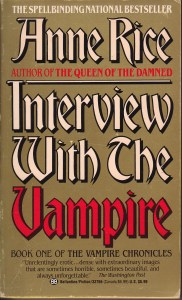
Interview VampireThe first vampire novel I ever read, I remember correctly, was one of the Dark Shadows series written by Marilyn Ross. I don’t recall which one, since I had to buy my books from Goodwill or some such vender utilized by the poor. Now, I’m really a squeamish guy and the sight of blood bothers me. Barnabas Collins, however, was a compelling character—deeply conflicted and a reluctant vampire. The combination of his sadness and the setting in coastal Maine kept me looking for Dark Shadows books every time we went shopping. It surprised me, given all that, that I had such difficulty getting into Anne Rice’s Interview with the Vampire. I started reading it years ago (it was also a second-hand copy, and, interestingly, the color scheme of the cover nearly matched Dark Shadows novels) and some eighty pages in put it down only to forget about it. Starting from the beginning a few weeks ago, I gave it another try. Although Louis is a conflicted vampire, the pace is languid and it was almost as if the self-pity was overdone. I was determined this time, however, to see it through.

One of the recurring themes of the book, and I presume the Vampire Chronicles series, is that vampires are not evil because of the Devil. In fact, there is nothing Satanic about them. Blame tends to fall on God for their state. The more I thought about it, the more the theodicy of the vampire began to resemble that of Job. Like Job, death for a vampire takes a long time. There is much suffering along the way. Louis can love, in a measure, and can loath himself. He never really understands what it is to be a vampire. The other undead he meets help to define him, but he can’t get too close. His life is a kind of Hell without Satan.

Rice’s vampires don’t fear crucifixes or shun churches. In fact, Louis takes a priest as one of his victims, sacramentally near an altar in a church. Religious imagery and discussion abound in the book. It truly is a vampire theodicy. Perhaps, for its day, it was the next step in vampire evolution. Bram Stoker, while the most famous contributor to the modern vampire myth, didn’t corner the market on defining the undead. When Louis meets vampires of the old world, they are mindless, plodding killing machines that even other vampires avoid. Rice’s vampires feel, think, and yes, theologize. I feel strangely satisfied now that I’ve finally finished the Interview. It was a vampire at my bedside for so long that it feels like an accomplishment to have finally laid it to rest.


The Devil Made Me

TheWitchesWitch-hunts, I suspect, will become all the rage again if a certain presidential candidate is elected. The fear of witches is not easily explained in a world driven by materialism, but certainly misogyny plays an unholy role in much of it. Stacy Schiff’s The Witches: Salem, 1692 has been selling well. Since my wife is one of the many descendants of the Towne family that suffered three witch accusations resulting in two executions (Rebecca Nurse, Mary Esty, and Sarah Cloyce) we read this book together. It is a detailed account of the year we went mad. A year when being different, especially not being Puritan, and not being male, was dangerous. Religious tolerance was not a gleam in the colonists’ eyes since religious freedom translated into not being forced into the government church, not allowing others the same privilege. Indeed, as Schiff points out, religious tolerance was considered by many to be a satanic idea. If ministers starved due to such freedom, it would be easy for Satan to take over. As it was, the Dark Prince seems to have done a pretty good job among the Puritans without such tolerance.

The idea of the Devil has been (and still is) the ultimate scapegoat. People in a capitalist society are naturally frustrated—surprisingly few see this—and frustration always seeks a reason for its own existence. That is patently clear at Salem: blame the Indians, blame the French, blame the Quakers, blame the women. Any and all may be agents of the Devil. Even the descriptions of the Lord of Darkness varied so much that, were he a human, no one could be quite sure who it was they saw. The Devil always takes the form of your enemy. All it takes is an influential clergy willing to push tense believers over the edge. Soon we begin building walls. Then we build gallows.

Religious tolerance has always been a frightening thought. Protestantism challenged a somewhat uniform Catholicism and the mite of a doubt burrowed deeply into peoples minds: is my religion the wrong one? Tolerating other religions means admitting that yours might be wrong. The logic that plays itself out is a terrifying one to some. Belief is never easily changed. States can’t stand dissenters. The only capital crime for which the federal government still executes citizens is treason. Treason sits uncomfortably on the other side of the coin whose obverse reads “tolerance.” You’d think that three centuries would be long enough to learn something. Unfortunately some lessons—often tragic ones for the powerless—have to be played out over and over before we start to comprehend that Satan can be anyone we want him to be.


Footprints in the Snow

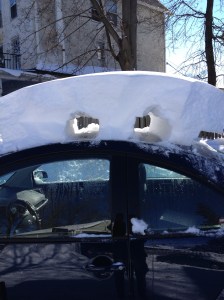
A friend keenly aware of my interest in the unusual sent me a story about the “Devil’s Footprints” that sometimes occur in snow. The article focuses on an instance in England in 1855 but which was reprised in 2009. The prints, made by a bipedal, cloven-hoofed animal, surmount tall barriers and occur on rooftops as well as on the ground. Such a phenomena is not limited to England. Associated with the Jersey Devil, similar unusual trails were reported during the flap of sightings in the early part of the last century here in New Jersey. As the piece on Mental Floss states, this is most assuredly not diabolical work, but it does make me wonder why people associate the unknown with the Devil.

IMG_2654

As a character in world religions, the Devil can trace his (and, like God, he is almost always a male) origins to the Zoroastrians. Zoroastrian theology is a dualistic outlook: ultimate good versus ultimate evil, Good God versus Bad God. The idea synced particularly well with the burgeoning of apocalyptic thought that hovered in the air during the time that the people of ancient Judah came into contact with Persian thinking. The idea was toned down, of course, to a being with lesser powers than God, but still a real foe with which to contend. By the time of the New Testament, the Devil was ensconced and associated with the Persian accuser known by the title of “the Satan,” or the divine prosecuting attorney. How this character came to be associated with strange footprints in the snow traces an odd trail indeed. The key is the cloven hooves.

No description of the Devil exists in the Bible. The best evidence suggests that the horns, goatish bottom, and cloven hooves come from an association with the Greek demigod Pan. Why Pan was singled out as a particularly bad god is not known. He was popular in ancient Greece. It is certain that the Jews of Jesus’ time would not have recognized a cloven hoofed beast as devilish. The livelihood of too many relied on sheep and goats. Once the transformation took place in the imagination, unexplained cloven footprints appearing in the night suddenly became those of the Devil. As Stacy Conradt points out in her Mental Floss post, several suggestions have been made for creatures of the natural world and their snowy markers. We don’t know what makes the footprints, however, and winter is all the richer for it.


Who the Devil?

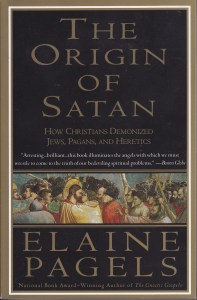
OriginSatanThose who’ve studied the history of ancient West Asian religions know that the concept of a devil, as a character, derives from Zoroastrian origins. In Zarathustra’s dualistic worldview, the forces of evil were concentrated in an “anti-God,” who, upon contact with the emerging monotheism of ancient Israel, became the satan. While scholars still argue about exactly what the role of the satan was, it is clear that it was a role, and not a name. The job of the satan was in some way to bring to accounting wicked deeds. By the time of the New Testament, “the Devil” had developed into an embodiment of evil more along classic Zoroastrian lines. What Elaine Pagels explores in The Origin of Satan is encapsulated in her subtitle: How Christians Demonized Jews, Pagans, and Heretics.

This is not a book about the historical development of the figure of Satan, but rather a study of how early Christians (and to an extent, Jews) viewed “the other.” Naturally she does discuss Satan, who developed along the lines suggested above, but more specifically she addresses how the accusation of being “of Satan” was used. Interestingly, it was generally utilized by those of ancient times to describe those of their own religion, but who held different viewpoints. Sects of Christianity and Judaism generally accused other sects in their own religious tradition of being “satanic.” Foreigners and pagans, well, what would you expect of them anyway? Those closest, ironically, are those most despised. Even early converts to Christianity from Roman polytheism tended to view their former religion as satanic. Satan, in other words, is “the other.” But not the far other. The near other.

While the book is full of Pagels’ usual erudition, it is also disappointing. Not as a book, but as a fact. Religions that claim God only wants us to love one another and treat each other well rely too readily on the figure of personified evil to castigate their enemies. As Pagels demonstrates, even as early as Augustine of Hippo there were those who realized Satan was not a “physical” being, but a symbol for evil. Yet on through the Middle Ages Satan would continue to be evoked to murder women and men thought to be witches or heretics. Satan, it seems, is simply a word for our darkest urges to harm those different from ourselves. We know that religions often have noble intentions. Perhaps the most noble could be to rid the world of Satan, and I don’t mean the mythological figure we all recognize without a hint.


The State Demon

It’s the time of year for seeing things. I suppose that’s why there have been two supposed sightings of the Jersey Devil flying around the internet this past week. The credulous take these kinds of things for evidence, and the posters claim complete sincerity and who doesn’t want to believe? Still, the photos and videos fail to convince. It’s the time of year when we want to see monsters.

DSCN0128

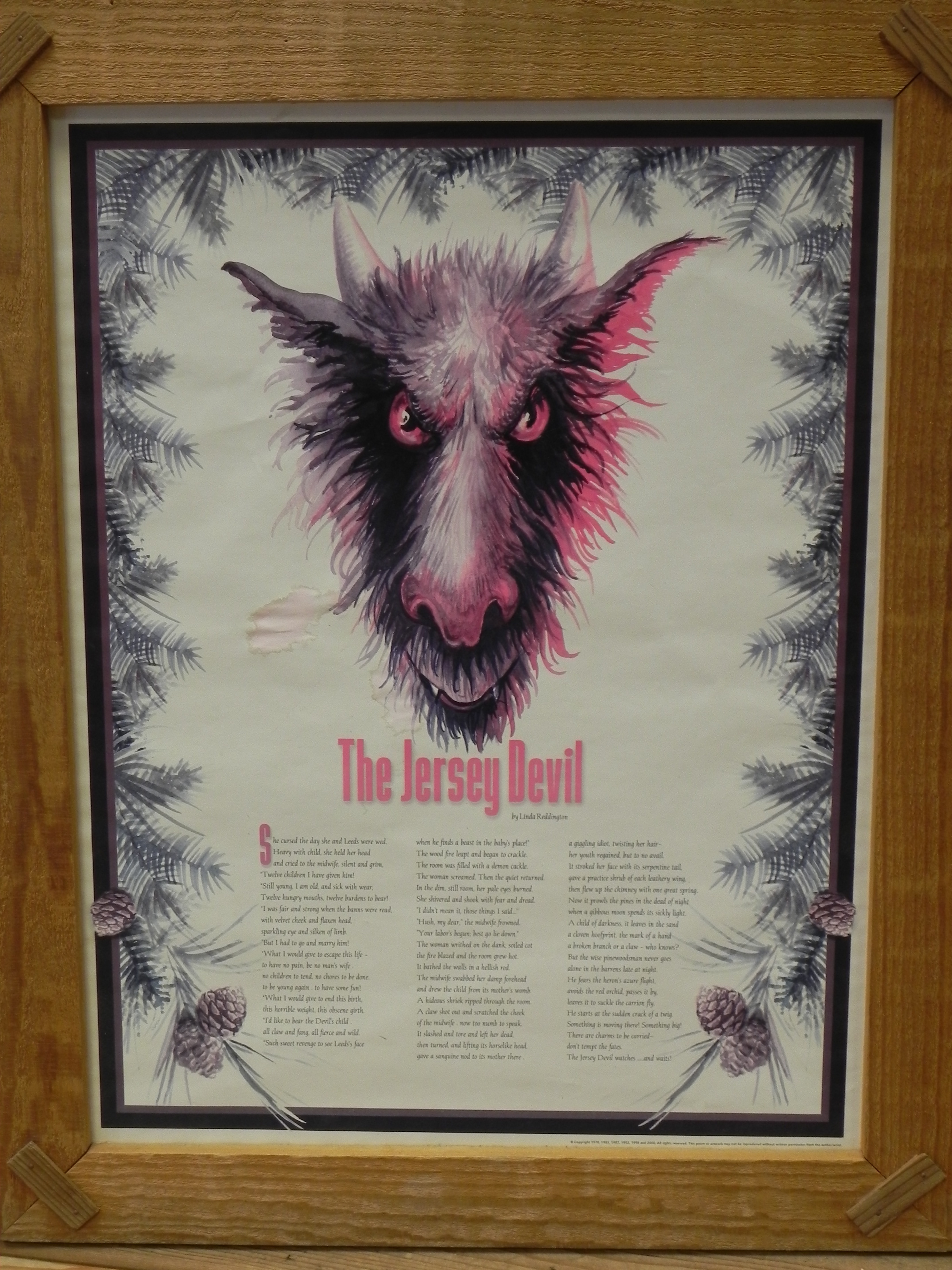
While the origin story of the Jersey Devil is one of the main strikes against it for sheer impossibility: Mother Leeds, who had twelve children, finding herself pregnant with a thirteenth, wished that it would be born a devil. The cursed child, meeting motherly expectations, came out a devil, flew up the chimney, and has haunted southern New Jersey ever since. The folklore elements are thick in this tale: the thirteenth child, the exasperated mother, devils in the woods. This doesn’t, however, suggest much confidence in the literal truth of the story. This traditional tale circulated in the same region where legitimately strange things were seen, especially around the turn of the last century. Every now and again the devil reappears in a present-day venue. At one time the Jersey Devil was even the official state demon of New Jersey.

The ease of use of photo-altering software has taken us further and further from the truth. It is an impoverished world that has no mystery to it, but the easily hoaxed world of Photoshopped monsters will cast doubt on all contenders, I fear, forevermore. We can no longer trust the veracity of the lens. Our world has become an electronic illusion. The creature spotted in the Pine Barrens can be more readily believed without photographic proof. The sober, shaken witness who can’t explain what s/he saw one dark night is more believable than a goat with wings or a stuffed animal on a string. Our religious sensibilities urge us to believe in the impossible. Our cameras urge caution. After all, internet fame is often the only kind available to those whose videos and photos go viral. The devil, they say, is in the details.


Devil’s Food

One figure among the standard repertoire of Halloween characters has never appeared on my list of favorite monsters. I suppose it may be because as a child I fervently believed there was a devil that he never made my A-list. Satan was real, according to my church, in some almost biological, corporeal form. Even as a youngster I knew vampires, werewolves, Frankenstein’s monster, and the rest, really didn’t exist (even after I hid under my covers all night once, after putting my head down on a bat that had flown into my bedroom). The devil was, however, biblical. And I never felt tempted to dress up with red horns and pointy tail, carrying a plastic pitchfork. Halloween was always among my favorite holidays, but it was for pretend monsters and ghosts (which might perhaps be real, but which were not diabolical, according to my childhood economy of the spiritual world). The consequences of devil imitation seemed eternal, and even today, in the rational light of the twenty-first century, I can still be given pause even though I know the concept is a Zoroastrian one that morphed into early Christianity’s need for a kind of anti-Christ.

IMG_0276 copy

There are many who still believe in a real devil. Some branches of Christianity (and Islam) teach that a literal devil lurks about in our world. In western culture he is a figure instantly recognizable, although there are differences of opinion in his anti-iconography. Last weekend I visited a fine little restaurant in a New Jersey town that has a reputation for being haunted (the town, not the restaurant). It was a seat-yourself day and the table my wife and I ended up selecting had shellacked cards on top as part of the decoration. There in front of me was the devil. I pondered this. The cards, all captioned in Spanish, had mundane subjects: an umbrella, a musician, plants, a spider (okay, so that last one’s a little scary too), but only one supernatural figure. Perhaps the entire deck, had I seen it, might have had more. No doubt, for a world that postulates a good God, a devil covers, well, a host of evils.

The word “devil” is somewhat loosely applied these days. New Jersey has its own cryptid called the Jersey Devil, which has led to iconic names for sports teams and perhaps a public official or two. But even in the aftermath of 9/11 there were those who seriously postulated seeing the face of the devil in the tumbling debris of the twin towers. For a character of the religious imagination, the devil has managed to impress deeply on the human psyche. I know in my rational mind that I should simply dismiss all of this and get on with the business of enjoying the monsters that will show up at my door later this week. Nevertheless, when the waiter comes out with our food, I look down at the table and decide to pass on the hot sauce for today, just in case.


Write the Truth

XalliopePublication is a tricky business. Just ask my friend, K. Marvin Bruce. Marvin and I have known each other for years as he’s been trying to break into fiction publishing. I don’t envy him. His novel, Passion of the Titans, was under contract with an indie publisher who eventually reneged on their agreement. What can you do? As a supporter of publishers you don’t want to sue, so the novel is floating around again, looking for a home. Meanwhile, I was flattered to receive in my mailbox a copy of Calliope magazine. Calliope is published by the Writer’s Special Interest Group of American Mensa, Ltd. Marvin’s story, “Initiating an Apocalypse,” won third place in their fiction open. Not only am I pleased for my friend, but I was glad to see his story was about gods. Zoroastrianism doesn’t get much attention these days, but Marvin’s tale is about a hapless professor who wants to start an apocalypse by using Zoroastrian deities. I won’t give any spoilers since I’m sure few people have read the story.

His tale has me thinking of gods in fiction. I suppose mainstream literary fiction avoids deities, but fantasy, science fiction, and horror all make good use of them from time to time. Neil Gaiman’s American Gods made quite a splash, and although Marvin has no hope of becoming a widely recognized name, his novel also features gods. It is a literary incarnation. We like to see gods in some ways limited to human circumstances. Omnipotence rarely makes for a good plot. In many respects the Bible attests to this. If God is omnipotent (which is not a claim the Bible actually makes) why can’t the world be a happier place? Indeed, the solution most fondly groped by theologians is either free will or a version of the Zoroastrian solution: a god who is evil. Enter the Devil.

The Devil is also undergoing a kind of literary renaissance. We find a plethora of books and movies starring the prince of darkness. Despite the panegyrics of rationalism delivered by angry atheists, nothing salves the human soul like a good supernatural entity. Fiction writers have long recognized that. Gaiman was not the first to make the gods do his bidding in literature. There is a likelihood that even Homer knew the appeal. Many people can accept that gods might exist, and they certainly don’t object to stories in which they cavort. Fiction, as literary analysts know, teaches us about reality. The characters may not be literally true, but the fact is that in our minds there is still plenty of room for gods. And, if you one of the rare ones to read Marvin’s story, you’ll see that, true to human experience, deities don’t act as we expect them to. Savvy publishers, it seems to me, would do well to recognize the appeal of the gods.


Rosemary by Any Other Name

Rosemary

With NBC’s remake of Rosemary’s Baby into a mini-series in the news, I sat down to watch the original again. I’ve blogged about it before, but with most available funds being diverted to college, watching new movies will be a rare treat for some years to come. Besides, the original is a mishmash of religious ideas that despite their lack of coherence still leave the viewer somewhat disturbed. Since the last time I watched the movie, I’ve read several books on witches and have come to recognize the strange brew that Roman Polanski concocted for public consumption. Reaching back to the myth of diabolic witches, the original movie presents such witches initiating a new world by literally spawning Satan on a woman whose name is based on the mother of Jesus and who will ultimately care for the helpless little devil. The viewer, despite the knowledge that Rosemary is carrying evil incarnate, still sides with the vulnerable, pregnant protagonist. It’s the end of the world as we know it.

I’m not sure how you make a miniseries out of this thin plot. I suppose a nine-month pregnancy would lend itself to slow development, but haven’t we grown a little too old for witches and devils? In fact, Wicca is now a recognized religion in much of the industrial world, and the devil’s been on the run for decades. Religious movies, or at least movies based on religious themes and characters, are perennially popular, however, no matter what the secularists tell us. And why not open a series about pregnancy on the weekend of Mother’s Day? Nothing stirs the emotions like putting a young mother at risk. That’s perhaps the insidious side of the original movie—we silently side with the devil.

Rosemary is, of course, manipulated by her husband with the everyman name of Guy. This isn’t in any sense his child and, like any businessman, he stands to gain enormously from someone else’s labor. Exploitation is the cost of the continuation of the human race. It doesn’t take much to figure out that we’re watching a parable here. After all, the Time magazine cover asking if God is dead makes a cameo in Dr. Saperstein’s office. And the setting in Manhattan clues us in from the beginning that this is the place were many millions are asked to make a few very rich. There is a witchery in New York, and for those who know how to look, the devil may be found in the details.