Too Close?

What with the US Navy admitting that UFOs are real and all, it seemed like a good idea to watch Close Encounters of the Third Kind over the holiday weekend.  Like many of my generation I saw it in a theater—itself kind of a distant memory—back in 1977.  I’m not sure why it’s been on my mind lately, but since it’s a long movie it takes a long weekend to accomodate it.  As we settled down to classic Spielberg scenes—lots of khaki and crowds and desert locations—it was a reminder of how silly we all looked in the seventies.  (What were we thinking?)  Other than that the film has aged pretty well.  The plot, although not action-packed, is probing and has several moments that seem to have inspired Poltergeist.  What made the film blog-worthy at this time, however, was the wearing of masks.

When Roy Neary and Jillian Guiler arrive at Devil’s Tower the governmental cover-up is in full play.  A nerve-gas leak—and who can check out whether such a thing really happened?—has a mask-wearing restriction in place.  I wondered where one could get a gas mask today when the crowd scenes of the pandemic won’t even leave a roll of toilet paper behind.  Checking for rubbing alcohol to make homemade hand sanitizer I found it selling for $300 per gallon on Amazon.  Where are we going to get a gas mask in circumstances such as these?  That particular scenario never really stood out to me before although I’ve seen the movie many times over the years.  Back when I was a student at Boston University the school tee-shirt worn by Barry Guiler was the interesting cultural context.

Films that survive the years take on different aspects over time.  Some suggest that a branch of the military admitting to the reality of UFOs during a pandemic was intended to underplay the event.  Others have argued that a similar release of information many months ago received similar lackluster interest.  If there are aliens out there, I have trouble imagining that they’d travel all this way for a synthesizer concert at a national monument that received a major uptick in visitors due to the movie’s release.  Maybe we love our fictional aliens more than the possibility of meeting those that seem to be vexing our navy?  The movie was the right choice for the circumstances, it seems to me.  Some things about the seventies are worth revisiting from time to time.  Strangely, in retrospect, life seemed simpler then.


Close Commandments

Okay, so I’ll admit that Jeffrey Kripal’s Authors of the Impossible put me in the mood for Close Encounters of the Third Kind. Watching this movie always calls for an investment of time and some emotional energy since it does drag a bit and there are some ponderously majestic scenes that simply make me want to scream. As I powered up the old DVD player this weekend, however, I received an epiphany while watching the movie for the first time in years. Early on during Richard Dreyfuss’s breakdown, the kids (incongruously) gather around the television with excitement to watch the Ten Commandments. The reason, clearly, is that they want to stay up late, and even having to watch Cecil B. DeMille’s warhorse is an adequate excuse. I’ll admit that it was one of my motivations for watching the lush, but equally dull, Ten Commandments as a child. Yes, I took it to be a pious attempt to render God’s literally true memoirs into celluloid, but its 4-hour running time did promise to keep me out of bed until after ten.

Young Moses experiences a theophany.

As my wife and I watched Close Encounters over the weekend, I realized for the first time that much of the cinematography is based on the Ten Commandments. Dreyfuss is a visionary, a prophet, if you will. He is drawn to a sacred mountain (Devil’s Tower) where, like Moses, he makes his way up and down, unable to decide whether to enter the divine presence or not. One of the pacing problems in the book of Exodus is the mental image of an 80 year-old Moses laboriously making his way up and down Sinai as God sends him on various errands. I imagine the children of Israel having time to cast a whole herd of golden cattle. As the UFOs make their grand appearance somewhat near the end of Close Encounters Roy Neary (Dreyfuss) and Jillian Guiler climb the mountain, see the theophanic display, and start back down. Only to go up again. On their way to Devil’s Tower they drive by several dead animals, like those struck down in the fifth plague of Exodus. The army forcing the people out of the area is itself an exodus. The return of those kidnapped by the aliens is a kind of letting go of those held captive. Apparently the Egyptians and aliens have a long history anyway.

I have no idea if Steven Spielberg was intentionally modeling Close Encounters on the Ten Commandments, but corollaries are clearly there. 1977 had not yet witnessed the decline of Erich von Däniken’s star, catapulted into orbit by Chariots of the Gods? where once again we find God driving spaceships and giving the Egyptians a hand with those pesky pyramids. Even the surnames of the characters seem to be a play on their biblical roles. Roy Neary, the one who draws near to God, the only one selected to literally ascend to heaven at the end, and Jillian Guiler, whose suspicion keeps her earthbound with her son Barry, who bears an eerie resemblance to the childlike aliens whom he befriends. Berry is the movie’s Joshua, the one who will keep the faith alive for the next generation. The story came to Spielberg, according to the media, when he saw a meteor shower in New Jersey as a youth. I missed last week’s meteor shower in New Jersey, and my baby ark on the Nile never sailed.


Mystery of Mystic

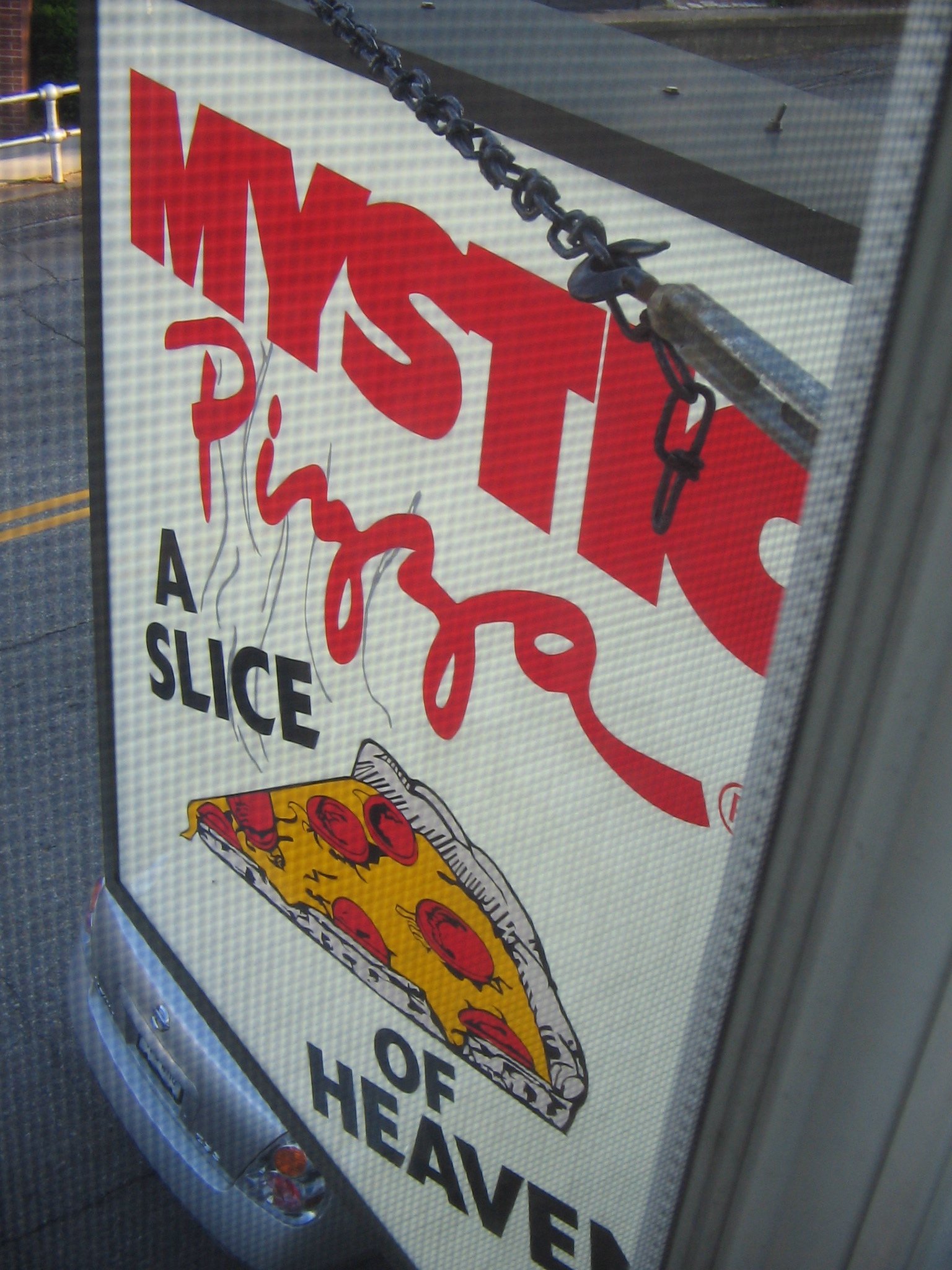
Ever since my school days at Boston University, even before a movie made the town famous, I wanted to visit Mystic, Connecticut. Perhaps it was the draw of the name that evoked foggy harbors and suggested the possibility of some kind of enlightenment. Perhaps it was because Mystic is near the gray waters of the north Atlantic that so captivate me. Perhaps because I am innately attracted by the sense of place. Whatever the reason, since we needed a break from my perpetual quasi-unemployment and my wife’s demanding hours, we have come to Mystic at last. Since traffic was exceptionally heavy, we haven’t had a chance to explore much beyond Mystic Pizza, now an iconic stop for all visitors.

She wasn't there

Curious about the name with its quasi-religious overtones, I tried to find in the town’s literature some hint of its origin. Nobody knows for sure. Like many “American” toponyms, however, Mystic likely derives from native American roots. The suggestion has been made that it means “great river whose water is driven in waves” (missi tuk). To the colonial ear ever alert for religious significance, this may have become “Mystic.” The true origin of the name may never be known.

Religious enthusiasm among early European colonists and their scions further west often inspired quasi-spiritual toponyms. Devil’s Tower and Devil’s Lake (Wyoming and Wisconsin, respectively) had no associations with the dark lord, but rather were locations of spiritual significance for the native populations. Grasping for a way to express this, the best evangelical Christianity could come up with was “Devil.” At least Mystic sounds much less diabolical. As we explore this town I will, by dint of natural disposition, keep an eye open for the religious implications. If I, perchance, uncover the true origin of the name, my readers will be the first to know.


Devil Went Down to Jersey

I have to confess to being a fan of Weird NJ. For those of you not fortunate enough to live in New Jersey, Weird NJ is an unconventional travel-guide published twice a year, celebrating the strangeness of the state. Ironically, I discovered Weird NJ while living in Wisconsin. I was attending the 150th birthday celebration of a couple of friends (combined ages, not paranormal!) where one of the gifts was the then recently published Weird Wisconsin. After the original magazine had caught on, books about individual states were commissioned and this was the first one I’d encountered. My wife knows that look in my eye, so on my birthday that year I had my own copy. Even though it is written for a decidedly non-academic readership, I learned more from it than most textbooks I’ve read. When New Jersey loomed large in our future, I added the book version of Weird New Jersey to my growing collection and soon came to rely on it as a repository of local folklore and interesting places to visit.

Thanks to Matt for permission to use his art, see Matt Can Draw for more!

(Thanks to Matt for permission to use his art, see Matt Can Draw for more!)
This short flight of fancy relates to religion in a very decided way. Within the pages of these publications many locations (popular with teenagers, I’m guessing) bear the moniker, “Devil’s —“ where the space may be filled by any number of nouns: Footprint, Kitchen, Pit, Pathway, Tree, or even Tea Table. This decided interest in naming places after the dark lord seems whelming, even for New Jersey, home of the infamous Jersey Devil. The need to have an evil entity to explain the darkness in our lives is very powerful. Certainly it is not limited to New Jersey as the well-known examples of Devil’s Tower, Devil’s Lake, and Devil’s Postpile attest (although mistranslation may frequently be responsible). Those cultures bound by a monotheistic outlook mark their fears with the Devil.

A relative latecomer to the Bible, the Devil had not been available for earlier attributions of evil. Thinkers of the pre-diabolical period reached widely varied conclusions as to who or what caused the troubles they experienced. Some blamed God while others simply accepted the vicissitudes of circumstance. (Then again, they didn’t have New Jersey as a frame of reference.) Once the Devil entered the picture, the problem of good and evil took on a sharper focus. That sharp distinction, however, frequently belies human experience where issues and situations are seldom as clean cut as they seem.