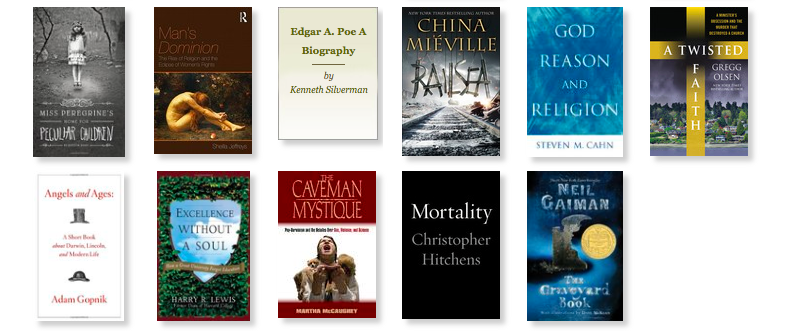
2013 in Books

Screen Shot 2014-01-05 at 6.03.10 AM

According to goodreads.com, I read 83 books in 2013. The beginning of a new year seems a good time to assess what is memorable among the reading material of the previous twelve months. I am an eclectic reader: this informed my research when I was teaching in higher education—nobody can know everything, and it doesn’t hurt to keep an eye on what fellow researchers in “unrelated” areas are doing. I always throw in a healthy dose of novels as well. Among the novels, some of the most profound were those written for younger readers (each of the books discussed here, by the way, can be found discussed in more detail by selecting the category “books” at the right on this blog). Neil Gaiman’s The Graveyard Book, Ransom Rigg’s Miss Peregrine’s Home for Peculiar Children, Suzanne Collins’ The Hunger Games, and Markus Zusak’s The Book Thief all stand out as particularly profound. They are all, as young adult books tend to be, stories about coming to terms with the adult world. The theme of death weighs heavily in all of them. In none do the children take refuge in religion.
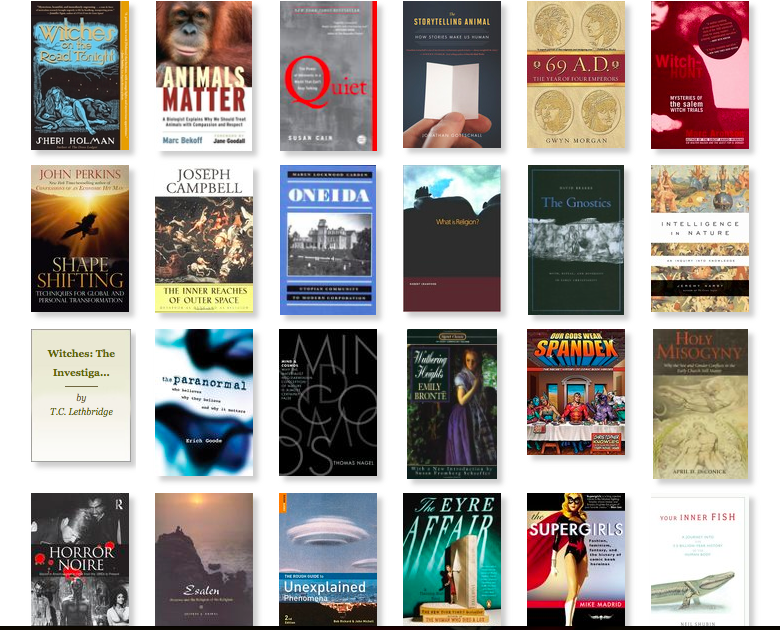
Screen Shot 2014-01-05 at 6.02.33 AM

Among the non-fiction offerings, revisiting my most memorable also reveals trends, I think, in how religion might be usefully applied to an increasingly secular culture. It is no easy task to choose favorites, but I see that I read three books about comic books: Mike Madrid’s The Supergirls and Divas, Dames, and Daredevils, and Christopher Knowles’ Our Gods Wear Spandex. The work of Jeffrey Kripal started me on the quest of taking superheroes seriously as sublimated religious figures. Clearly that is the case, as has become increasingly apparent in top-grossing movies. Another set of books (Thomas Nagel’s Mind and Cosmos, John Angell and Tony Marzluff’s Gifts of the Crow, and Curtis White’s The Science Delusion) highlighted some of the deeply rooted flaws of a materialist reading of the world, whether they intended to or not. Robin Coleman’s Horror Noire, and Susan Hitchcock’s Frankenstein indicated that monsters are among the most eloquent of social critics, even when they have little to say. I would recommend any of these books without hesitation.
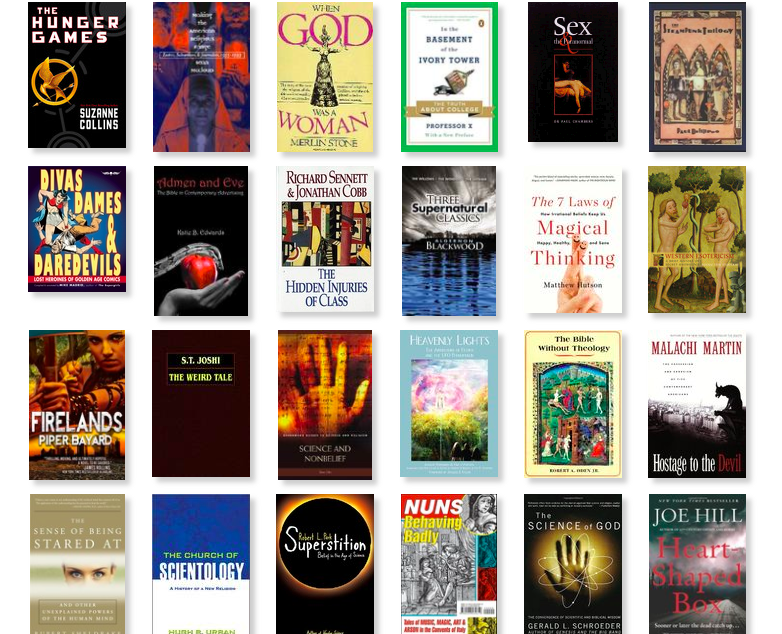
Screen Shot 2014-01-05 at 6.02.02 AM

Some of my reading was on specific religious traditions. Maren Cardin’s Oneida, Hugh Urban’s The Church of Scientology, Sean McCloud’s Making the American Religious Fringe, and Andrew Chestnut’s Devoted to Death each showcased either a single or several traditions that have emerged in the last century or two that have had a striking impact on America’s religious morphology. Katie Edward’s Admen and Eve is a great example of how businesses have figured out that a religiously hungry society will buy, if marketing pays attention to religion. Among the most powerful books I read were Susan Cain’s Quiet and Jonathan Gottschall’s The Storytelling Animal. Being human is, after all, the most religious of experiences. Starting with fiction, I’ll end with fiction. The novels for adults I remember most vividly are those with strong female protagonists: Sheri Holman’s Witches on the Road Tonight, Piper Bayard’s Firelands, and Elizabeth Kostova’s The Historian.
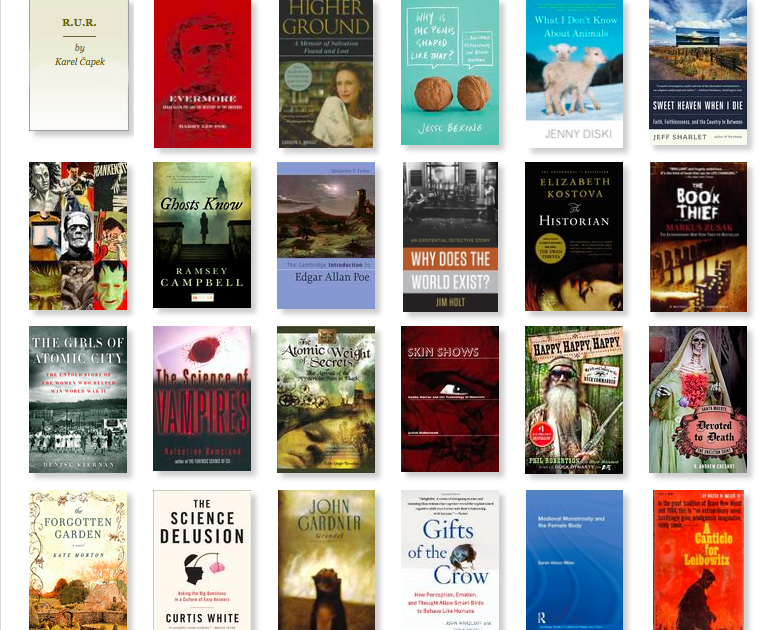
Screen Shot 2014-01-05 at 6.01.24 AM

This blog offers me a chance to give brief sketches of books that have much more to say than a few words might summarize. The fact that religious ideas and themes might be found in such a range of books underlines once again that we live in a religious milieu, whether we want to admit it or not. Read on!


Making Saints

Some places are inaccessible in the academic world. Or perhaps invisible. I couldn’t help but have Santa Muerte on my mind as I visited the Phoenix/Tempe area of Arizona. I knew from reading Andrew Chestnut’s Devoted to Death that the skeleton saint has a large following in that area. Having been raised in a working class religion in a blue-collar household, I also knew that such trappings might not be entirely visible around a university setting. Arizona State is a huge school and my minimal free time on the trip only permitted a wander-radius of a couple blocks from around the campus. Many universities are, because of their property-value-lowering non-profit status, on the edge of sketchy neighborhoods where work-a-day people live. It didn’t seem that way in Tempe. The areas I reached all seemed to have that adobe-solid middle-class feel to them. Not that I go looking for seedy neighborhoods when I’m traveling by myself, but I do like to see stores that aren’t part of a chain, and to get a sense of local culture. For most academics, the pedestrian devotion to Santa Muerte is below the radar.

The concept has haunted me ever since reading Chestnut’s study—why would people find appealing to death attractive? Santa Muerte has the trappings of a Catholic saint, but she is, plainly put, death personified. She is a favorite among drug lords and criminals, and that is somewhat understandable. Her Hispanic devotees, I realize, often live lives of desperate poverty. The well-heeled saints of conventional religion might not be able to see things from their perspective. Although the Catholic Church continues to make saints, many of the traditional saints predate capitalism. Capitalism creates its own insidious disenfranchisement. I realized this already as a child growing up in a setting where just about everybody I knew had it better than my family did. For some to prosper, others must suffer in such a system. I knew which end I belonged on.

As in my visits to Santa Barbara (a much more conventional saint, by the way), Austin and Houston, in Tempe the Hispanic population was evident mostly in the menial labor sector. The person who makes your hotel bed or brings the hot plate of food to you in the restaurant. The person who mops up your spills or picks up your trash. And they are the ones who’ve made it into the earning bracket of the minimum wage. Why not worship personified death? Does not Santa Muerte remind them that we all face the same rictus grin at the end of our days? Isn’t it best to be on good terms before we reach that inevitable place? It was clear that on my visit I wasn’t going to be able to get far enough from prosperity to see the skeleton saint myself. At Phoenix Sky Harbor airport, waiting for my 11:30 p.m. flight back to cloudy skies, all the shops were closed. I passed by a boutique with local art, and there I possibly glimpsed her. A small statuette, possibly just the grim reaper, among other Day of the Dead motifs. Was it inspired by Santa Muerte? I would never know, I pondered, as the Hispanic airport attendants, still at work around me, were busy emptying the garbage.

IMG_1080


Dying for Religion

devotedtodeathReligions never lose their ability to surprise. This entire concept of belief is one with which I am intimately familiar but about which I’m completely puzzled. If we’re honest, we don’t know from whence belief comes or why it is so effective in keeping people balanced. (There are fanatics for rationalism just as surely as there are for religious faith.) When I saw R. Andrew Chestnut’s Devoted to Death: Santa Muerte, The Skeleton Saint, I figured it would be a good read for October, when Halloween comes so readily to mind. Although I’ve studied religions all my life, I’d never heard of Santa Muerte, “Saint Death.” Probably this is because, as a representative of folk religion, Santa Muerte is not an “official” religious figure. Folk religions are what the faithful actually believe, rather than what the religious officials declare that they will believe. Many a deluded bishop would learn to his chagrin, if he deigned to speak with mere laity, that his platitudes count only in the high court of theological heaven. Saint Death is more like the experience of the rest of us.

Chestnut, a scholar of Mexican religions, discovered Santa Meurte while living in Houston. His book is a narrative introduction to the background and history of the religion, its beliefs and practices, and a consideration of what the skeleton saint offers so many Latinos. Although the news in the northern reaches of America often does not bear it, Santa Meurte has regularly made the headlines in southern climes. As a symbol of death, and therefore potential protection from death, Santa Meurte has gained notoriety by her worship being taken up by drug runners and convicts. Mexico’s regrettably long struggle with poverty and sometimes corrupt governments has led to a society in which death is very familiar. As Chestnut demonstrates, Santa Meurte likely has her roots in the Grim Reaperess of plague-ridden medieval Spain, and she has been a somewhat hidden figure in Mexican Catholicism for at least a century or two. Her first public exposure came in 2001, and since then her association with the criminal element has been repeatedly highlighted in the media.

Santa Meurte, however, is a source of consolation for those who have little in life to anticipate but death. Often, in societies driven by the acquisition of wealth, plutocrats forget that justice comes in the guise of the Reaper. To the believer, Santa Meurte is not evil. She is a natural offshoot of the Catholic veneration of saints in a culture where human aspiration is quickly and unfeelingly snuffed out. Those in positions of power claim the Santa is Satan, but they may be looking in the wrong place for evil. Pointing to the Gospel statements that death will be overcome, they overlook the passages that insist on giving away all that you have will make you ready for the kingdom of heaven. Death, even if trumped at the final trump, will greet us all by and by. Santa Meurte is a very practical saint. Chestnut’s book is a good choice to read when the chilly wind shakes the trees for their particular October rattle of dry, lifeless leaves.