Brain Exercise

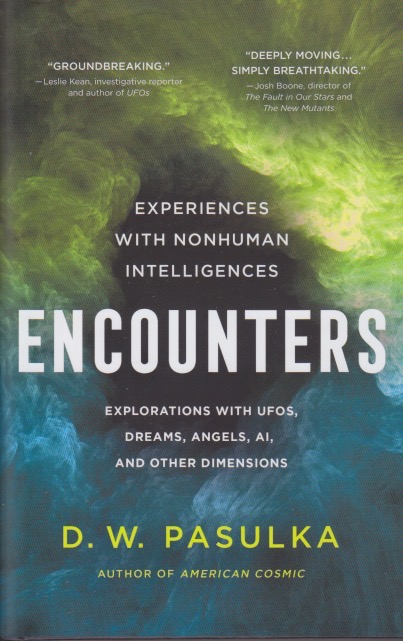
Why do we read, if not to expand our minds?  I’ve read all of Diana Walsh Pasulka’s previous books but Encounters is mind-blowing.  I feel particularly honored that a scholar of religion has been able to put together so many pieces of a very strange puzzle.  Pasulka’s first book was about Purgatory.  Having grown up Catholic that seems a natural enough choice.  Her second book, American Cosmic, focused on a topic that academics were just starting to address at the time—UFOs.  That book justly earned her acclaim.  Encounters takes a few steps further into the mysteries of being human.  Those who experience UFOs have much in common with people who have other extraordinary encounters.  The profiles in this book will give you pause time and again.

Many of us have felt that the unfortunately successful government strategy of ridicule toward experiencers has been a blanket covering up the truth for too long.  I was interested in UFOs as a child and was unmercifully teased for it.  One of the reasons I was interested was that I learned, when I was about eleven, that my grandfather had been interested as well.  I was only two when he died, so there was no way to learn this personally.  It came through discovering a couple of his books that my mother had kept.  Since she was one of five siblings, it’s difficult to say if he’d had any other books on the subject, but being a reasonable kid, I wondered why this was a forbidden topic.  You could talk about ghosts (at least a little bit) and be considered “normal.”  Mention UFO’s and you’re insane.

When the Navy’s video recordings of UFOs—renamed UAPs—were released in 2019, there was silence in the room for about half an hour.  Serious people began to realize there might be something to this.  Of course, those who’d internalized the ridicule response continued to fall back on it, perhaps as a defense mechanism.  That revelation has allowed, however, serious consideration of what is a very weird phenomenon.  I’ve deliberately avoided saying too much about what Pasulka covers in her book.  As I generally intend when I do this, what I’m hinting is that you should read this book.  You should do so with an open mind.  If you do, you might find yourself thinking in some new ways.  Of course, some will ridicule.  Others, however, may walk away with an expanded perception of reality.

Religion and Its Objects

UFO religions—or should they now be called UAP religions?—have long been of interest to scholars of religion.  A recent piece on Religion Dispatches titled “With Release of Pentagon Report, UFO Narrative Belief System Is Suddenly Supported by Military Witness Testimonies,” by Diana Pasulka, explores this.  Anyone following mainstream media is perhaps experiencing a bit of whiplash on the topic since, prior to admission of interest by the government, the official stance was to ridicule the entire topic.  That’s the reason what were long known as Unidentified Flying Objects now have to be called Unidentified Aerial Phenomena.  Since a government can never admit it made mistakes, it simply changes the terminology.  My interest here, however, is in the connection with religion.

I’ve explored the connection between horror and religion from time to time—ahem—and so it is natural enough to wonder about the relationship between religion and UAPs.  (Or should I stick with UFOs?)  The two have some commonalities.  Initially, both deal with the unknown.  Indeed, the word monster comes from a root denoting an omen, or a revelation.  Something isn’t a revelation unless it’s been keep hidden.  So with UFOs.  The government’s long interest, which had been somewhat successfully hidden, allowed for a reveal.  Religions, however, tend to thrive on hidden things.  The monotheistic religions, for example, claim to inform us about what God has chosen to reveal about (generally) himself.  Even today when pushed into a theological corner, believers will appeal to mystery.  Both monsters and UFOs live in mystery.

Science prefers things out in the light.  Is it any wonder that scientists are reluctant to apply themselves and their hard-earned credentials to the UAP problem?  Those of us in religious studies generally have little to lose.  It’s not like we’ve got prestige on our side, or some billion-dollar grant riding on our reputation.  We can afford to take a look and monsters and other unknowns and see how they trigger the religious impulse.  Pasulka’s article has more to do with credibility.  UFO religions have long struggled with being considered outsider belief systems.  UFOs were publicly ridiculed, so any religion that focused on them was, by extension, laughable.  I’ve long believed that ridicule serves little purpose when it comes to belief systems.  Making fun of a mystery is less common than shaming those who believe in what we’ve been told definitely isn’t real.  Until suddenly it becomes real.  Is there any question why religions develop when mysteries remain?


Almost Heaven?

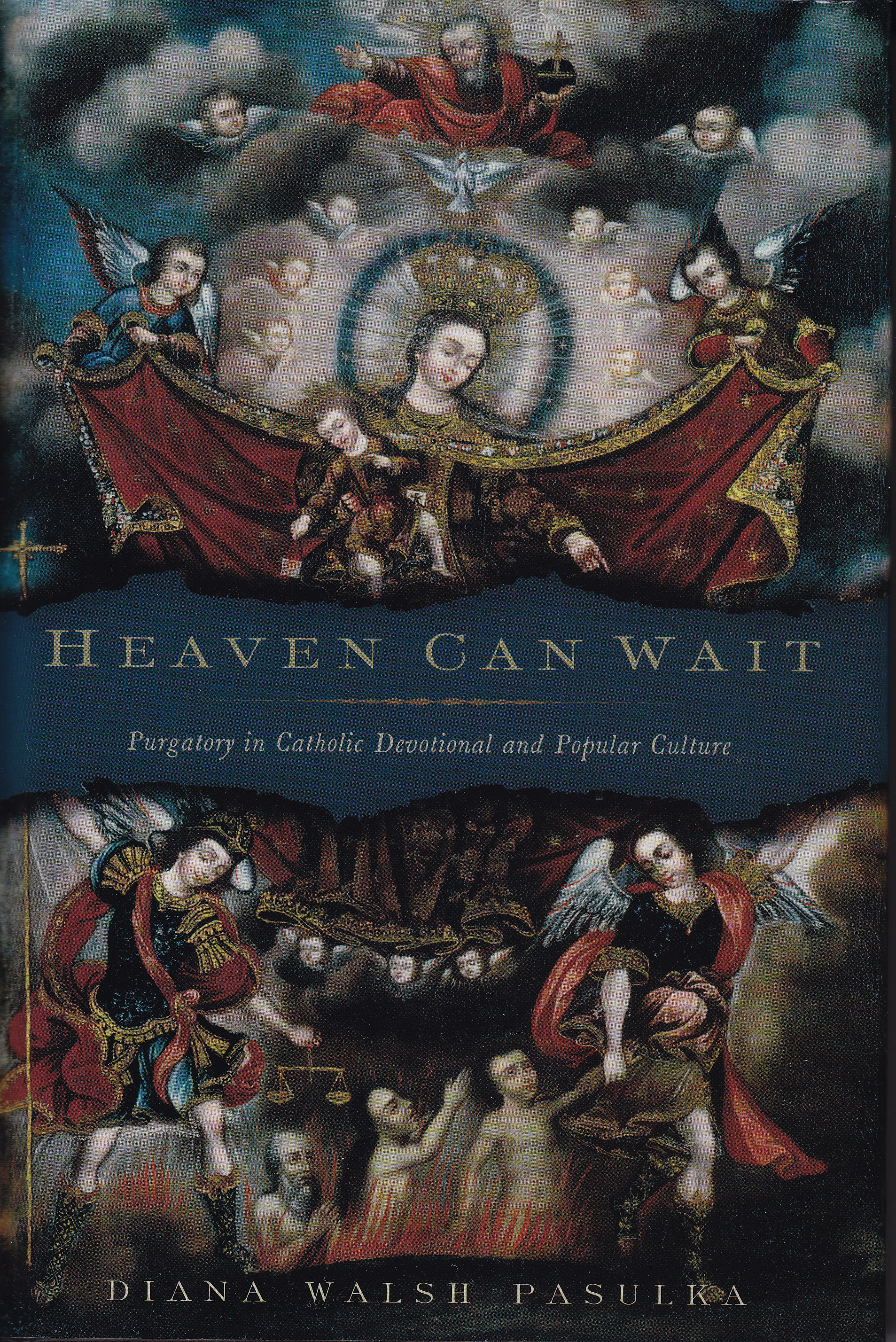
HeavenCanWaitLike most kids raised Protestant, I had little idea about the Catholic worldview.  Despite family wishes, I had Catholic friends, and topics such a Purgatory inevitably came up.  (Well, they did if you were me, with my insatiable interest in religion and its trappings.)  Purgatory was a concept both just and unjust at the same time. It seemed only fair to give people who’d made mistakes a chance at Heaven, yet, at the same time, to make them suffer when they already realized that they’d made mistakes seemed like, to put it bluntly, bad parenting.  The key was in the name: Purgatory.  A place to purge the evil.  Melvillian try pots. Given this background, I couldn’t wait to read Diana Walsh Pasulka’s Heaven Can Wait: Purgatory in Catholic Devotional and Popular Culture. The afterlife is the ultimate 64-dollar question. It pays to be informed.

This fascinating study demonstrates that the idea of purgatory has long roots into Christian history. The Bible does mention Heaven and Hell, concepts borrowed from Zoroastrianism, but it doesn’t directly mention Purgatory. For this reason most Protestants reject it out of hand as Popish and superstitious.  Heaven Can Wait, however, explores how the idea grew into an almost inevitable aspect of Catholic theology. Most intriguing to me was the concept that, like Belinda Carlisle’s Heaven, Purgatory is a place on earth. Specifically, in many Medieval minds, in Ireland. There a cave of torments, guarded by monks, on an island in Lough Derg provided those brave enough to enter the chance to purge their sins before death.  In short, those who braved this cave could bypass Hell by suffering in advance.  Heaven on an installment plan, crudely put.  As Walsh Pasulka describes the accounts of Lough Derg, archetypes begin to fly thick and fast, like proverbial bats out of Hell. This single location, sometimes venerated by, sometimes destroyed by the church, was a vortex of torment.

Over time, as the rationalism of the Enlightenment settled in, the idea of a state of being having a physical locality led to changes in the concept of Purgatory.  The kids I knew took it for granted that it existed, and, with tween angst, accepted that that’s probably where they’d end up.  At least for a while.  Protestant that I was, my choices were a bit more stark. If I messed up, as I well knew I did, my torment would be neverending. Heaven Can Wait is a rewarding exploration of how an idea, logical in its original context, survived long after the worldview of the church had begun to change. Indeed, it survives to this very day.  And like most doctrines of the church, it has a way of scaring even the most inoffensive souls straight.