
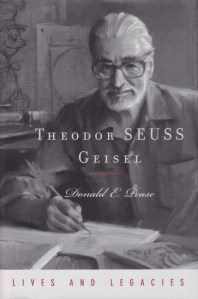
 Few names from childhood are as well known as Dr. Seuss. When my wife and I read Theodor Seuss Geisel, in the Lives and Legacies series, we realized that neither one of us had learned to read with his books. It’s not that they hadn’t been written and widely adopted yet (they had by the time we started school), but rather that our districts had gone with other fare. I learned with the famous Dick and Jane series, and I think there must’ve been some Seuss thrown in here and there. We didn’t own any of his books, but I remember my mother reading from library copies of Hop on Pop. When our daughter was born we read to her daily and Dr. Seuss was a large part of our informal curriculum. Before reading this book, however, I knew very little about who Theodor Geisel was.
The series Lives and Legacies features short books, so this is a quick and no-frills way to meet the man. Although Geisel was born into a middle class family, he experienced (ironically) the trauma of being in a German family during the First World War. What we would call hate crimes today were committed against German-Americans during the war, even though there were sizable populations of Teutonic Americans by that point (including my mother’s family). Not only that, but Prohibition put his father’s brewing company out of business. Still, Seuss was accepted at Dartmouth and, like many who make it to the Ivy League, his connections helped him to a successful career in advertising and then in writing children’s books.
Geisel was a successful man, but wasn’t driven by money. He was an artist both with images and words, and as Pease makes clear he approached his craft seriously. As he matured he began to address social and political issues in his larger formatted books. He eventually became the most successful children’s book author in history. Reading to my daughter when she was young we discovered that, unlike the often idealized times of the fifties (followed by the sixties into which I was born) there is a wealth of quality children’s literature available. It’s easy for middle-class kids to be raised loving reading. Dr. Seuss knew that the pretensions of adults often created the seriousness with which we face life. Children enjoy fun and the ridiculous. He never lost sight of that simple fact. We live in times when it is readily to be wished that many of the adults in power would go back and read a little Seuss and perhaps, just perhaps, learn their lessons.

 Steve A. Wiggins