Haunted States

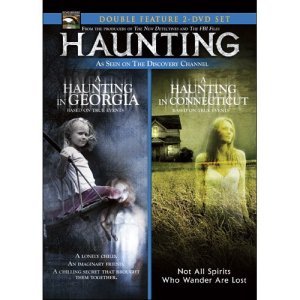
I’ve been going through a spate of watching “The Haunting” movies.  Just to be clear, I don’t mean The Haunting, by Robert Wise (1963), which is excellent.  Instead I mean movies spun off of the Discovery Channel’s series A Haunting.  Several years ago, between jobs and too near an FYE store, I picked up a cheap two-fer.  This set contained the television movies A Haunting in Connecticut and A Haunting in Georgia.  I watched them once and then traded them in to get something else.  The first one really bothered me.  The Connecticut story deals with a childhood cancer victim, and that alone is scary enough.  It had the limitations of a television movie and left me thinking it wasn’t too satisfying.  The Georgia haunting was more of a documentary, but it was also open-ended.

Then someone got the idea to make a movie out of the two.  The Haunting in Connecticut blows the plot over the top.  I kept thinking as I watched it, isn’t it in bad taste to make a horror movie based on the true life horror of tragic disease?  The protagonist of the story, Philip Snedecker, died about three years after the movie came out.  Although the plot generally followed the first movie an entire subplot was added to pad it out.  A nineteenth-century funeral director has enslaved a young man to be his medium.  The undertaker steals and marks dead bodies to enhance the boy’s powers.  These completely fictional characters intermingle with the real life tragic Snedeckers.  As you might expect, chaos ensues.

The oddly named The Haunting in Connecticut 2: Ghosts of Georgia also had to add an entire fabricated story to the troubles of the Wyrick family.  In real life the Wyricks moved into a house where their daughter started seeing things, including a kindly ghost named Mr. Gordy.  She also saw some sinister spirits.  So much so that her family invited a parapsychologist to investigate.  The theatrical version adds in a stationmaster on the underground railroad who was also a taxidermist.  Instead of helping all the slaves to freedom, he saved some for stuffing later.  No real motivation is given, beyond his enjoyment of sawdust and thread and death.  

While these two movies really didn’t help much, I generally find watching horror during a pandemic therapeutic.  Horror films sometimes help viewers envision worst-case scenarios and figure out how they might deal with them, learning from the victims’ mistakes.  I suspect that’s why, a few years back, the CDC posted instructions on what to do in case of a zombie apocalypse.  It was all about disaster preparedness.  Of course, in those days we had no idea what was really coming to Connecticut, and Georgia, and to every state of the union.
Haunted State

Some few years back, when FYE was still a thing, I’d hunt for bargains at our local.  I came across a two-for-one DVD that seemed promising, but when I got it home I discovered it was a made-for-television combo, and movies of that ilk often fudge on many angles.  I watched them nevertheless.  These were the Discovery Channel’s first two specials in what would become a series titled “A Haunting.”  I have to admit A Haunting in Connecticut freaked me out so much that I decided to trade the disc back in—something I rarely do.  (The other feature, A Haunting in Georgia, I could barely remember.)  As is usual with things I get rid of, I grew curious once again—this time a decade later.  Fortunately both movies are included in Amazon Prime, so I was all set.  I just needed that rarest commodity of all, time.

You might think that a guy who gets up at 4 a.m. on weekends would have plenty of extra time.  That’s not the case.  Nevertheless, I squeezed the clock to watch these shows again for research purposes.  Neither one was so scary as I recall—I’ve seen quite a few movies since then—but they did get October off to a moody start.  Of the two I recalled far less of the Georgia story.  Perhaps part of the reason is that it left so much unresolved.  The Wyrick family apparently experienced many ghosts and their investigator, William G. Roll, took their claims seriously.  While not an Ed and Lorraine Warren film, like its sibling, it follows the pattern of repeated, reported activity, investigation, and, well, not quite resolution.  The family attends a Pentecostal church, and, interestingly, the documentary treats it respectfully.

Unlike A Haunting in Connecticut, A Haunting in Georgia films some events in real time—notably the church service.  The pastor is interviewed and he, unlike Dr. Roll, believes the entity to be demonic.  The documentary treats him with the same gravitas as it does the Berkeley-trained psychologist.  There’s too much going on here to make a memorable narrative, though.  Stories, at least in the classical fictional sense, have some kind of resolution.  The Georgia narrative has too much complexity and too little sense that anything has been solved.  To me the amazing thing was that I had watched this film before and I remembered maybe only the first fifteen minutes.  Both films went on the bigger things, getting remade into theatrical features that I’ve never seen.  But then again, I barely have time for my own unresolved story.  Maybe FYE offers its own brand of local haunting.


Amish Paradise

Once upon a time, intelligence could be found on cable networks such as Discovery Channel, and Animal Planet. Like higher education, however, these ventures soon learned that people do not want to be educated, but entertained. So it was that I found myself watching, with increasing bewilderment, Amish Mafia. The very discord of the title is intentional as the show “dramatizes” disagreements among the Anabaptist communities of central Pennsylvania. The result is coarse and seedy, and not a little salacious. And addictive.

Photo by it:Utente:TheCadExpert (Wikicommons)

Photo by it:Utente:TheCadExpert (Wikicommons)

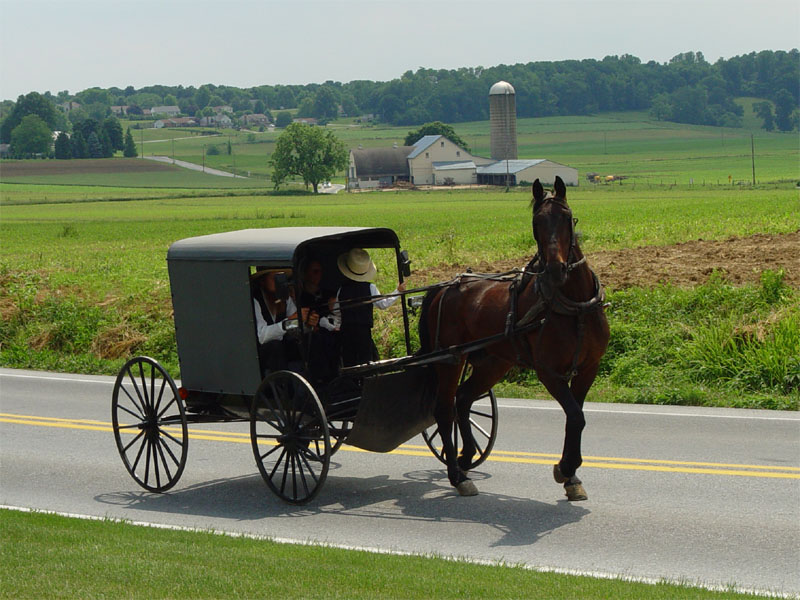
I grew up not too far from several Amish communities, and I’ve visited Lancaster a time or two. Living a lifestyle that the vast majority of Americans would classify as boring, the Amish keep to themselves, constructing an existence based on strict religious principles and a rejection of modernity. Recently, however, the Amish have become a sexy topic for romances and fictional clashes between their traditional way of life and the high-tech world that surrounds them. For those of us who felt a kind of authenticity to The Witness, watching Mennonites lock and load their assault rifles to intimidate their rival construction workers, and, in the words of Weird Al Yankovic, “get[ting] medieval on your heinie,” Amish Mafia presents the viewer with a world of kidnapping, extortion, and shunning, all within one episode. Trashing-talking pietists climb into luxury cars and put drunken buggy drivers in straight-jackets where they’re hauled off to extreme Bible-reading therapy. This seemed nothing like the Amish I had learned about in classes on primitivist societies.

We like to watch the self-righteous crumble. Who doesn’t want to believe that they are about as good as their neighbor? Those of us in Pennsylvania, Ohio, Indiana, Illinois, and Iowa (from my experience) see the Amish occasionally, quietly living their lives without the amenities that define us. We resent that, yes, you can get along without cars, telephones, televisions, internet, and weapons. Who really needs well-made furniture and quilts to keep warm at night when you’ve got Ikea and a furnace like a locomotive in your basement? And they know their Bible. Goodie-two-shoes showing us something that many of us have suspected all along—authenticity comes from inside, not an electronic world we can’t touch. I don’t idealize the Amish. Their lifestyle takes discipline and a level of belief in a worldview that doesn’t match what I’ve been taught. But then, Amish Mafia also requires a gratuitous suspension of disbelief.