Claim This Panel

Validation.  We’re surrounded by it.  Now that we have the internet, everyone seems to want us to verify who we are.  And we were told as kids that there are no such things as trolls!  Personally, I have no idea why a hacker would want to be me.  I mean for destabilizing the government by messing with elections, well, of course, but I mean for academic purposes.  How do you really know who I am?  I googled myself the other day—I’m curious how my most recent book is doing because I’ve heard nothing from the publisher since it appeared—and noticed that in the “knowledge panel” on Google they had the picture of the wrong person.  I guess I’d better verify myself!

The erstwhile academic (aka “independent scholar”) gets invitations via email from Google Scholar to claim their papers.  I suppose in an effort to provide competition to Academia.edu, the researcher finds her or his papers available on Google Scholar’s website.  So far, so good.  But the invitation comes with instructions to verify your “work email.”  Said email must end in a .edu extension in order to be valid.  In other words, “independent scholar” is an invalid category.  This train of logic demonstrates one of the serious problems with high education shrinkage and the industry becoming tighter and tighter with its positions.  How do you verify yourself if your email address is the same as any Jane or Joe?  You can’t.  “Scholar” is limited to those lucky enough to have picked up a very rare position, especially in some fields, such as religion.

My recent experience with the DMV was an exercise in validation.  I presented the woman my vital paperwork (which was less than I had to show to get the New Jersey license that I had to cash in to get a license in Pennsylvania) while wearing a mask.  Irony can be quite stunning at times.  How did they know I wasn’t some masked bandit stealing someone’s paperwork on the way to the DMV?  I guess they could ask me to verify by my work email.  Then they’d discover that I’m merely an independent scholar.  If they googled me they’d find the wrong person’s photo on my knowledge panel.  Won’t someone validate me, please?  It would be nice to be able to claim my own papers on Google Scholar.  But until “independent scholar” becomes a real thing, I guess you can ask that guy (who’s not me) on the “knowledge panel” that bears my name.

Who Are You, Really?

It’s just an ordinary thing—renewing your driver’s license.  I remember waltzing in (actually, one never waltzes into the DMV, “trudging” is more accurate) to the DMV to get my new license.  Apart from the federally mandated several-hours wait, it wasn’t too bad.  You finally get to the counter, they snap your photo, laminate it, you pay, and you leave.  You’ve wasted a good part of the day, but you can legally continue to drive.  Then September 11 happened.  Fake IDs were deemed a national security threat.  You had to prove who you are before you could get that renewed license.  Never mind that for the rest of the days during those past four years nobody gave a fig who you were, for this day of your life you have to prove it.

Now we’re taking it a step further with REAL ID.  Forget your past, fake news ID.  Now you really have to prove it.  Mostly by bringing in documents that are all electronic now.  Your gas or electric bill?  Uh, don’t look while I type in my password.  My phone counts every step I take and knows exactly where they were taken.  It wants my fingerprints to even open.  Doesn’t this prove I’m me?  Can’t I just show you I can open my phone?  Besides, I know no one else who wants to be me, but now I’ve got to bring a stack of paperwork in (and some of it could easily be faked online by people who know far more about computers than me), stand in that endless line, to have my nation rest secure at night that I actually am who my driver’s license says I am.  Of course, we self-reflective types often wonder who we really are anyway.  Don’t they read my blog?  Given the strictures I have to sign into my own work laptop, I can only conclude that the internet has made us extremely insecure.

My issue is more philosophical.  Who am I?  An editor?  A writer?  An ex-professor?  A husband, father, son, brother, uncle, and cousin?  A pacifist?  A vegan?  A critical thinker? I suppose it depends on who you talk to (and that’s presuming anyone wants to talk to someone else about me).  When I walk out with my shiny new driver’s license I guess that will all be resolved.  Of course, you need to take the word of the bored-looking woman behind the counter who will cursorily examine my paperwork, knowing that there are approximately 5,280 other people she’ll see today, cataloging and certifying each one.  Does she really know who I am?  Does that magic box in front of her face have the answer to my question?  They hand me a plastic card.  Who am I?  A potential driver with proven ID.


Temporary Id

Who am I, really?  I can’t help but ponder this whenever I apply for a new form of identification.  While at the Department of Motor Vehicles I observed a room full of strangers—if there’s a melting pot in the United States, it’s the DMV.  Outside those cloistered in the major cities, you must drive to survive in this country (or at least to thrive) and the ritual of waiting your turn by number at the DMV is part of it.  I glanced at my application while waiting.  I’ve held drivers’ licenses in at least four states, but I’ve lived in at least six—how do you count where you live, really?  I think I must’ve had an Illinois license at some point, but I could find no record of it.  Who am I?  Are the Illinois years lost?  Big brother will find out, no doubt.

To apply for a license in Pennsylvania, as in most states, you have to prove you are who you say you are.  Swapping in your old license just doesn’t work any more.  While the actual “who” depends on government-issue documents (social security, birth certificates, or passports) the where question is more financial.  To prove your residence you must present bills with your name and current address.  You’re defined by your money.  Bills demonstrate that you’re integrated into the system, the matrix.  I spent one day, as a temp with Manpower, working for Detroit Electric (no, I didn’t have a Michigan license; I kept the Massachusetts one), processing requests for new service.  Despite not being asked back because they had expected a woman (really!), I learned that to get service you had to prove you were part of this matrix, with a history of paying your bills.

None of these agencies ask the deeper, more philosophical questions of identity.  None seem to care that each day is a struggle to define our spiritual selves in a world hopelessly secular and financial.  Yes, my birth certificate “proves” I was born in Pennsylvania.  The DMV records “prove” I learned to drive here and had my first license in this state.  They show nothing of the real question of who I am.  A reasonable facsimile of my visage appears on the plastic card that certifies my citizenship within these artificial borders.  But now my home state stamps “Temporary” on the card so that a security check can be run.  They want to discover if I am who my records say I am.  What the powers that be don’t seem to recognize is that although where we are born influences us every day for the rest of our lives, no little plastic card, despite the amount of information it conveys, can say who it is I really am.  “Temporary” may be the truest word on it.


Who Do You Say?

DMZ. What acronym inspires more terror? Or did I mean DMV? I can’t keep my acronyms straight. Nothing reveals the layers of bureaucracy in clearer cross-section than the Motor Vehicle Agency. A trip to the DMV with every conceivable form of identification (usually inadequate) inevitably becomes a multi-trip visit as I’m sent home again and again to excavate some forgotten form to prove my identity. Who am I? Is there any more religious a question? Moral rights, civil rights, human rights, all define who we are. Reading about war recently, I came across the concept of the soldier giving up life for country—a profoundly religious act—based on nation as a kind of deity. A deity that can demand sacrifice. The cost for the nation is slight while the cost for the individual is unsurpassable. It all revolves around the identity of I.

Religion is often presented in terms of the worship of gods or the belief in supernatural powers. Undoubtedly those elements are often involved, but religion is a human enterprise, and at the center of all human enterprises is, well, humanity. Religion is generally associated with a Latin root that means “binding.” The nature of that binding and the easiest religions have no word for religion itself. One way to conceptualize it is the binding of an individual to some cause greater than the self. Community, humanity, deity—something that gives meaning to an existence that remains unsatisfying if it is only individual-focused. In a consumer market that involves choice—we choose our religion. In ancient times, up until modernity, actually, you were born into it. The self may not have existed in the same way that it does now. We install complex rules to ensure that no self (except the rich and powerful) is able to benefit from the system at the expense of the whole.

DSCN4694

In the eyes of most ancient religions humans are identified as those who are in trouble. We’re lost, reincarnated, suffering, fallen and some kind of help is required. In return our response should be one of gratitude. Humanity the subservient. Now that we’ve recognized ourselves as the creators of religion—are not the gods just ourselves writ large?—we once again face an identity crisis. There is no larger religion that binds us. Generals, however, don’t want to die on the field so we need privates. And if ever the police should stop you while driving, there’s no assurance you’ll give them your real name just because it is the responsible thing to do. So we make licenses to prove we can drive and to prove we are who we say we are. No religion need be involved, just papers that prove I am who I say I am. I think of Pilate’s question and ponder this bit of plastic bearing my likeness. I am who the government says I am.


Corn is King

For those who no longer believe in Hell, the DMV can serve a very useful function. Actually, the Department of Motor Vehicles is truly the great leveler of society—just about everyone has to cross its threshold, it is just that they all try to do it at the same time. Waiting in lines has always been a problem for me. It’s not that I think my time is more important than anybody else’s, it’s just that I have so much to do without standing in endless lines. Especially since work keeps me away from useful pursuits for over eleven hours out of every twenty-four, weekends seem somehow too sacred to be spent at the DMV. But the Devil must be paid his due. When paying the Devil, I take along Stephen King to pass the time. So it was over the weekend that I found myself reading “Children of the Corn.”

Of course, like most horror movie fans, I have seen the movie a time or two. I’d never read the story before. This is one of the King tales based most directly on religion gone wrong; the children, as any reader/watcher knows, have distorted Christianity into a midwestern corn-god religion. It may seem unlikely to urban folk, but I have stood next to corn stalks that have towered high above my head, ominously silent like triffids on a sunny Wisconsin afternoon. It can be unnerving. Almost a religious experience. But turning back to King, the story differs from the movie, of course, and what the written version makes clear is that the children distort the New Testament, but leave the Old Testament intact. King, like many horror writers, is biblically literate. Yet, this picture of Old Testament god versus New Testament god is stereotypical and a little misguided. The god of Christianity is a deity of many moods. The wrath in Revelation, or even some of Jesus’ sermons, however, stems directly from Yahweh’s darker moments.

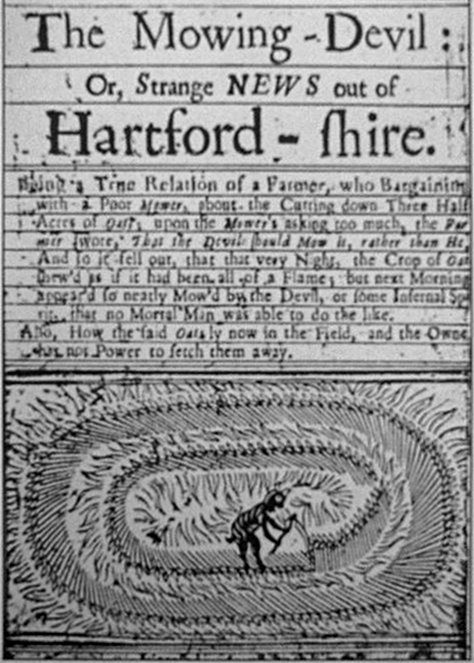
Diablefaucheur

How do we know what is demanded by this mercurial deity? The theological ethicists argue over this daily, but nowhere in the Bible does God have a problem with people treating each other as they would want to be treated. Some of the punishments for minor infractions seem a bit severe—or very severe—but the basic principle, given the Weltanschuung in which it operates, need not cause undue fear. Women, homosexuals, gentiles, Jews, anybody reading parts of the Bible will no doubt be offended by the details. As the saying goes, the Devil is in the details. And that’s why I’m spending my entire Saturday morning at the DMV.