Begging Your Question

I still remember when I first consciously heard it.  The phrase “begging the question,” I mean.  I was a doctoral student at the time and one thing you do in grad school is ask a lot of questions.  I asked my advisor what the phrase meant.  “Asking a question when you’ve already assumed the answer,” he replied.  I’ve been writing quite a lot about feedback loops these days, and this was yet another of them.  Begging the question, in other words, is a fallacy where the asker isn’t seeking an answer, but is attempting to persuade another of a pre-decided outlook.  The concept is subtle, but important.  That’s why it disturbs me that most academics these days use the phrase “begs the question” when they mean “asks the question.”

I’m afraid I don’t have statistics here, but I read academese all day long—it’s my job.  I can’t footnote where this occurs but I can attest that it happens all the time.  Whenever I read “begs the question” I stop and reason it out.  Does the author mean “begs” or “raises” or “poses” or “asks” the question?  Begging a question isn’t the same as raising or posing or asking it since the latter three indicate an answer is being sought.  Precision in thinking is difficult work.  It can give you a headache.  We all fail sometimes.  Perhaps that’s why we eschew it, as a society.  It’s much easier to beg the question.  Still, doesn’t that mean this valuable concept is in danger of losing its, well, value?

I realize that posing such a question makes me sound like one of those old guys who says, “back when I was a youngster…” but the fact is the educational system in the United Kingdom made you ask lots of questions.  In a way that’s unheard of over here, where money assures your credentials, I knew two students who failed out of the doctoral program at Edinburgh when I was there.  One of them an American.  It wasn’t just a matter of laying your money on the barrelhead and walking out the door with a diploma.  I’ve read certified copies of dissertations (not from institutions in the United Kingdom) where Zeus was spelled “Zues” (throughout) and the biblical seer was called “Danial.”  Now, I suppose that raises the question of the value of degrees where you don’t even need to spell your subject’s name correctly.  Begging the question is a fallacy, not a synonym for asking.  And I know that if your thesis begs a question then you’re barking up the wrong tree, but that won’t stop you from landing a job in the academy.
Writers Reading

A lot of misconceptions about books abound out there.  One of those misconceptions that has become clear to me is that authors write books to teach.  (Or to make money.  Ha!)  That may well be part of the motivation, but for me, the larger part has been writing books to learn.  You see, the frontiers of human knowledge cannot be reached without stretching.  Writing a book is a way of learning.  Long gone are the days when a person could read every known published work.  Indeed, there aren’t enough hours on the clock for anyone even to read all published books on the Bible, let alone the far bigger topics these days.  And so writing a book that deals with a biblical topic—let’s say demons—is the ultimate learning exercise.  It’s a very humbling one.

I recently read an article where book pirates (yes, there is such a thing!  I should explain: there are those who believe authors are ripping off society by getting royalties for their books.  These pirates, like those of galleys of yore, take ebooks and make them available for free on the internet.) call authors “elitists” for wanting to earn something from their labors.  These folks, I’d humbly suggest, have never written a book.  Most books (and I’m mainly familiar with non-fiction publishing here, but the same applies to the other kind) take years to write.  Authors read incessantly, and if they have day jobs (which many do) it is their “free time” that goes into reading and writing.  They do it for many reasons, but in my case, I do it to learn.

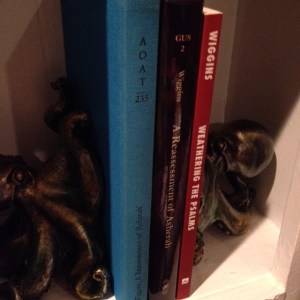
The doctoral dissertation is accomplished by reading as much as possible beforehand and writing up the results quick, before someone else takes your thesis.  It is the practice I also used for my second book as well, Weathering the Psalms.  The third book, Holy Horror, was a little bit different.  Yes, I read beforehand, but much of the research went on after the body of the book had largely taken form.  I had to test my assumptions, which are on ground most academics, needing and fearing tenure, tremble to tread.  I read books academic and popular, and having been classically trained, often went back and read the books that led to the first books I read.  It is a never-ending journey.  I could easily spend a lifetime writing because I’d be learning.  But like other misconceptions, those who write books don’t lead lives of luxury.  They work for a living, but they live for the chance to learn.  And that’s worth more than royalties.  Besides, the nine-to-five demands constant attention.