No Doubt

The mind inclined toward doubt is in for a rough ride in an evangelical childhood.  I recall vividly my many, many hours struggling against doubt, trying, crying, praying for certainty and faith.  Many, many dark nights of the soul.  Attending college and seminary I learned of the others in history who struggled the same way, or at least similarly.  I also learned that doubt is natural and healthy, it protects us from falling headlong into the many snares and traps the world continually sets for us.  Blind faith, as I recently quoted from Kurt Vonnegut, is dangerous to everyone.  I was thinking about this again the other day as there was something I fervently wanted to happen but I just couldn’t bring myself to believe would actually come to pass.  My mind isn’t built for blind faith.

Given that, it probably isn’t any surprise that I went into religious studies as a field, even though it’s a dead end.  I still believe it’s vitally important, but that’s a belief much of the world doesn’t share.  It’s one of the few fields of study where a doctorate leaves you without job prospects if you don’t get a teaching post, if you’re not ordained.  And should doubters be wearing clerical collars and preaching to those who want to believe?  Belief is malleable.  It changes over time and it does so via its constant interaction with doubt.  It leads to a life of second-guessing and constant reassessment.  I suppose that’s why I’m baffled to see politicians with less education being so cock-sure that they’re right about things.  I doubt they know what they’re talking about.
Institutions take on lives, like people do.  Although I disagree with the treatment of corporations as individuals by law, still, I understand the thinking behind it.  The church, for example, grew to be a very powerful force in the fourth-century Roman empire.  These collective individuals had vested interest in keeping that power as the church grew more and more influential.  That dynamic still exists where even a small, non-denominational group gathers and asserts that it alone is right.  All you have to do, it tells its members, is believe.  Don’t doubt.  And if you do doubt you’ll be excluded.  Exclusion is difficult to bear.  But even doubting Thomas has hundreds of churches named after him.  Each, no doubt, has many true believers as members.  And on the outside mingle the doubters.

Programming God

Robots have been part of my world far longer than I ever recognized. Still, growing up in a small town in the 1960s, their impact was fairly minimal—they may have had a part in the manufacture of the car we drove, and perhaps helped prepare some of the products we bought—but those robots were far away. Far more present were those on television who, for the most part, were funny and helpful. This month’s Wired magazine runs a story entitled “Trusting Our Robots,” by Emily Anthes. The point of her short article is that people feel more comfortable with robots that are programmed to appear uncertain. We don’t trust robots to drive our cars, as she points out, but we give them more, old-fashioned primate sympathy when we make them look like they’re having a hard time. Just a couple weeks back Time magazine had a blurb on how we’re now at the point of programming drones to kill without human input. Add a dose of uncertainty and we get a glimpse of what it must be like to be gods.

Underneath our exteriors, we all know that robots do what they are programmed to do. In many respects—physically, especially—they are superior to us. Nevertheless, human knowledge is not perfect. We, too, are prone to uncertainty. Our robots aren’t better than we are, only more efficient. Doubt is a human quality. Perhaps our most endearing. As Ms. Anthes notes, “even when confronted with evidence of our own inferiority, we resist a robot’s help.” We have evolved over millions of years to interact with other creatures. Those non-biological entities we’ve created and endowed with artificial intelligence (sound familiar?) somehow can’t equal the right we’ve earned from struggling against, and along with, nature for these many eons. Would God really trust us with the keys to the universe?

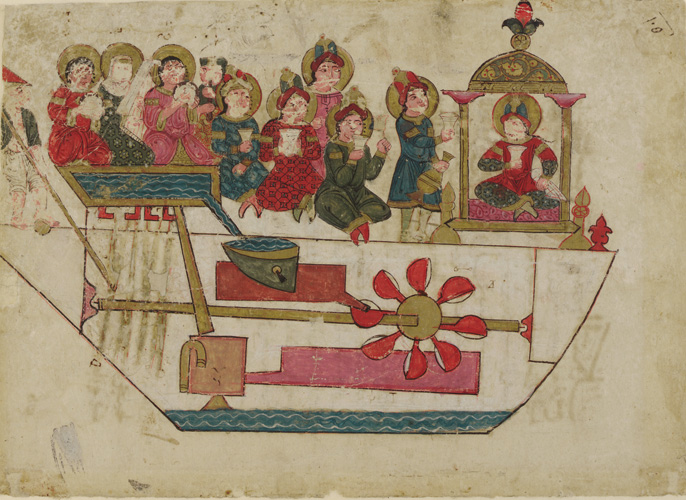
An early plan for a robot.

An early plan for a robot.

Robots, we are told, are our inevitable future. Some visionaries look forward to uploading human consciousness (even though we have no idea what it is) into a machine and, with replaceable parts, living forever. Before the dead and resurrected Jesus, according to the gospel of John, stood Thomas—the man some traditions said was Jesus’ very twin—and yet he doubted. As much as we claim otherwise, we adore Thomas for it. Evolving even in a world full of religion—itself a product of our evolution—we are so unsure. Our robots, however, programmed by us, have no doubts. Even when they act confused, it’s only because we tell them too. Our minds, as Wired tells us, resist letting robots drive the car for us. We let them pull the trigger, however, and pray our programmers got it right.


Sweet Something

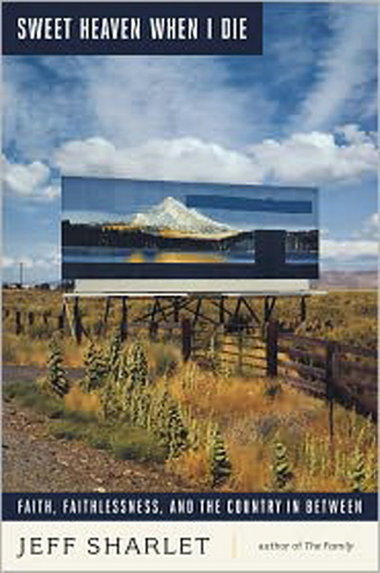
SweetHeavenWhenIDieAs an observer of religion who always struggles to get published, I found a companion soul in Jeff Sharlet’s Sweet Heaven When I Die: Faith, Faithlessness, and the Country In Between. Although the book is a collection of very disparate essays, it shows the subtle faces that religion frequently takes. We’re used to hearing religion described in bombastic terms, but Sharlet is more attuned to its soft rhythms than that. Yes, an essay or two may have a strident believer, but most of the faith found here is so deeply woven into the lives he examines that you might not even notice it was there had Sharlet not already warned you. Here is a man of no particular religious conviction showing us how it is—not judging, not ridiculing, not pandering. Religion, despite the gleeful proclamations of its detractors, is not likely to die out. It is more likely just to go unnoticed.

A number of the essays here gave me pause. In the first Sharlet notes of a friend, “She was fascinated by the thought that God was entitled to kill you at any time.” This friend is, of course, of Christian persuasion. I had never thought of the biblical paradox in that way before—divine entitlement. It is so like Job; the Lord giveth and the Lord taketh away. Christianity, historically, comes with a whole cartload of guilt: not only is God entitled, but we deserve to be killed. The Christianity in which I grew up was explicit about this—we live on borrowed time. As a child I heard more than one evangelist thunder this good news. We really deserve to die. Once we are good and vulnerable, the preacher offers us a way out. Pass around the collection plate. God is entitled; I shall not soon forget that.

Toward the end of the book another of Sharlet’s interviewees declares that doubt is a calling. Again, the professional religionist is stunned. Many religions eschew doubt as somehow evil—wickedly questioning the divine. Doubters, however, seldom cause religious trouble. Those whose convictions lie deep and untested will burst open like a spring-loaded trap at various provocations. Those who survive are left to weep and wonder. The doubter, the friend of Thomas, does not seek to harm, but can’t live without discovering the truth. This is true religion.

There are any number of stories here of persons of various levels of faith conviction. You’ll find few clergy or specialists among them, but you’ll find a book whose honesty cannot be doubted. At points I struggled to find an implicit religious, or faith-based theme. It is there. You just have to listen. And trust that Jeff Sharlet will not lead you astray.


Doubting Peter

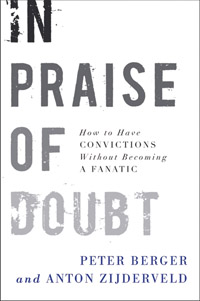
As a student at that university across the river from Harvard, it was clearly a matter of institutional pride that Boston University could claim Peter Berger. He was one that Harvard didn’t manage to get. Of course, I never took any courses with Professor Berger, but his work on sociology of religion is still considered the standard in the field. When his recent book, In Praise of Doubt, appeared a couple of years back, I knew that I had to read it. Originally published by an academic press, it was unnecessarily expensive (well, as the minion of an academic publisher I now realize the rationale for the prices, but I still get spasms in my wallet every time). When it appeared in paperback I finally located a copy that I could justify buying. I was not disappointed.

This little book begins innocuously enough, but by the end you find yourself realizing that you’ve just downed a potent draught. We are all familiar with doubt, but what many of us do not stop to consider is its role in different religious perspectives. Moving us through absolutism and relativism, In Praise of Doubt demonstrates how either position may lead to a “fundamentalism” of sorts, and for the same basic reason: neither position professes enough doubt. Having been raised in a fundamentalist environment, I knew that doubt was the great enemy. Certainty was the only true sign of faithfulness. The problem, for me, is that I’ve always harbored doubts. The more I learned, the less certain I became. Doubt had acquired the stench of sin, and I tried to avoid the very element that constituted my personality. Berger has finally given doubt its due.

In a world of extremists—extreme religionists and extreme atheists—the still, small voice of doubt is frequently drowned out. Doubt, however, has a noble pedigree and even more remarkable progeny: tolerance. Those who are certain tend to have little tolerance for those who differ, or worse, those who challenge their views. The doubter, as Berger (and co-author Anton Zijderveld) asserts, is less spineless than s/he appears, being open to the fact that no one has all the answers. No matter how eloquently Hitchens, Harris, or Dawkins may grow, they do not have all the answers any more than (god help us) Pat Robertson, Rick Warren or Tim Tebow. Probability and logic tend to suggest the former are closer (much closer) to the evidence than the latter, but who knows? It might even be possible that the Evangelical camp may one day learn the virtue of a little uncertainty by reading this book. But frankly, I doubt it.