The Panel

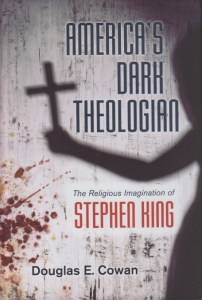
More than one person pointed it out to me, so I guess I must be getting a (small) reputation.  During one of my campus editorial visits I stopped into the center for Religion and American Culture at that venerable institution known as IUPUI—Indiana University Purdue University Indianapolis.  I was immediately impressed and, of course, since I’m no longer in academia I’ve realized that the impact of religion on culture is my real interest in it.  What was pointed out to me, however, was an episode of their “Religion and” series.  This one was held via Zoom and has been posted here, so if you, like me, work, or are just finding out about it, can still see it.  I encourage that behavior.  This particular panel was “Religion and Horror.”
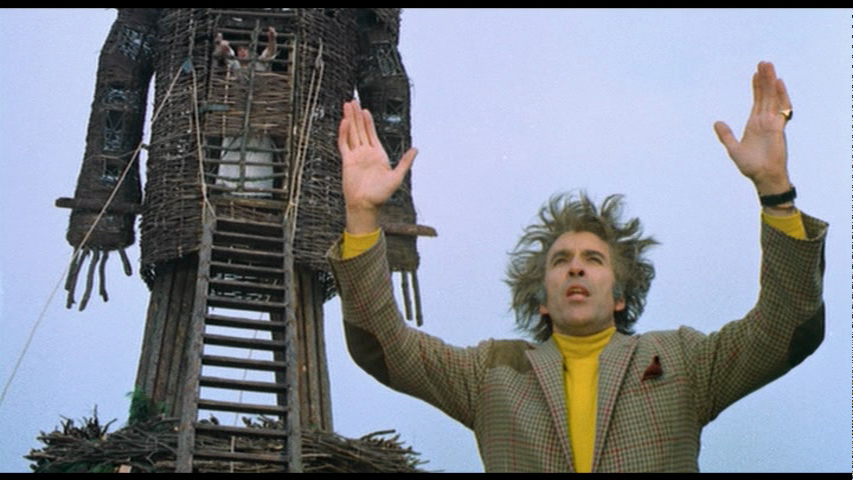
As the word “panel” indicates, it was a moderated group discussion.  The panelists were Douglas E. Cowan of the University of Waterloo, Erika Engstrom of the University of Kentucky School of Journalism and Media, and W. Scott Poole of the College of Charleston.  The moderator was Melissa Borja of the University of Michigan.  What a great way to spend an October afternoon!  It is also good to know that I’m not the only one who’s noticed that religion and horror are similar and even address similar needs.  I’ve read books by Cowan and Poole and have even met the former a couple of times.  No longer a university employee, I largely work in insolation, so it’s great to hear conversation about the kinds of things in my head once in a while.  A number of refrains became obvious during this all-too-brief discussion.

We’ve been conditioned to think of religion as inherently good.  In general, we’ve also been conditioned to think of horror as inherently bad.  As with most black-and-white categories, both of these things get some key points wrong.  Religions, like everything else, have histories.  Those who study those histories learn that much of what’s passed along to believers is intended to make them into repeat, paying customers.  Try teaching in a seminary for a few years and then attempt to dispute that.  And, the panelists pointed out, horror is also a product, intended to sell.  This explains the endless parade of, for example, Halloween movies.  Just when you think you’ve purchased the last one you’ll ever need to buy there’s another.  There was so much squeezed into that one hour that I was glad I was taking notes.  But then, it was a recording—you can see it too, and I urge you to do so.

Forbidden Things

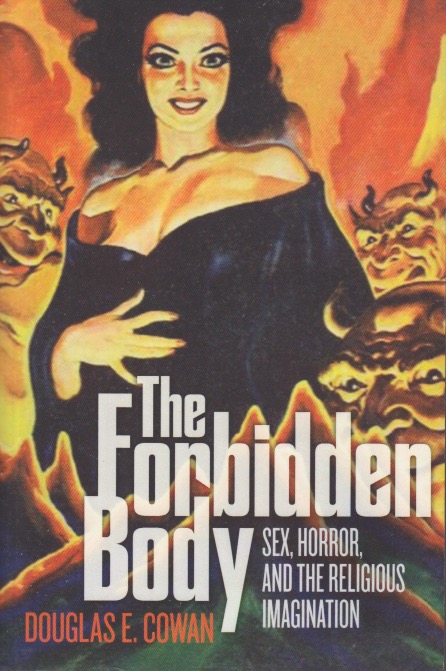
I owe Douglas Cowan a debt of gratitude.  Spending evenings at the American Academy of Religion and Society of Biblical Literature annual meeting curled up with his then new book, Sacred Terror, I was amazed.  Vaguely in the back of my mind I knew that film scholars were writing about horror, but I didn’t know that religion scholars even could.  Of course, later I discovered that Cowan had predecessors, as do we all, but that still didn’t change the fact that he opened my eyes to possibilities.  Being a slow reader with an unrelenting 925, I can’t keep up with any one author’s total output but I knew I’d need to read The Forbidden Body as soon as it was announced.  Subtitled Sex, Horror, and the Religious Imagination, it covers many aspects of what’s being called embodiment studies.  And there are, of course, monsters.

Where he finds the time to read so much and watch so much I can only guess.  This book covers a lot of territory that I can’t even begin to summarize here, but it goes without saying that Cowan’s many observations are worth paying attention to.  If I were to try to find a main theme I think it would be bodies out of place.  At least that what it seems to me.  Bodies out of place can mean many, many things.  Horror isn’t shy, of course, about showing you many of these.  As always, the unexpected part is religion.  Better, religious imagination.  I’ve been trying for years to articulate how religion and horror are related, and this is obviously something I haven’t been the only one pondering.  Cowan offers trenchant thoughts on this and even gives you some glimpses of unexpected monsters along the way.

Horror is often considered puerile, I know.  You get an image of a bunch of guys in business suits or military uniforms shaking your shoulders and saying “grow up!”  But what is it we’re growing up for?  To feed the monster.  So that those who are the monster can pamper their bodies with the luxuries everyone else works to provide.  Religion often serves to motivate those who are on the production end of this scale, but there is a truly Ottoian fear that compels us, lying not so very far beneath the surface.  Religion reaches out to those who encounter the monster.  And those people have bodies.  Cowan touches on many aspects of horror here from Corman to Lovecraft to Sade.  My response, perhaps appropriately, is that my head feels like it’s exploding.  I have so much yet to learn.


Dark Theology

I’ve been struggling for several years, I expect it’s no secret, with how horror and religion relate to one another.  Many think the task itself pointless, as if pop culture can simply be brushed off like an annoying bug.  But flies keep coming back.  They won’t be ignored.  Almost a decade ago I discovered Douglas E. Cowan was also walking this spooky path past the cemetery.  I also know that as an academic he must demonstrate his chops in technical projects.  America’s Dark Theologian: The Religious Imagination of Stephen King was extremely welcomed by me.  Like many people I’ve read some Stephen King.  Like Cowan, I’ve noticed how often and how deeply religion is entangled in his story-worlds.  Before King is simply dismissed, we must reckon with the fact that movies based on his novels and stories have a long  pedigree and almost canonical status.

This is not the place to analyze America’s Dark Theologian in depth, but it is a place that would highly recommend the book.  Cowan takes several aspects of King’s works and shows how they tie explicitly to traditional religious thinking and longing.  I haven’t read nearly all the books Cowan cites here, nevertheless, the analysis he offers is compelling.  Scholars of disciplines outside religious studies have tended to dismiss it as being moribund.  Cowan shows that those who make a living in pop culture disagree.  King makes no bones about the fact that he sees the application not only of religion, but also theology, as one of the driving forces for his fiction.  We dismiss such observations at our peril.  Think of you favorite King novel and ponder; is there religion there?

Clearly religion’s not always the cause, but Cowan gives a careful consideration to much of King’s oeuvre, and there’s no denying he’s onto something.  As he points out, King is far more interested in the questions than in the answers.  Those who know religious studies—theology, if you must—know that the same is true there.  I’ve studied religion my entire intellectual life.  One of the reasons students evaluated my teaching so positively, at least I hope, is that because I encouraged the questions and did not privilege the answers.  In this field, answers are merely speculations.  We only really fall into serious danger when we cease asking questions.  Cowan does an excellent job of parsing out some various pieces that will make some kind of basis for a systematic theology of Stephen King’s thought-worlds.  We would be wise, I believe, to pay attention.


Frightening Faith

sacred-terrorBack when I first started this blog, I regretted that I had read Douglas E. Cowan’s Sacred Terror: Religion and Horror on the Silver Screen so long ago. You see, I try hard to post on a specific book only once—there’s really no rule about that, but I read a lot and don’t like to play favorites. Since it had been a year or two since I’d read it, my memory was a touch hazy about the details at the time. I did a post anyway. Now that we’re in the thick of fall, and my daily commute both begins and ends in darkness, I decided to read it again. This particular book is validating for a guy like me. Many scholars feel they need to apologize for such low brow peccadilloes as watching horror movies. I mean, don’t scholars read all the time? And when they’re not reading, surely they have better things to do with their time than watch cheesy exploitation films? My generation, however, has started to come to terms with this basic disconnect. A few of us have somehow made it past the bouncers.

Cowan’s book is the one I first read that dared make explicit what many of us feel—religion and horror are not so different. As a sociologist of religion Cowan brings a specific lens to the subject, and his book analyzes different societal fears (sociophobics) that these movies address. And even though he admits being a bit squeamish, he brings an impressive number of films to the table. The fears of hoi polloi, it turns out, are often the very same ones religion seeks to redress. After reading his book the first time, my list of must see DVDs grew. The same happened this time around.

It requires a certain maturity of character to both realize and admit that horror meets a deep need. We don’t like to feel vulnerable. More than once, armed with my Ph.D. and years of training my rational faculties, I’ve still ended up sleeping with the lights on. I can tell fact from fiction, but there’s an itch that horror scratches which other genres just can’t reach. As much as I enjoy science fiction on the screen, its debased little brother has fingernails just the right length. As Cowan points out, fear is one of the primal human emotions. The world we’ve constructed hasn’t eliminated fear—although I can’t recall the last time I saw a cougar or wolf in the wild—but has constructed it as more of our own making. In our own image, I might suggest. And since nobody likes to be alone during a scary movie, it gives me some comfort to know that Dr. Cowan is out there, somewhere, watching with me.