
 It would be difficult to suggest an ancient class of people with greater New Age credibility than the druids. Although I spent three years among the Celts, I claim to have no special knowledge of the druids, and when I saw Peter Berresford Ellis’ book on the subject, I decided to learn more. Not really a straightforward history—not enough of the druidic culture survived in any material form for the writing of such a history—Ellis instead summarizes a complex gallimaufry of evidence and speculations into a reasonable facsimile of who the druids might have been. Ellis suggests that the druids were more a caste of society, rather like the Brahmin caste among Vedic culture. Should that seem far-fetched, it would be difficult to read A Brief History of the Druids without noticing the obvious connections between the cultures. The Celts, of which the druids are a subset, have their origins in eastern Europe rather than the usual supposition of a homeland over the sea in Ireland, Scotland, or Wales. Connected to India via a common ancestral language, Indians and Celts both derive from the same Indo-European linguistic family tree.
Ellis’ book is so full of information that it is unwieldy at times, especially for those of us who find the formidable Gaelic names intimidating. Nevertheless, it is an excellent source for learning about the religion of the druids, insofar as it may be reconstructed. One of the most striking aspects of Celtic culture that emerges from the book is how it differed from the Roman culture that would come to dominate the western world. An obvious example is that Celtic society offered a much more enlightened place for female rights and leadership than would emerge along the Tiber. Another important difference was the Celtic antipathy to abuses of private property ownership. Gaelic bishops earned the ire of Rome by declaring that egalitarianism is the will of God. In the words of a fifth century Celtic bishop:
“Do you think yourself Christian if you oppress the poor?… if you enrich yourself by making others poor? If you wring your food from others’ tears? A Christian is [one] who… never allows a poor man to be oppressed when he is by… whose doors are open to all, whose table every poor man knows, whose food is offered to all.” Words a Perry or Bachmann might do well to read.
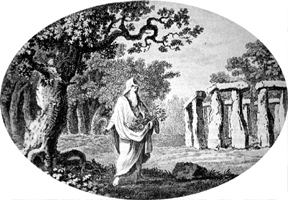
So noble were the druids in the eyes of eighteenth-century antiquarians that many suggested Abraham was the original druid and that the great figures of the Bible were part of the druidic heritage. The world, alas, has gone after Rome instead. Rather than druids we have CEOs and politicians worth a mint before they ever “swear” an oath of office. If the current Celtic revival brings back some powerful druids, perhaps the world might just become a more tolerable place.
 Steve A. Wiggins