Hungry for Choice

I was recently asked to speak to a senior seminar about Holy Horror (many thanks for the invite!).  One of the questions asked was how/why I chose the movies I did.  The same question applies to Nightmares with the Bible.  The thing is, my avocation is an expensive one, particularly on an editor’s salary.  The number of horror movies is vast and our time on this planet is limited, so one thing any researcher has to do is draw limits.  Otherwise you get a never-ending project (some dissertations go that way).  I had figured, for both books, that I’d seen enough movies to make the point I was trying to make.  Neither book was intended to be “the last word,” or comprehensive, but were attempts to open the conversation.  Since none of my books have earned back nearly what resources I’ve put into them, a line has to be drawn.  Movies are expensive when they get to the bottom of the “outgoes” column.
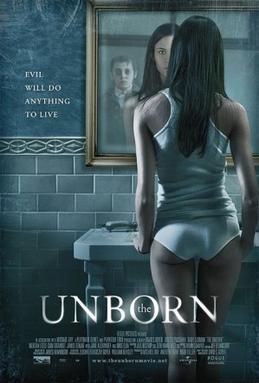
All of this is to explain why I didn’t include The Unborn in either book.  (It fits into both.)  I was aware of the movie, but I had to decide what I could afford in order to get the books written.  I confess that I wish I’d watched this one sooner.  (Remember, it’s a conversation!)   This movie has so much in it that I may break my self-imposed rule of no double-dipping for blog topics.  Or perhaps I’ll pitch something to Horror Homeroom.  The Unborn is about a dybbuk.  Like The Possession, it features a Jewish exorcism.  Like An American Haunting, a holy book is destroyed.  (The credits include a statement that no actual Torahs were harmed in the making of the film.) Interestingly, the exorcism is a joint effort between a rabbi and an Episcopal priest.  Held in an asylum.  It’s also a story about twins.

The skinny: college-aged Casey is being pursued by a three-generation dybbuk.  Her mother, who died by suicide in an asylum, had been adopted.  Casey is unaware that she was a twin, her brother having died in utero.  She discovers her birth grandmother, a Holocaust survivor, who clues her in to why all the strange things are happening to her.  Her own twin brother was possessed by a dybbuk at Auschwitz.  It is now after Casey, having caused her mother’s suicide.  The plot is pretty sprawling, and the exorcism scene over-the-top, but I’m only scratching the surface here.  There’s so much to unpack that I wish I had a bigger movie-and-book budget.  But then we all have our demons with which to struggle.


Strange Worlds

The Bible can lead you astray sometimes. Don’t worry, it’s unintentional, I’m sure. It has less to do with the Bible itself than with the way it was compiled. Any book written over centuries by different people is bound to show some inconsistencies. Unfortunately some of those inconsistencies are about things people really want to know. What happens when you die, for instance. Pretty important to get that one straight. The Bible has shifting views about that, and those views led to ideas such as Heaven, Hell, Purgatory, and reincarnation. Wait, what? Reincarnation? Isn’t that an eastern religion thing? That’s what I always thought. Then I read the provocative Between Worlds: Dybbuks, Exorcists, and Early Modern Judaism by J. H. Chajes. This started for me, as things often do, with a scary movie.

Some time back I watched The Possession. For those of you who haven’t seen it, it regards a Jewish exorcism—based on a true story, it says, but aren’t they all? Now demons exist in the Hebrew Bible, but the monster in this movie wasn’t exactly a demon. It was a dybbuk. Sharing the Gentile liability, I wasn’t aware of what a dybbuk was. A religion professor in the movie tried to explain it, but I had to read a book. Between Worlds seemed the best place to start. What a fascinating book this is! Anyone who’s interested in the history of exorcism, whether Christian or Jewish (and perhaps even Muslim) will find abundant information here. Jewish exorcism? Much of it depends on how one understands the concept of “soul.” It also depends on who’s doing the possessing. A dybbuk is a displaced human soul from someone deceased. If it can’t get into Gehinnom (which Jesus mentions a time or two) it reincarnates into an available body, often sharing it with the resident soul.

From there things only get more unusual. For those of us who know about exorcism from the movie (you know the one I mean) or even from Chick tracts, the idea that a human soul (which can be good or bad, depending) can possess someone is unexpected. The fact that reincarnation developed from the same Bible that gave us Heaven and Hell is equally surprising. I suspect it’s because the Good Book doesn’t give a clear picture of what comes hereafter. The Hebrew Bible has Sheol, and the New Testament adds Heaven, Gehenna, Hell, and the underpinnings of Purgatory—a buyer’s market for the afterlife. With that being the case I suppose it’s to be expected that some spirits prefer to move from house to house. To learn what’s available Chajes is an excellent choice.