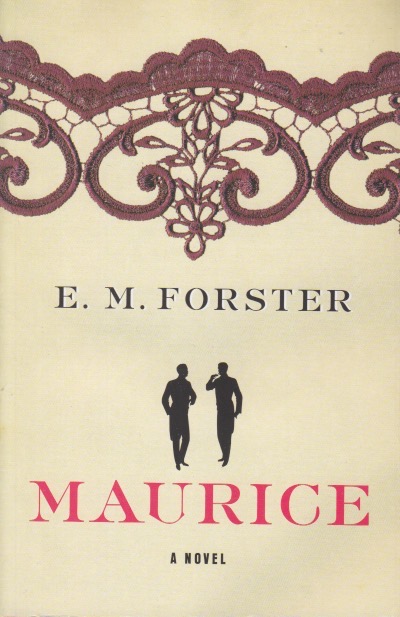
Seeing the Forster

The thing about exploring dark academia is that its recognition is fairly new.  It seems that the “concept” emerged only ten years ago and the longer that it’s around the more sources it gathers, like a dust bunny growing under the bed.  I’ve never read E. M. Forster before, although I’ve seen movies based on his novels.  He was an interesting chap, trying out sci-fi (or at least dystopian fiction) as well as his literary novels.  Maurice was not published during his life because it explored homosexuality.  Forster was gay when it was technically illegal, and this novel reveals much of the struggle faced by homosexuals during the early decades of the twentieth century.  The novel has been cited as an example of dark academia, I suspect because much of the early part takes place in Cambridge.  Although it has a happy ending it’s not an easy novel to read.

Quite apart from the hideous paranoia of society at the time towards any kind of homosexuality, Forster’s style was, for me, difficult to decipher.  I know this is my issue, and not his.  His use of British expressions underscored for me how difficult it is to understand idiom in another culture.  At more than one place I was unsure what the speaker meant because the British slang used was so different from what I encountered living in the UK in the early nineties.  Not that the story is difficult to follow.  It is movingly written, demonstrating the torment of those who realized their orientation as they faced in an intolerant society.  Maurice even tries to “cure” his homosexuality, but efforts fail.  There is a darkness here, appropriate for dark academia.

Forster died in 1970, just when homosexuality was beginning to be understood not as a sickness, but a disposition.  It’s not a choice, and as the animal kingdom tells us, it’s certainly not limited to human beings.  The novel makes note of the fact that Greece, the origin of much of western culture, approved and promoted homosexual relationships.  Maurice is told that he could move to France of Italy where such relationships were not illegal.  There’s no question that the societal stance toward homosexuality was based on particular understandings of biblical texts, some now thoroughly discredited by biblical scholars (Sodom was not destroyed for homosexuality as biblical intertexts clearly show).  Generations of people, including Forster, were put through lives of torment in order to keep a prejudice alive.  Academia may be dark indeed.


Evolving Technology

Speaking of prediction, after yesterday’s post my wife sent me a BBC story entitled “The Machine Stops: Did EM Forster predict the internet age?”. Although the story by Chris Long is classified as Entertainment and Arts, the issues raised are very serious. Vital even. Now I have to admit that I’ve never read E. M. Forster’s work. As much as I love short stories, I tend to use my reading time on novels and non-fiction and Forester’s focus on class distinctions isn’t what I always find the most engaging. Still, as the BBC story makes clear, what makes “The Machine Stops” so important isn’t its “prediction” of the internet, but rather what that envisioned technology does to people. It changes them. One of the unrealized facets of evolution is that our fellow beasts without opposable thumbs have fallen somewhat behind in the race to invent technologies that impact the entire planet in an intrusive way. No atomic bombs have been built by whales. Of course, I’ve always suspected they’re smarter than we are.

With the internet—a kind of accidental technology—we have changed the world for most people. There are still many millions who aren’t constantly wired, but for those of us who’ve allowed ourselves to become assimilated, we can imagine life no other way. I, for one, couldn’t do my job without the web. Well, I suppose I could, but expectations would have to be much, much lower. And my check couldn’t be deposited electronically into an account that I have to take it on faith really exists. Long, in this BBC piece, notes that the poignancy of the story is that being connected by an “internet” changes the nature of human interactions. Anyone who’s shared an elevator with three other people all texting their friends simultaneously knows what I mean. I’ve gone entire days without an actual human being uttering a word to me. And this is while working in a city of 8 million people. Keep the business virtual. Are we not men? (Pardon the gender-based noun; it’s only virtual.)

2015-11-07 18.47.57

I’ve loved and lost many readers on this blog. Those who are perceptive will realize this is merely an electronic voice meant to replace a human one. A voice, if I may be so bold, crying in the webberness. Technology changes us. I bought my first computer to be a glorified typewriter. Now my life revolves around its more evolved descendants. Technology has raised to an even higher level that question that has haunted since technology was no more than a good fire to sit around at night: what is it to be human? Today that answer involves the internet. And I’m not sure if I should be worried or not, but last night I dreamed of electric sheep.