New Hope Nightmare

One of my favorite places along the Delaware River is the town of New Hope.  Across the river is the very nice town of Lambertville, New Jersey, but New Hope has a feel to it.  When I learned that a new horror museum had opened there—Nightmare in New Hope—we scrambled to change plans to get there right away.  We went the Saturday before Easter.  We’d planned to spend some time touring the rest of the town as well since it’d been years since we’d done so.  We managed to find parking and, since the museum opens at one, grabbed some lunch and went to Farley’s Bookshop.  Independent Bookstore Day was actually the following weekend, but bookstores need no special occasion.  Farley’s has changed a lot since our last visit.  It’s smaller (as has happened with many indies) and brighter.  I found plenty to like there, but I did miss the darker, dustier feel to the first incarnation of the store I’d known.
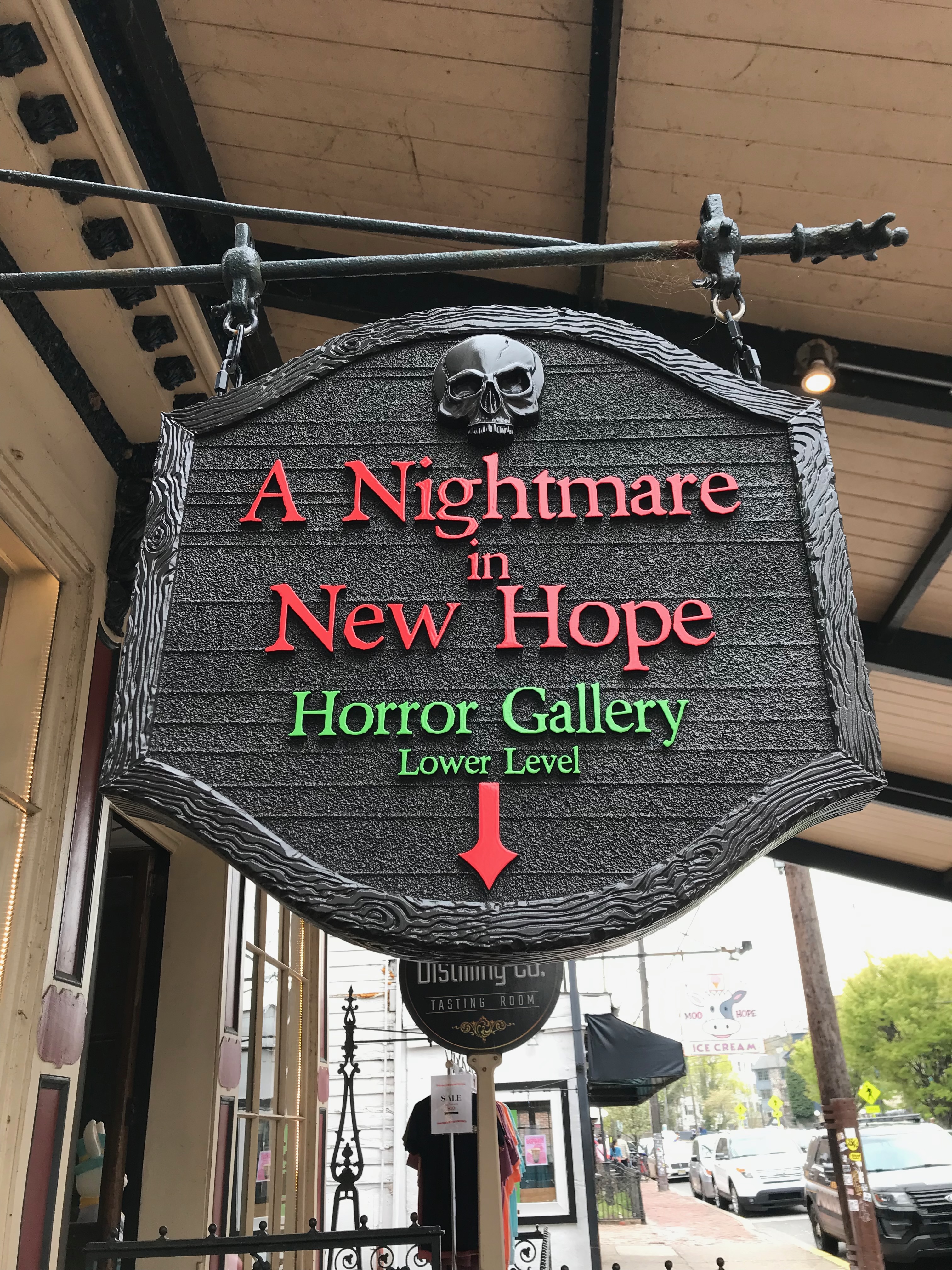
We made our way to Nightmare in New Hope.  And waited.  And waited.  Several people passed by, noting that they’d have gone in if it were open.  One of our party messaged the website since telephoning did nothing.  Eventually the owner indicated that he was closed for Easter.  Of all things.  A horror museum, open only on weekends, closed for the first nice weather we’d had on a weekend?  That was the main reason we’d driven an hour to get there.  We found a place with vegan ice cream and fed the ducks on the river.  I was sad that the main objective of the trip, the museum, hadn’t turned out.  And I knew it would be quite some time before we could try again.

My daughter, knowing my tendency to get depressed over such things, suggested we could go to Peddler’s Village instead.  My wife and daughter had visited it before, and so we decided to round out our Saturday trip there.  Peddler’s Village is a set of speciality shops that was born about the same time that I was.  These days there are about 60 shops with items that may or may not be strictly necessary.  Although we’d been to Farley’s, I couldn’t pass up the Lahaska Bookshop, part of the Village.  It was warm that day and we saw maybe only five or six shops.  At least one of them was an independent bookstore.  Not exactly the day we’d planned, but a day spent in and around New Hope is never wasted.  But really, closed for Easter without even putting a notice on the website?
(See updates here and here.)


Easter Gathering

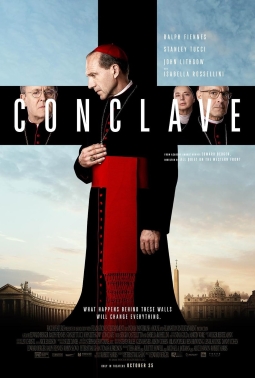
On Easter I’m thinking of Conclave.  My wife had been wanting to see it and we watched it on Good Friday—a work day, of course, in this “Christian” nation.  In any case, it’s fascinating for a couple of reasons.  One is that, as a drama surrounding the election of a new pope, it draws you in.  The politics and intrigue are, I assure you, quite real within in the church.  People are, in seems, incurably political.  Conclave is fiction, of course.  And in reality, very few people are ever admitted to the chambers where a world leader is elected by those priests who’ve risen to the highest levels of church hierarchy.  This fictional reconstruction may give a window into that.  The other reason that I found it so fascinating is that it was quite a box office success for being a movie about a religious subject that isn’t biblical.  Appropriate viewing for Easter weekend.

There were a few striking scenes.  Here’s the outline, though: a pope has died and Cardinal Lawrence is the deacon in charge of the conclave to elect a new one.  Four main candidates exist—one a staunch traditionalist, one a liberal, one an African who is conservative, and the last a moderate American who has a past.  The pope had appointed a new cardinal shortly before his death and some people think he’d make a good pope, despite his relative youth.  One of the striking scenes is Cardinal Lawrence’s homily to open the conclave.  He preaches against certainty.  Not only is this a powerful scene, for some of us watching he is absolutely correct.  Certainty is the death of faith.  That scene alone is worth watching the movie for.  Go ahead, it’s Easter.

The other striking scene is the twist ending, which I won’t reveal here.  Anyone who’s honest and who’s lived long enough to become a pope has secrets.  Not all of them reach to the level of scandal, but the movie also emphasizes that the pope is also a sinner but must be willing to seek forgiveness.  Indeed and amen.  The problem we face today is that, even and perhaps especially in Protestantism, many people look to condemn sinners without realizing their own faults.  The movie points out that even the holiest acknowledged person within Christendom can’t make any claims to perfection.  If we’d all admit that we’re doing the best we can not to offend deity or fellow human being, perhaps there really would be cause to celebrate this Easter.  Even without a conclave.


Easter Fools

One of the most interesting aspects of Easter is its peripatetic nature.  It wanders around the calendar awaiting the first Sunday after the first full moon after the vernal equinox.  By definition it’s always in spring, but it can range widely as to when it actually falls.  This year it meets up with another unusual holiday—one with very uncertain origins.  April Fools’ Day is poorly documented and understudied.  This is one of the reasons I find holidays so fascinating.  Scholars seldom take them seriously and, well, April fools.  Who’s going to look into that?  When working on The Wicker Man (which is about holiday horror), I found there was little to find about April Fools’ Day.  There’s no agreement as to why it’s called that or how it started.  I have a pet theory, but no evidence to back it up.

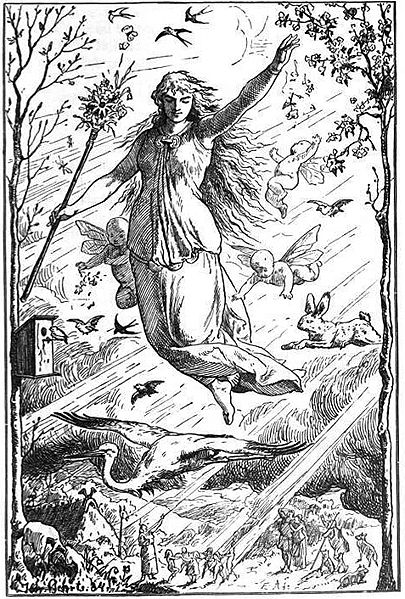
Image credit: Heinrich Vogtherr the Younger, public domain via Wikimedia Commons

We tend to think of April Fools’ as a day for practical jokes.  Indeed, the horror movie based on it is a big, long practical joke.  I wonder, however, if it goes back to my other old avocation, the weather.  The weather led me to write a book as well, of course.  For those in the northern hemisphere—particularly up in the more temperate parts of that hemisphere—April can indeed fool.  Around here it’s been decidedly cool for spring after a real warm spell a couple weeks back.  One year while living in Wisconsin we took a family trip for my wife’s mid-April birthday only to end up playing mini-golf in the snow.  April fools, you see.  We’re not out of the woods yet, regarding winter.  This understanding of seasons makes me think April Fools’ Day evolved from a statement about the weather.

Irish Celts believed spring began at Imbolc, at the start of February.  In that viewpoint, summer begins on May Day (Beltane), just a month away.  Now that Easter has fallen on the last day of March we’re left with an April bereft of official holidays, other than April Fools’ Day.  In fact, work-wise it’s a barren period from Presidents Day, in mid February, through Memorial Day at the end of May.  Just as the weather’s warming up to make the occasional long walk through the woods a magical journey of discovery, we’re confined to our offices—virtual or physical—gazing longingly out the window as nature invites us out to play.  Well, April fools, does it not?


What Would Ostara Say?

Easter is an uneven holiday.  In Britain it leads to days off work.  In the US, which prides itself on being religious, it’s business as usual.  Nobody closes for any days surrounding the holiest day of the Christian year.  That irony has always struck me about this season.  Of course, going to college there were breaks in the spring, and at a Christian school, special observances for sacred times.  In seminary it goes without saying.  In my case, working on a doctorate in the UK (an activity with few true breaks), we experienced the British sense of holidays surrounding Easter.  At Nashotah House you simply couldn’t miss it.  In fact, the Triduum was a contest of endurance with late night services and hours and hours in chapel.  Once I was forced into secular life, the shift was blinding.

Capitalism rolls right over Easter without even slowing down.  Who brakes for a Sunday holiday?  I am a believer in significant days.  I write about holiday horror, and holidays in general, because I’m certain of their importance.  The relentless pursuit of gain that is the American way is wearying.  Most everyone I know who isn’t retired is just plain tired.  Tired all the time.  We’re given few pauses and fed many worries.  So much so that resurrection from the dead can feel like something scary indeed.  Will work in the afterlife be as unrelenting as it is in this one?  All of this becomes especially evident to me on years like this one where Easter creeps up on me.  Not a fixed day in the calendar, sometimes you don’t even look up until you’re practically on top of it.

I remember in high school spending practically all day on Good Friday in church.  When working at Ritz Camera (after seminary, trying to stay ahead of student loan payments), managers looked at you funny if you asked for it off.  You see, I need spiritual time to recover from the onslaught of work.  Easter, however, is just another Sunday.  Watched on Zoom, with maybe special music.  If you’re able to be there in person there may be lilies with their distinctive Pascal scent.  Then the next day it’s back to work as usual.  Thinking about Easter always make me think about hearts being where the treasure is located.  When we take treasure too literally, it leads to too much work.  My mind, I fear, is that of a professor, with built in spring break.  And semester breaks.  Not exactly holidays, but unstructured time to catch up on work.  Holy days.


Balance

Spring came early this year.  I’m not talking about Punxsutawney Phil, but rather the fact that a leap year shifts the vernal equinox a day forward.  According to experts, spring begins today.  In The Wicker Man (it’s about oh so much more than the movie!) I discuss the seasonal holidays of the Celts.  The vernal equinox was surely known, but the beginning of spring was understood to be Imbolc, around February 2.  Since their summer began on May Day (thus the eponymous Wicker Man), the equinox was halfway through spring.  Modern paganism traces the equinox celebrations back to Ostara.  The day takes its name from the germanic goddess Ēostre, who also gave her name to Easter.  The holidays were intertwined, just as Christmas was entangled with Yule.

I find the equinoxes and solstices times for a spiritual pause.  Sure, there’s the simple astronomical fact of equality of light and dark, but there’s also something more.  Something that feels cosmic and that helps direct our destiny.  From now on there will be more light than dark.  But only for six months.  Even with Daylight Saving Time, our capture of light is of limited duration.  It makes sense to make use of the light while we have it.  Of course, those of us who rise early end up falling asleep before dark, but even so it’s starting to get lighter in the mornings again.  The equinox is a time for reflection.  And like most times for reflection, business doesn’t recognize it as a holiday.  Who ever heard of a holiday on a Tuesday?

The thing about spiritual messages is that they often come to you rather than the other way around.  At certain times, however, conditions are just right for something to break through.  It does require some listening, however.  So today, as nature holds everything in balance, try to take an unrushed moment to ponder.  For some of us it may come before the fury of work tears through our peaceful meditations, while for others it may come with the calm that five o’clock brings.  However we find it, this is a special time because this day is unusual.  It is a time of balance.  We all know how rare such things are in life in a topsy-turvy world.  The earliest flowers are already blooming around here, suggesting that as light increases so will hope greet us, if we watch for it.  The world is full of wonder, and an equinox is a time to look for it.


Holiday Hopping

Weekends in spring are like touching base.  They’re the only places you can’t be tagged out and you run from one to the next, hoping not to get caught.  Our British colleagues, more secular than we, tend to have both Good Friday and Easter Monday off work.  Religious America grins that Easter’s always on a Sunday so nobody has to be given any time off.  This disparity has long played into my fascination with holidays.  After generously giving you off both Christmas and New Years—within a week of each other!—the typical US company will throw a long weekend or two into January and February, but then won’t let you out of sight until the end of May.  And this is just as the weather is warming up and we’re wanting to be outdoors a bit more.  On weekends only, of course.

Holidays are a religious idea.  We have the various world religions to thank for them.  The idea of sacred time was, once upon a time, taken seriously.  And nothing is more secular than business.  World religions gave us the concept of weekends and the little breaks that we take from doing the same stultifying thing day after blessed day.  The more enlightened of companies have decided, after senior-level employees have accumulated days off with years of service, that adding extra days for every decade of servitude isn’t really fair and stop the practice.  So we find ourselves in that strange day between Good Friday (a work day) and Easter (thankfully, a Sunday), and thinking, “you know I could really use a break about now.”  We cast a weather eye toward Memorial Day while dreaming Beltane dreams.

My personal fascination with holidays really kicked off when beginning 925 work.  I don’t mind long work hours if it’s a vocation rather than a job.  When the relationship’s purely economic, however, you begin to miss the time to regenerate.  We remember someone died yesterday, too—we’re told—liberate us.  Tomorrow amid lily scent we’re informed he came back.  The rest of us, however, look at the clock and know that despite world-changing events we’ll be back at our desks on Monday since, well, what do you think we’re paying you for?  Don’t try pointing across the Atlantic, either.  They’re burdened with holidays and we’ve been liberated to capitalism.  And what are you doing, reading this blog on a Saturday?  I am most honored and grateful.  And I hope you have some time to rest, since it’s still a long way to the last Monday in May.


Balance

Psych!  Yesterday was actually the vernal equinox.  And speaking of psychs, it was about the coldest morning jog I’ve had all winter.  (The equinox itself didn’t occur until 5:24 p.m., which is way it was the 20th instead of the 21st.  And I honestly can’t understand how that works since don’t you need 24 hours for night and day to be equal?  There’s a reason I went into the humanities.)  Interestingly, in the pagan Wheel of the Year, it was Ostara.  And the similarity of that title to Easter isn’t really coincidence.  (By the by, I discuss this to some extent in The Wicker Man, due out in September.)  Easter is, in essence, a spring holiday.  Ēostre, a germanic goddess of spring, seems to have been its namesake. 

First light comes suddenly, for those awake early enough to see it.  I keep a close eye on the diminishing darkness so that I can get out and jog in the twilight.  It will be too dusky to see and then suddenly it’s not.  Sunrise is like an epiphany each day.  From now on light will increase both morning and evening until the summer solstice, or Midsummer.  Between Ostara and Midsummer lies May Day, or, as it was also known, Beltane.  Beltane is the fuel behind The Wicker Man, or so I argue in my book.  Holidays are important.  More of them should be recognized.  If the pandemic taught us anything it’s that most of us probably work too hard.  At any rate, spring is now here.

The mornings are still below freezing, at least around here.  The winter never got very cold and we had very little snow.  Some would argue that it was more like an extended, chilly spring.  The light, however, was missing.  I spend a lot of time awake in the predawn hours.  There’s a stillness to that time that’s a daily gift.  Yesterday was a brief moment of balance.  Soon it will be time to start mowing the lawn and to do the endless weeding of summer.  Those will last until long after the other equinox, awaiting in September.  Climate change has assured us that the weather will be erratic, but the waxing and waning of the light is as old as the spinning of this weary planet.  We’ve entered the light half of the year.  Equinoxes remind us that balance is rare and should be appreciated when it arrives.  It’s worth making into a holiday once more.


Easter Weather

The weather doesn’t always cooperate for holidays.  Easter is, at heart, a celebration of spring—life after death.  Around here this holiday has been accompanied by fits and starts in warmer weather and instead of warmer it’s actually colder again.  Just a week ago there was snow in the air.  Life’s that way; you don’t always know what to expect.  I guess I’m still in hibernation mode.  No matter the season, there never seems to be enough time to sleep.  As a youth I always attended sunrise services on Easter.  These days I regularly rise before the sun, so as long as I’m capable it’s like every day is Easter.  But with work.  Even on what many recognize as Easter—which overlaps with Passover this year—the Orthodox feel we have it too early, what with the Julian calendar still being in effect.  It’s all a matter of how we look at time.

As much as I hate mowing, I admire the exuberance of grass.  It’s ready to welcome the longer days by stretching toward the sun.  Drinking in the plenteous rain.  The dandelions have already begun to spread, opening their yellow eyes to all and sundry passing insects.  Easter is a time to reflect on life returning after winter.  And I can’t help but think of those in the southern hemisphere for which Easter falls in the autumn.  The theology fails to match the seasons as life springs up just as winter is about to set in.  The Christian viewpoint is a northern one, keyed to our seasons.  The weather doesn’t always observe the prevailing theology.

Around here Good Friday was a fine, sunny day.  Like most of the fine, sunny days it was a work day.  Now it’s a chillier Easter, the Saturday between being a mix with some rain.  When I was young—eagerly awaking for sunrise services, which I often had a hand in designing—I marveled at how the weather often seemed to cooperate.  Now as I think back, I remember coming out of Good Friday services into the incongruous sunshine and finding many an Easter still bearing an unseasonal chill.  Weather is, of course, a local and global phenomenon.  One person’s chilly Easter is too hot for someone further away.  And for yet others the onset of autumn.  Globalism has taught us to look further, to think in terms of how others might be experiencing this world.  Easter seems an appropriate time to do just that.


Spring Holidays

March and April, despite having their holidays, tend to be months of pretty solid capitalistic work.  Congress may take its April recess and universities have their spring break, but the working stiffs just keep going.  I’ve worked for a couple of British companies and they have a dilemma in the Human Resources department.  Britain has a lot more days off per year than American business practice does.  The dilemma?  How to tell your colonials that the head offices will be closed around Easter when those of the New World will remain open.  You see, very few American companies recognize what some Christians call Holy Week as a time for anything other than work.  Back in the days when I was still trying to work myself into the Episcopal priesthood, I had to ask my manager for Good Friday off and permission was only reluctantly given.

The two major Christian holidays of Christmas and Easter are vastly different in their public expression.  Despite the outlook of Scrooge, most companies consider Christmas a holiday, even to the point of giving you a Friday or Monday off if it falls on a weekend.  A present, as it were.  Easter, on the other hand, reliably falls on a Sunday.  Viewed in isolation there’s no need to give people any days off.  Since I was a teen, however, I took Maundy Thursday and Good Friday seriously.  You were, even in the Methodist church, encouraged to spend the latter in church, especially around the middle of the day.  If at all possible, it should be raining.  It wasn’t a day off for rest and relaxation, but for contemplating sin and its costs (hardly conducive to capitalism).

Universities, however, have tended to shift spring break to St. Patrick’s Day so as to get the damage of drunken students off campus.  Indeed, Purim, the Jewish spring holiday, also advocates drinking until Haman and Mordecai become indistinguishable when spoken.  Sort of like Hamilton, it was the holiday that saved the book of Esther, just like the Broadway show preserved the ten-dollar bill.  When it comes to business, however, Americans are all business.  (Did someone  mention a ten-dollar bill?!)  Money, as MC reminds us, makes the vorld go round.  And holidays are viewed as constant interruptions.  The typical work calendar will have no holidays from President’s Day in February until Memorial Day at the end of May.  It’s typically the longest stretch without a paid holiday.  Just when the weather’s starting to get nicer.  But let’s not forget, money is fully in charge here, for where your treasure is, there your heart shall be also.


Spring Forward

Spring officially arrives in the northern hemisphere today.  Days will be longer than nights for six months after this and many pagans will be celebrating Ostara.  Named after Ēostre, the goddess who apparently gave Easter its name, Ostara is an amalgam of the various equinox feasts and observations of antiquity.  The ancient Celts, as far as we know, held four particular holidays that fall roughly halfway between the solstices and equinoxes, with February marking Imbolc and Beltane yet to come in May.  We don’t know that they celebrated the equinox, but we don’t know that they didn’t either.  Equinoxes are a bit difficult to measure precisely with the sun’s position overhead, but we know the clever folks responsible for Stonehenge and Maes Howe could do such things, even in antiquity.

Ostara, maybe

According to Bede the Anglo-Saxons had several feasts for the goddess Ēostre.  Luckily (from his perspective), Christians had Pascha (Easter) some time near the equinox.  It’s late this year, however, since we just had the full moon (the “Worm Moon”) on Friday.  Easter is the first Sunday after the first full moon after the vernal equinox.  So today we’ve got Ēostre.  We know little of her beyond Bede.  Ancient Germanic peoples, like the ancient Celts, didn’t keep extensive written records.  Their religions, based on what we know of most ancient religions, were likely lively affairs.  Spring is a celebratory season and already buds and blossoms are appearing around here.  Goddess or no, there’s a feminine wonderment about the season.  It’s difficult not to feel at least a little hopeful.

Ancient deities have long been a source of fascination.  Eclipsed by an aggressively political Christianity, many of them vanished without leaving us many traces at all.  The human mind seems inclined to create gods to explain this strange but wonderful world we inhabit.  It’s clear that it wasn’t made just for us.  The birds and insects, and even the elusive reptiles and amphibians, are beginning to reappear.  Many mammals and some birds rough it through the cold hoping to emerge again into the warmth of spring.  We’ve had some warm days already, but there are likely more cold ones to come.  As the pagan gods, as Ēostre remind(s) us, transitions come in fits and starts.  Setbacks are part of progress.  Many of us believe the moral arc of the universe tends toward what is good and right.  It may take a long time to arrive, but the equinox, in its very name, bears the clue.


Naming Easter

Today, for some, it’s Easter.  Others call the day Pascha, after the Hebrew word pasach, or “Passover.”  At its deepest roots it is a spring celebration timed around the vernal equinox.  The name “Easter,” however, has an interesting story.  All the more so for having missing parts.  There was apparently an Anglo-Saxon goddess named Eostre.  Since these Teutonic peoples didn’t have their own archives we only learn about the April festival dedicated to this dawn goddess from the Venerable Bede.  Being venerable, we tend to trust him.  He tells us that what is called Pascha used to be called Easter because of the goddess and her celebrations.  We’re often left, however, with not enough information about the deities of old Europe because, ironically, literacy had not come to them.

As we move into what publishers are calling post-literary culture, I have to wonder at the losses that will mean for the future.  We all know, deep down, that electronic media are ephemeral.  We just hope our bank accounts stay viable until we die so we don’t run out of money.  In any case, Easter is a good illustration of what historians and those interested in the development of ideas have to do when few written records exist.  We look at artifacts and images and make our best guess.  This is clearly evident in the field of studies of another goddess—Asherah—upon whom I lavished my dissertation.  We do have some written records, but for many scholars they aren’t enough.  We guess that this or that image might be of her, although they’re not labelled.  A similar problem applies to Eostre.

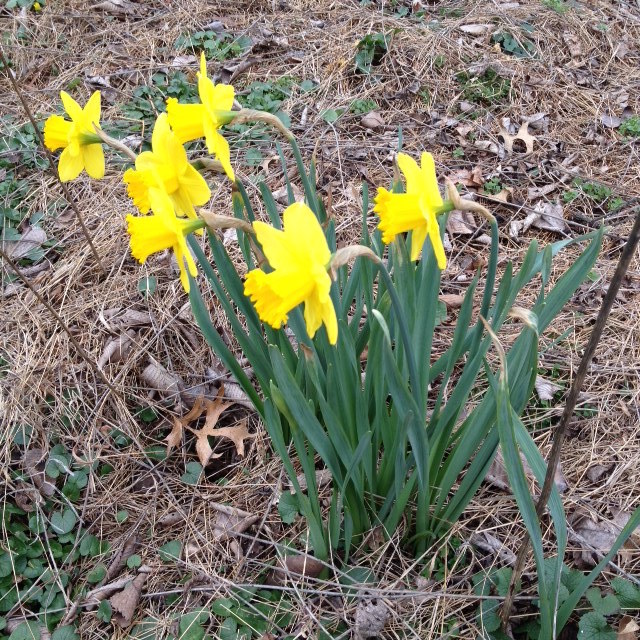
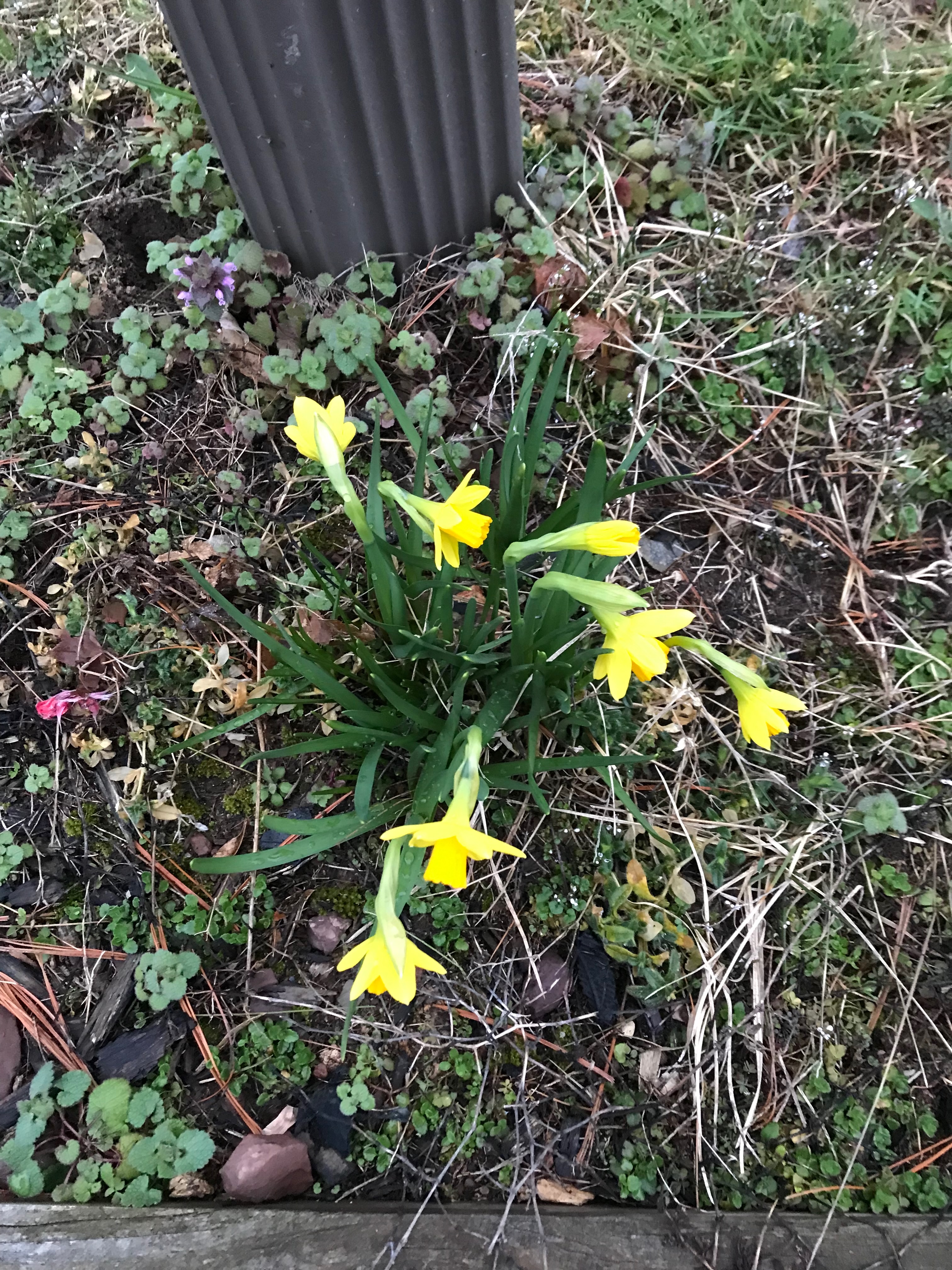
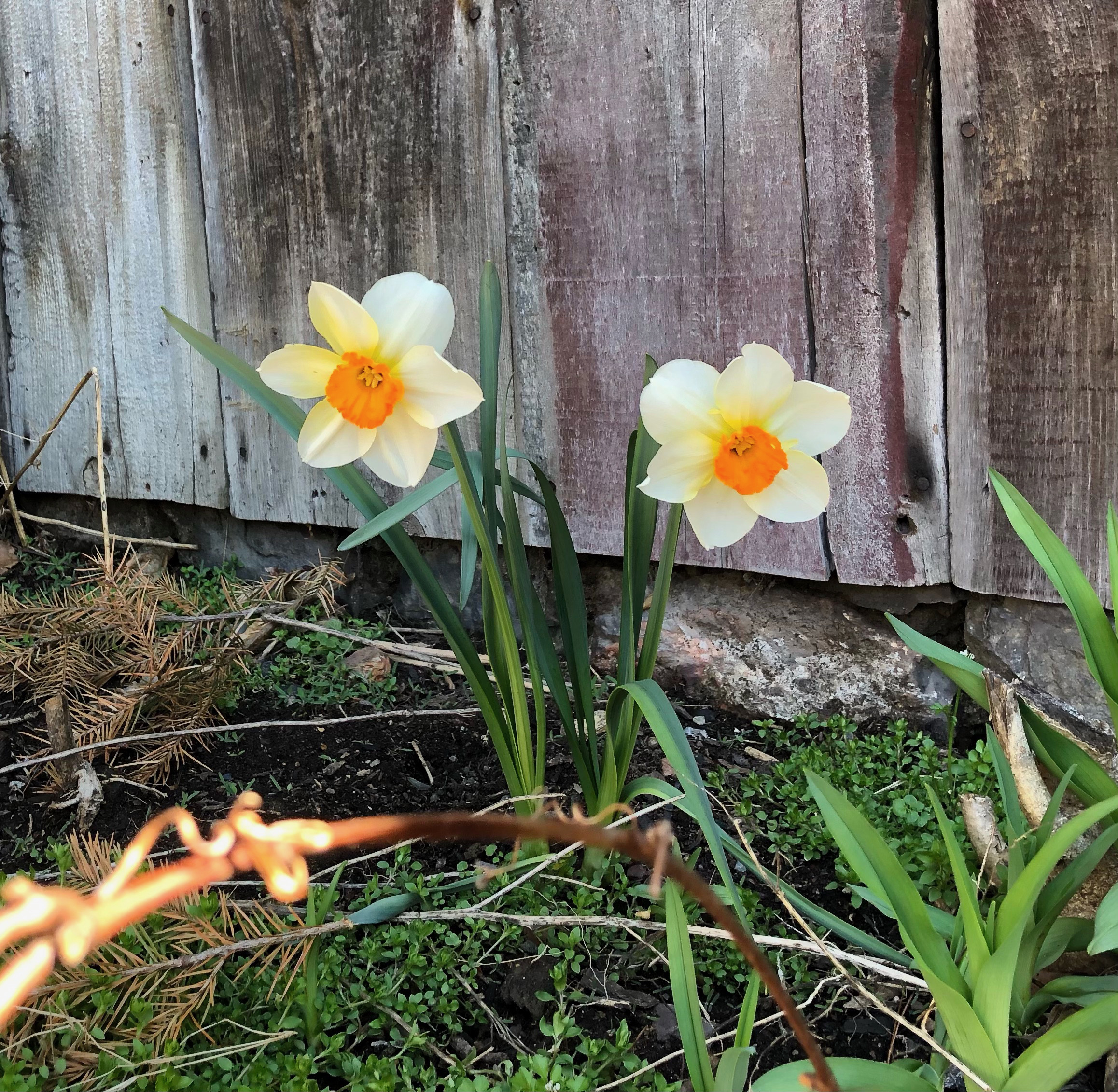
There is little doubt that a goddess named Eostre existed.  It makes perfect sense that she would be celebrated in April.  Before Daylight Saving Time was invented, it was light around 5 a.m. this time of year.  For early birds (historically we were in the majority) it would’ve been obvious.  The goddess of the dawn is coming back to us.  Shining in our eyes as we try to pry a little more slumber from a shortening night.  Early Christians tended to adapt rather than to reject  non-Christian celebrations.  The name of Easter is yet another of those conveniences.  Although it snowed a little around here on what some call Maundy Thursday, today Easter is here to remind us of resurrection.  Life does return and our daffodils, although they may be shivering, have bravely broken through the sod to greet the dawn.


Whose Holiday?

I write a lot about holidays.  One of the reasons is that even long before capitalism, societies took breaks right in the middle of things.  One of the major seasons of celebration was the vernal equinox.  Easter is tied to Passover, of course, but since nobody knows the year of Jesus’ crucifixion the actual date can’t be determined.  Passover is a moveable feast and since the lunar calendar is essential in setting Passover’s date, Easter is calculated as being the first Sunday after the first full moon after the vernal equinox.  There has been talk of the three major branches of Christianity—Catholic, Orthodox, and Protestant—agreeing on a set date for Easter but even if that happened there would be splinter groups who liked it the old way and the confusion would only grow.

Since astronomical observation has grown so mathematical, the date of Easter can be calculated far into the future.  We know just when the vernal equinox will occur, and we know when the full moon will come around.  All that’s needed is some calendars and a whole lot of patience (and maybe a calculator).  Despite society’s obvious preference for Christmas, Easter has its own array of attendant holidays for some Christians.  (Not all Christians celebrate Easter.)  For instance, for some today is Maundy Thursday.  Tomorrow most will recognize as Good Friday.  Nobody’s quite sure what to call Saturday, and many Christians will begin to celebrate Easter at midnight even before Sunday wakes up.  Easter does last more than a single day, in some traditions, but it’s not quite as developed as the twelve days of Christmas.

Lately I’ve been considering that how these holy days are sacred for some and secular for others.  One of the realizations that globalization has wrought is that not everybody shares the same concepts of how universal events—such as the vernal equinox—should be commemorated.  Although on the equator every day’s not quite an equinox due to the earth’s tilt, it isn’t as dramatic as the changes that occur in temperate zones.  Christianity was custom-built for European holidays, which is what it tends to keep.  The history of the holidays is more complex than it might seem at first.  Add to that widespread disagreement around the world as to both religion and to when certain events should be calculated and you’ll need more than a slide-rule to figure it out.  So as we begin the Catholic and Protestant Easter season (Orthodox Easter is about a month away yet), it may be helpful to remind ourselves that what day it is might just be a matter of perspective.

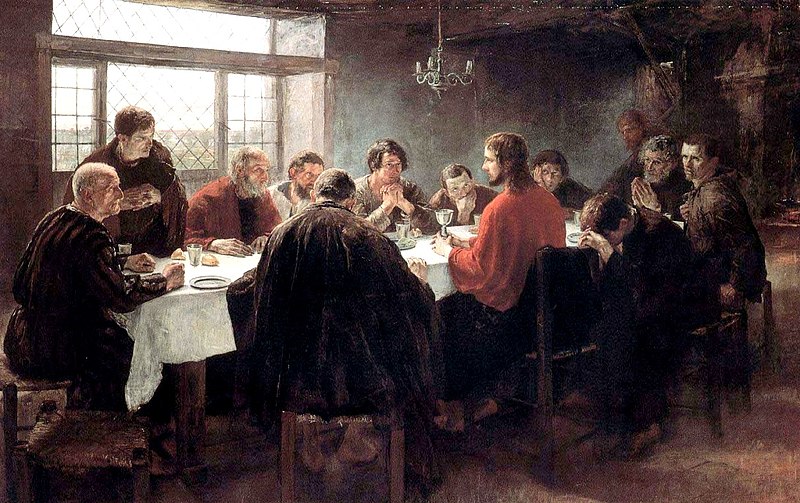
Stiftung Gertrud Schnürle 1975, Fritz von Uhde, The Last Supper, via Wikimedia Commons


Holy or un?

It’s either brave or stupid.  Maybe both.  Writing about a movie you haven’t watched, I mean.  Multiple people (do I have a reputation, or what?) have pointed out to me that Good Friday (for some) is the release date for The Unholy.  Since Good Friday’s a week away I guess we’re getting an early start this year.  The Unholy is a new horror movie and although I try not to watch trailers before seeing a movie—too many of them show too much in advance—I already have a sense of what it’s about.  This post isn’t really about the movie, however.  It’s about the bigger issue.  The concern many have is that it’s being released on Good Friday.  One thing I’ve learned is that to get attention you have to shock people, no, Donald?  Getting noticed is difficult and outrage generally works.

Friday, for many, is movie night.  Good Friday is, for some Christians, a day for church.  I’ve yet to have an employer (other than Nashotah House) that recognized it as a special day at all.  Easter always falls on Sunday so there’s no need to give time off work, at least in this capitalist, Christian culture.  But if you try to release a horror movie that day, people notice.  Mel Gibson knew that crucifixion could make the basis of a horror film, and people noticed.  Sitting over here in the backwaters just outside academe, I took to horror as a means of keeping my book writing active.  One reason was that horror gets people’s attention.  (It also helps if your books are reasonably priced.)

As a young man I used to spend a good deal of Good Friday in church.  Since I was serious about school I’m thinking we probably had the day off in my district.  Attending a Christian college, followed by seminary, I suspect these also paid attention to the liturgical year.  Then in the real world I learned the truth—it’s just another day.  A day for going to work and increasing the profits for whatever company may have hired you.  When the day’s over you’ll be inclined to relax, and perhaps watch a movie.  Right now going to a theater opens the possibility for horror itself so I won’t be there on opening night for The Unholy, but I think there was some savvy thinking going on, in any case.  And it may just be that the movie was titled specifically to fit the occasion.


Being Equal Again

Things creep up on you.  Like the equinox.  It really should be a holiday, but then again today’s already Saturday.  And from today, for the next six months, there will be more light than darkness.  It was an occasion ancient cultures marked and celebrated.  For us, unless it happens to fall near Easter (it’s still a couple weeks away this year), it’s an item in the news feed and nothing more.  It is, however, an opportunity to celebrate our place in nature.  The temperatures are beginning to warm just a bit around here, despite the flecks of snow in the air just three days ago.  The more tenacious of the spring perennials have already begun to shine green.  Things have begun to come back to life.  That’s why Easter is always in the spring.

Today it will be light as much as it is dark.  Balance.  Our old wobbly earth strikes this metaphorical fulcrum twice a year, giving us a glimpse of what lies ahead.  Birds, those great prognosticators, have been showing up to let us know things are about to change.  Finches, robins, starlings, and mourning doves have been conspicuous the last few days.  Even as the dirty, icy snow piles continue to hold on in their private mountains, they too seem to know time has come to be moving on.  Change is the way of nature.  This just happens to be the half of the year when we can see what we’re doing.  At this great balancing point of the year we should take the opportunity to ask if we like where we’re heading.  Do we welcome the light?

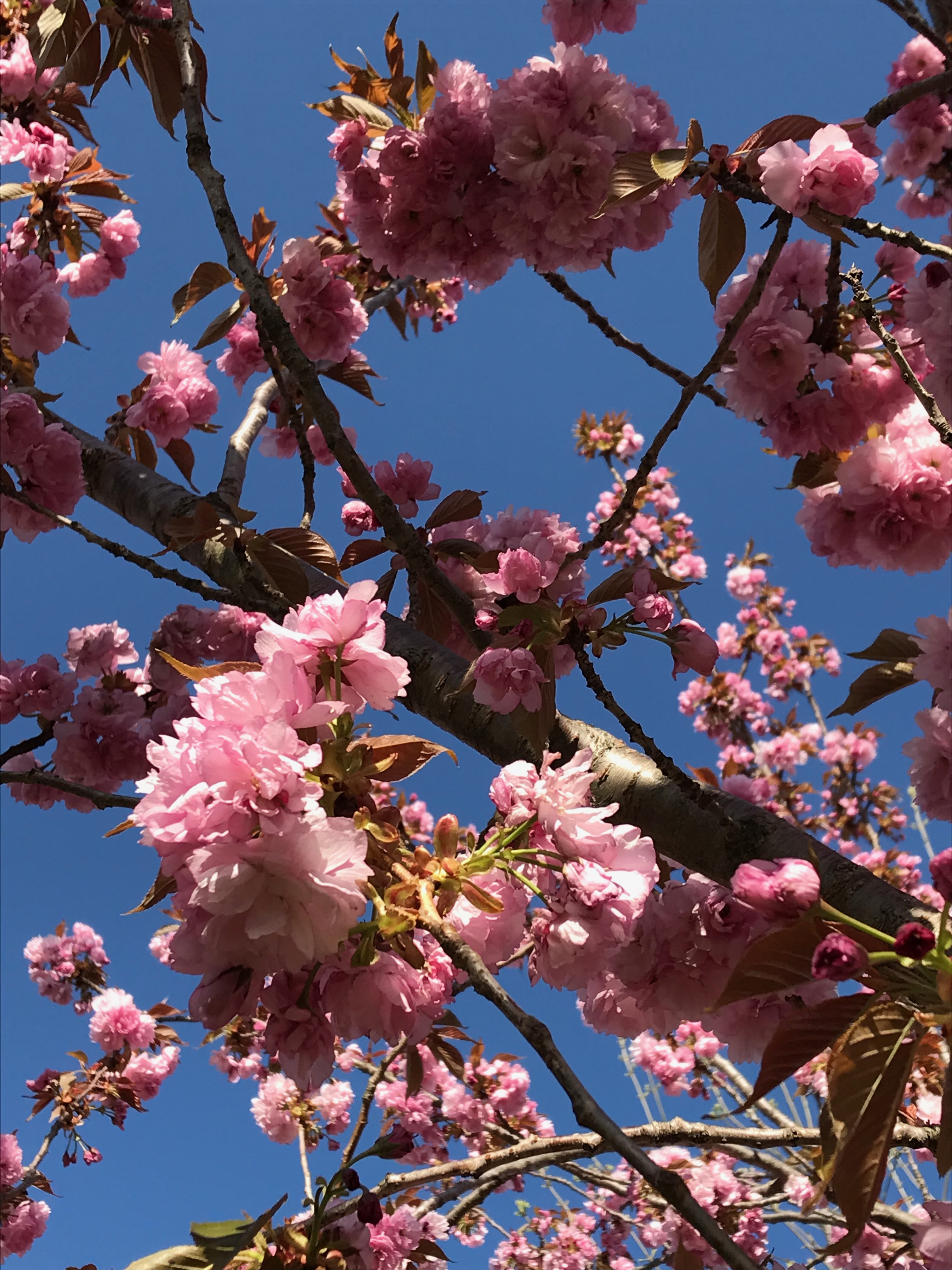
Soon enough we’ll begin to take it for granted.  Life will continue its busy ways even as we tell ourselves summer is the time for vacations.  Perhaps so.  But let’s linger in this moment.  Take a few minutes to ponder what it means to be in balance.  Equality.  It feels like something worth celebrating.  Corporate American parsimoniously counts days that might be considered grudging respites from trying to cop a profit.  Although we’re given Christmas off it can’t abide that moving target called Easter, which always comes on a Sunday anyway.  Here in that calendrical holiday barren zone between Presidents’ and Memorial days, we’ll always find spring, if we look for it.  It’s evident in the changing of the light, even if there’s still a chill in the air.  Even as our bosses ignore it, the red buds begin to appear on the trees.


Cancelled Easter

The year they cancelled Easter.  Well, not exactly.  Perhaps I’m merely a product of the commercialization of my time, but my thoughts go back to the Grinch.  “It came without boxes,” he said, “it came without bags” (and any more might be copyright infringement).  You get the point—holidays aren’t reliant upon their trappings.  Can Easter come without colorful eggs?  Without baskets and bonnets?  Without Peeps and chocolates?  Yes, it can.  We’ve taken another holiday with religious origins and associated it with what you can buy.  I know it’s more than that for some people.  It’s singing stirring hymns (all of which can be found on YouTube), and dressing nice (which can still be  done at home), but mainly I think it’s the sense of togetherness that’s missing.  The freedom of bursting from our personal tombs in which we’ve been stuck for three weeks.

Around here snow was falling on Good Friday.  A friend told me her company decided since everyone was working remotely they would give them an extra holiday that day.  Others of us slogged on as usual, for unlike Christmas, the Easter/Passover complex is not about getting days off work.  These are, I guess, working class holidays.  Our capitalistic outlook wants us to spend money, though, on holidays.  Halloween (on which I foresee a plethora of plague doctor costumes) has become almost as lucrative as Christmas.  The spring holidays—St. Valentine’s, St. Patrick’s, and Easter—encourage spending as well.  Can we not get to the heart of a holiday without pulling out our wallets?  Spring holidays are all about the return of life after winter.  It was snowing, but I could hear lawnmowers in the distance.

With capitalism growing old and sluggish, the next spending holiday isn’t until Mother’s Day, yet another spring celebration associated with flowers and life.  My wife has been saying that what she misses is being out to see things coming back to life in spring.  Some of the trees are putting on quite a show already.  Magnolias and dogwoods have started to scatter their petals with the snowflakes.  Our daffodils have been blooming since March.  The forsythias are already going green.  Life is returning.  That’s what Easter, and in its own way Passover, is all about.  Life after imprisonment—freedom.  Liberation.  We have to put them off this year, but they’re all movable feasts.  We keep quietly apart in the hopes that life really will return after disease and death.  And it will come regardless.  It always does.