Fly by Night

Nightwing is a movie I learned about by reading Stephen King’s Danse Macabre.  The idea has merit but falls below the expected level of any horror film of the era—and I’m a fan of seventies horror.  Those in the know suggest that this was supposed to be Jaws with vampire bats in the era when horror movies started to re-realize the dangerous potential of nature itself.  A basic problem underlies the dull pacing, non-indigenous actors playing Indians, and fatally overstuffed plot: vampire bats aren’t dangerous.  Bats are highly advantageous to the ecosystems in which they thrive and the idea that six or seven bites could drain a person of blood is ridiculous on the surface and looks rather silly in execution.  At least the later movie Bats (also bad) had genetically mutated mammals.  Eco-horror can be effective.  Natural bats are difficult villains, though.  
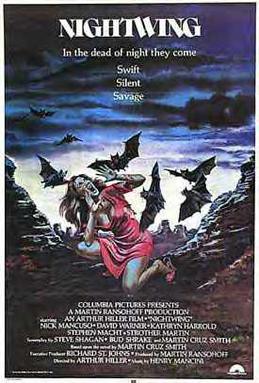
So, on Hopi lands an elderly priest summons the end of the world.  Releasing a god, the bats form the precursor to a native apocalypse.  Two tribes with differing views of white drilling rights on their lands argue over this while killer vampire bats attack.  They kill a group of Quaker missionaries.  Luckily, a British vampire bat killer is after the swarm.  He travels around killing bats, which, he says, are pure evil.  The deputy of the “good” tribe, which resists white incursion, eventually teams up with the bat killer because he saved his girlfriend who was going to leave him for medical school.  For some reason, two kinds of plague (including bubonic) are released but when the tribal priests all die during a rain dance it’s because of natural causes.  The leaders of the two tribes keep trying to catch each other out.

As the movie plods along, making the viewer root for the bats, the several dropped plot lines are left dangling like so many participles at the end.  The plagues?  Red herrings.  The tribal conflict?  Unresolved.  The special poison brought in to kill the bats?  Unused.  Total number of people killed to justify a wholesale bat massacre?  Nine.  Anytime I’m viewing a horror movie and I find myself repeatedly glancing at my watch, I know that something’s off.  It’s October and bats are a typical aspect of Halloween decor.  Nightwing, however, just doesn’t make them scary.  The movie was based on a novel which I’m now strangely tempted to read.  By all accounts, even though the author was partially credited with the screenplay, the book, as usual, is better.
Life Plant

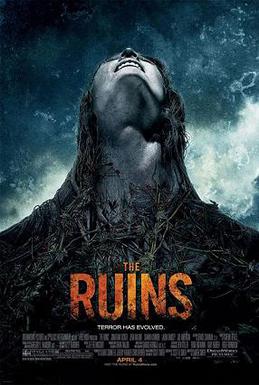
If your backyard is like mine, you’ll find The Ruins scary.  It’s pretty scary even if your plant-control skills are better than mine.  There’ll probably be some spoilers here, so I’ll say upfront that I recommend the movie.  If you’re wanting to see it fresh, well, you might want to pick up here afterwards.  Two couples vacationing in Mexico befriend a German who’s off to find his missing brother, last known to have visited an obscure archaeological site.  When the group arrives, they discover that the local Maya, who don’t speak Spanish or English, try to prevent them from approaching the pyramid.  Once they touch the vines growing all over it, the locals kill anyone who tries to leave.  It takes the group a few days to learn that the vines are carnivorous, and if you get a wound, they will invade your body through it.  It gets pretty gnarly.

Plants, we are coming to learn, share some form of consciousness.  They move (slowly by animal standards, but they do).  And they can quickly “consume” such things as say, oh, paving stones, that have been deployed to control them.   In a matter of maybe three weeks crab grass had nearly completely covered such stones that I laid out to try to reduce the amount of mowing the yard requires.  Plants exemplify the tenaciousness of life.  They can far outlive humans, or any other animal.  Being rooted in the earth has its benefits, it seems.  The Ruins has been described as ecological horror, and I would agree with that.  One thing, though.  Ecological horror often makes it clear that humans “started it.”  Here, the plant grows in one location only, kept under strict control by the locals.

Although the movie didn’t rock the critics, I thought the acting was good and the premise well laid out.  This writer knows how to put his protagonists at the edge of a cliff and then throw rocks at them.  The tourists are all likable people, but they’ve stumbled upon something dangerous, inadvertently, and they have to try to survive amid plants that seem to have a kind of sentience as well.  Somewhat like Triffids.  This is a very tense story.  There’s a bit of gore as well, so be warned.  Nevertheless, it’s not a gross-out for gross-out’s sake.  The larger story is intelligent and it even raises several ethical issues along the way.  And it seems to suggest that if you’re planning to travel to Mexico, stick with the well-touristed ruins rather than trying to discover some new ones.


For the Eyes

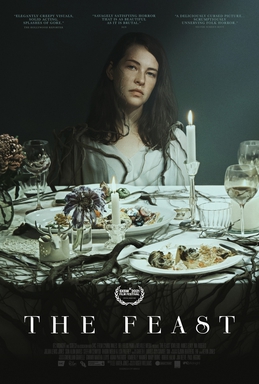
A Welsh horror film?  Lately Euro-horror has caught my attention.  European sensibilities give horror a distinctive flavor, and The Feast doesn’t pull the usual horror tricks.  And reading the subtitles keeps you on your toes.  It’s more a slow build that manages to be unnerving from the start.  A family of four—parents and two boys in their late teens or early twenties—is hosting a feast.  A local girl, Cadi, is hired to help cater the affair.  The family is really seeking to get a neighbor to allow exploratory mineral drilling on her land.  She refuses, horrified when they mention that they’ll only drill on the rise.  The neighbor, aghast, says they know better because they’ll awaken “her.”  The unnamed her is a goddess who is within the rise and who’s been disturbed by the family’s drilling on the land adjacent to their neighbors’ property.

A number of aspects push this beyond Euro-horror.  The goddess, treated as superstition by the family, introduces religion into the horror.  (Cadi, as it turns out, died on her way to the house and the goddess inhabited her body.)  The remote location and role of the countryside also bring this into the folk horror realm.  Having an underlying ecological message, the film is eco-horror as well.  As such it has a positive message, even as all those at the feast, apart from the uncompromising neighbor, die before the evening is out.  Gods will express their wrath.  Although there’s gore, the concept is intelligent and possessed Cady’s unwillingness to speak throughout much of the film adds to the tension.

Horror films with subtitles sometimes don’t work, but The Feast manages pretty well.  Much of the disturbing atmosphere comes from the house.  A modern construction, built over what had formerly been the family’s farm, stands in stark contrast to the natural world all around.  As is often the case in eco-horror, the land is waiting to take its revenge.  It’s a message appropriate for a time when we fail to live up to our own environmental standards, and consider the checks and balances of nature itself as “superstition.”  Maybe a goddess will not awaken and kill everyone at the dinner party, but the wealthy will not be spared, as the movie prophesies.  We share the planet and the earth allows us to survive.  There’s a sense that we deserve to be reminded that living on a finite planet requires careful stewardship of it all.  If you’re going to throw a feast, at least make sure it’s not at the expense of nature.  Some goddesses are best not aroused.