Lobo

Tor Johnson—actually Karl Erik Tore Johansson—became famous but not rich.  Such was the fate of some early horror actors, including Bela Lugosi.  Johnson hung out, however, with the low-budget crowd, making the most of his size to take on a kind of “enforcer” role.  One of his recurring characters was “Lobo.”  Lobo served mad scientists and had very little of his own brain power.  He often had few, or no lines to learn.  Having watched The Beast of Yucca Flats, in which he starred, I decided to see if The Unearthly was any better.  The production values were certainly higher, but this was an earlier film by a different crew.  It’s more like the standard fare you expect for a late fifties horror show.  It features a mad scientist, and Lobo is, of course, the servant.
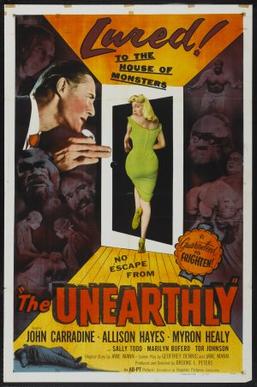
Dr. Charles Conway believes he has found the way to eternal life.  It’s attained by transplanting a new gland into a human being.  The problem is, it hasn’t worked so far.  Like a true mad scientist, Conway is convinced that it will work, it’s just a matter of try, try again.  And why advertise for willing subjects when you can have a local crooked doctor send you patients with various personality disorders, and no families, so that you can experiment on them?  With slow-moving Lobo as his only security system, Conway carries on until a sting operation catches him red-handed.  There’s really not much to this story.  It doesn’t have the inspired inanity of an Ed Wood production, but then, it hasn’t really grown a cult following.

My reason for watching was Tor Johnson.  Before I was born he’d attained the status of the model of a best-selling Halloween mask, based on his monster roles.  This seems to indicate that his oeuvre was well known, despite the kinds of movies he was in.  A large man who’d aged out of “professional wrestling,” Johnson had many uncredited movie roles before hooking up with Ed Wood.  He was featured in three of Wood’s films, including the infamous Plan 9 from Outer Space.  He’s part of a crowd surrounding the under-funded, independent filmmakers of an intriguing era before modern horror really came into its own.  The Unearthly, where his famous line “Time for go to bed” is spoken, suffers from banality and has become pretty obscure.  I personally wouldn’t have known to look for it had it not been for the fact that Johnson was in it, dragging it into the “must watch” category.  And that it was a freebie.

Ghoulish Night

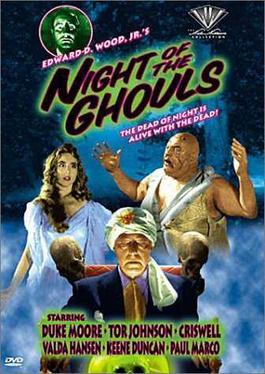
Night of the Ghouls, I like to think that even as a child I would have opined, is a bit silly.  It does show improvement over some of Ed Wood’s other films and the plot is really no more harebrained than some movies I did watch as a kid.  I’ve been trying to figure Wood out.  He was apparently incompetent, but he had no formal training and that could explain things a bit.  He was also creative.  This film is broadly a sequel to the worse Bride of the Monster.  Although only a couple of characters appear in both films, there is quite a bit of reference to the earlier story.  There was a mad scientist who made monsters.  The house burned down (actually an atomic explosion in the former), but someone—no-one knows who—rebuilt on the same location.

In a typically convoluted Wood plot (he wrote as well as directed the film), a bogus necromancer (who is actually, without knowing it, a really powerful necromancer) bilks clients out of their money by raising their dead loved ones for a few minutes.  He keeps the police and others away by having his young female assistant pretend to be a ghost outside the house.  But then she runs into an actual vampiric ghost who’s killing people who wander onto the property.  The police eventually decide to investigate and prove themselves as incompetent as the writing for the film.  They do manage to put an end to the fraudulent seances but it’s up to the real raised dead to put an end to Dr. Acula and his assistant.  At least there’s no atomic explosion at the finish.

The film, in Wood style, is black-and-white and the props are cheap and not really convincing.  A bit of the movie seems to have been intentional comic relief.  It doesn’t really work as a horror film because there’s nothing really scary about it.  Wood was a lifelong fan of horror movies, but fandom doesn’t always equal the ability to replicate the object of desire.  There are several possible horror atmospheres—Poe horror is quite different from Lovecraft horror, for example.  Wood seems to have been unable to strike a vein, however, that was close to an authentic horror feel.  The Scooby-Dooesque role of the necromancer doesn’t really help, I’m afraid.  Still, for fans this is vintage Ed Wood work.  I can’t claim to have figured him out, but if you’ve a hankering for a bad movie, this isn’t a horrible choice.


Hidden Wood

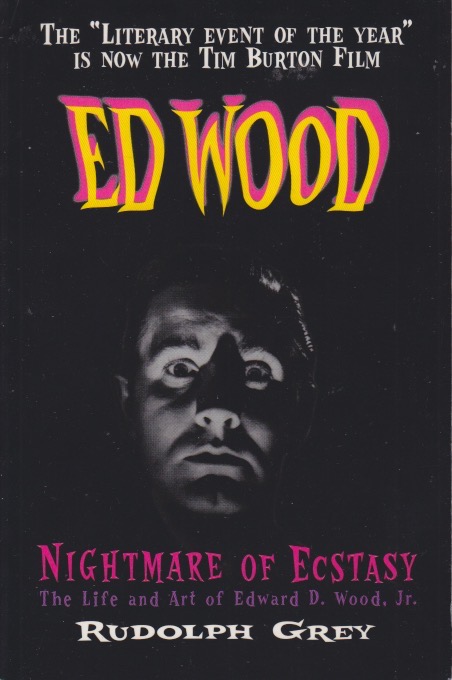
Fandom can lead to fame, even if it’s just cult fandom.  The nature of Ed Wood’s films is such that he could’ve been among those forgotten had he not posthumously developed a following.  Unfortunately it didn’t arise in time to ameliorate the tragic final years of his life when he died pretty much penniless, drinking away the pain.  Rudolph Grey’s Nightmare of Ecstasy: The Life and Work of Edward D. Wood, Jr. may have helped rescue him from obscurity.  Of course, Wood had gained a following earlier than the book, but nobody had really thought to document his life.  What I find so compelling is that Wood was like so many of us—trying hard to gain some recognition only to be shut out of what we love by a huge industry that calls the shots.  It’s difficult to get notice as an independent filmmaker, or even as a writer publishing with smaller presses.

Wood lived a most unusual life.  A straight transvestite, he fought as a Marine in World War Two.  He moved to California to try to break into filmmaking and wrote and directed several movies.  When this failed to make enough money to support him, he turned to writing pornographic novels and film scripts.  Wood had, interestingly, befriended a lonely and washed up Bela Lugosi.  His last two movies were Wood’s work.  Wood found camaraderie with other outsiders in Hollywood and he cast them in his low-budget productions.  He would try to shoot his films in less than a week.  Considering the constraints under which he operated, his movies really aren’t that bad.  They aren’t good by conventional standards, but they’re better than many other people could’ve made them in his circumstances.

This book isn’t a conventional biography.  There’s no narrative apart from the recollections culled from interviews of those who knew him and occasional letters and writings of Wood himself.  As with any biography there are gaps and lacunae.  From a writer’s point of view perhaps the saddest part of the story is how Wood and his wife were evicted from their final apartment and he had to leave his papers and manuscripts behind.  These were reportedly thrown into a dumpster and lost forever.  Although his movies may have been bad, Wood was a capable writer.  And like any writer he felt the loss of his work keenly.  He only lived about three more days after that.  His friends had largely abandoned him, alienated by his drinking and its effects on him.  Next year will mark the fiftieth anniversary of his death and, I hope, the commemorative watching of some bad movies that deserve to be remembered.


Bad Movies

It’s embarrassing.  No, really it is.  The other day I was posting on yet another bad movie I’d watched and I realized that I should add a new Category (although I’m likely the only one who uses them) on this blog.  Now, it’s a pain to add a new Category to a blog with over 5,000 posts.  I reasoned that my bad movie watching, although a lifetime pursuit, really only appeared on this blog recently.  I had to scroll through the existing Category, “Movies,” to remind myself of what I’d posted on.  I found a few to add to my new Category, then a few more.  Finally the number grew to embarrassing portions.  I kept scrolling until it made me dizzy.  I couldn’t remember whether I’d posted on The Room or not.  It’s not a horror film, but it is very bad.  So bad I watched a parody of it.  Using the search function “The Room” brought up just too many hits and I was already woozy.  Maybe I didn’t want to admit to that one.

Photo by Denise Jans on Unsplash

There’s an aesthetic to watching bad movies.  In fact, there are books written justifying the practice.  I thought maybe I had started my bad movie watching posts with Ed Wood’s Plan 9 from Outer Space, but no.  No, it went back further than that.  As someone who writes books about movies (maybe bad books about movies?) I need to do my homework.  Not only do I write books on movies, I also write on them for Horror Homeroom on occasion.  I’m scheduled to teach a class on a movie this fall.  I’ve even presented on movies to church groups (they never invite me back to talk on that topic again, however).  I know the reason lies much deeper, though.

Part of it derives from a childhood of watching bad movies.  There’s nostalgia involved.  More than that, however, I grew up poor.  Unless you’re a rags-to-riches story (I’m not) that mentality stays with you your entire life.  I’m always trying to cut costs, but I love movies.  On weekends I look for what’s free, with or without ads, on Amazon Prime.  They cater to bad movies, it turns out.  And before long it becomes like an addiction.  There’s a fascination to watching something so obviously poor that nevertheless ended up in theaters.  In other words, hope glimmers through.  My books are far too expensive to sell well.  My name isn’t widely known.  There is, in other words, a validation in watching bad movies.  I’ve got a well-populated Category for them right here.


People of Slime

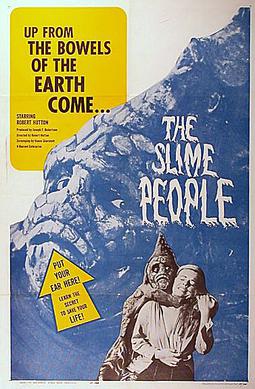
An old saying advises not to speak ill of the dead.  And I suspect this also applies to the living dead.  Night of the Living Dead (1968) is a classic horror film that represents the maturing of the genre.  Of course, it’s not the only horror film of the sixties, and I don’t mean to speak ill of it by suggesting that George Romero—who was used to working with a small budget—had seen The Slime People.  But I wonder if he had.  Directed by and starring Robert Hutton, The Slime People was released in 1963 and although it’s really bad, some of the scenes from this black-and-white groaner seem to have been borrowed five years later by the more able director.  The interviews by the newscasters and the driving country roads, and even the chasing of the angry mob could’ve served as direct inspirations.

The slime people are from subterranean earth, forced into action by underground nuclear testing.  Building a solid fog wall around Los Angeles, they take over the city while a pilot, a scientist and his two lovely daughters, and a marine, save the day.  Although the military had been fighting the monsters, they just couldn’t win.  The scientist really doesn’t help solve the issue but the pilot (Hutton) finds the creatures’ wall machine and the scientist is able to blow it up with a spear, saving the day.  This is one of those films so bad that it’s good.  The writing is poor and the plot makes little sense overall.  It doesn’t quite have the style of an Ed Wood film, but it participates in the aesthetic of watching bad movies.

Hutton isn’t a bad actor.  Hampered by a too-low budget (one of the signs that a movie might be one of the good bad ones), he couldn’t film the story he envisioned.  Much of the budget was reputedly spent on the slime people costumes, ensuring that Hutton drew no salary for his own role in his movie.  A couple of the other stars were veteran actors, and this prevents the movie from being a mere hack job.  I take some hope from the fact that many films like this eventually become cult classics.  Yes, sometimes it’s so that we can laugh at them, but I think there may be something deeper involved.  Those of us who watch bad movies might recognize something of ourselves in them.  We too struggle to tell our story, without big budgets and without studio support.  And yet we persist.


Dinosaur Planet

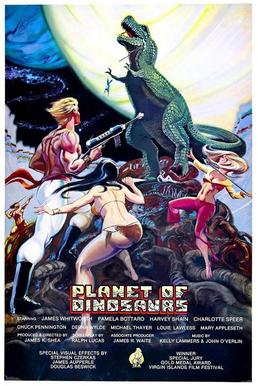
Time, as the crew of the Odyssey finds out, can cast things in a different light.  Admittedly I watched Planet of the Dinosaurs because it was free on Amazon Prime and I was having trouble keeping awake on a weekend afternoon.  It’s the kind of bad movie I’d’ve loved as a kid, and if I’m honest, I still do.  Although it was released in 1977 (it’s hard to believe Star Wars was the same year) the award-winning (!) stop-motion dinosaurs are so unbelievable that it hardly seems possible that the film’s budget was almost all spent on them.  It certainly didn’t go to pay a writer because the dialogue is about the cheesiest I recall ever hearing.  Jurassic Park was still a decade and a half away, after which no stop-motion dinosaur would ever be credible again.

Still, bad movies aren’t all bad.  In fact, there’s an aesthetic to them.  For me the real draw, as with an Ed Wood movie, is that these directors were struggling against an inadequate budget.  This isn’t in the Spielberg league.  And you can only afford so much.  The idea is akin to that of Planet of the Apes—which benefitted not only by a better budget but by a script by Rod Serling.  A planet similar to earth but caught in a different time.  And it’s a chance to explore what it would’ve meant for people and dinosaurs to coexist, which, despite some ark hawkers, never happened.  If it had we probably wouldn’t be here to make bad movies about it.

Our set of nine castaways manage to survive with only four eaten by dinosaurs.  And when these stop-motion reptiles aren’t on screen, the people are filmed walking, inanely talking, or thinking that a stockade of sticks and twine will keep out nine metric tons of Tyrannosaurus Rex.  There’s an attempt at social commentary when the vice-president of the company funding the mission realizes that he’s not the boss among castaways.  Where there’s no money, the balance of power shifts.  Of course, he gets impaled by a Centrosaurus.  At the end, the five survivors have settled down, built a house, and started having children.  They look pretty good for having survived on dinosaur meat and berries.  It helps that the corporate VP isn’t around.  I watch movies like this because, like James Shea, I’m on a tight budget.  And Amazon Prime often dictates what I watch when I’m having trouble keeping my eyes open. 


Glen Da

My current fascination with Ed Wood is, strangely, related to waking up too early.  I’ve tried for years to calibrate my schedule to more like a normal one—I’ve always been an early riser—but have had difficulty doing so.  Weekends at home, therefore, include afternoons when I’m always too sleepy to read, so I watch free movies.  I’d heard about Plan 9 from Outer Space for years before I finally watched it, and it was an epiphany.  Ed Wood, the hapless director, became posthumously famous for his poorly made films, and I’ve been catching as many of those as I can.  While Glen or Glenda wasn’t Wood’s first film, it is the one that kicked off his notoriety.  Considering that it was made in 1953 it is also way ahead of its time.  It is very cheaply made and contains what would eventually become many Wood hallmarks.

Ed Wood was a heterosexual transvestite.  Even today, some seventy years later, this is a category that often confuses hoi polloi.  That’s largely because sex and gender are often misunderstood as the same thing.  Gender is a societally ascribed role—men do this, women do that—based on often unconsidered stereotypes.  Today men dressing as women and vice versa is often played for laughs, or, if serious, is mistaken as an indicative sign of homosexuality.  Glen or Glenda is sometimes classified as a docudrama that attempts to explain this distinction.  Wood, who also stars in the movie, was an actual transvestite, something that wasn’t accepted in the button-down fifties.  After all, one command in the Bible prohibits cross-dressing (likely confusing it with assumed sexual behavior).

None of this makes Glen or Glenda a great movie.  Way ahead of its time, yes, but a strange mix of things nevertheless.  Star billing goes to Bela Lugosi, washed up by this point in his life.  His role as a scientist—often presented as “God”—is unclear.  The devil also appears in the movie, as do several vignettes, reportedly added by the producer, to make this more an exploitation film.  What comes through clearly is that this was a deeply personal film for Wood.  He was trying, as directors and authors often do, to explain himself to the world.  The most successful tend to do this with panache and style, and, let’s be honest, big budgets.  Hollywood, like the publishing industry, is unkind to those who don’t come with well-lined pockets.  It doesn’t mean that the rest of us don’t have stories to tell.  Ed Wood persisted in telling his and, as Glen or Glenda shows, being way ahead of the curve.


Monster Bride

I’ve been taken with Ed Wood lately.  It’s quite possible, lost somewhere in my memory banks, that I saw one of his movies as a kid.  If I did it would’ve been Bride of the Monster.  Just in case I hadn’t, I decided to watch it again.  As I’ve noted about Wood before, I admire someone who persists in the face of constant criticism.  Someone who refuses to back down, even if they end up alcoholic and dying too young, in poverty.  Now he’s coming to his deserved recognition.  Even if his movies weren’t intentionally bad, when I laugh out loud I’m not laughing at Ed Wood.  No, it’s the absurdity of fame and the price it both expects and exacts.  Wood paid that price and now that it’s too late he’s grown a considerable fan base.  Or maybe it’s never too late.

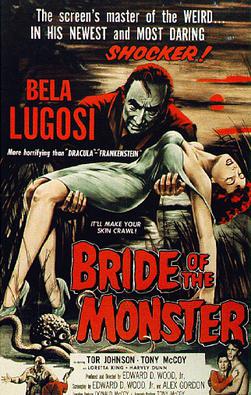
Bride of the Monster brings Bela Lugosi back to the screen as a mad scientist.  Rejected and mocked (I’m sure some of this was personal), he locates an isolated swamp house from which he plans his revenge on the world.  He’s somehow managed to build a nuclear reactor in his hidden lab and he intends to make a race of giants to conquer the earth.  Naturally enough, he starts with an octopus.  As the story unfolds, we learn that he was also responsible for the Loch Ness Monster.  He’s employed a human (but somehow bullet-proof) henchman, Lobo, to help him in his quest.  When a nosy reporter and her police detective boyfriend get involved, well, you might imagine the results.

The stories behind Ed Wood films, it seems, are as entertaining as the movies themselves.  This one, for example, has as its protagonist an acting unknown (Lugosi was the name draw).  Tony McCoy was the son of the owner of a meat-packing plant.  He received the lead role as part of his father’s stipulations for funding the movie.  Another stipulation was that it had to end with an atomic explosion (which it does).  Wood would go to any length to see his movies made, even agreeing to casting choices and plot points made by those who had no other connections to the film.  That’s part of the charm of Ed Wood’s movies—they were made to order.  And they demonstrate that deepest of human desires—to tell a story.  If I didn’t see this as a kid, I would’ve loved it if I had. 


Life Lessons

Most of us know a bad movie when we see it.  Some of us walk away.  The rest of us linger and wonder.  Some weeks ago now I watched Ed Wood’s Plan 9 from Outer Space.  “So bad that it’s good” is the mantra often chanted about it.  I lingered because of Ed Wood.  While it’s somewhat fictionalized, Tim Burton’s Ed Wood is itself an odd movie.  It performed poorly for a Burton film starring Johnny Depp.  Critically, however, it was praised and it eventually became a cult film about a cult film.  Or films.  Mainly, I suspect, because Ed Wood is such an interesting figure.  He was a man who wanted to make movies—knew he was meant to make movies—but never got the backing he needed to make them.  He did it anyhow.

Ed Wood starts with Glen or Glenda.  Written and directed by Wood, who also starred in it, this movie was about cross-dressing.  In real life Wood’s mother used to dress him up as a girl and although he was heterosexual, Wood became a transvestite.  This was, of course, in the days when such a thing was scandalous.  Making all of this surreal, and poignant, Wood had befriended an unemployable Bela Lugosi—known to be a drug addict—and had him star as God in the movie.  The next film Ed Wood focuses on is Bride of the Monster.  Again starring Lugosi, this one has a giant octopus in it and heads toward horror territory.  The film about a filmmaker ends with his notorious Plan 9 from Outer Space, the last film in which Lugosi appears and which was financed by a Baptist church.

Ed Wood ends before Wood becomes a poverty-stricken alcoholic and dies in his fifties.  There is a poignancy both to the stories of Wood and Lugosi that also applies to many people in life.  People who know, without a doubt, what they should be doing with their time on earth but who are kept from it by those, who like Lugosi’s God, pull the strings.  We all have limited time and as we grow older we realize that spending it doing a job that’s a drudgery is really a kind of crime.  Would Ed Wood have become a famous director if he’d been backed by the money to produce the movies he wanted to?  We have no way of knowing.  What we do have, however, is a tribute by a talented film maker to a fallen colleague, and that, it seems is the best part of human nature.


No Plan

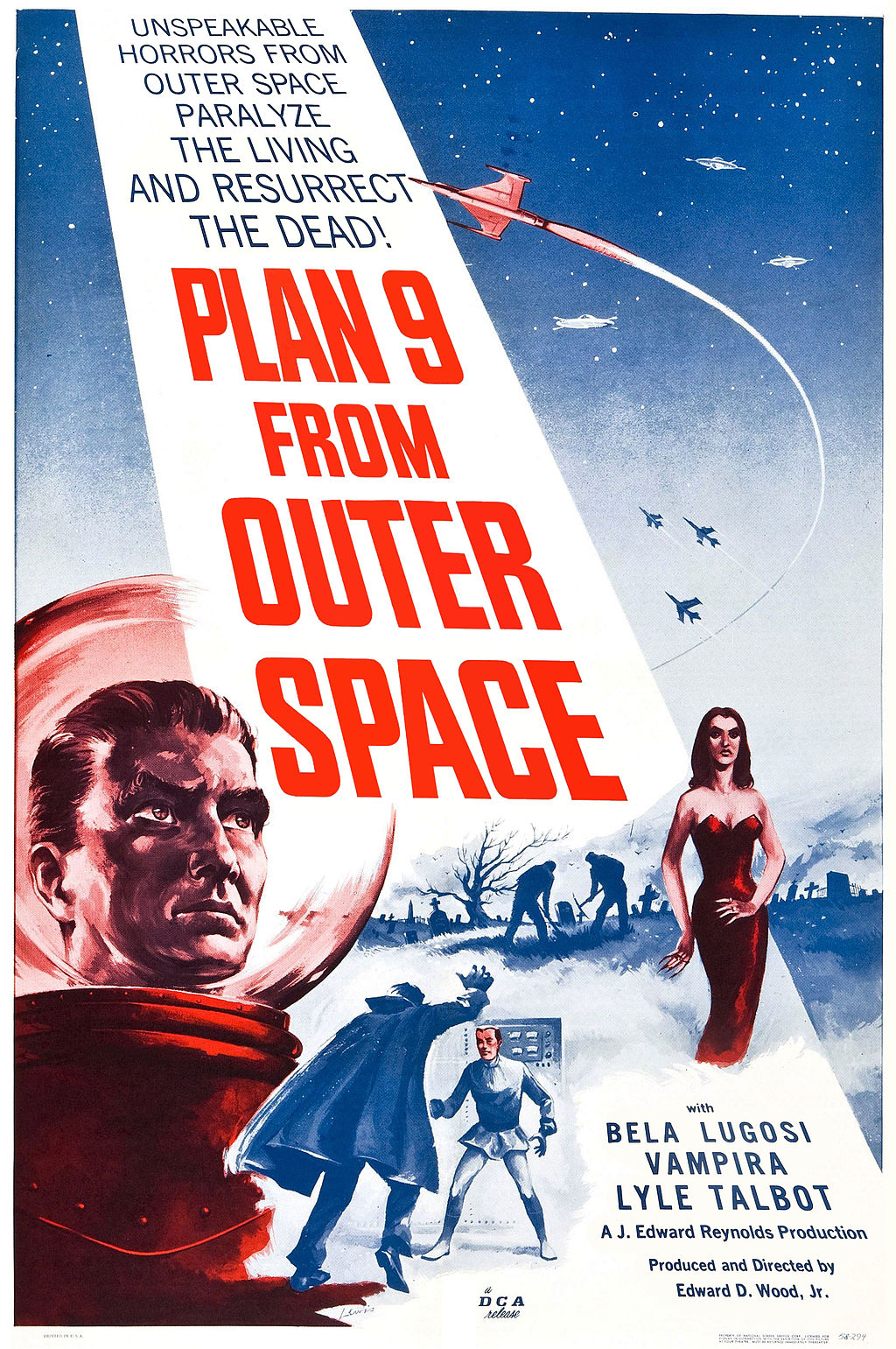
I suppose it’s debatable whether it can be considered a holiday treat to watch what is often called the worst movie ever made.  Still, I did so over the Christmas break.  Ed Wood’s Plan 9 from Outer Space is a frequent nominee for worst film, and Wood himself an enigma.  Disagreement over whether he really had such poor taste or whether he was hampered with budgets too small to achieve his goals seem to float around.  Was he misunderstood or simply clueless?  As many of us learn, breaking into big entertainment—whether it be film making, novel writing, or music performance—is a game of chance in which your chances are nearly nil.  So we might have some appreciation for those like Wood who, perhaps lacking talent, press on anyway.  Wood, who became an alcoholic, died in poverty, his work scorned.

Plan 9 from Outer Space is truly bad.  Everything from the stilted writing to the wooden acting is risible.  The idea that aliens are raising the dead to get world leaders to admit they’re there might give you a chuckle, but edit in previously shot footage of Bela Lugosi as a vampire, and confusion reigns.  Lugosi, who also died in poverty, was no longer even alive when the movie was released.  He and Wood had become friends.  Despite all its obstacles, the film has a good message.  The arrogance of humanity in assuming no higher beings could exist is still as much of a problem now as it was in the fifties.  And interestingly enough, Wood throws God into the dialogue as well.  There is even a Bible scene, if I ever get around to writing a sequel to Holy Horror.

At the end, the earthlings give a sigh of relief watching the flying saucer explode, even as they admit that the aliens are more intelligent and advanced than we are.  There’s almost a parable here that still holds true in the United States, at least.  We don’t like to listen to those who know more than we do, and after we defeat them we reflect on how they really were better equipped to handle things.  It may not have been any consolation to Wood as he died at the age of 54, but his films would go on to gain substantial cult followings.  I had been meaning to watch Plan 9 for many years, and now that I have my response is one of sympathy for a creative guy who simply didn’t have the means to do what he wanted to do.  And yet he did it anyway.  There’s almost a holiday feel to it.