Murphy’s Mansion

2003 was quite a year for me.  Nashotah House had experienced a fundamentalist takeover and, were I as good at reading writing on the wall as Daniel was, well, you know.  I was still working on Weathering the Psalms and teaching my classes, remaining academic dean as well.  My daughter was still pre-ten and I’d taken a very active interest in geology.  I didn’t have time for many movies.  My recent (if approaching two decades can be termed such) re-interest in horror hadn’t yet begun.  All of which is to say, I had no reason to watch The Haunted Mansion.  Oh, Disney was a big part of our lives, but I was trying hard to raise a child better adjusted than I ever was.  A haunted house movie didn’t seem like a good idea.  Especially at Nashotah.
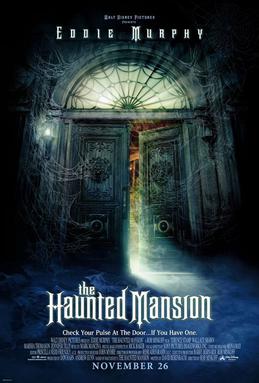
The critics didn’t like Haunted Mansion, unlike the other Disney ride-inspired movie earlier that year, Pirates of the Caribbean.  We even missed that one in theaters, only catching up with the sequel.  In any case, Haunted Mansion, upon first viewing, isn’t as bad as I was led to expect.  The story has some depth and even seems to recycle the undead from the Black Pearl.  Disney had explored the dark side before, but this was, at the time, the closest they’d come to actual horror.  Well, comedy horror anyway.  I suspect that Eddie Murphy doesn’t tend to bring horror to mind, but he plays his part well enough.  The story is relatively compelling, although some of the elements are standard tropes.  And with Disney’s budget, it was well made.  I’d watch it again.

It seems that it falls into that twilight zone of Disney movies that have become cult classics.  We expect Disney to be either plain old classic or forgotten and locked in the vault.  Those who appreciate darker themes, however, have brought both Haunted Mansion and The Black Cauldron up to the level of having cult followings.  You tend to think well-funded studios would fail miserably when they fail and never speak of such things again.  And yet, The Haunted Mansion got a reboot last year.  Disney’s flirtation with horror speaks to the fact that kids don’t mind being a little scared.  For adults, there’s nothing terrifying here.  There is, however, a story.  A moody atmosphere—although broken up by Murphy’s renowned patter.  And plenty of ghosts and even some musing on Purgatory, Heaven, and Hell.  There’s a bit to unpack here.  So more on that the next time I watch it.  But it may take some time since I’m still catching up.


Body or Soul?

Something’s wrong with Buddy Love.  He doesn’t act like a professor.  Meanwhile, Sherman Klump, heavyset but brilliant, feels that human companionship is passing him by.  Still, he’s a professor and has the support of a major university—at least as long as he brings the grant money in.  The Nutty Professor, a re-envisioning of the 1963 Jerry Lewis film, is instructive to watch.  One of the immediately obvious things to those of us who’ve been professors, is that movie makers don’t really understand what it’s like.  And it’s not just comedies—Indiana Jones doesn’t get it any more than Dean Richmond does.  Academics who watch these films shake their heads, if they think about the presentation of their profession.  Indeed, for being high profile, it is a job the public does not understand.

That’s not really what this post is about, however.  Although it’s been a few years, I suspect The Nutty Professor still has some currency.  In case I’m wrong, here’s the gist: it’s a modern, funny version of Dr. Jekyll and Mr. Hyde.  An overweight professor invents a formula that leads to instant weight loss.  The formula, however, also has side-effects, such as a boost in testosterone levels that leads to instability and violence.  In the climactic scene of the movie, Eddie Murphy transforms back and forth from Sherman to Buddy while on stage at the alumni ball.  Papa Klump, who has paid to attend, calls out, “Someone had better go and call the exorcist!”  

Now, this is screwball comedy.  Still, it reflects something that I’ve been struggling with in my current book—the public view of possession.  Demons aren’t generally known for changing body mass indices.  They’re after the soul, after all.  Still, there’s an element of truth, according to church teaching, about what Papa Klump says—demons are bodily afflictions.  Traditionally, they can’t impact a person’s soul.  In fact, possession is not considered a sin, and those under demonic influence aren’t held responsible for sins they commit while under that influence.  The soul is considered, unlike the physical body, something that cannot be “possessed.”  I know not to take movies like this seriously, but they do contribute to the pool of public “knowledge” about possession.  In this way, at least, it’s important to pay attention.  Such films may not really comprehend what the lives of professors are like, but they do reflect, even if in a nutty way, what people believe.