Fantasy Land

As a naive kid with a solid master’s degree, I was accepted for doctoral work at Aberdeen, St Andrews, Oxford, and Cambridge.  Only Edinburgh, however, was able to come up with some funding that made it possible for me to matriculate.  I’ve always been particularly grateful to Edinburgh since otherwise I would never have made it that far.  Oxford was, also, a little confusing what with all its different colleges and specializations.  As an American in the pre-internet age it wasn’t easy to learn about such things and academic advisors in the US didn’t have much helpful input to offer.  Like Harvard, however, Oxford is the single university that opens career doors for academics in my field.  I didn’t know that, of course.  Still, Oxford is a fine place to explore and despite my grousing about being made to travel, I was pleasantly surprised by the opportunity to partake of a high table dinner in Christ Church Hall.

I’d been far too busy to plan this trip, and I didn’t realize the significance of this dinner until I walked into the hall, and suddenly realized—as everyone else in my party already knew—that this was the Hogwarts Hall from the Harry Potter movies.  There’s an air of ancient tradition here, and it’s clear that my employer is held in very high regard in this particular shire.  I wasn’t aware that this would be part of the meeting I was here to attend, but I did wonder again at just how much popular culture drives our awareness and perception of ancient things.  Even my own reaction of recognizing this as the hall in Hogwarts was instructive.  Had I not seen the early movies of that series I’d likely have been simply impressed by the grandeur of the place itself.  My most recent books explore this same phenomenon, but in a different key.

Between gawking at J. R. R. Tolkien’s house that morning and ending the day at Christ Church, there was an element of fantasy to this trip for which I was simply unprepared.  Of course, it was a business trip, and I have trouble planning to have any fun on such occasions.  I take work far too seriously to let down and enjoy, unless I’m instructed to do so.  As I ran a couple of other small errands in Oxford, I realized there’s much yet to explore about the city.  I spent over three years in Edinburgh and didn’t see everything there by a long stretch.  And I doff my cap to Scotland still, for had my alma mater not made this possible I wouldn’t have had dinner among the Potter fans at all.  If movies didn’t tell us what to think, it would be just another old building in an ancient college defined by tradition.

Caveat Emptor

When you work in academic publishing, various higher education news sources find you.  Not able to distinguish faculty from industry professionals that rely on them for their by-products, these sites often offer friendly advice on how to succeed in academia.  Having had not a little experience in that venue (if you’ll pardon my litotes), I noted a recent headline before clicking the delete button.  I can’t reconstruct it word-for-word, but the gist of it was that if you wanted to earn more as an academic, you should study overseas.  Your salary, the article implied, would be higher if you did.  Now I recognize that things constantly change, but in my field of study if you want to get any job at all, let alone a good paying one, you study domestically.  Specifically at Harvard.  Academics, just like publishers, rest on their laurels.

The funny thing about this headline is that it contained the same advice that I received all the way back in the 1980s.  I followed up on it, choosing Edinburgh after having been accepted at Oxford, Cambridge, Aberdeen, and St. Andrews.  Only later did I learn that of those schools only Oxford opened the door to positions in my native United States, being, as it is, the Harvard of the United Kingdom.  Defying the odds, I did get a job that, when I became Academic Dean with access to industry stats, I discovered was among the lowest paying of its peers.  Studying overseas, in other words, had the exact opposite effect than the headline promises.  Perhaps things have changed in the intervening years.  Even today I have to remind people that Edinburgh is a world-class research university, one of the four ancient schools in the kingdom of the Scots.  Some of the most famous minds in human history studied there.  Ach, well, a job by any other name would smell of sweat.

Xenophobia isn’t unique to the GOP.  It exists in higher education too.  Academics are extremely tribal, and if you try to break in from the outside—no matter where you study—you’ll learn that your money might be spent more wisely learning a trade.  As a homeowner, I’ve discovered that just about any practical job that doesn’t require college pays better than what you can get with the detritus of a doctorate on your résumé.  In fact, during times when work was scarce I tried to hide it.  One of the skills I picked up in my educational journey was not to believe everything you read.  Problem is, you only pick that up after you’ve already paid that tuition bill.  The delete button is right there; don’t be afraid to use it.


Holly Days

Thirty years ago today, my wife and I were penniless grad students.  Trying to be logical about when to marry—I’d been accepted at Edinburgh University shortly after we’d decided on a May wedding and the latest I could matriculate was April—we decided the holidays would be the best time.  Not Christmas, of course.  Or New Year’s Day.  As students we held to the illusion that others observed the natural caesura between the two.  We considered it from the feast of Stephen to New Year’s Eve, days when everyone is recovering from the intensity of Christmas or staying up late to welcome in 1989.  We settled on December 30.  The church was already decorated for Christmas, saving that expense.  Having moved up the date by some five months we did ask them to remove the banner that read “For unto us a child is born.”  Our reasons were purely academic.

I generally avoid writing too much about my personal life on this blog, but a thirty-year wedding anniversary is somewhat extraordinary.  Being a working-class kid I told my wife when I proposed that I couldn’t promise much but I could assure her our life together would be interesting.  That slippery qualifier has proven correct time and again.  Our first three years as a couple were spent in Edinburgh, and quite unexpectedly, the next fourteen at Nashotah House.  The first two of those years involved being apart from Sunday through Wednesday as I commuted from Champaign-Urbana to Delafield to teach my courses.  And, of course, to attend chapel.  Our daughter was born while we lived at the seminary and a Fundamentalist takeover led to the loss of my first (and to date only) full-time academic job.

The academic job market had been tough when I started and it had tanked in the meantime.  We had to uproot and move to New Jersey to find any work at all.  Publishing proved remarkably unstable and yet we stuck together.  This year we bought a house and moved to Pennsylvania.  It took three decades, but we’ve finally achieved what some would term normalcy.  The fact is, though, that long-term marriages are to be celebrated.  Many of the vicissitudes we’ve faced could easily have capsized our little boat.  Looking back over the years I can see that we never did prosper in any kind of financial or career situation.  Life has indeed been interesting.  I don’t blog much about my personal life, but today I can’t help but think of how incredibly fortunate I am to have found a soul-mate willing to stick with a guy who still thinks like a penniless grad student.  Thirty years of schooling and it’s not nearly enough.

A young couple’s anniversary in Wales.


I’ll Be Googled

It’s a strange sensation to do an innocent web search only to find yourself cited.  (And no, I was not googling myself.  At least not this time.)  I was searching an obscure publisher and my own pre-publication book, Holy Horror, came up on Google books.  Now, the computer engineers I know tell me that Google remembers your searches, and this has a way of being unintentionally flattering; when I search for my book it pops up on the first page because I have searched for it before.  Still, it was a bit of a surprise to find myself where I had no idea I’d been cited.  All of this drew my mind back to my “post-graduate” days at Edinburgh University.  To how much the world has changed.

One of the first things you learn as a grad student is you can’t believe everything you read.  Granted, most of us learned that as children, but nevertheless, with academic publishing a new bar is raised.  That which is published by a university press is authoritative.  So we’re led to believe.  But even university presses can be fooled.  This prompts the fundamental question of who you can really believe.  Our current political climate has elevated that uncertainty to crisis levels, of course, and the vast majority of people aren’t equipped to deconstruct arguments shouted loudly.  Where you read something matters.   Even publishers, however, are fallible.  So what am I to make of being cited by the web?  And is my book already available before I have seen a copy?

Even credibility can be bought and sold.  Colleagues make a much better living than me with the same level of training, but with more influential connections.  It was just this reason that I decided to try to shift my writing to these who don’t need credentials to impress each other.  Some of the smartest people I ever knew were the janitors with whom I started my working life.  As a fellow post-grad in Edinburgh once said, professors are always ready to fail you for your lack of knowledge but most can’t tell you what an immersion heater is.  (That’s one of those Britishisms that no amount of graduate courses at Harvard will teach you.)  I suppose when it’s all said and done nobody else will ever search for the obscure publisher that brought my book to Google’s attention.  No matter, at least Google will always flatter me.


Blogday

Sects and Violence in the Ancient World is nine years old today.  Not that I’m keeping count.  Really, I’m not.  WordPress sent me a notice, and they ought to know, being the virtual womb whence my thoughts gestate.  The original plan for this blog was to take my abiding interest in the religions of antiquity and give them a more public face.  My brother-in-law, Neal Stephenson, thought I should do podcasts, because, at the time I spoke incessantly about ancient deities.  I can still hold forth about Asherah at great length, but ancient Near Eastern studies is, believe it or not, an evolving field.  You need access to a university library, or at least JSTOR, and a whole sabbatical’s worth of time to keep up with it.  Even though telecommuting, I’m a nine-to-five guy now, and my research involves mostly reading books.

So Sects and Violence began to evolve.  I realized after teaching biblical studies for over a decade-and-a-half that my real interest was in how the Bible was understood in culture.  Having a doctorate from a world-class university in the origins of the Good Book certainly should add credibility.  My own journey down that pathway began because of interpretations of Scripture that were strongly cultural in origin.  I first began reading with Dick and Jane but quickly moved on to Holy Writ.  It has shaped my life since before I was ten.  It’s only natural I should be curious.

Like most tweens, I discovered sects.  Why did so many people believe so many different things?  And many of them call themselves Christians.  And the Christians I knew said the others weren’t Christian at all.  And so the conversations went, excluding others left, right, and center.  As someone who wanted answers, this fascinated me.  The Bible was the basis for many belief systems of sects everywhere.  From Haiti to Ruby Ridge.  From New York City to Easter Island.  From Tierra del Fuego to Seoul.  And not just one Bible, but many scriptures.  And these beliefs led to behavior that could be called “strange” were it not so thoroughly pervasive.  Scientists and economists say we’ve outlived the need for religion.  By far the vast majority of people in the world disagree.  I couldn’t have articulated it that way nine years ago, but since losing my teaching platform, I’ve been giving away for free what over four decades of dedicated study—with bona fides, no less!—has revealed.  Happy blogday to Sects and Violence in the Ancient World.


Rookie Mistakes

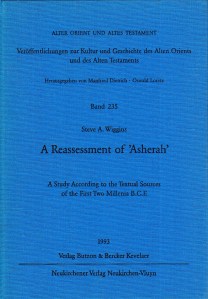
So now it’s got a stain on the cover. And it didn’t even come with a book jacket. Perhaps it’s symbolic? The year was 1993. I’d finished my doctorate at Edinburgh the year before, and, against all odds, had landed a full-time teaching position. That position was at Nashotah House, but never mind. Like all doctoral students I’d sent out my dissertation for publication. It’d been accepted by the prestigious series Alter Orient und Altes Testament, produced by the dual publisher Verlag Butzon & Bercker and Neukirchener Verlag. Most European houses print these books cloth-bound (mine in blue!), no dust jacket, straight to the library market. I was proud. I had my first copy in hand in time to show around at the American Academy of Religion and Society of Biblical Literature annual meeting. There I spied William Holladay, my Hebrew teacher, now deceased. He was sitting on the floor in a corridor, eating his lunch. I joined him and showed him my book. In his inimitable way, he snatched it (leaving a grease stain on the cover) and within seconds said, “there’s a word misspelled in your title.”

Crestfallen, I took my first copy back. I wrote to the publisher, but these things only ever receive one printing and I never heard back. How embarrassing! Your first foray into academic publishing, and you look like an idiot who can’t spel. Now, in my defense, the cover is simply what I thought was a photomechanical replication of the the title page. The world “Millennia” was spelled correctly where I’d proofed it inside. How they left out an “n” on the binding die is a mystery. I never got proofs of the cover. Besides, a book’s title is on the title page, right? Never judge a book by it’s cover! Mine has a stain on it.

The book, although on Asherah, never got much notice. It’s still routinely overlooked. One of the truly sad things, though, came from a senior scholar in the field, nameless here, who did mention my work. In his book he put a [sic] after the ailing word on the cover. That was an intentional slight. Had he looked at the title page—from which I’d been taught to take bibliographic references—he would’ve found the word spelled correctly. Many publishers do not let authors proof the binding die for their cloth-stamped covers. A senior scholar knocking down a struggling junior with an obscure three-letter word. Welcome to academia. The book did get a kind of second life when Gorgias Press reprinted it, with additional material. I still sometimes pull that first copy off the shelf, however, and wonder what can take the stain out of blue canvas. As long as someone can feel superior citing a mistake beyond a young colleague’s control, I suspect it will remain.


The Pace of Progress

Scientists tell us the earth is slowing down. It’s only by a fraction of a fraction of a second, but like a top set spinning these endless revolutions can’t go on forever. Although the evidence all points in this direction, it feels like it’s speeding up. How else can I account for the apparent loss of time I’ve been sensing? Let me contextualize that. I’ve been attending the Society of Biblical Literature and American Academy of Religion annual meeting since 1991. That first meeting in Kansas City’s acid-etched in my friable consciousness with the long hours waiting for interviews that never came and no mentors to show me what to do. Those three-and-a-half days stretched on into an endless Tom Sawyer summer. I was anxious to get back to my wife in Edinburgh to and finish my dissertation. Fast forward a quarter of a century.

My days are now filled with back-to-back meetings. Normally by now I’d have had a leisurely perambulation among the bookstalls (where I spend all day) taking in the volumes the competitors publish, noting what I need to read. Instead, the time has been shortened. I have to keep a constant watch on my watch for the next appointment. Hearing about new books being born rather than tending the infants that surround me. We are a thriving population of readers here. Although it looks like a large crowd, I know that in reality we don’t make much of a dent. Boston’s big enough to absorb us and all our feverish ideas. When wakefulness arrives at my usual New York commuting time, even the nights seem to be shorter. Where has the time gone?

Most of those I meet have no idea I write books of my own. It was a process started long before the conferral of a diploma from a university far away. The earth is spinning in that direction, I’m told, so I should be in the tailwind of Edinburgh all the time. I’ve grown old with some of these colleagues. Those I’ve known since I was a young man, thinking he knew something about life, learning how little he really knew in this very city. I’m pretty sure I know even less now. The world, for example, seems to be speeding up to me. In fact I know it’s slowing down. Days are growing longer, but there is ever more yet to do. And all I want to accomplish right now is to walk around a bit and browse the books that others have written. I’m absolutely sure the earth is indeed speeding up.


Zounds Like

Liberation from the confines of academia allows for the occasional indulgence in taboo subjects. I can’t remember when I first heard of stigmata. I didn’t grow up Catholic, and, like many Protestants, distrusted much of what came from Rome. Still, I was interested in the supernatural. When I learned that people in this modern day and age sometimes developed unexplained wounds corresponding to crucifixion, I was intrigued. Ted Harrison’s book, Stigmata: A Medieval Mystery in a Modern Age, is the first I’ve actually read on the subject. It has some fascinating observations to share. It was some time after seminary that I learned that Francis of Assisi (aka St. Francis) was the first stigmatic. I had admired Francis for turning down wealth to assist the poor and commune with nature—what’s not to like?—but I didn’t realize that he had initiated this rare, but real phenomenon.

Harrison considers the question of why it was only in the 13th century that the stigmata began to occur. They have occurred ever since, in very small numbers, primarily in Italy and primarily among women. But why then? He points out that the church, shortly before this time, began to emphasize the physical suffering of Jesus on the cross. We’re probably all familiar with some of the gruesome images that emerged from the church and its artists at that time. As such images proliferated, people were given a visual focus that directed their devotions. Every great once in a while, this led to stigmata. Why women? As Harrison points out, men with intense spiritual needs could become priests. Women could not. The church would not forbid personal devotion, and if such devotion led to stigmata, well, a person arguably had a direct line to the divine. That was something normally preserved for priests through the Eucharist.

Stigmata have to be understood in the context of mysticism. The more recent cases studied by Harrison include some non-Catholics and some other unexpected candidates for what is, after all, a very intense spiritual experience. What emerges is a thoughtful, one might dare say contemplative, approach to the issue. Some stigmata have been self-inflicted. Some have not. Medical personnel have witnessed and examined these improbable wounds and have not explained them away. Once, during a faculty meeting at the New College of Edinburgh University (I was post-graduate student representative) one faculty member groused after one of my advisors had presented a challenging idea: “you’ve dropped us in a mythological world. I want to get us out.” There it is in a nutshell. Some people can live in a world where stigmata occur. Others have to explain it away. The difference is all in the matter of perspective.


Brick in the Wall

Kids. You never know what’ll come out of their mouths. Not bounded by logic or the rules of physics, they come up with some of the most truly creative ideas that grace our species. The growing up process usually includes filters that separate the real from the imaginary. But not always. In a recent statement, Donald Trump said that his proposed wall between Mexico and the United States should be invisible. His concern, according to a Washington Post story by Christopher Ingraham, is that catapults could be used to launch drugs over the wall. Somebody could get hit in the head. (It sounds like somebody has been already.) So the wall should be see-through. This wall, which the majority of Americans don’t want, and which will have to be deconstructed at great expense after his presidency (such as it is), will be a technological marvel. It’ll even have solar panels, added by old king coal himself.

I can’t help but think of Star Trek IV: The Voyage Home. Earth is being destroyed—not by Trump in this scenario, but by aliens looking for whales that we’ve driven extinct (there’s the Trump part). The crew of the Enterprise, in a Klingon warship, have to transport humpback whales from the 1980s into the future. The problem is see-through aluminum does not yet exist. Scottie, posing as a professor from Edinburgh—back in the days when my alma mater bore some cachet—gives the formula to a San Francisco manufacturing firm in return for enough of the metal to make a holding tank for the aquatic mammals. They slingshot around the sun back to the future just in time to save earth from a catastrophe worthy of Trump Enterprises. Problem is, see through aluminum is fiction.

Photo credit: George Louis, Wikimedia Commons

In my daydreams I often picture this wall. My thoughts inevitably go to Berlin and shortsighted solutions. History (which most American presidents have made a point of studying) teaches that walls don’t work. The technology is ancient. As is the technology of how to get around, under, and over walls. In fact, basic career counseling will often use the wall as an exercise to get you thinking of ways to overcome obstacles in your path. Dealing with walls is one of the most time-honored of human pastimes. You see, walls were originally built to keep us safe especially from non-human threats. We didn’t want toothy big cats or cave bears wandering in during the night and making snacks of us. We built walls. Then we wondered what was going on over on the other side. Just now, it seems, that idea has begun to dawn on a man who might benefit from trying to understand The Voyage Home.


Signed, Sealed, Forgotten

the_seventh_sign

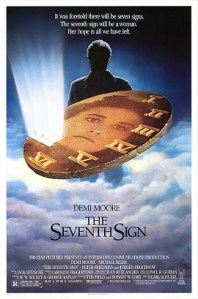
I’m a little ashamed to admit it. With such a long list of moody horror movies out there, I gave in to watching The Seventh Sign again. 1988 was a momentous year. I had graduated from Boston University School of Theology the year before and had been functionally unemployed, as befits a future adjunct professor. I had joined the Episcopal Church, cutting off my chances of ordination in my previous United Methodist sect. I’d been accepted into doctoral programs at Oxford, St Andrews, Aberdeen, and Edinburgh but couldn’t afford any of them. I proposed to my future wife and by the end of the year had married her. In the midst of it all a friend convinced me to go see The Seventh Sign, then in theaters. A typical end of the world movie, The Seventh Sign was a “see once” movie to me, but I guess I’m weaker than I thought.

The movie got me to thinking about the end of the world. Not literally, but rather how we came to have such a strange idea. As creatures conscious of our own deaths, I suppose it’s natural that we think everything comes to an end. The mythical scenario of “the end of days,” however, is cobbled together from various pieces of the Bible, like some distorted, religious picture puzzle. The Book of Revelation doesn’t give a coherent story of the future. In seminary I learned that it was because Revelation is actually about what was happening in the Roman Empire in the first century, not about what would happen in the days when I happened to find myself conscious and eating Kraft macaroni and cheese, mixed with water instead of milk and working for Ritz Camera. I was sleeping on the floor of a friend’s apartment. That was my own kind of personal apocalypse, I guess.

The Seventh Sign is unusual in that a Jewish boy, Avi, and a lapsed Christian woman, Abby (who rents a room to the new incarnation of Jesus who lives, apparently, quite a lot like I did at the time) have to figure this out together. Tying in several other mythological motifs, the number of seals broken is, if I count correctly, only five. The world is saved by self-sacrifice, as is generally expected, and everyone ends up feeling let down. It is a downer of a movie, and not very scary for a horror film. What struck me was how many scenes I remembered so precisely. So I guess it did manage to impress me on some level, back in 1988. I selected Edinburgh University and now once again, find myself outside the institution I covet. I’m still waiting to see what happens with those two last seals.


Auld Reekie

DSCN3452

Those of us who once tried to storm the walls of academe from humble beginnings soon learn our lesson. This is a guild meant only for those whose parents knew enough to suggest an Ivy League education. Those whose parents have never heard of Harvard (they exist!) and who don’t know what an Oxford is aren’t really well-placed to give advice on these matters. At a small-town high school you couldn’t count on a guidance counselor noticing your academic prowess as anything more than a statistical blip in a non-challenging career. I learned about the Ivy League too late. It was, therefore, a very pleasant surprise to have an Edinburgh colleague ask me to write a piece for a Cambridge Companion. I don’t have the contract yet, but even the invitation made my day. Maybe my month. Or career.

I spend my days commissioning just such works for a different press. I know hundreds of colleagues. Only one ever said, “would you consider writing…” I’m not being entirely fair here. I’ve been asked to contribute to Festschriften. Such volumes are the highest praise an academic can be given. John C. L. Gibson, of blessed memory, was the first honoree. Nick Wyatt was the second. Simon Parker, also departed, whose Festschrift is currently in the works, was the third. I’ve been asked for others, but regular research is beyond my reach with my current schedule. I can churn out an original article once a decade, it seems. The ideas are still there, alive and popping. The time, alas, is not.

So I’m happily sitting here thinking of how to write a Companion article. The colleague who asked me is someone I recently met. He found out that I had attended his alma mater and wondered why I hadn’t landed a regular teaching post. Edinburgh University, in the larger world, is a recognized name. I can’t see through the ivy to discern it on this side of the Atlantic, but I’m assured it’s still there. Recognizing that those who fall between the cracks can still sink a taproot and make a contribution, he asked me if I might consider it. He had me at Edinburgh. School loyalty still counts for something, I’m glad to learn. For once I feel that I don’t have to apologize for having ventured to Scotland with only my transcripts and high hopes in my pocket (and with an indulgent wife by my side). Now I’ve been asked to write. I’ve gone all red, and I hide my face behind my hand. Of course I’ll do it.


Two Unrelated Stories

Harvard University’s been in the news. Well, Harvard makes the news, so that not news. The first story that has appeared is that Harvard, like me, is giving it away. Information on religion, that is. Like a fire sale. Or making room for next season’s fashions. According to the Anglican Journal, Harvard is offering a free world religions class online. Some of us who have degrees in various world religions offer similar services but, well, we are not Harvard, are we? This isn’t really sour grapes, but I see my colleagues’ blogs—those who teach anywhere, not necessarily at Harvard—and they get plenty of hits. They have institutional backing. That job offer is a seal of quality, don’t you know. Freelancers, well, who trusts them? I’ll professionally prattle on about religion anyway.

Then a colleague sent me a story by Charlotte Allen entitled “Jesus’ Wife: The Final Debunking,” from The Weekly Standard. For those of you not up on the scholarly gossip of the deity’s latest amorous exploits, some time ago a Harvard professor advocated for a fragment of a lost gospel purporting to mention Jesus’ wife. The media had it’s little frenzy (like father, like son, so it seemed), and scholars argued—which is what they do. Most saw this fragment as an obvious fake, but when someone from Harvard declares otherwise the media listens. Now, in a piece of investigative reporting soon to appear in The Atlantic, the origins of this fake manuscript are pretty much laid out for all to see. It seems that being at the only true university in this country isn’t really the basis for not being taken in by forgers. I’m not picking on the professor—we’ve all been taken in by clever forgers—we want to believe. Deception happens all the time and all over the place: “ancient” documents are faked, someone makes money or notoriety, and we all go home shamefaced at the end of the day. Still, there’s a point to be made.

DSCN3510

Humans are worshipful beings. If you want a job in higher education your best bet is to attend Harvard. It opens doors for you. While in seminary at Boston University School of Theology, I applied for transfer to Harvard Divinity School and was accepted. I decided not to cross that river, however. Edinburgh was my future. In Scotland, I spent my dissertation attempting to show just how thin the evidence was for Yahweh’s wife, if you take the time to look at each piece. Naturally, the dissertation and subsequent book were largely ignored. Edinburgh used to be the Athens of the North, but it’s not Harvard, though. Now scholars are beginning to question the new orthodoxy of a happily married deity. While the academic dispute goes from one bed to another, it begins to sound like Days of Our Lives. Scholarly drama may not be front page news, but it doesn’t fail to entertain.


Beg to Differ

Screen Shot 2016-05-09 at 4.15.19 AM

“What do you burn apart from witches?” “More witches!” Earning a doctorate is kind of like learning how to get lost. It certainly doesn’t make you either cool or employable, but it allows you a few years to accumulate enough debt to keep you out of trouble for awhile. One of the things I learned along the way is that you should always follow the crowd. I look at the schools that only hire Harvard grads and there can be no doubt. I look at all the Trump supporters and I know there can be no question. Yes, the ayes have it. So, I never learned to tell which bands were truly worth listening to until I learned to follow the critics. I never studied music. Like most people, I know what I like but I can’t say why. I only discovered Radiohead in the last few months. Some of my critics claim my complaint of lack of time is only an excuse, but I don’t listen to music unless I can really listen to music. It can’t be pure filler. Put on Beethoven’s seventh and you’ll see what I mean.

In any case, my wife alerted me to the new Radiohead song “Burn the Witch.” And you can’t listen to a new song without watching it as well. This time it’s worth it. The claymation video accompanying the song (conveniently found here on NPR) is a reprisal of “The Wicker Man,” one of the truly intellectual movies in the horror genre. Of course, that’s something I picked up from the crowd. We’re told by the most powerful and charismatic bigots of our age that life is all about acquiring stuff. Were I to argue with that, well, I guess I’d be the witch to be burnt. Before listening to/watching the Radiohead song, do yourself a favor and watch “The Wicker Man” (the original, please, accept no substitutes). Go on, everybody’s doing it.

The most dangerous thing in the world is an independent thinker. No, I didn’t learn that at Harvard. On my first walking tour through Edinburgh with one of my doctoral advisors he pointed out the part of town where they used to kill witches. He was truly an original thinker (still is) and taught me to be one too. Problem is, I should’ve been following the crowd all along. You want people to pay attention to you? Go to Harvard! Want people to vote for you? Clearly show you’ve got what it takes (money). Give a man a little cash and anything will do for brains, to paraphrase one of the smartest movies of all time. The only way forward is to do what everyone else is doing. And pick up some kindling along the way—you’re going to need it.


Scholarly Synchronicity

Simon Parker STH Professor April 2, 1999 PORTRAIT

Simon Parker
STH Professor
April 2, 1999
PORTRAIT

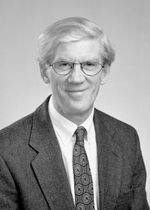
One of the great ironies in my life is having been basically ignored while I was employed in higher education only to have people make overtures to me once I no longer had the resources to undertake the task. I’ve been asked to peer review articles, and write articles and contribute to books. I even had a series editor try to get me to write a monograph. Thing is, I don’t have regular access to a library, and I spend eleven hours a day either at work or getting to and from work. When am I going to find time to write a well-researched book or article? Well, I’ve been working on my Society of Biblical Literature article since May and it should be ready by November. If it weren’t based on pop culture, I could never have managed it under present circumstances. Still, when a colleague asked me to contribute to Simon Parker’s Festschrift I couldn’t say no. Although I didn’t take classes with Simon, he was Academic Dean when I was at Boston University School of Theology. Although I didn’t know it at the time, we shared an interest in Ugaritic studies, and we exchanged articles and ideas via letter when I was in Edinburgh. We became friends. Simon died suddenly the year I lost my job at Nashotah House.

Since that time I’ve written over a couple thousand blog posts, and read a few hundred books, but that’s not the same as academic research. I’ve been worried about what I might contribute to do honor to a scholar and a gentleman. Then I tried looking at some old files from two laptops ago. Of course the new laptop can’t open them (that’s why Scrivener is a lifesaver). I pulled out a paper that I wrote the year I lost my job. I never did finish it, but it was well underway when my confidence began to crumble. After translating it to the new decade, I opened it only to find the first footnote dedicating it to Simon Parker. I stopped, stunned. That can’t be right. When I wrote this I knew nothing of a Festschrift. Then it hit me. I had originally written the article just after I learned of Simon’s untimely death. Do I still believe in signs?

So now I have a base from which to start. I have only a couple months to bang it into shape, and I also have to finish my SBL article. While at Nashotah House I produced an article a year and a second book (published only last year), i.e., the “academic standard.” Nobody invited me to contribute. Now that I have no time, people are finally interested in what I might have to say. Not interested enough, of course, to offer me an academic position, but it does look like the publication record might continue after all. It won’t be what it could have been had I had a library, but I am nevertheless honored. One of the accolades that academics covet is having colleagues care enough to write something for you. I guess that’s been on my mind for a decade in the case of Simon Parker. I only hope that I can do him proud from where I am.


Galileo’s Tool

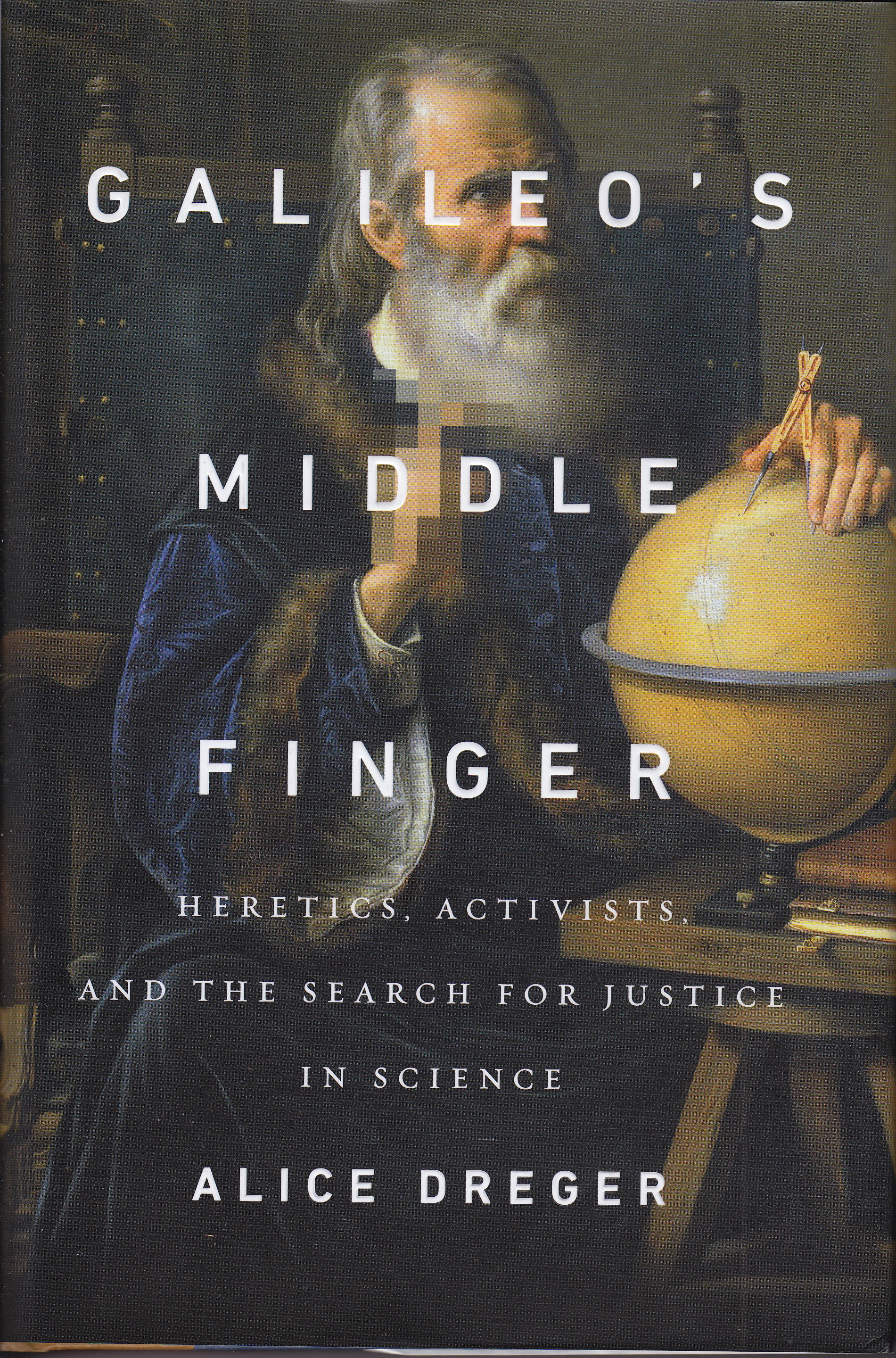
GalileoMiddleEarly in my academic career I got into trouble not because a Harvard professor hadn’t adequately checked his data, but because I had pointed out that a Harvard professor hadn’t adequately checked his data. You see, I was a naive realist. I believed academics were objective, factual sorts who looked for the truth no matter how uncomfortable it was. My honesty didn’t earn me many friends, and I still can’t mention this professor by name because I have seen grown men melt into tears at his name, due to their overwhelming loyalty. By contrast, a fellow Edinburgh student once told me that he disagreed with our mutual dissertation adviser, “on principle.” As the old saying goes, nullius in verba, take nobody’s word for it. Reading Alice Dreger’s Galileo’s Middle Finger: Heretics, Activists, and the Search for Justice in Science drove home a number of important points, one of the most memorable being that academics take real risks when they won’t fudge the facts to fit the establishment’s expectations.

Although this autobiographically revealing book is about as honest as a writer can be, it deals largely with issues of social justice in the context of those who “don’t fit.” Intersex individuals, especially, are treated before they can give consent and live their lives based on other people’s expectations of what their gender “should be.” Like most people I was raised thinking there were only two genders. Science has consistently demonstrated that “gender” is a construct that occurs along a continuum. Some species change gender in their lives. Some have such complicated reproductive techniques that far more than two genders are postulated to make sense of it all. And yet, when it comes to humans, we suppose that we’re either female or male. And religions consistently claim that any sex outside those parameters is evil. We are so naive.

Dreger focuses her attention much more widely in this important book. She shows how universities, constantly becoming more corporate, often don’t support research that challenges their investments, or “branding.” She demonstrates first-hand the character-assassination that academic snipers use so well on those who follow the evidence. She is living proof that education and activism should go together. Intricate and with bizarre loops and twists thrown in, her account of what some people will do to silence others, and get it peer reviewed, saddens me. I’ve always believed that education is the surest way to solve social ills. Education, however, is increasingly being purchased by special-interest groups that protect the establishment. The establishment may no longer be the church, but we need another Galileo, and soon.