Shipmates

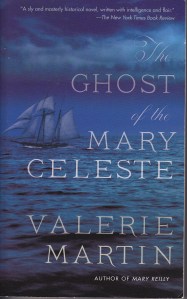
MaryCelesteGhosts have a way of persisting. I’ve had Valerie Martin’s The Ghost of the Mary Celeste on my reading list since I first saw it in hardcover on a bookstore shelf. The Mary Celeste was an actual ship, found with not a soul aboard, lifeboat intact, and no sign of violence, back in the 1870s. To this day no one knows what happened to the crew. Valerie Martin takes this frame and fills it in with a family drawn into Spiritualism, a religion that was just beginning at the time. Spiritualism, which developed in the aftermath of the Fox sisters and the eerie rapping at their upstate New York home, is one of the few religions to be completely at home with ghosts. The faith still exists today, and although Margaret Fox “confessed” to having hoaxed the effects she also retracted her confession, leaving ghost hunters perplexed to this day. These two mysteries, brought together in the moody month of November, make for a compelling novel that urges the reader forward.

Martin also adds the presence of Sir Arthur Conan Doyle to the story. Doyle, an avowed believer in the spiritual realm, also created Sherlock Holmes. As the various characters try to piece together what happened to the Mary Celeste, the ghosts of those lost at sea ambiguously communicate with the living. The world between realms, in this story, is permeable but indistinct. Those lost at sea are, in the narrative, restless. The mood of the novel is unrelentingly moving and thoughtful. Ghosts haunt, but don’t appear. Readers are left to draw their own conclusions.

As today is the fortieth anniversary of the sinking of the Edmund Fitzgerald, it seems appropriate to think about the Mary Celeste. Since Percy Shelley drowned in his own personal boating accident, loss at sea has become one of the hallmarks of Romanticism. Conceived as an answer to the cold, callus industrialism that trailed the scientific revolution, Romanticism suggested that there was an enchantment to nature and that things were not always as they seemed. Prosaically, there’s nothing poetic about dying in a violent shipwreck. That’s what makes the Mary Celeste so compelling. There is no violence here. The sea calls and claims captain and crew as her own. The lack of resolution has led to a very open-ended mystery—the perfect foil to a harsh materialism. Today the Mary Celeste and Edmund Fitzgerald will be sailing my internal seas as the season of spirits and shipwrecks come together in the lengthening nights of November.
Medusa on the Rocks

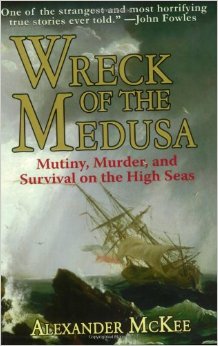
WreckOfTheMedusaShipwrecks possess a compelling resonance that is difficult to explain. I have seldom been on boats, but from my youngest days I’ve been drawn to the coast. While a student in Boston I made weekend trips to Gloucester to be near the place where ships go out to sea, sitting by the quote from Psalm 107 at the base of the famous fisherman statue. Moby Dick has passed under my eyes many times. While at Nashotah House I was frequently tormented with nightmares of sinking ships. Titanic was a huge movie late in those years, and even before watching it, I dreamed of going unceasingly down. In a used bookstore, Alexander McKee’s Wreck of the Medusa recently caught my attention. Although I’d never heard of the Medusa, the name suggested classic themes, and the shipwreck, I knew, would entail suffering and loss and human drama. I knew I had to take it home with me.

The true story of the wreck is tragic in just about every conceivable context. The year was 1816 and aristocracy was still openly practiced. The Medusa, bound for Africa from France, ran aground and, in echoes of what would happen (at least in some instances) a century in the future, the insufficient number of lifeboats were claimed by the wealthy and powerful. The most tragic aspect, however, was the matter of the raft. The masts were felled and a poorly designed raft was hastily constructed (the Medusa was grounded, not sinking). The greatest number of people were herded onto this raft where the water came up to nearly their waists, as the six boats towed the makeshift craft toward shore. At the instigation of the about-to-be-installed governor of Senegal, those towing the raft dropped the line and rowed themselves to safety. The raft, with no means of propulsion, was left adrift where 135 people of the 150 on board slowly died over the next two weeks. The governor and his party made it safely to their destination.

To me, this election week, it seems that I’ve just read a potent parable. We have public officials in place who, like those safely in the boats, cry out “we abandon them” before the masses of those who expect and deserve their protection. Power, it is said, corrupts, and as we witness the constant increase of political power over the sea of humanity taught that their religion favors the party able to quote the Bible the loudest, we sometimes forget that sinking ships may leave very long memories. In another week we will reach the commemoration of the sinking of the Edmund Fitzgerald. The Essex, the Medusa, and countless other tragically doomed ships may easily slip our minds now being propelled at full speed toward the spending frenzy of Christmas. Meanwhile, I urge us all to take a few November moments to consider where this ship is heading, and if there is yet time to change her course.


Gitche Gumee

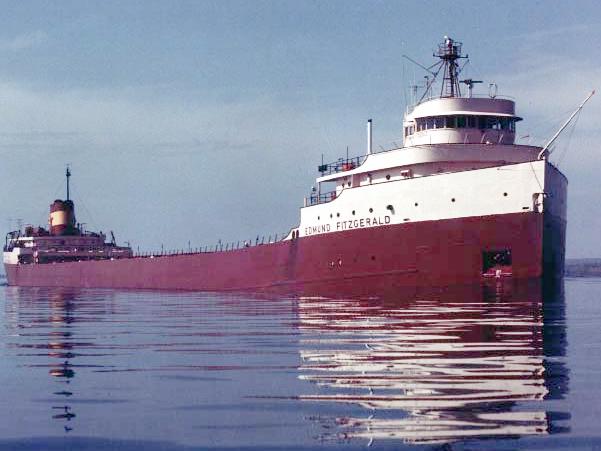
Up on the rugged western shore of Lake Superior the lamp atop Split Rock Lighthouse will be illuminated for the only time this year tonight. Immensities and superlatives fail at some sites, and as the cold waves lap eternally at the shore, this is one of them. Split Rock illumines its beacon in commemoration of the sinking of the Edmund Fitzgerald on the far end of that great lake on this date many years ago. While not as large as the Titanic, the Edmund Fitzgerald outstretched two football fields and carried more than fifty million pounds of cargo, immeasurables we are forced to recalibrate into yardage and tonnage. When the Fitzgerald sank during an unnamed November storm in 1975 only twenty-nine people died, but the tragedy soon became part of American legend. The image of immensities battling for the souls of twenty-nine human lives possesses an eerie, epic quality. When faced with the raw rage of nature, we are helpless indeed.

Shipwrecks may be the ultimate metaphor, for like ships we are consciousness in a protective vessel. Of course some deny that a soul exists, but in November it is difficult to doubt. A century ago the Titanic sank, and we still wonder in fascination. Human life is fragile when confronting the north Atlantic, or Lake Superior, or even the great waves that wash ashore and sweep some away. Great bodies of water, some psychologists say, represent forces larger than ourselves in the human psyche. Some suggest the ocean in dreams represents sex, but others would say it’s God. In the realm of metaphor anything is possible. It is no accident that many Christian sects begin the rite of membership with total immersion in water. When the Fitzgerald was baptized, twenty-nine men died.

Standing on the vast shoreline of a gray Lake Superior has a way of making you feel insignificant. Enormity was easily related to divinity in the primitive mind, but standing next to something truly vast still sends me into a protective crouch as I ponder just how little I really am. In this year of destructive storms, as we’ve taken to naming the winter squalls that whip across the continent with noble names such as Athena and Brutus, we are still at the mercy of something unspeakably large. The weather is the ocean above us, and it bears children named Andrew, Irene, Katrina, and Sandy. Each reminds us that we are constantly at the mercy of something far larger than human comprehension. Every year as the tenth of November rolls around I think of the Edmund Fitzgerald and the overwhelming forces that surround us. There is indeed a metaphor hidden here, for those willing to plunge into the frigid depths to find it.