Dark History

I wouldn’t have watched The History Boys had my current interest in dark academia not emerged.  A comedy-drama based on a play by Alan Bennett, it’s set in a British boys’ school where the seniors who’ve made record-breaking A-levels, are set to try to get into Oxford and Cambridge.  The movie revolves around two teachers, “Hector,” who is unorthodox but full of humanistic spirit and Irwin, who urges the boys to stand out in originality, even if it means bending the truth, or outright lying.  The darkness, although played lightly, is that Hector gropes the boys.  This has led to some criticism of the film since Hector is presented in a positive light.  Bennett, who also wrote the screenplay, pointed out that the “boys” are actually consenting age, and know that Hector does nothing more than fondle them when fully clothed.  This hasn’t protected the film from the furor of those who find the idea offensive.
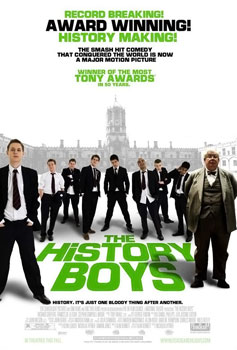
Beside the divergent approaches of Hector and Irwin’s completely opposite angles, although understated, remains the middle voice of Mrs. Lintott, the history teacher.  She does make the point as the boys prep for their entrance exams, that women have been silenced in history and they should never forget this.  The Cutler’s Grammar School boys all win entry to Oxford, and the movie ends by each of them saying what has become of them.  There’s really too much going on in the movie to chase down every plot line.  For example, the very religious physical education instructor’s story.  He’s brought up short while using Jesus to urge the boys on when one of his students is Jewish and another Muslim.  Of course, school life is all-encompassing, and vignettes are the most that movies might offer.

The History Boys is a film that would bear rewatching for the words alone.  Since the movie is based on a play and the playwright wrote the script, it is naturally very well written.  The dialogue contains many potentially quotable bits.  Dark academia tends to be that way.  At least some of it is.  Often set in educational locations, it recalls how we came to understand our world.  It really is a fraught journey.  Here the coda showing what happened to the boys is a reminder that our fates choose us rather than the other way around.  And that’s what dark academia explores—we may set out to do one thing, becoming an expert, only to find ourselves scratching out a living doing something else.  I know I’d see this again, to continue my own education.

Unverified

Dear Google Scholar and ResearchGate,

Thank you for listing me as a scholar on your website.  I am pleased that my academic publications interest you.  I am writing to you today, however, about your verification process.  Neither of your sites will verify me since I do not have an email with a .edu domain.  Now, I fully realize that even adjunct instructors are often given a university or college email address.  This is so students and administrators can reach them.  Speaking as a former adjunct instructor at both Rutgers University and Montclair State University, I can verify that such an email address does not verify your scholarship.  It is a means of communication only.  It does not verify anyone (although it may come in handy if you need to contact someone internally).

For large companies with a great deal of resources, I am surprised at your narrow view of both “scholar” and “verification.”  I earned a doctorate at Edinburgh University before email was widely used.  I taught, full-time, for over a decade at a seminary that did not request any .edu emails until well into my years there.  I taught for a full academic year at the University of Wisconsin Oshkosh.  Had you requested “verification” earlier (pardon me, you may not have existed then), I would have been able to contact you from nashotah.edu, uwosh.edu, rutgers.edu, or montclair.edu.  Your choice.  However, since you only decided to begin your online resources after I had moved into publishing, where the emails end in a .com domain, you were simply too late.  The thing about technology is that it has to keep up.

I hardly blame you.  My doctoral university was opened in 1583, long before today’s giants were twinkles in the eyes of the likes of Bill Gates or Steve Jobs.  Scholars used to write these artifacts, called “books” on paper.  They sent them through a service called “the mail” to publishers.  I know all of that has changed.  The fact is, however, that I have published six scholarly books, and several articles.  I am still writing books.  I am simply wondering if you can answer the question of when I became unverifiable because of my email address?  I have a website that details my educational and professional history.  Academia.edu has not asked me to verify myself and my profile there gets a reasonable number of hits.  My question is when are you going to catch up with the times?  Many, many scholars do not work at .edu-domain institutions.  Of course, nobody knows who we are.  Thank you for your kind attention.

Unverified  


Prior Memory

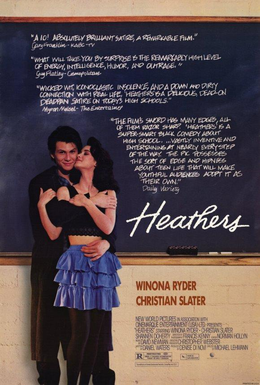
Sometimes I just don’t know where my mind is.  A few months back my wife and I decided to watch Heathers for the first time.  It got a bad rap when it came out but we finally gave in because there were so many cultural references to it that we felt we had to be informed.  Now none of that makes it worth comment.  What does, in what’s left of my mind, is that I was sure I’d written a blog post about it.  I hadn’t.  The thing is, I even thought I remembered some of what I wrote about it.  Uhn-uhn.  Didn’t happen.  So I guess I can trawl my memory and see if I can recollect what I thought I had already said.  Here goes.

The movie is a disturbing and funny look at growing up and its hard lessons.  Everyone said that it glorified suicide, but that wasn’t what I saw.  One person attempts it, and the others are all actually murdered and made to look as if they died by suicide.  Not a lighthearted topic, I know, but the students pretty much all want to live.  J. D. (read into that what you will) is the real criminal.  An outsider with a chip on his shoulder, and who has no problems being (or associating with) a criminal.  Or making others into criminals.  

As with many, perhaps most, adults, I remember the confusion of puberty quite well.  I wanted to be liked in school (I never had many friends) but I was quiet, bookish, and very religious.  Having grown up feeling generally unliked, I found acceptance, for a time, at church.   This movie captures that aspect well—the desire to fit in with a cohort that is particularly hostile (teenagers).

What brought Heathers back to mind after these few months was the fact that some classify it as a dark academia movie.  Dark academia generally has some schooling involved, sometimes directly, sometimes as implied.  There is a natural kind of darkness in high school and into college years.  This is something we may be in danger of losing with universities becoming glorified trade schools.  Not all of life is about finding a job.  The humanities suggest that being human is sometimes enough.  Heathers seems to have aged pretty well, being over thirty at this point.  Some of us took three decades to see it.  And if we feel like we’re losing our minds from time to time, at least now I’ll know I have indeed posted upon this movie.


University Death

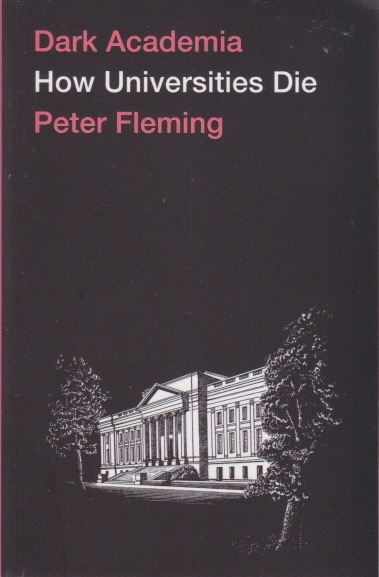
This is an important and thoroughly depressing book.  Despite globalization, I fear that a book from down under might fail to be readily found in the United States, where it’s also needed.  Peter Fleming’s thesis is spelled out in the subtitle.  Dark Academia: How Universities Die.  I’ve read a few other books like this, but I was attracted by the title of this one.  Fleming points out much of what I already knew, but with the stats to back it up, as well as compelling personal stories.  Few people worry about professors.  We’re conditioned to think their lives are easy and carefree.  I doubt they ever were, but since the eighties, when universities started to act like business ventures, the cracks showed in the foundations and their lives grew harder.  Capitalism ruins everything.  Fleming discusses the political maneuvering in the UK and Australia, as well as in the US.  We’re all facing the same nemesis.  Greed.

Politicians began attacking universities likely because they realized that educated individuals can see through the shenanigans that people like Trump, and Reagan and Bush before him, pulled.  They didn’t want alternative voices.  Debate is anathema.  The easiest solution was to make education a business because businesses always want more money.  Now, I’m shooting from the hip here, but Fleming pulls such things together with evidence.  I have witnessed firsthand some of what he describes—living as an adjunct instructor, barely making enough to cover the bills.  At the same time learning the university I was working for had been hiring “managers” (hundreds of deans, associate deans, etc.) but couldn’t afford to hire faculty.  That sports (something Fleming doesn’t address) were allocated far more money than teaching.  Yes, things were bad.

Fleming points, rightly, in my opinion, to neoliberalism as the culprit.  That’s the form of liberalism that’s wedded to free market capitalism while spouting the causes that traditional liberals support—care and concern for all people.  The older I get the more I see that neoliberalism is what the Republican Party used to be.  They’ve veered hard right and since, in America, liberals have never really had a chance to hold power since Roosevelt, they’ve become neoliberals.  Thus began the transformation of higher education before I ever started my doctorate, but I didn’t know it.  I’m no political scientist.  I’m a teacher interested in the past.  And religion.  Having grown up poor, I invested all my scant resources into getting qualified to teach, only to discover that the ivory tower was being sold to the highest bidder.  Dark academia indeed.


Finding the Source

I need to know the origins of things.  Call it a sickness if you will, but I’m compelled to trace things to their source.  This is why I went on to earn a doctorate, and it’s a trait that hasn’t left, despite my career malfunction.  My interest in origins was recently reawakened by the citation, in a book, of a source that was incomplete.  I turned to the internet, of course.  I found the source, reprinted on a Tumblr page, for which I was grateful, but there was no proper citation there either.  Instead, a link to another webpage, which itself consists of yet another link.  Even after pages of googling, I was no closer to finding the source.  This is why I miss libraries.  You were there with books, some of them centuries old, looking at the source.  Outside the academy this rarely happens.  Particularly when you work 9-2-5.

The internet age is one of taking someone else’s word for it.  That’s why it’s important to establish credibility.  The website where I found the information—the top ranked site on both Ecosia and Google—had old books as the background, but no “about” page.  Who had put this information here and where did s/he get it?  The item I was looking for was from the 1700s.  I don’t have a print copy lying around and I was wondering what the source was—a book?  A journal article?  A newspaper?  An actual archive?  And why can’t Google find it in a library?  I know the source actually exists because I also found it referenced in a reputable print book, but one with inadequate citation.  Some of us were cut out for this kind of thing.  Constitutionally researchers.  But you have to work to live.

One of the greatest pieces of advice ever is to stay curious.  It helps keep a mind active, even a 9-2-5 one.  I’ll keep looking for this mysterious source.  I’ll check out likely references in the bibliography.  I’m sure that other people have the same compunction not to take someone else’s word for it.  Particularly not an anonymous poster on some website.  Especially in this day of AI lies.  One of my high school teachers once said that a reputation for being trusted is something you earn by lifelong cultivation.  If people know you are a reliable source, they will believe the things you say.  Anonymous information can be helpful from time to time, but without knowing the source I always remain skeptical.  And curious.


Writing Academic

One of the things that Stephen King detests (or at least detested back in the seventies) was academic literary criticism.  Perhaps you’re more normal than King or I, but if you read such things you find yourself immediately sucked into a world where the writer seems determined to demonstrate their erudition by splicing together words that shouldn’t really sleep together and then throws theory at you until you fall off the cliff.  It can be a frustrating experience for the reader, even as the writer is granted tenure for it.  One of these days I’ll learn my lesson.  Buying books by academics is dicey prospect.  I’m drawn in by the ideas, and the early pages, then I’m soon in the deep end remembering that I never learned to swim.

Is it really fair, I wonder, to begin a book—the first one or two pages impossibly engaging—then start winging ponderous, theory-laden words at the reader?  Your publisher paid for an attractive, inviting design and the reader, lured like a child to a candy store, thinks this will be sweet.  Then the sugar coating wears off and you’re faced with another 253 pages of clawing at words you recognize, hoping to make some sense out of what seemed, and still is, an engaging idea.  This has happened to me multiple times.  I live between worlds.  Even when I was an academic, however, I eschewed theory-heavy language.  I had nothing to prove, other than the point of my article.  And to prove a point, it seemed to me, people have to understand what you’re trying to say.

Higher education is in crisis mode.  Among the various fields you can study, the humanities are under especial scrutiny.  Have you read a book by an English professor lately (present company excepted!)?  Although their title is “English” you can be left wondering what language it actually is that they’re writing.  And they are capable of plain speaking.  Those first two pages demonstrate that.  They are capable, but are they willing?  I begin to understand Mr. King’s reservations.  I’ve run into books even in the field in which I have a doctorate that I can’t understand.  I find myself tentatively cracking open the Oxford English Dictionary to see if perhaps I’ve misunderstood the connotations of that word for my entire life.  I don’t mind a challenging read now and again.  At the same time, I mourn the loss of something beautiful when I can’t make out what the author seems to be saying.  Perhaps such books should come with warning labels.  I suspect Stephen King would have a good turn of phrase for what such a label should say.


Prophetic Cookie?

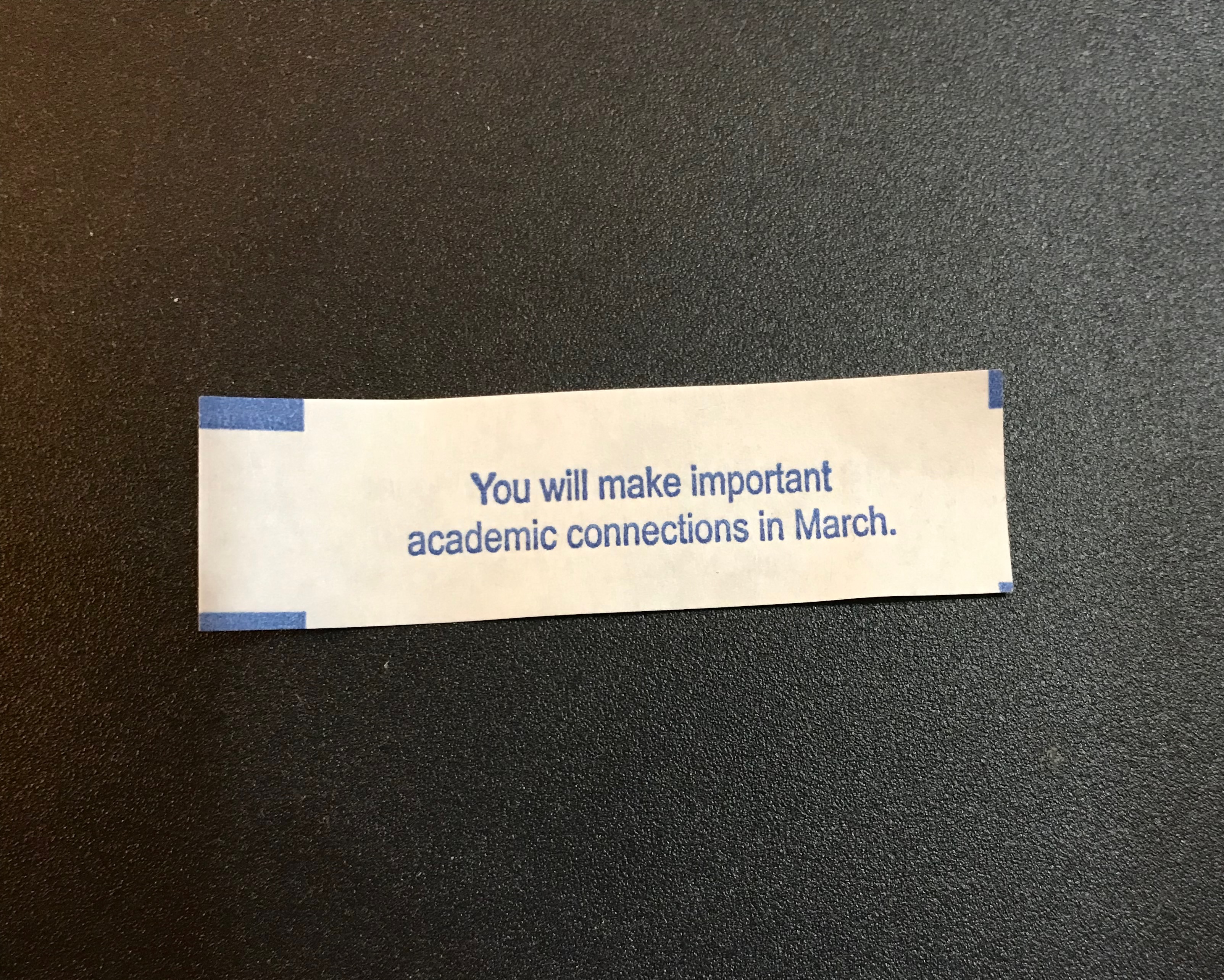
I have no idea if they really exist in China, but the Chinese fortune cookie is ubiquitous in the United States.  I’m assuming that China isn’t tracking them to know where Americans eat, but I do often wonder about what’s inside.  Many years ago I noticed that the “fortune” aspect had dropped out.  Predictions weren’t made any more and your typical cookie had an anodyne, but sometimes witty reflection in it.  They might’ve been called “aphorism cookies.”  Well, that all changed for me after a meal that included said cookies.  I was surprised to see an actual prediction, and, not only that, but one that was strangely apt.  It reads, “You will make important academic connections in March.”  Considering that academics make up a minuscule part of the population, that seems oddly specific, doesn’t it?  And with a date—March.  This differs qualitatively from “Leadership is action, not position.”

There are other future-oriented prophecies in cookies, of course.  “You will become known for your generosity.”  (Gee, that’s nice.)  Or “A short vacation is in order for you.”  But I’ve decided to hang onto this academic fortune to see if it might come true.  I do have many, many academic connections, of course.  That’s part of my job.  And I was an academic myself in my palmier days.  But what seems strange to me is that many people reading “academic” in a fortune would automatically dismiss it, I suspect.  An important academic connection, no less.  Knowing a professor, from my experience, often doesn’t help in getting you anywhere.  I value their friendships, of course, but it hasn’t sold more books.  Or got me that teaching job I still covet.

Will the cookie prevail where other measures have fallen short?  I have to wait a few months to find out.  And more importantly, I have to remember this fortune.  I can, I suppose, put it on my bulletin board amid the Sleepy Hollow and other mementos and hope that half a year from now that I’ll recollect this little post, and that little cookie.  Of course, if someone offers me a job at a local college in March I’ll consider the deal sealed—the cookie was wise.  If nothing apparently happens, however, I’ll still have to wait beyond that to see if something emerges from my many daily interactions with academics.  Maybe one of them will truly be listening.  That’s the thing about predictions—they’re as much interpretation as they are prognostication.


Life Course

Curriculum vita.  The course of a life.  I see quite a few CVs, although I’m not on any search committees.  As I was examining one the other day I recollected how, when I first tried to put one together, I was told to leave high school and its achievements out of it.  Nobody’s really interested in that anymore.  Presumably college is an indication of choice whereas high school is a matter of where your parents live.  Or how much money they have.  College says something indicative about you.  Although many parents—not mine, to be clear—help bankroll college and may have a say in where you go, college is “your choice.”  Unbounded by geography, young people mostly old enough to take care of themselves, are given a really tremendous responsibility here.  And it was certainly influenced by high school.

Some choices are economic, and that also says something about a person.  Some are faith-based, which definitely says something about you.  Some are terribly ambitious, and those tend to get you the biggest head start on your life course.  Of course, some of us did not realize that.  Some of us, not sure if college would work or not, chose somewhere close to home.  Somewhere where escape, if needed, was possible.  And of course, your college shows up ever after on your CV.  I often wonder if things would’ve worked out differently if I’d gone somewhere else for college.  I needed somewhere understanding to shake me out of the false narrative I’d been told.  Had I gone somewhere more strident I might’ve retrenched in my pre-decided ideas.  Of course, those pre-decided ideas are what made me decide to go to college in the first place.

How can we possibly measure the course of a life?  From big event to big event?  So many of the meaningful bits occur in small spaces wedged in-between the large markers of who we are.  We can’t possibly know all the consequences of our choices, even as we attempt to select the right option at each step of the way.  And there’s no guarantee regarding the outcome.  Were it a feasible option I’d go back to college again—I would start at a different place this time—to test the results of my first decade of higher education.  For, I know, although a CV can reveal more than it might intend, it leaves much more unsaid than it can possibly say.


Tech Warning

My moon roof is open.  That’s what the late-night alert says.  Thing is, I don’t have a moon roof.  Maybe I should go out to the garage and check, just to be sure.  You see, these new cars, which are as much computer as they are a means of conveyance, are subject to glitches just like the computers at work always seem to be.  And if this is true of a massive and lucrative company like Toyota, how can the rest of us really trust what our devices tell us?  After all, mainly they exist to sell us more stuff.  So whenever we take the Prius out, after it’s put away I get some kind of warning on my phone.  Nearly every single time.  If somebody’s been sitting in the back seat—or even if a bag was resting there—I’m cheerfully reminded to check the back seat once I get into the house.  I appreciate its concern and when I grow even more forgetful I may need it.  But that moon roof…

I use and appreciate technology.  I believe in the science behind it.  It makes life simpler, in some ways.  Much more complex in others.  I confess that I miss paper maps.  Do you remember the thrill of driving into an unknown city and having to figure out how to get to an address with no GPS?  Now that seems like an adventure movie.  Our cars practically—sometimes literally—drive themselves.  I’m no motor-head, not by a long shot.  I do remember my first car that didn’t have power steering or power brakes.  It had a stick-shift and you had to wrassle it at times.  Show it who was in charge.  With technology we’ve all become the serfs.  It breaks down and you have to take it to an expert.  Not quite the same as changing a tire.

I worry about the larger implications of this.  As a writer I worry that my largest output is only electronic.  Publishers don’t seem to realize that those of us who write do it as a way of surviving death.  We have something to say and we want it etched in stone.  Or at least printed on paper.  Tucked away in some Library of Congress stacks in the hopes that it will remain there for good.  I often think of dystopias.  The stories unfold and ancient documents—our documents—are found.  But unless they get the grid up and running, and have Silicon Valley to help them, our electronic words are gone.  It’s as if you left the moon roof open, even though you don’t have one.


Conference Voice

“Conference voice” is a phenomenon that began with my career malfunction.  While teaching I attended the AAR/SBL annual meeting every year but one.  Even the year that Nashotah House fired me I attended, through the generosity of a seminary colleague who’d left for a parish and who used discretionary funds to help me afford it.  (Churches can actually help people from time to time.)  In any case,  I always met many colleagues at the meeting itself, and had many conversations.  Besides, I taught a full docket of courses every year.  Then the malfunction.  I was eventually hired by Gorgias Press but I had to do adjunct teaching to make ends meet.  I taught up to about ten courses per year at Rutgers, all in the evening.  Then I was hired by Routledge.  The commute to NYC precluded any adjunct work, so I settled into the quiet world of editing.

I also began attending AAR/SBL again.  I came home with “conference voice.”  After going for days, or even weeks, with no substantial conversation, I’d lost my lecturing vocal stamina.  At the conference I had five days of back-to-back meetings, often in a crowded and noisy exhibit hall.  I’m a soft-spoken individual (I can project when teaching) and my larynx was stressed by the concentrated five days of constant conversation.  My voice had dropped in pitch by the time I got home and it took a few days to get better.  I would lapse into cenobic silence for another year.  After the conference I’d return every year with aching vocal cords.  My family sympathized, but I really just don’t talk that much.  Especially at work.

Recently I met a friend for lunch.  I hadn’t seen him to chat for a few years so we spent over two-and-a-half hours talking.  Part of it in a restaurant where I needed to raise my voice.   I awoke the next morning with conference voice.  This bothered me because I’d been invited to do a podcast episode about a horror movie and I faced an existential crisis: what does my real voice sound like?  In my mind, my profession is teaching.  The voice I had at Nashotah House, University of Wisconsin Oshkosh, Rutgers University and Montclair State, was my real sound, such as it was.  Life has landed me in a situation where I seldom speak, and almost never to groups where I need to project.  Conference voice is a reminder of what I was meant to do and what I, of necessity, must do.


Work for Good

You learn a lot as a primary caregiver.  Since dealing with a family cancer diagnosis last year I joined a local support network for caregivers.  Three things I’ve learned: healthcare is very uneven, we ended up in a good facility, and finding a social worker on your own is very difficult.  I see lots of messages on the support boards from people in poor facilities that can’t find the help they need.  I know what social workers do—I had several friends who majored in social work in college—but in this age of all the information in the world at your fingertips, just try to find a social worker!  I was trying to find a website to suggest to a person on my board who didn’t know where to turn.  Searches bring up links to places trying to sell you their services to find a social worker.  Are we really that callous?  

People tend not to try to find a social worker unless they really need one.  Many people, I suspect, wait until they feel pretty desperate.  This is not when you need some salesperson trying to sell you something.  Medical care can be very expensive—devastatingly so—and there are professionals out there who specialize in helping you get through such things.  Why are they so difficult to find?  I tried government sites that seem more interested in telling you how to become a social worker than how to find one.  If we’re in such a state that we don’t have enough social workers why don’t we pay them more?  Here’s a hint, most politicians could stand a salary cut.  My college friends all said they knew it didn’t pay well, but social work was a way to help people. Saints still walk among us.

We have the means to help everyone.  What we lack is the will.  We continue to let capitalism and the hope of individual wealth run our economy.  Economy means nothing without people.  And we have many people who are willing to receive less personally to help others get by.  Why do we have to hide them behind a pay wall?  What does that say about us?  We’ve been fortunate.  Our medical facility immediately put us in touch with a social worker.  If, however, you end up where healthcare choices are limited, or don’t know how to find a social worker on your own, the internet’s not a great resource, unless you want to pay someone to help you find help.  What have we become?


Why Write Then?

People far smarter and more prominent than yours truly have pointed this out, generally in vain: academic writing is driving itself extinct.  And some of us will not mourn it, if it does.  You see, academics are taught to write with an erudition and pomposity that satisfies dissertation committees made up of people who had to do the same.  This academic hazing generally obscures otherwise interesting observations.  Now thoroughly indoctrinated, academics go on to write their next book, and their articles, in this same turgid prose that obfuscates mightily.  To what purpose?  So that those critics higher on the food chain won’t be tempted to take on this morsel, preferring instead some “popularizer” who actually knows the craft of writing?

Poor writing is poor writing.  Those of us who’ve graded undergraduate papers have spent many red pens (I used to use green, so as not to be so negative) correcting bad stuff.  Why then do we give in to writing even worse ourselves?  I’m not proud.  I’ll admit that I’ve read academic books I really didn’t understand.  And it wasn’t because I’m not properly trained.  It’s because the writing was so full of jargon and “scholar X said but scholar Y rebutted”s that I get lost in the jungle.  One of the things repeatedly said about my teaching, back in the day, was that it was effective because I could explain complicated things in ways people could understand.  Isn’t that the purpose of publication in general?  Too many scholars write only for other scholars.  Not that there’s anything wrong with that, but if they wrote clearly maybe some of the rest of us could get in on the conversation.

I’m sure I’m not the only one to get really excited about a book.  The topic doesn’t matter.  Shivering with anticipation you order it and await its arrival, staring out the window awaiting the postie or the Amazon van.  It arrives and you caress it a little before opening it.  Then you find it’s written in academese.  You struggle to get through it, uncertain that you’ve really learned anything at all.  Except how not to write.  Those in higher education lament that the system is crumbling.  One of the reasons, I contend, is that nobody can understand what they’re saying.  What’s wrong with writing for the average, educated person?  Do you need sixteen five-syllable words in one sentence?  Look, I bought your book because I already believed in you.  If you make me regret my spending you can be sure that I’ll be purchasing someone else’s books from now on.


Life Learning

One thing a recovering academic must learn is that the vast majority of people don’t really care what drives the academy.  They aren’t too worried about larger issues as systemic racism, or various groups’ feelings of unequal treatment.  In fact, most people are just looking to get by, keeping depression and hopelessness at bay.  There are few avenues to break out of the middle class, and even fewer to move up from the lower.  And going to school hasn’t been presented to most people as an opportunity, but as a chore that must be done until work can be secured and they can pursue surviving on their own.  This truth comes to me time and again when I’m reminded that deep thinking doesn’t sell books (not unless you’ve already established a reputation) and that if you try to bring the concerns of the academy to the public, they’ll look the other way.

The real trick, it seems to me, is educating people without them knowing they’re being taught.  People don’t like being talked down to.  Understandably.  When I listen to people without college educations, I learn a ton.  This is my matrix as well—it’s where I grew up.  Higher education changes the way you think, but it shouldn’t prevent you from communicating with those who are the vast majority of people in the world.  Anything can seem to be normal when it happens long enough, even living in ivory towers and discussing things almost nobody else cares about.  You see, I’m a realist.  And I still have a lot to learn.

When I write my books, my style is accessible but my topics are academic.  It has taken me years to realize this simple fact.  Anyone can read my books from Holy Horror on and understand them, but why would they want to?  The questions raised are those of the academy, and those in the academy know you by your specialization (ancient West Asian religions, historically declined, thank you).  A glance at how my Academia.edu page is viewed tells the story.  Nobody who visits there is interested in horror films or this blog.  They want the resource that can’t be renewed—my work on ancient history of religions.  I’ve moved to horror because I find lots of very intelligent people here.  Like those with whom I grew up, they are generally ignored by the academy.  They are also very accepting of outsiders.  You have to unlearn being an academic.  And it might just lead somewhere productive.


In Praise of Lecture

As I look at our world and see divisions that certain politicians only make worse for their own gain, I wonder where we’ve jumped the rails.  I was just reading about science lectures in the early part of the last century.  This reminded me of a public lecture on dinosaurs that we attended in Edinburgh with some friends.  Yes, we were graduate students looking for stimulating, and inexpensive, entertainment.  I’ve always considered entertainment a learning opportunity.  Having grown up both poor and curious, I feel a fascination regarding most new things and I began to wonder why we don’t have more public science lectures these days.  We really enjoyed the dinosaur talk.  I think the lecturer was Jack Horner, but what really stuck with me was not his name, but the good feeling the talk left behind.

At Nashotah House, Milwaukee and Madison were both a little too far to venture for an evening lecture.  We had to be in chapel early the next morning, and besides, I had already started waking up early (around five in those days) to do my research and writing.  When we came out of Nashotah, the internet had taken over the world.  Let’s face it, when you reach, say, middle age, you don’t want to have to go out much in the evenings any more.  At least if you’re an introvert like me.  Particularly when it’s cold out.  And how do you even find public lectures these days?  We live near several colleges and universities in the Lehigh Valley, and I get occasional notices, but the lecture in Edinburgh was actually in a public venue, not a university site.  You see, I think that’s what we need to get people back on the side of science and critical thinking.

The internet favors your biases.  Algorithms send your way more of what you’ve already seen.  Each click brings someone some income.  (I hasten to add that I get no income from this blog; I pay for the privilege to post on it.)  Wouldn’t it be better if towns had lecture halls and scientists (and others) had the name draw to bring people in?  While at a small venue in the Easton Book Festival a couple years back, a university guy from New Jersey talked to me after my presentation.  “We don’t have many opportunities for smart entertainment,” he told me.  I’m no scientist and there’s a real debate about the “smart” part, but I took his point.  You used to be able to find public lectures that were cheap or free.  And everyone left feeling like they’d received a gift.


Ravens and Teachers

Humans, it is claimed, have a theory of mind.  What this means is that we know what others are thinking, or better, at least we can anticipate what they might be thinking.  This allows us to be self-aware and live in a complex society.  We can see someone else and infer what’s going on in his or her noggin.  This is often considered a uniquely human trait, but I’m not sure how widespread it is.  You see, I frequently run into the situation where someone expects something of me without telling me.  It happened just recently with an organization to which I belong.  I’m a very busy person.  I suspect most of us are—not having time to accomplish everything we need to get done.  If someone wants something from me I have to be told what it is and I have to be told in detail.

One of the things my students always said was that I was a good teacher.  The reason for this, I think, is that when I explain something I back up a bit before the beginning.  I try to assume no knowledge on the subject before going in a bit more deeply.  This method works because of my personal theory of mind.  These people wouldn’t be taking a class on this subject if they already knew the stuff I could assume.  For understanding something new, things have to be explained thoroughly.  That doesn’t mean taking a lot of extra time, but it does mean not assuming others know what I know.  For many people this is difficult.  We’re all busy.  We tell others “Do this,” without explaining what exactly “this” is.  The results are predictable.  It happens all the time in work emails.

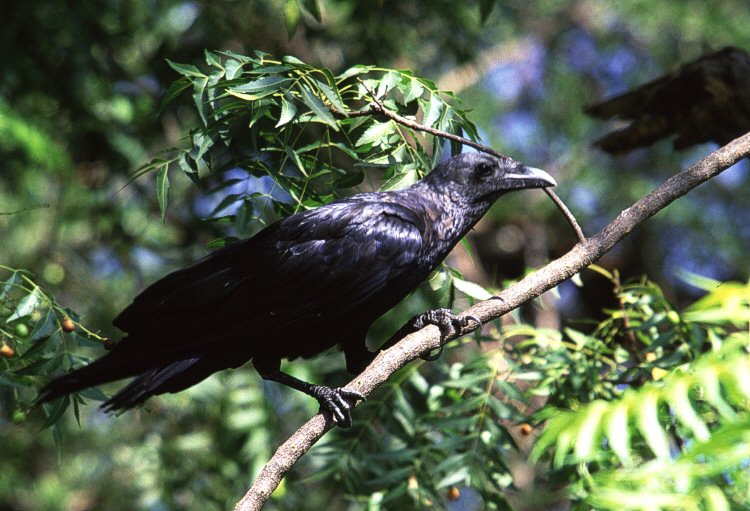
I’ve recently written of teachers and ravens.  The effective among the former understand the value of full explanation.  The latter have a theory of mind that allows them to go as far as to try to fool others by giving not enough information.  We might learn a lesson either by sitting in the classroom of the former or by watching the ravens that skulk on the edge of civilized areas.  What they have in common is the ability to realize that others operate with limited information.  In order to learn, information has to be conveyed and conveyed well.  Even now colleagues at work are surprised at when I explain something that it’s done thoroughly and clearly.  When I receive information it’s often piecemeal and frustrating.  The reason, I infer, is that we don’t spend enough time paying attention to either our teachers or the ravens.

Image credit: Wikipedia Commons, public domain