Bright Idea

No, I didn’t see a long tunnel with a light at the end, but I did have soot on my hands from the flash.  I’m no electrician and the ordering instructions weren’t clear about how to get the dryer installed, as well as delivered.  The driver, who spoke English haltingly, told me he would not set it up.  There was another problem with the order: the dryer cord was for a four-pronged outlet, but our house has a three.  I suppose that’s why the cord doesn’t get attached to the appliance.  Now, we lived in Scotland for three years.  Electronic devices there are sold with a cord that you have to wire into the plug yourself—different places have different outlet types.  With fear and trembling I’d wired a lamp or two.  I prefer not to play God when it comes to electricity.
I don’t know how many appliance-related deaths happen each year, but I’m sure it’s not a null set.  Here’s what happened.  A week after delivery I found time to go to the hardware store to exchange the four-prong for a three-prong.  I went home and wired it up.  The plug didn’t fit into the socket.  Muttering under my breath, I turned to the internet to find out what had gone wrong.  Well, it turns out that electric kitchen ranges are also not wired sometimes, and they take a different three-prong plug with wires handling different voltages or whatever.  Yet another weekend came and I finally got the right cord.  A little insecure from the two attempted efforts, I put the plug in the socket to see if it fit.  A bright spark and a loud pop occurred.  Two of the connectors had been touching and I’d closed the circuit.  If I’d been holding it differently, I wouldn’t have survived the experience.

As a child I once electrocuted myself, quite by accident, it is an experience I never wanted to have again.  I was so shook up after being so close to it again that I couldn’t face going back to the store to see if they had another one—the cord was now soot-blackened, and useless.  Living in a capitalist society my mind immediately turned to my electric bill, wondering how much that light and sound show would cost me.  The dryer is energy-efficient, all the more so for not having ever been used up to that point.  Now we’re hooked up and ready to go and I’m thinking how fragile life is.  And how, in middle and high school we had to have wood shop and metal shop but not a thing about that favorite tool of the gods—electricity.
Soft Wired

A museum of discarded electronics.  I’ve been thinking that might be a good use for all the tech we’ve had to buy over the years that quickly becomes outmoded.  (Useless, that is.)  As I look over these devices I can recall just why they were purchased.  Mostly it was to solve a more immediate problem.  You perhaps overspend so that you can avoid disrupting the tech services you’ve learned you can’t live without.  Then new tech comes along and you need new hardware to do the same thing you’ve always done.  Soon you’ve got a museum’s worth of old tech.  I tried to get my mother on the internet by sending her an old computer that I bought with grant money back in my Nashotah House days.  When it was all set up, it was discovered that it was too old to connect to the modern internet.  I’ve lost track of how many computers are in the attic, but at least now there’s one less.  The thing these all have in common is that they require electricity.

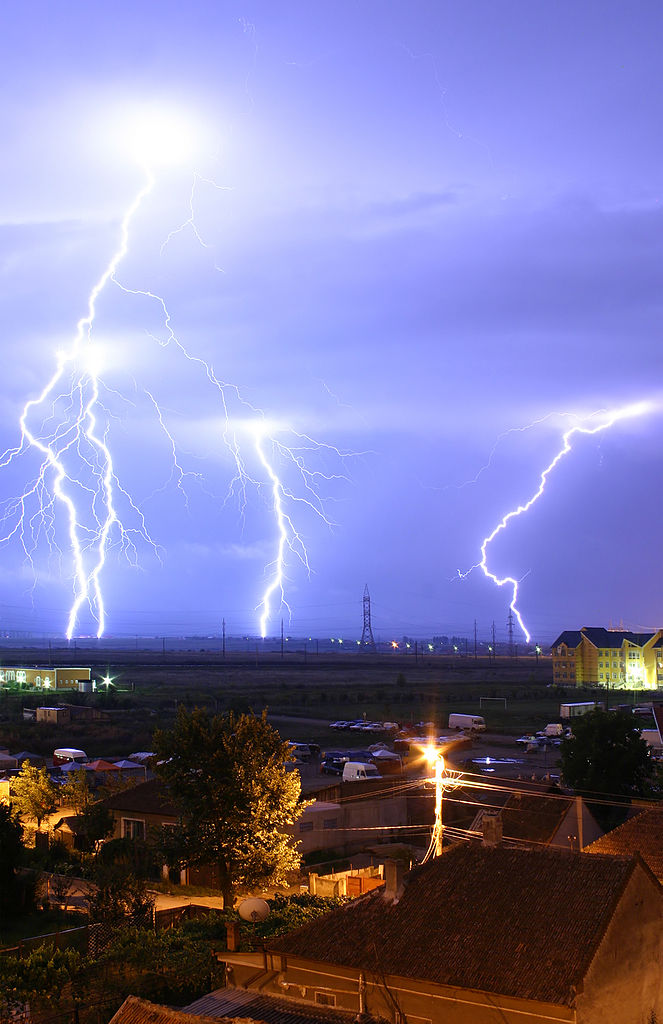
Image credit: Mircea Madau, public domain via Wikimedia Commons

A few weeks ago I wrote about our eclectic electric issues.  While our utilities company and electrician try to sort out who does what (it turns out that our house was never properly wired up from the mains), we’ve got a dilemma.  Since we all work from home and we all use computers, how are we going to work on a day when the electricity has to be off?  (Let’s hope it’s after this cold snap is over.)  We depend on electricity in this electronic world.  The solution may be to buy some new tech.  A battery-powered hot spot and fully charged laptops might be able to get us through an hour or two with no electricity.  We’ve become so dependent on the juice that the thought of being without it is scary.

The solution, of course, will quickly become outmoded as 6G and 7G, on to infinity, await in the wings.  They will all need electricity.  A house that was never properly hardwired can be a tricky thing.  Electricians and linemen have to have weekends too.  In a world where constant connectivity has eliminated snow days, such force majeure on a personal level holds no, well, force.  Aligning three employers who say it’s okay to step “out of the office” for a few hours at a time not of your own choosing will be impossible.  So we buy a new tech solution and hope it’s fully charged.  And when we’re fully wired up again the new device can eventually go in the museum of obscure electronics.


Eclectic Electric

It all began with the internet going out.  Less than a month ago the modem was replaced, but the tech this time thought it could be the co-ax cable.  We went outside and he fed the cable through, but when he got to the box he noticed a problem.  “Your electrical drop isn’t attached to the house,” he said.  Sure enough, he was right.  “I can’t replace the rest of the cable until that’s fixed—it’s an electrocution risk.” So I called the electric company.  They said I’d need an electrician to secure the conduit to the house, but they’d send somebody out to look.  The tech must’ve been in the area because he arrived just after I spoke to our electrician.  “Your cable has never been permanently connected to the house,” he observed.  “It should be.  We can do that, but you’ve got to get an electrician to attach that conduit.”

The funny thing about this is actually two-fold.  One is that our home inspector didn’t notice that the electrical cable was not secured to the house (once the tech pointed it out to me it was perfectly obvious).  The second is that the former owner of the house claimed to be an electrician.  In fact, he runs a electrical contracting business.  The electrician we pay has said, on one of his many jobs here, “I don’t think he was an electrician.”  I, for one, believe the guy we pay.  So now we have to have him come out and secure the conduit.  Then call the electric company and have them permanently connect the cable (the house has only been here since 1890, so do a few weeks matter?).  Then we call our internet provider and have them replace the cable that’s been causing our internet issues.

We like our quirky old house.  It does seem, however, that many owners have neglected various aspects of it.  And that our home inspector was a somnambulist.  We’re just trying to get it up to code.  Well, actually, we’re just trying to get a secure internet connection because three livelihoods rely upon it.  Shoddy work has consequences, and caveat emptor reigns.  Few things are more basic to modern life than electricity.  Or even the internet, for that matter.  These things are fragile, it turns out, in ways difficult to imagine.  There’s a lesson hidden here, and it reaches back, I suspect, before the taming of electricity.

Image credit: Mircea Madau, public domain via Wikimedia Commons

Electricity

After the oven incident (see last Monday’s post), I took some time to examine the burned out bake element from the range.  Clearly a break in the piece led to some arcing like you might get in Frankenstein’s laboratory.  By the time I’d arrived on the scene (I always seem to be behind my time), the fire was snaking along the element itself and now that the piece is cooled and removed I was fascinated by the damage it caused.  I suspect this is why I leave any electrical repairs to experts.  This is dangerous stuff.  Interestingly, in the realm of monsters electricity is most frequently associated (in my mind, anyway) with Frankenstein’s creature.  Mary Shelley’s novel isn’t explicit about how galvanism resurrected the patchwork human, but it was clearly part of the tale.

Electricity retains a certain element of mystery for some of us.  If we stop and reflect on how recent our understanding and harnessing of it is, that further adds to the drama.  People have been thinking about and trying to understand religion for thousands of years.  Like early electricity, religion involves invisible forces.  Of course, lightning and sparks and arcing oven elements can be seen, but seeing isn’t the same as comprehending.  We are a curious species and we want to understand.  Being inside the situation, however, our understanding will never be complete.  We can get a pretty good grasp, a functional one even, but our brains will always limit just how much we can understand.

It should come as no surprise that those of us who chose to study religion are intrigued by mysteries.  The divine, the transcendent—no matter what you want to call it—can never be fully understood.  Thus the impatience with evangelicals and others who pretend they’ve got all the answers.  No, we’re all still attempting to get to the bottom (or top) of this mystery.  Like electricity, religion can do an enormous amount of damage.  Motivating those who have only a cursory understanding how it works has historically led to debacle after debacle.  It has generated wars and perpetuated human misery.  Like electricity, when used properly religion has done a tremendous amount of good in the world as well.  The thing is, as my bake element shows, we have all come to learn that electricity should be handled by those who know what they’re doing.  Ironically, religion has never gathered the same level of respect for the specialists.