How You Feel

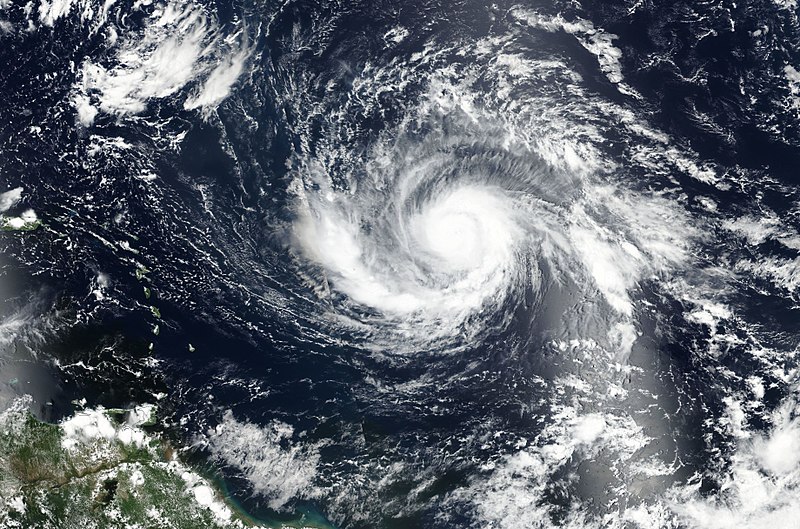
Image credit: NASA, public domain via Wikimedia Commons

Have you ever had someone tell you how you should feel?  This always feels like an odd thing on the receiving end.  Each of us is born, learns from our experiences, and confronts emotions.  Many people believe that they might improve others’ lives if only others would feel the way they think they should.  Interestingly, and simultaneously, at work and in social settings we’re being told to honor diversity.  We are to respect the feelings of others, no matter how uncomfortable they make us feel.  Who is the guardian of others’ feelings?  Emotions are tricky to figure out.  We can clearly see them at work in animals—the age-old flight or fight response, for example, is based on fear.  Still, based on their own experience and temperament, one animal will run while another in the same circumstances will attack.

Emotions don’t come with an instruction manual.  For a not insignificant outlay of resources you may hire a professional to help you work through them.  Or you might learn to trust your emotions.  They evolved for a reason.  Telling someone else how to feel invalidates their experience.  If they feel frustrated, or lonely, or angry, aren’t those legitimate human responses when neither fight or flight works?  Human societies create great complexities.  Some of us like things the way they were.  Many of us currently alive are only a generation away from people who grew up with horses clopping down the street and now all of life is virtually virtual.  How does that make you feel?  How do you even assess what the right feeling might be?

Advice givers mean well.  Perhaps your emotional state causes them discomfort.  If only you would cope the way that they cope then we could all go home happy.  The lament, however, is a time-honored means of expressing frustration when things just aren’t going your way.  We like to believe that good people prosper and that things work out for them in the end.  We like to believe lots of things.  We also have plenty of feelings about them.  Invalidating others’ experience may make us feel better about ourselves.  After all, we have just given valuable advice to someone who hasn’t experienced the situation like we have.  Being a parent may be the best way of learning to empathize and help another human being deal with the always tricky realm of emotion.  The important thing is to let others know that, no matter what somebody else says, only they know how they are feeling.
Science v. Evil

Can we eliminate evil? More than a question of metaphysics, this is also the title of an episode of the third season of Through the Wormhole. I’ve noted before that this particular season has been delving more profoundly into areas once reserved for religious thought. Evil is perhaps the most religious of topics, as distinguishing good from evil is at the heart of many religious traditions. Fast forward from the founding of your favorite religion to today. In order to answer the question of whether or not we can eliminate evil, we turn to neuroscience rather than any sacred book. Looking at brain scans, the scientists of Through the Wormhole have isolated areas that indicate who might be a sociopath—a convenient measure of evil—and also who might be less empathetic than whom. Perhaps drugs could be developed to inhibit sociopathic behavior and tendencies. As always, these episodes leave me somewhat distressed.

800px-Planisphæri_cœleste

Losing my long-term position in higher education “without cause” threw me into mental turmoil. Never one to use medications for a long term, I was shattered when my doctor suggested anti-depressants. Would this chemical, designed to “correct” my brain chemistry change who I was? The morning the treatment began, I hesitated to take the first pill, staring long at it and wondering if the person I’d been would be lost forever. I hated being on the prescription. Worse, it was a medication that you couldn’t simply stop. The drop in anti-depressants could bring me dangerously low. Although my employment situation hasn’t radically improved since then, I eventually weaned myself from the prescription. Looking back now, I see that time as an interlude in who I was, depression and all. Mine was, thankfully, a mild case. It has, nevertheless, left me wondering about the nature of evil.

Extremely empathetic, I have never had sociopathic tendencies. I care for insects and amphibians, as well as my fellow humans. I react to the emotions of others. Yet, like all people, I suspect, I know that I’ve got my own personal evils with which to struggle. I wonder if it is a matter of degree. Religions often suggest that the solution to evil is repentance and taking the decision to live a new life. What if one’s brain, however, prevents that? Would the administration of a drug amount to a kind of salvation? And what of those theologies based on concepts of human depravity—can neuroscience prove them wrong? When the moral questions are raised, the physical solutions offer answers. Can we ever reconcile belief and biology? The jury may never come back with a verdict on that one.


Evolving Morals

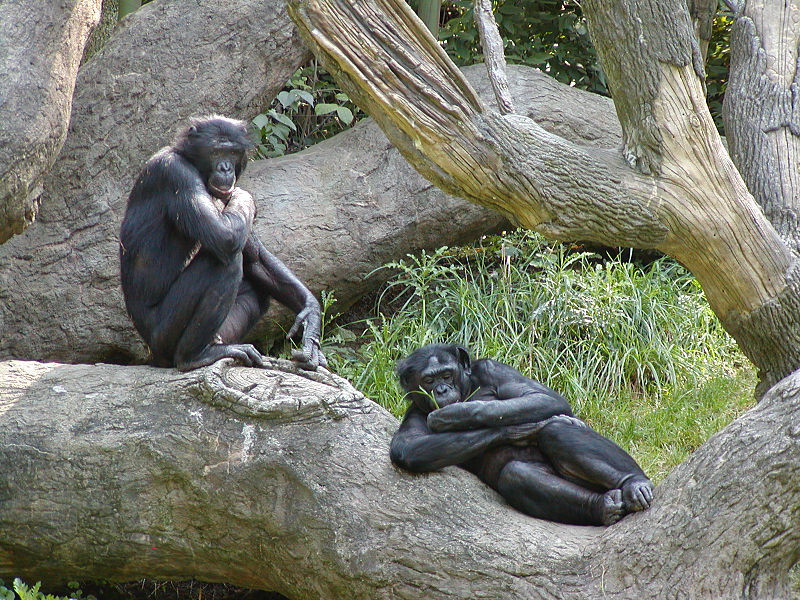
CNN recently interviewed Frans de Waal about his new book, The Bonobo and the Atheist: In Search of Humanism among the Primates. Of course the book immediately went on my “to read” list. I’ve followed de Waal’s non-technical work for years and I have come to trust his judgment. As director of part of Yerkes Primate Research Center, de Waal knows apes better than most of us know our neighbors. He has been exploring the origins of altruism and empathy in the great apes and has come to some amazing conclusions. His past work has shown that much of what we have attributed to special revelation has actually arisen in people through regular evolution. The apes, particularly the bonobos, but also chimpanzees, show startlingly human reactions to moral situations. In the interview, de Waal notes the implications for religion. In his opinion, morality predates religion since the former is seen in other primates while the latter is not.

As much as I trust de Waal’s judgment, the unanswered question remains: what exactly is religion? Animals display rudimentary religious behaviors, but in human-speak religion is often intertwined with belief. In watching a recent episode of Morgan Freeman’s Through the Wormhole—“Is There Life After Death?”—it was clear that while scientists tend to stand on the “no” side of this divide, in the end it comes down to a matter of belief. Not all religions, however, are tied to belief. Some religions assert that what you believe is not important, but rather, what you do. In such religions morality is much more like our primate kin’s version of religion. As Freeman points out, you really can’t know what another person believes. You can ask, but if you believe their response is always an open question. Here is the dilemma of religion as a matter of belief. Even Jesus putatively said, “by their fruits you will know them.” Morality here sounds like religion.

Frans de Waal suggests in his interview that morality differs from religion by being earlier in the evolutionary scale. If, however, religion evolved—which it surely did, as we can continue to observe its evolution today—it may be of a piece with morality. We object to suggesting animals have religion; this suggestion would knock humanity off its pedestal as the only species to which an incredibly human-like god revealed (as it is said) himself. What de Waal has gone beyond proving in his previous books is that much of what qualifies as religion is found among the great apes. De Waal doesn’t put it in those words, but as a lifelong student of religion I have observed the connections first-hand. A scientist may not feel qualified to define religion, just as a religionist is not qualified to correct a scientist. I eagerly await the chance to read The Bonobo and the Atheist, but I already know that I will find much of what de Waal writes to be beyond question, and we may all be much closer to the origins of religion than we realize. Even our great ape kin.

Michelangelo's muse? (Photo by Greg Hume)

Michelangelo’s muse? (Photo by Greg Hume)


Hate, in the Name of Love

I knew I was in trouble when I looked up the concept “codependency” on Wikipedia this morning and read, “This article has multiple issues.”

I was reminded of an article my wife pointed out to me on MSNBC earlier this week concerning Fred Phelps and his Westboro Baptist Church. My thoughts about religious freedom clash with my outrage over what may be legally classified as a religion. I’ve mentioned Phelps before, but the deeper issue here is whether freedom of religion can truly be free. Westboro is being sued (rightfully, imho) in a case that is going to the Supreme Court. His codependent hatred is causing excessive grief to the father of a soldier killed in Iraq. Phelps claims it is God’s will that he spread his Gospel of Hate.

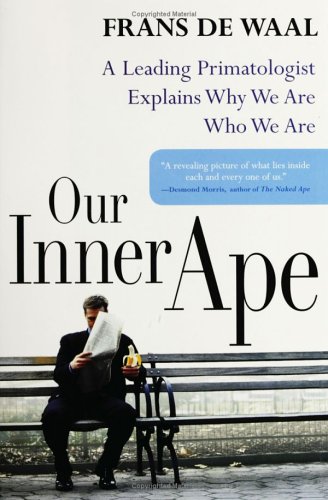
Reading Frans de Waal’s Our Inner Ape, it quickly becomes apparent that empathy is what makes human society possible. Without our ability to feel for another, nature would lead us on a selfish rampage that would not be satiated until everyone but the alpha male was ruthlessly butchered. This seems to be Phelps’ idea of Heaven. It should be a stark warning sign when apes have better bred manners than a pastor.

Hatred and religion may form a codependent bond. Each feeds off the fear and distrust of the other, striking blindly at anything that is different, challenging, or unclear. Religion does have its noble children – those who in the name of their faith try to make life better for others. If the world were run according to Phelps’ religion, however, I would opt for life on the planet of the apes.


Ape Versus Primate


I have just finished reading one of the most important books I’ve found in quite some time: Frans de Waal’s Our Inner Ape. My attention was first drawn to the author when Rutgers University sponsored a talk he gave in the fall that I was unfortunately unable to attend. Simultaneously I saw his book footnoted in a text I was reading and decided to follow up on it. In addition to containing fascinating, documented anecdotes concerning ape behavior (he tells of a bonobo that attempted to help an injured bird fly!) de Waal holds a mirror up to the great apes and sees humanity reflected back. His discussion of the origins of morality makes far more sense to me than any theory I’ve seen a professional ethicist concoct. Our sense of empathy, de Waal notes with considerable evidence, derives from our common ancestor with the apes.

After discussing the understudied trait of kindness in the apes, de Waal writes: “With morality firmly rooted in sentiment it’s easy to agree with Darwin and Westermarck on its evolution and to disagree with those who think culture and religion contain the answer. Modern religions are only a few thousand years old. It’s hard to imagine that human psychology was radically different before religions arose. It’s not that religion and culture don’t have a role to play, but the building blocks of morality clearly predate humanity. We recognize them in our primate relatives, with empathy being most conspicuous in the bonobo and reciprocity in the chimpanzee. Moral rules tell us when and how to apply these tendencies, but the tendencies themselves have been in the works since time immemorial” (225).

These might just be platitudes if ample evidence did not demonstrate their veracity. Apes plan ahead, recognize fairness, and can even see issues from the point of view of others (something Gorgias Press might benefit from learning). They are clearly inheritors of the moral sense that evolution has crafted among all cooperative animals over the eons. Religions like to lay claim to the origins of morality: we behave this way because our god told us to. In a sense that may be true, but only if the “god” is nature itself and the instruction it gives is the way for a species to thrive. Caring for one another, all religions aside, is the formula that evolution presents as the most successful choice of natural selection.


Out of Reach

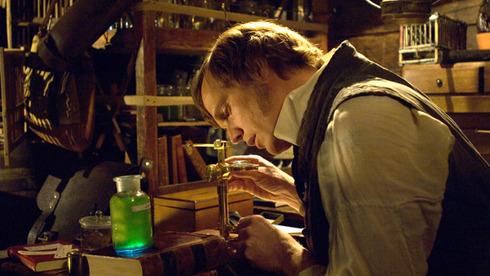
Last weekend I had hoped to see the movie Creation: The True Story of Charles Darwin. This is a movie that has had trouble in the United States since distribution companies felt it would be too controversial for American audiences. Believing that evolution is still a taboo topic in the most “advanced” nation on the planet is a peculiar conundrum. Why are we so sensitive concerning our natural pedigree?

Primatologists are constantly discovering new and unexpected connections between the great apes and homo sapiens. We share biological, and as we are increasingly aware, cerebral traits. Empathy and xenophobia, two features once believed unique to humans, are in evidence among our great ape cousins. We are on a continuum rather than a segmented train.

Bearing these provocative thoughts in mind, I was ready to head out to the theater, even if I had to go alone, to see the story of Darwin. I’ve read enough biographies to know there are some heart-rending moments in the story, situations that I would not be able to face – but it is a story of truth. It is ironic that we sometimes fear the truth, since religion is our effort to find exactly that. So, resolve firmly in hand, I searched for New Jersey theaters showing the film. None. The nearest show was in Midtown Manhattan. Add a twenty-dollar train ticket to the cost of admission, and to an underemployed academic the price was out of reach. Perhaps some day the movie will become available for general public consumption. Until it does, however, I’ll just have to lament my frustration to a local empathetic ape.

A scene from the movie, so I'm told