Fighting over Chocolate

It’s really a teen movie, The Chocolate War is.  That may be the sweet spot for dark academia.  I’m maybe a bit old for such things, but being old tends to mean remembering how it was.  Not exactly how it was, though.  Chocolate War takes place in a Catholic boys school, Trinity by name.  Perpetually underfunded, the students have to sell chocolate (now we’re in territory I recall—remember me, Gertrude?) to help keep it running.  Meanwhile, the Vigils, a secret society, have a considerable amount of pull on campus.  Led by a prescient and overly mature boy for his age, Archie, the Vigils assign select students difficult tasks in a kind of high school hazing.  Jerry, a freshman whose mother recently died, is assigned to refuse to sell chocolates for ten days.  He then decides (for reasons never explained) not to sell them at all.
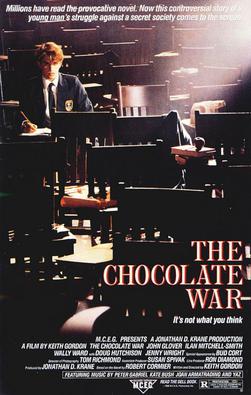
The refusal leads to a financial crisis for the school.  The Vigils try to force Jerry to sell, engaging in harassment tactics.  Nothing works.  Then Archie coerces him into a “boxing” assembly where students pay to have their specific punches thrown by one of the boys (a bully or Jerry) at the other, who simply has to take it.  Before the match begins, Archie, the Vigils’ leader, is tricked into taking the bully’s place.  Jerry, who’s on the football team, knocks him out, sending some teeth flying (probably why the film got an R rating).  In the end, Archie is demoted, but Jerry realizes that with his refusal to comply, he led to the result he was protesting against (the harassment and boxing match led to selling all the chocolate despite his refusal to participate).

Dated, yes (1988), Dead Poets Society, no.  Still, there’s much to ponder here.  Bullying—used by very high offices in this land—seems to be a growing problem.  And yes, when you get a bunch of adolescent boys together, trouble can arise.  It’s believable.  Although considered a flop, critics were kinder than the box office.  There are dark messages to decode here.  The price of nonconformity—an issue that doesn’t disappear with adulthood—and, perhaps looming larger, its effectiveness.  The teacher temporarily running the school, Brother Leon, is part of the problem, as is often the case in dark academia.  He’s not evil, however.  The film places the abuse of power on Archie, although he doesn’t condone violence.  Ultimately violence is used to unseat him.  With the result that the system (Trinity) prevails nonetheless.  Worth considering.


Television

Television has lost its prominence in the internet age.  Those of us entering the “senior” category of life’s grades were raised on television.  I know I watched far too much as a kid.  Now I consider the wasted opportunity to grow minds, and sensibilities, through television.  Mostly I blame the sit-com.  There’s not much learning going on when someone else contrives scenarios to make you laugh on a weekly schedule.  They are beguiling and I watched more than my fair share of them when I was younger.  Now, as an adult, I value the more profound examples of early viewing.  We didn’t watch The Twilight Zone with the devotion of Gilligan’s Island, but those episodes I did see had a profound effect.  The same is true of Dark Shadows.  One thing these shows had in common was that they were quite literate, eschewing the mindless competition.

College led to me no longer watching television regularly.  That hiatus lasted until my wife and I began watching a couple of weeklies after I’d return from Nashotah House.  While at the seminary full-time, television reception was quite poor and we tended toward rented movies on VHS.  By the time we moved to New Jersey television had changed so that you needed some kind of magic box to watch even commercial channels.  We relied on DVDs of shows we wanted to see.  That’s how Lost came into our lives.  Now, however, facing senior issues (health, people dying, wondering if retirement might ever happen) I’ve started to revisit television I missed.  The X-Files is pretty prominent.  Being an historian at heart, I’ve been exploring the inspirations for The X-Files, picking up Kolchak: The Night Stalker, and Twin Peaks.  I have to balance this with time for writing since work still claims the lion’s share of my waking hours.

Photo credit: Smithsonian Institution, via Flickr’s The Commons

I’ve lost track of what’s on the tube.  Now we spend workday evening hours watching intelligent television that we missed back when it aired.  We can’t afford it all, of course.  Dark Shadows, for example, has over 1200 episodes and “complete sets” are pricey.  Lost was either a birthday or Christmas present years ago.  I bought The Twilight Zone over a decade ago for a week that I knew I was going to be home alone.  We accumulated The X-Files over a number of years.  Twin Peaks, since it was only two seasons, wasn’t too expensive.  Kolchak is on Amazon Prime.  Many of these shows are a kind of therapeutic watching for me.  Some might call it escapism, but it runs deeper than that.  It becomes part of who we are.


Holy X

It took several years, but we finally closed the X-Files.  It was shortly after we bought the house, I believe, when we decided to watch the series the whole way through.  This was prompted by my wife giving me season eleven as a present, and I was wondering if I’d lost track of the thread.  We recently finished the last episode of the last season, with the movies interjected into the correct locations.  It was an impressive franchise.  I didn’t watch The X-Files when it originally aired.  We didn’t watch TV in those days (Nashotah House didn’t have cable and reception was awful), but another reason was that I was unmercifully teased for being interested in such things as a kid, and now it was trendy.  Once I got started, though, I was hooked.

Copyright: FOX; fair use screen capture

A few things struck me this time through, but one of the bluntest instruments to hit me was just how profoundly religion was interlaced with the series.  Many episodes involve religion directly, and others address faith and belief, even if outside the confines of established religion.  Since I tend to pause to reflect, I come a bit late to the table most of the time.  If I’d been on the ball, and if I’d begun writing books on horror sooner, I might’ve found a project in the religion of the X-Files.  As it is, several books have been written analyzing the series.  Maybe that’s where I’ll turn next.

You see, the original projected end for the series was season seven in 2000.  The mythology was wrapped up, and David Duchovny was leaving the show, which was, in essence, the story of Fox Mulder.  Two more seasons were ordered, however, with Fox on the run.  Things again were wrapped up in season nine.  Season ten came to air in 2016 and we watched it in real time, with primitive streaming.  In 2018, however, moving ended up being chaotic, and any watching would have to wait.  It seems pretty clear that, even with endless resurrections of the Smoking Man—Mulder’s Darth Vader—that the crisis of the world’s end (on which season ten ended) had finally been resolved.  That season, however, was eerily prescient regarding the pandemic.  Season eleven was a strong pushback against the Trump presidency with its “fake news” and constantly shifting facts.  Many of the episodes note how dangerous this is.  At the end it seems that the miraculous son, dead and resurrected, immaculately conceived, survives, as do the father and, if it’s not reading too much into it, a holy spirit.


The Daily Show

Long ago—over a dozen years now—I decided this blog would receive daily updates.  Some of the more successful blogs out there receive multiple daily updates, but I’m just one guy, and a working stiff at that.  When you do something every day a couple of contradictory things happen: one, you get better at it (if you’re a Gladwellian, it may take almost three decades, but the principle holds), and two, the quality varies.  I’ve long noticed this about daily ventures.  (I’ve also lately begun to realize that even daily shows take time out to refresh.)  I used to stay up to watch David Letterman (that seems impossible to believe in my current time warp).  When he was good he was very good, but when he wasn’t it was painful to watch.  You can’t be “on” every single day.  Emotions are funny that way.

Over the past year or so I’ve taken to occasionally binging on “Good Mythical Morning”—a YouTube daily show starring Rhett and Link.  These North Carolinians are inherently likable.  They’re a couple of guys who, in many ways, refuse to grow up.  They’re smart, and often funny.  And extremely popular.  Their channel has approaching 18 million subscribers.  They have off days, as do we all.  Sometimes I wake up feeling so contrary in the morning that I’m not sure I’m the same person who crawled into that bed only hours before.  Some days I don’t feel like writing a blog post.  On other days I feel like writing several.  What perhaps stands out to regular readers, if only one or two, is that some days you’re off.  So tragically human.  So wonderfully human.

I’ve often wondered if this is just a condition of life.  Pets, for example, have off days too.  I suppose the difference is that those committed to a daily show have put themselves out there so others can see them.  On one of those aptitude tests I took in high school the results suggested I should’ve been an entertainer.  Instead I took a religious and scholarly approach to things.  Maybe because I’m a middle child I always felt that nobody really paid attention to me.  So here I am, a baker’s dozen years out from writing daily on religion, ancient West Asian topics, books, and horror.  And sometimes current events, when I  feel like it.  If you’re taking the daily show route, you need to be aware that, despite the ennui, not every day will be the same.  Even someone as successful as Letterman knew that.


Might As Well Read

During my recent travels I had a layover at Sea-Tac Airport. Since I don’t get out much, I always find a walk through the airport a way of measuring what other people find important. At least in a circumscribed way. When you’re traveling you’re limited in your options. Most airlines have addressed passenger ennui by offering devices with electronic entertainment. Instead of an in-flight movie, you’ll have choices of what you want to do, courtesy of the endless magic of in-flight wifi. So the thinking goes. Airports, it would stand to reason, will offer plenty of travel-size diversions. The kinds of things you’re allowed to take onto a plane but which won’t or can’t be used to harm others. A sign at Sea-Tac reads “Books. Food. And yes, beer. Just ahead.” An interesting choice of offerings.

I was strangely heartened by the pride of place given to books. Yes, people still find the book on a plane satisfying. Stories have a way of drawing us in. Making us forget that we’re in a cramped space filled with strangers and recirculated, pressurized air. Books have the ability to take us far away. It’s a magic that movies can’t always achieve. Books leave more to the imagination. I recently rediscovered this on a solo trip across the Atlantic. I used the opportunity to read a novel cover-to-cover. The impact was incredible. For those six hours I was on the ground, following the adventures of young people caught up in the liminal zone of adventure and love. It was a powerful experience.

On my daily commute I tend to read non-fiction. Perhaps it’s the result of earning a doctorate, or perhaps it’s the stigma of enjoyable reading being “fluff.” The great majority of books I read this way teach me a lot. I read about many different subjects, and have recently learned to make commuting time a type of research exercise. But then, a cross-country plane ride is different. While an evening commute from New York City can stretch to three hours or more, that’s fairly rare. Instead, air time is unbroken time. I look forward to it with the prospect of a good novel. Airports are one place where hoi polloi don’t mind hanging out in a bookstore. Yes, the fare will be mostly bestsellers, but anything that gets people to read is a good thing. And, of course, if that doesn’t work for you there’s always beer. Just ahead.


Reel Salvation

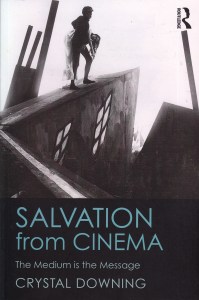
salvationcinemaSalvation is a fraught concept. It’s one of those topics that’s been commandeered by the evangelical camp so that mainstreamers are afraid to touch it, as if it’s catching. The thing is, Christianity is built around the idea that people require saving. The question is how you go about getting “saved.” Some insist it’s being “born again,” while others take a more gradual, one might dare say “evolutionary,” approach. Either way the end result in the same—being rescued from that which threatens you. Like many people, I watch movies. Sometimes I do so with manic intensity, not really knowing why I do it. My personal rationalization is escapism. Living in a world of harsh realities such as Trump (and even before there were sources of great anxiety) one needs an escape hatch. You might say I’m seeking salvation through film.

Crystal Downing suggests I may not be alone in this. Salvation from Cinema: The Medium is the Message is a book that explores the salvific function of movies. These are not just Christian or Bible movies she’s talking about. Indeed, she spends some time wrestling with that preposition “from” in the title. Is cinema something from which one might be saved, or by which one might find salvation? The latter is her focus and she sharpens it by looking at theories which might make it happen. The stories, the stars, and even nudity are put forward as ways the silver screen has been thought to bring salvation to viewers. She also includes a very interesting discussion of breaking the fourth wall. This technique brings the contents directly to the viewer. The second half of her book is more theoretically dense, engaging with modern theorists about what salvation from cinema might mean. Her selection of films to discuss is wide and intriguing.

There can be little question that cinema has a deeper significance than it’s usually supposed. Part of the reason is, as Downing discusses, the easy marriage of capitalism and celluloid in the United States. Movies make money. To counter this she also discusses foreign and art house films as well. There can be little question that those who stand in the queue are seeking something. While cheaper than many diversions, going to the movies does involve a small investment and as capitalists we expect a return on that. So it is that we sit in the dark and allow others to guide us toward the light. That’s as fine a metaphor for salvation as any that the preacher might proffer.