Six-Hundred and Sixty-Six

I have to confess to never having read a biography of Aleister Crowley.  I’ve known of him since I was a teenager, however, since you can’t read very much about esoteric stuff without running into his name once in a while.  Crowley was famous for starting the religion called Thelema, revitalizing interest in magick (the additional “k” was to distinguish it from stage magic), and for generally being a bad boy.  In fact, he declared himself the “wickedest man on earth” and liked to be called “the Beast” and loved the number 666.  It was the latter point that caught my attention recently.  In pop culture, 666 really only took off after The Omen.  (Movies often dictate, or at least inform, our religion.)  Crowley, who lived much earlier than the film, saw the marketability of 666 and I wondered how it caught his attention.
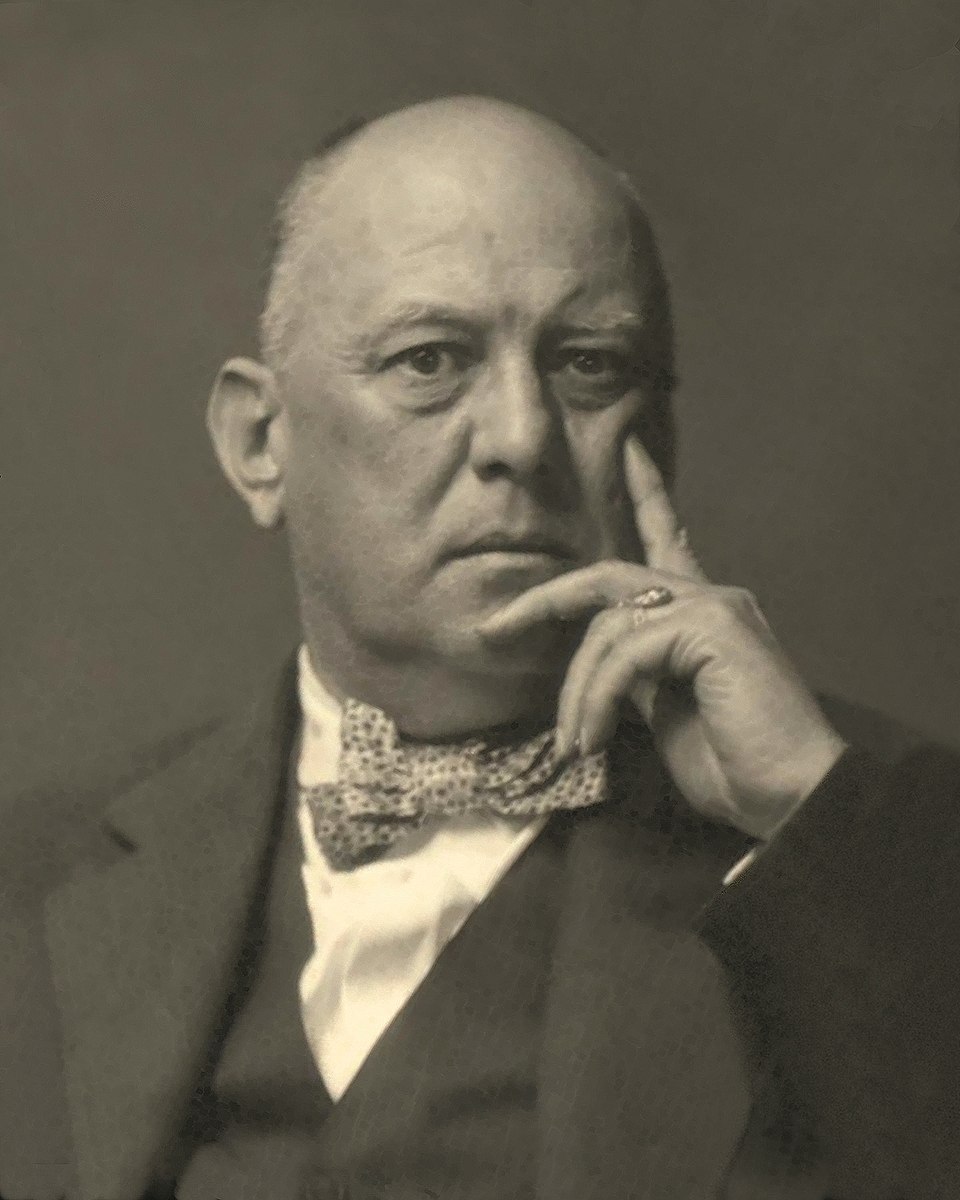
Aleister Crowley, public domain via Wikimedia Commons

As I recently posted, the end of the world as we know it is a fairly modern construct.  I happened to be reading about Crowley recently and learned that he was raised in the Plymouth Brethren tradition.  (They don’t loudly claim him as a native son, for some reason.)  He is probably the most famous of the Brethren, across all walks of life.  He even earned a place on the cover of Sgt. Pepper’s Lonely Hearts Club Band.  The Plymouth Brethren were massively influenced by John Nelson Darby, the inventor of dispensationalism.  Dispensationalism is the fairly new Christian belief that time can be divided into ages, or “dispensations,” during which God has a plan already mapped out.  He apparently waited for Darby before letting the rest of the world in on this secret.

Things about Crowley then began to make a little more sense.  His choice to name himself after Darby’s preoccupations adds up.  I haven’t read any biographies so this may be old news, well known among scholars of esoterica.  It nevertheless bears pondering because the religion we teach our kids may have unexpected consequences.  Crowley rejected the Brethren (whose moral predilections were not to his liking, especially as a hot-blooded young man) but the religion influenced him nevertheless.  I wonder if the teachings Crowley received as a child encouraged him to become, in his own mind, the opposite.  Crowley wasn’t “the Beast.”  His precepts included “love is the law” (granted, his version of love was a touch earthier than Christians with whom he’d be raised, but still), not a bad start for an ethical system.  Even the wickedest man on earth believed in the power of love, even if his religion introduced him to 666.

Secret Religion

Recently I read an article about a religion called Sabbateanism. I’d never heard of it before, so I turned to the collective wisdom of the human race—the Internet—and came away only more confused. There are so many religions in the world today that no one person can rightfully claim to be an expert on them all. The Sabbateans, it seems, are a secret sect, so not being able to learn about them should not be surprising after all. A Google search soon suggested reading about Illuminati and I realized I was once again in the realm of the conspiracy theory. A few months ago my wife and I began reading a book on the Freemasons (we both have grandparents who were Masons, so it has always been an area of interest). The book, however, was so convoluted that we had to give up. As Poe long ago realized, the best place to hide something is in plain sight. As I pulled up to a stoplight recently, I noticed the car in front of me had the masonic emblem hidden as a decal on its brake lights. Was I on the road to enlightenment?

Sabbateans, it seems, can be traced back to a seventeenth-century rabbi called Sabbatai Zevi, who lived under Muslim rule. Apparently he converted to Islam, but was also recognized as a messiah (there have been more than a few) and his followers went underground. We are told, at least by Wikipedia (where the article suffers from lack of verification) that several groups resemble, or may have derived from, the Sabbateans. It should come as no surprise that a secretive religion would be difficult to verify. That’s the whole point. Most religions claim that a certain small cross-section of believers has some esoteric knowledge that the rest of us lack. It would be difficult to claim any kind of authority if they didn’t.

Conspiracy theories are endlessly fascinating. Whether it is the Bilderberg Group or the Rosicrucians, we’re just sure somebody’s holding out on secret knowledge and power that keeps the rest of us in the dark. Mainstream religions, which tend to train their clergy in mysterious seminaries with arcane knowledge, have always been critical of secret societies. Catholics claimed Masons to be heretical, while Protestants claimed them to be too Catholic. Every religion, however, has its secrets. Umberto Eco and Dan Brown (it hurts just to use those names together in the same sentence) both recognized the appeal of the conspiracy theory in popular literature. The Illuminati, I’m told, are largely taken as a joke on the Internet. In my quieter moments I tent my fingers and consider: that’s just the way they’d want it to be, isn’t it?

Who is this man?

Who is this man?


Esoteric Goddesses

250px-Statuette_Goddess_Louvre_AO20127One of the nice things about the internet is that you can indulge your unorthodox interests and nobody will much care (except, of course, the US government). The other day, while reading about monsters, I found a fellow WordPress site, EsoterX. More specifically, I found a blog post on Ashtaroth. Those who have more than a passing interest in my background know that I spent a few years of my life writing about the goddess Asherah. Asherah and Ashtaroth are sometimes easily confused by anyone not reading about them in the original languages, but I settled on Asherah because we simply don’t have much textual information on Ashtaroth. Ashtaroth has gone by a number of names over time: Athtart, Astarte, and, as I just learned from EsoterX, Lord Treasurer of Hell. I won’t try to repeat the clever observations of EsoterX, but I can’t help myself add my own two shekels’ worth.

Ashtaroth is clearly one of the bad girls of the Hebrew Bible. She tempts the upright astray, and she seems to have been a perennial favorite among the less-than-orthodox Israelites. The Bible doesn’t take much care to flesh her out fully, and she appears only in minor roles in the Ugaritic texts. Some in the ancient world easily associated her with Ishtar, and their names do seem to bear some kind of relationship. Ashtaroth is connected to the planet Venus, as was the latter goddess Aphrodite—named, appropriately enough by the Romans, as Venus. Ashtaroth was also a militaristic goddess associated with horses. That girl got around.

Unfortunately, in the literature that survives from the earliest period, we are left with only the sketchiest of outlines of this once important goddess. Many of the Semitic deities have been revived in popular mythology of the modern age, and Ashtaroth, with her sexy, yet belligerent nature, is always appealing to the puerile imagination of pubescent boys. She was taken with great seriousness long ago, however, although her origins are lost to history and her attributes have become general enough to fit just about any old generic goddess. I’m glad to see that EsoterX has given her a shout-out and has traced a brief history of the goddess through the ages. Maybe someday we’ll find some accurate information on her early days. If we do, will somebody please give me a poke? I will probably be busy reading EsoterX.