Hungry Again

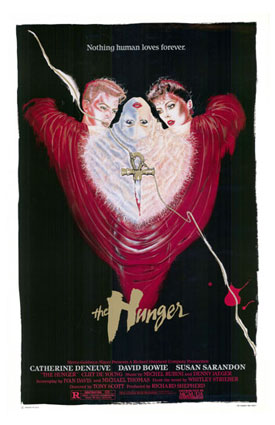
The_Hunger_film_poster
Vampires are on my mind. The funny thing is this often is the case when I’m unemployed. Feeling lost and alone, I settled down to watch the most depressing vampire movie I know, The Hunger. Miriam Blaylock, an unaging vampire, has made her way through history by taking lovers with the promise of eternal life. As she makes her lovers vampires, they survive centuries as young people, but then suddenly age and die within days. Terribly artistic (how could it not be with David Bowie as the male lead?), the film has a very heavy atmosphere and a calculating coldness as Miriam promises her lovers that they will live forever, knowing that once the aging begins, their decaying corpses will continue to live, weak, hungry, and wanting to die. I did say that it was depressing, right? The vampire, besides feeding off the essence of others, is concerned with eternal life. Religious symbols do not affect Blaylock and her ilk—in fact, they wear knives hidden within ankhs to stab their victims. The ankh, the Egyptian sign of eternal life, is the means of death. The only way to live forever is to feed off others.

Like many of those who pay attention to society, I have been fascinated by the enduring power of the vampire. When I was a child watching Dark Shadows on TV after school, I supposed vampires were things kids were interested in—the adults I knew had other things on their minds. As my generation grew, however, the vampire grew along with us. We had Interview with a Vampire, Lost Boys, Buffy the Vampire Slayer, Blade, Underworld, the Twilight series, I am Legend, Van Helsing, Priest, the Vampire Diaries, and on and on and on. Why are we so fascinated with a mythological creature? The vampire is profoundly religious and deeply symbolic. Evolution endows us all with a will to survive, the desire, if you will, of eternal life. The vampire is the symbol of that hope with no constraints. We are taught, and some of us even believe, that other people have the same rights as we do. The vampire’s urges, however, overwhelm even personal conviction and we are all potential victims.

Vampirism may be the ultimate symbol of our society. When future historians look back on the late twentieth and then the twenty-first century, won’t they see a world of profoundly deep inequality? Won’t they see multiple millions being sucked dry by the reassuring words that they are “middle class”? In The Hunger, daylight, crosses and mirrors do not dissuade the undead. Miriam needs her lovers, even though it will mean an agonizing unending end for them. Promises are made, and, when broken, the lovers are too weak to fight back. And her wealth increases with every generation. I lost my job at a very profitable company. Those who remain, on top, do not suffer fear of want. I look at Miriam Blaylock and wonder what it must be like to think that way.
Mermaid Missionary

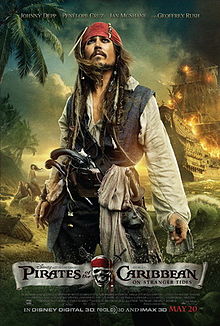
Last summer I was invited to address a church in Princeton about Christian themes in the movies. Back in my seminary days I often presented biblical material at adult forums, but my interest in religious themes in movies has grown over the years. I don’t claim to be an expert, but I have watched secular movies with an eye toward religiosity since I was in high school. The day of the presentation followed a recent viewing of Pirates of the Caribbean: On Stranger Tides. Although I’ve posted on it before, that particular movie is among the most heavily freighted with Christian themes of any I’ve seen. Now that I’ve had a chance to watch it again on the small screen without the distractions of getting home through traffic afterward, I would redouble my assertions. The very premise of the movie—the hope for eternal life—is a decidedly Christian refrain and the pirates, who wear their sins on their sleeves, are eager to attain it. The missionary, mentioned in my previous post on the film, serves as a kind of foil for that theme, insisting that all souls can be redeemed. Except, he decides, Blackbeard’s.

The reason that Blackbeard falls out of the missionary’s personal book of life is his mistreatment of a mermaid. Now the swarming, man-eating mermaids are among the most memorable images from the story. One has to be captured to unlock the magic of the Fountain of Youth, and the victim happens to be the missionary’s mermaid. In a Florence Nightingale moment, the two different species fall in love—celibate preacher and heathen, mythological creature. An odd couple indeed. Carried in a glass coffin filled with water, the mermaid also needs air to survive and the heartless pirates don’t really much care. To save the little mermaid from asphyxiation, Philip shoves his Bible into the gap he breeched between coffin and lid, saving the fishwife’s life. Talk about conversion!

When the glass coffin breaks, spilling all the water, the mermaid is reborn as a human. Echoes of Splash come to mind here, as well as Disney’s earlier effort, The Little Mermaid. The transformation in this case, seems spiritual as well as physical. Syrena, whose very name invokes the classical sirens, is the one who delivers the magical chalices (communion, anyone?) to Jack Sparrow to save the life of Angelica, or, more likely, to bring Blackbeard to an end. Our busy mermaid, now transformed again to her fishly form, saves the injured missionary by converting him to her way of life under the waves. There are shades of Lovecraft here as well as a reversal of Ariel’s fate in Little Mermaid. Although critics were harsh on this movie where a comic character now takes on a serious role, I still find it compelling. Nearly all the main characters undergo transformations as the story unfolds and whether heathenish or not, almost everyone ends up a better Christian of one sort or another.


Everlasting Life

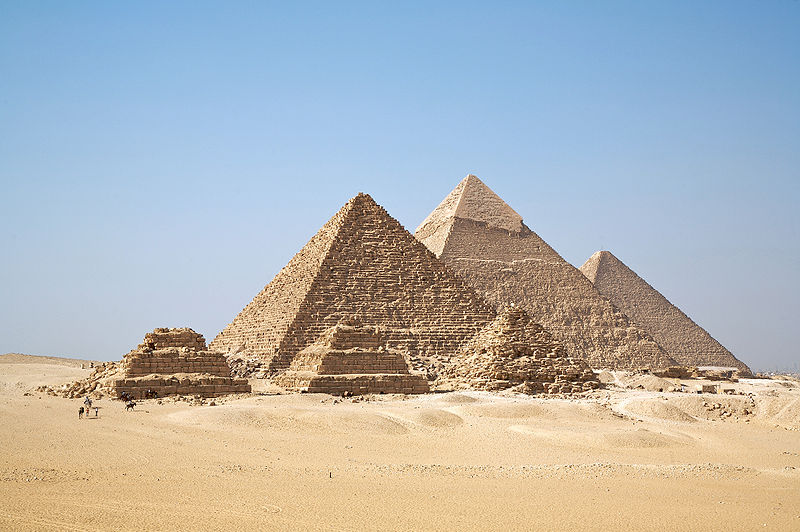
From WikiCommons

In the 27th century BCE, the Egyptians began building pyramids. These monuments, testaments to the belief in an afterlife for the king, are among the most easily recognizable structures in the world. Shaped to reflect the primordial mound that first emerged from the watery mass that existed before the world, the pyramid was more than a tomb. Pyramids were the key to everlasting life. In the Old Kingdom of Egypt this was limited to the king, but since the king represented Egypt nobody seemed to mind too much. Inside the pyramids were spells and incantations to help the king make it through to the next world. His success in this venture was of national importance.

During later periods of Egyptian religion, notably during the breakdown in centralized authority during the First Intermediate Period, the idea of an afterlife became democratized. Citizens who could never aspire to kingship desired an afterlife as well. The official theology of the day bent to the will of the masses and allowed a “ba” or, very loosely considered “soul,” to be assigned to each person. Those who could afford mummification and a Book of the Dead could make it to the afterlife as well. The preserve of the royalty had been breached, and the afterlife was open to all. Interestingly, the Israelites, many centuries later, did not seem to accept this idea. It is only very late in the Hebrew Bible before we get inklings that an afterlife was being anticipated. Living la vida Torah was reward enough.

It seems almost impossible in today’s world of religion for eternal consequences to realize that the original monotheistic religion was largely unconcerned with the afterlife. Once the idea caught on, however, there was no turning back. What is the motivation for religious belief if an eternal reward is lacking? Metaphorical pyramids continue to be erected. Would monotheistic religion still exist if it returned to its original outlook? Would politicians, television stars, and sports players give God the glory if it all ended at death? It hardly seems likely. Once a pyramid has been constructed, it is almost impossible to take it apart again.