Reformation Blues

Welcome to Reformation Year! Well, not actually. It’s more like an anniversary. Five centuries ago this Halloween, Martin Luther grabbed his silver hammer and history forever changed. In 1517 nobody could guess that that obscure strip of land across the Atlantic (nobody knew how far west it went except maybe those who already had lived here for millennia) would one day identify itself so strongly as Protestant that other religions would be merely tolerated. Even when it established itself as a land of religious freedom, it mainly would have Protestants in mind. Indeed, Martin Luther unlikely ever met a Hindu or Buddhist. His concern was the Catholic Church which, in all fairness, had already split into two major branches a few centuries before he was born.

lossy-page1-558px-Martin_Luther_by_Cranach-restoration

Thinking about the Reformation makes me uncomfortable. As my regular readers know, I’m concerned about ultimates. In a universe where “you only live once,” and eternity is so very long, you need to make the right choices when selecting a means of salvation. Really, an eternity in constant torment makes a Trump administration look like a day in the kiddie zoo. This is a very important choice. Heaven and Hell are a non-zero-sum game. You pick the wrong one and you suffer for ever and ever and ever. And ever. With one united church at least you could know that everyone else believed the same. Now you have to shop around for salvation. Which brand really does whiten best? Which is the most flame retardant? Things got pretty complicated as soon as that nail entered that Wittenberg wood.

The truly sad thing is that all this splintering represents those of the same “religion.” It’s bad enough that Christian versus “infidel” was already a thing, but from 1517 onward it was Christ versus Christie, as it were. You may have been lucky enough to have been born into the right family, but if you descended from the wrong scion you were still going to end up in Hell. Catholicism may have been corrupt—selling indulgences is pretty shady business when you can get them for free—but once that break is made we can’t all be right. Somebody’s going to end up eternally in torment and it’s not even going to be the heathens. Reformation suggests something’s wrong in Rome. You can’t hide behind being born Baptist, Methodist, Presbyterian, or Lutheran. No, you’ve got to do your homework and learn which is actually correct. Where is Pascal when you need to make a bet?


Ice Church

Eternity is a concept closely associated with religious thought. It bears a freight that phrases such as “steady-state universe” and “Big Bang” lack. Indeed, the foundations of Christianity and Islam involve the belief that eternal life can be had for those who play by the rules. Great cathedrals and mosques were erected to last forever, or at least until the end of the physical world. Perhaps that is the reason I find the idea of a church constructed out of ice so engaging. Annually for the past several years, a church has been built of ice in the Romanian Alps. Accessible only by cable car, the church is a temporary structure in a land where varieties of Christianity (let alone other faiths) are openly hostile to one another. As the globe slowly wobbles back to a northern inclination, the church will melt and disappear. Still, in its brief time in the world, baptisms and marriages will be performed there. Eternal vows in a temporary structure.

A theological message is inherent in such an institution. We are trained from our earliest days to be consumers. We are to acquire goods and desire more. Were we ever to be satisfied, capitalism would crash to the ground like an ice church left out in the heat. The secular world in unrelenting in its message that we are born to eat, buy, and use. The more expensive, the better. And the more quickly obsolete, the more profitable it will be. The towers of our cities are constructed of concrete and steel, and yet, I have watched new buildings grow and supplant those that have seemingly stood forever but which, in reality, have existed for less than a century. Indeed, all of our towers ought to be made of ice.

IMG_1252

Ice is cold and hard, but it is still water. An article in The Guardian notes that some pastors see this as a kind of baptism frozen in time. Shape given to that which follows the contours of its container. The water, however, will ultimately follow its natural order and rejoin the oceans of the world. While humans are naturally disposed to collect, to save up against lean times, we have to be taught to be consumers. Some of us are content with relatively little, knowing that elsewhere our fellow human beings have nothing at all. Their churches are made of ice, and our corporations are eager to reach even them, to teach them to covet what the more “affluent” have. And the world slowly warms, turning all into liquidity.


Where No One has Gone Before

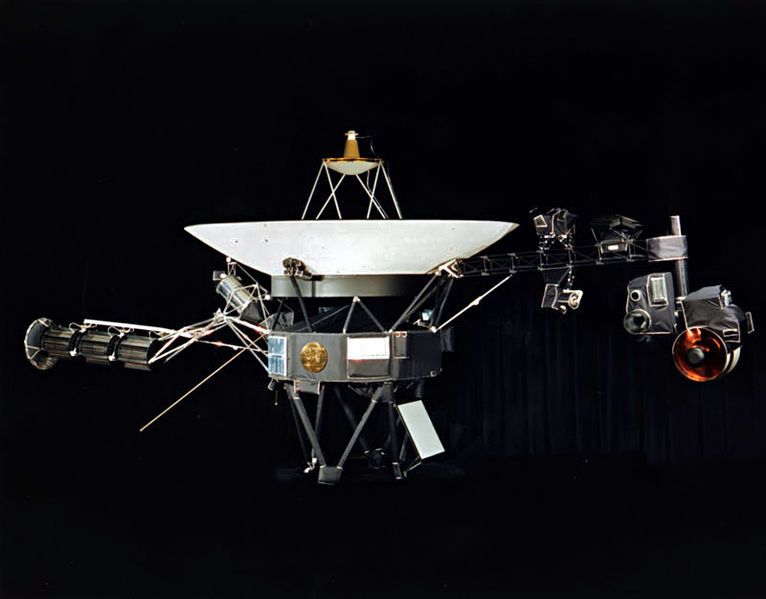
766px-VoyagerI already miss Voyager. Not that I ever met her, but I followed her progress from her youngest days and to when she was a curious youngster flirting with Jupiter and Saturn, to her more circumspect considerations of the outer gas giants. An extension of human curiosity itself, Voyager 1, like the Energizer Bunny, just kept going and going and going, revealing a solar system more beautiful and complex than we earth-bound denizens knew. And she didn’t see God. Ancient people had always supposed, given the human disposition to climbing, that God was somewhere above us. Even the discovery that we live on a globe didn’t really change that—we are still down here, so God must still be up there. Voyager 1 has traveled 11 billion miles with nary a glance at the divine, and she is now the first human-made object, besides perhaps God, to exit the solar system.

Space has always been a personal fascination. I took astronomy both in a Cold War era high school that actually had a working planetarium (in a very moderate-income town, even!), and in college (where there was no planetarium). In unguarded moments I even considered astronomy as a career. I don’t have the “right stuff” to be an astronaut, but I can stare at the sky for hours and wonder. Voyager was out there doing things I’d never do, seeing what I could never see, experiencing the deathly frigidity of cold, cold space. And now she’s leaving home. No one is certain how long she’ll keep serving humanity with new images and information. It will take her a long, long time to reach anywhere else, unless she’s abducted by aliens. In the meantime, all of us down here will age and die, as will the next few generations. Voyager will simply keep going.

Space is beautiful in its solitude. The objects that we’ve glimpsed out there have been full of wonder and mystery. Still, we are told, it is mostly empty space. Or dark matter. Perhaps because of the active volcanos on our own planet we were once told that Hell lay under our feet. There is a fiery world below, to be sure, as science has demonstrated. We call it the mantel rather than Hell, and visits to it are decidedly short-lived rather than eternal, but ancient religious thinkers got the temperature about right. If the analogy holds, Voyager 1 may yet meet some kind of deity out there. She, after all, has escaped the solar system and has slipped into Heaven. In order to explore eternity, we need to boldly let her go where no device has gone before. Although I never really knew her, I already miss Voyager 1 badly.


Deep Things

Religion concerns itself with the big issues. The biggest. As a child, I remember wondering how anyone could be concerned with less than the ultimate. No, I wasn’t a nascent Tillichian, I was just someone who saw things in what I supposed was a practical light. If you’ve got the temporary, the fleeting, the insubstantial over here, and the permanent, immortal, supreme over there—who wouldn’t go for the gusto? I suppose by my reasoning that all people would end up clergy of some sort, we would all be fixated on why we’re here and what our purpose was. You’ll still find pockets of theologians here and there who debate these kinds of issues, but our existence has grown comfortable enough that, for some people at least, if this ends up being all there is then, gosh, it’s been a fun ride thank you very much. But I don’t want to get out of the train just yet. I wonder if there’s more than the ultimate. It is a religious question.

For a while I grew enamored of the trappings of religion. Ceremony, ritual, strong rhetoric in sermons—these things can move you, and become beguiling. Somehow, knowing there’s an infinite universe just outside the church doors gives me pause for consideration. The ultimate must be very big. Walking through a large city helps to provide some perspective. I find myself next to buildings that cause me to tremble when I consider the implications. Next to those tons and tons of stone, steel, and glass, I am the smallest spark. But those buildings are dwarfed by the city that contains them, and that city a mere pinpoint on a map of the country. Even the planet is less than an atom in the universe of infinite size. Who can help but to be concerned about the scope of it all? Ever since I was a child I’ve worried about this.

In the media today, religion is all about hypocrisy and whose pants are at what latitude vis-a-vis whom. While matters of love are ultimate in their own way, we, as people, have a much larger space with which to concern ourselves. Science has stepped up to the dock when it comes to sworn testimony about the universe we inhabit, but even scientists shrug once we get back before the big bang. Time is even more inexorable than space—there’s always got to be a time before time. Like any child we can always ask, and what happened before that? Perhaps time is the true ultimate. Thank you for spending a bit of your ultimate reading this. It’s time for me to catch the bus, but work will never inspire me the way the rest of the universe does.

Hubble's eye view

Hubble’s eye view