Aging

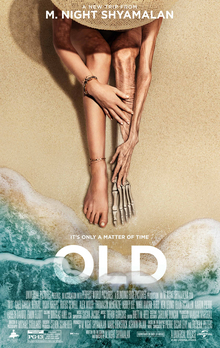
M. Night Shyamalan’s horror is thoughtful.  Old is a little difficult to accept because it’s very difficult to keep artificially aging actors at a steady rate, either by make-up or substitution.  And it seems that the mysterious beach that ages people but also heals them should, in some way, make exploring its medical possibilities somewhat difficult.  Still, it is a noteworthy day-light horror offering that has an underlying ethical question.  I will need to include a spoiler to discuss that ethical issue, but before I get there, a vacation brochure.  Individuals, and families, are brought to a resort where everything’s perfect.  Then they are driven to a remote beach and discover that they really can’t leave.  And they age at a rapid rate.  (This may make you think of a Gilligan’s Island episode, but this one has no laughs.)  The aging is first noticed with the children and by the time the adults realize what is happening, it’s too late.

Here comes a spoiler.  Old was released during the pandemic’s second year, so I suspect it wasn’t widely seen.  If you’re still waiting, here’s your chance.  Ready?  Okay.  So, this island’s aging properties have been tapped by a pharmaceutical company to test new drugs on patients with various diseases.  Instead of waiting years for results, they can know in a day whether a treatment, unwittingly taken by the clients when they first arrived, worked.  If a “client” has no symptoms for a day, it is the equivalent of years.  The company, although it is responsible for the deaths of the people in the trial, give the results away, saving many lives for free.  Here is the ethical dilemma—do you save thousands, or millions, by having one person die to test the drug?  The real issue is that it’s done without consent.  Those aging have no idea they’re test subjects. 

Consent is an ideal, but in fact life happens to us and we seldom have the right of refusal.  Perhaps that’s the more insidious message here—giving consent furthers the illusion that we’re in charge of our lives.  I’m sure all of us can think of things that happened to us not because we chose them, but because we were at the right or wrong place at the wrong or right time.  When some such thing transpires, it often takes us considerable time to regain our balance, to feel like we’re “in control” again.  I chose to watch Old, perhaps when it wasn’t a good time to do so.  Or did I choose it?  And whose morals are these?


Double-Dipping

Double-dipping takes many forms.  The kind I’m talking about is trying to get more than your fair share by either taking twice, or by fooling others into buying the same thing two times.  I’ve fallen victim myself.  Some publishers will sell a hardcover book and then release the paperback with a different title a couple years later.  If you’re a fan of the subject, you’ll buy the same book twice because they won’t easily tell you that it is the same one.  On paper the strategy is to get libraries to buy the hardcover (which costs more) instead of waiting for the paperback.  Why change the title if not to fool someone?  Maybe I’m just embarrassed by the vegan egg on my own face because I realize that I’ve bought the same book more than once.  Maybe more than once.  With a limited budget, I don’t appreciate being deceived.

The egg is even older and more obvious when I realize that those of us of a certain age can’t keep our memories as sharp as they used to be.  I read a lot.  I try to get through 60 or 70 books a year.  Have done for over a decade now.  If a book doesn’t create a strong impact, it may go into that category of enjoyable but not really memorable.  So when I recently learned that a publisher had double-dipped with a book I’d bought and read—twice—I felt violated and embarrassed.  Even more troubling was the fact that I wrote blog posts about each of the books (about three years apart) without recognizing I’d already read it.  To be fair, buried on the copyright page (who reads that?) the paperback confessed that it was the same as the differently titled hardcover.  Of course, I’d already bought the book, read it, and blogged about it (twice) before someone pointed out to me that it was the same book.  Gotcha!

I hold myself to high ethical standards.  I hope that I’m an honest person; I tell the truth whenever possible.  I’d certainly not try to sell someone two of the same thing without telling them that they weren’t buying something new, but simply giving more money for something they already had.  Even Amazon says, “Purchased on,” and gives you the date if you call up a book you’ve already bought.  Publishers, I know, have a difficult time.  Publishing is a “low margin” business, which means that you have to sell lots in order to stay solvent, and each sale brings in only a small profit.  Temptation to double-dip must be very strong.  Still, I feel a bit silly to have fallen for it, even when it’s what I do for a living.


Think

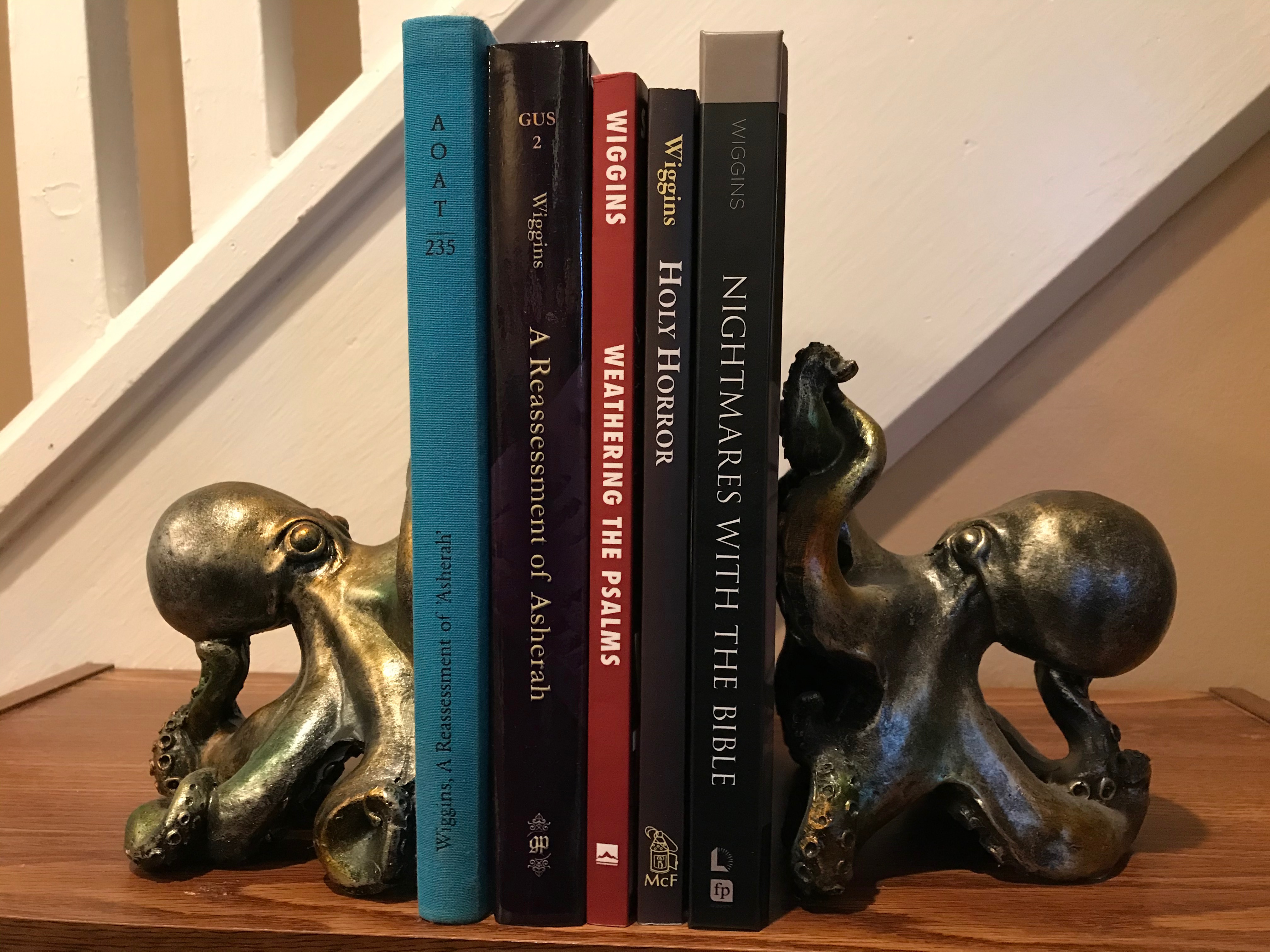
Those of us who write books have been victims of theft.  One of the culprits is Meta, owner of Facebook.  The Atlantic recently released a tool that allows authors to check if LibGen, a pirated book site used by Meta and others, has their work in its system.  Considering that I have yet to earn enough on my writing to pay even one month’s rent/mortgage, you get a little touchy about being stolen from by corporate giants.  Three of my books (A Reassessment of Asherah, Weathering the Psalms, and Nightmares with the Bible) are in LibGen’s collection.  To put it plainly, they have been stolen.  Now the first thing I noticed was that my McFarland books weren’t listed (Holy Horror and Sleepy Hollow as American Myth, of course, the latter is not yet published).  I also know that McFarland, unlike many other publishers, proactively lets authors know when they are discussing AI use of their content, and informing us that if deals are made we will be compensated.

I dislike nearly everything about AI, but especially its hubris.  Machines can’t think like biological organisms can and biological organisms that they can teach machines to “think” have another think coming.  Is it mere coincidence that this kind of thing happens at the same time reading the classics, with their pointed lessons about hubris, has declined?  I think not.  The humanities education teaches you something you can’t get at your local tech training school—how to think.  And I mean actually think.  Not parrot what you see on the news or social media, but to use your brain to do the hard work of thinking.  Programmers program, they don’t teach thinking.

Meanwhile, programmers have made theft easy but difficult to prosecute.  Companies like Meta feel entitled to use stolen goods so their programmers can make you think your machine can think.  Think about it!  Have we really become this stupid as a society that we can’t see how all of this is simply the rich using their influence to steal from the poor?  LibGen, and similar sites, flaunt copyright laws because they can.  In general, I think knowledge should be freely shared—there’s never been a paywall for this blog, for instance.  But I also know that when I sit down to write a book, and spend years doing so, I hope to be paid something for doing so.  And I don’t appreciate social media companies that have enough money to buy the moon stealing from me.  There’s a reason my social media use is minimal.  I’d rather think.


Creeping Again

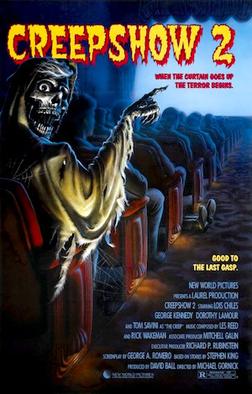
The morality of Creepshow 2 is pretty straightforward.  Of course, this is early Stephen King.  Sometimes it’s good to keep things simple.  Horror anthologies sometimes work and sometimes they don’t.  This one falls somewhere in the middle.  Of course, George Romario didn’t direct, although he wrote the screenplay.  And King didn’t write the screenplay, as in the first installment, but he shows up for a bit part.  Campy and funny, as the first film established, there are a few scary moments, but you get the sense that the bad guys deserve what they get.  There are only three regular segments, apart from the cartoon framing, each with a “do something bad, get punished” theme.  “Old Chief Wood’nhead” seems to start out insensitively to First Nations people, but it features an avenging statue “cigar store Indian” whole doles out justice.  It’s the most disturbing of the three segments since the robbers show no human compassion at all.  Of course, the chief gets them.

“The Raft” features less obviously bad protagonists.  Four teens drive out to an isolated lake with a swimming platform (the eponymous raft) in the center.  They all get high on their way there, and it’s clear the guys want to get their girls to the raft to have sex with them.  A mysterious floating blob surrounds the raft and eats them one by one.  You start to think Randy might survive for being good but when left alone with Laverne (his best friend’s girl) he begins to seduce her while she’s asleep.  None of them survive.  The last segment, “The Hitch-hiker,” follows a woman who’s having an affair.  Late getting home, she hits a, well, hitch-hiker and ends up as his victim.

The Creepshow franchise is, of course, comedy horror.  This film does end with a moralizing message that comic books don’t lead to juvenile delinquency, but rather other factors do.  This feels like an important message in days of increasing efforts to ban books.  Easy solutions by unthinking adults never solve the “problems” they hope to address.  Often what it comes down to is an aesthetic difference rather than true morality.  Morals don’t fit across the board, especially if you don’t think through your own motivations.  Of course, it’s nice to have a movie where such deep thinking isn’t really required.  Kids being eaten alive for being kids may be a bit harsh, but the others in this pleasant little diversion really just get what’s coming to them, and right soon.


Used, Again

It may be impolitic to admit it, but I have positive associations with Amazon.  This goes back to before they started using smily boxes.  Before Amazon, getting books often involved mail orders and checks and several weeks before delivery.  Now Bookshop.org does a similar service, and with more of a conscience, but Amazon showed everybody how.  I do have a complaint, however, with the internet giant.  They allow used book sellers to be the top place when ordering a book, since they sometimes have a lower-than-retail price.  I used to sell used books on Amazon, back when I had no full-time job.  I took great care to list books according to the accepted standards of book conditions.  I know I’ve written about this before, but two recent used book orders simply didn’t measure up.  So, herewith, a tutorial:

“Like new” means in mint condition.  You should not be able to tell the book was read.  Look for soft rather than sharp edges on the pages, slight curling of the cover (especially paperbacks) from repeated opening.  Hey sellers, if you have any of this, the proper category is either “fine” or “very good”—not “like new.”  I’m not really a collector (in that way), but if I order a book “like new” I expect that I won’t be able to tell it’s ever been read.  Normally I opt for “very good.”  This brings it down to a less expensive bracket and it implies things are in pretty good shape.  If your book has extensive writing or highlighting in it, it is not “very good,” but “good.”  If it does have minor markings you are required to list them.  I recently bought a “very good” book in which practically the whole first chapter was highlighted.  This isn’t easily missed, and it’s certainly not “very good.”

I get it, classifying books takes some discrimination.  The categories are there, however, to protect the buyer.  People do all sorts of weird stuff to their books.  The used book seller, on Amazon, is morally obligated to tell us about what’s going on.  And Amazon, please make clear when a book is “new” or not!  I recently bought a book that was listed as new but it had clearly been read at least once.  Be honest, people.  Book folk, in general, are good folk.  Reading is so important for a civil society.  Books are collectible items.  If you’re thinking of going into the biz, please remember that I’ve found books for a buck at library book sales in better condition than many “very good” books I found used online.  Just be honest—you’ll still sell the book, even if for a few pennies less.


Stand with Women

We like to think we’re the most advanced civilization in the world, but we allow the appointment of “justices” who still believe women are inferior to men.  Millions of women who’d been born into the modern world yesterday found themselves thrust back into medievalist thinking that now seems to reign in the Supreme Court.  Even Donald Trump, who is responsible, has expressed his doubts.  When will we acknowledge that women should have the same rights as men?  How long do we have to continue this inane struggle against religious amateurs who believe their reading of Scripture is the only correct one?  I was raised by a woman on her own.  Uneducated, with no practical job skills, she remained religious and very capably reared three sons.  She was far more capable than my father.

Democracy can be gamed, of course.  And the “angry white man” has become America’s new face to the world.  The petulant, selfish male who thinks everyone else is getting the benefits.  Even as Catholic-majority nations are declaring women’s rights, America is stepping backward in the Human Rights Index because certain senators refused to allow voting on legitimate candidates for the supreme court.  How they can go home and face their wives I do not know.  Of course, our laws do not apply to our lawmakers.  As revelations continually show, theirs is a world of “do as I say, not as I do.”  Is it so difficult to say it out loud?  Women are fully human and have an inherent claim to the same rights as men.  But then again, when have those blinded by religion ever seen clearly?

America, do you enjoy seeing your rights stripped away?  Do you enjoy justices who one day decide it’s our right to carry weapons in public and then next to say that women must remain home barefoot and pregnant?  Is this the mentality that now rules the gamed “supreme” court?  I’d like to exegete that word supreme and ask our “justices” just how deeply they’ve studied religion.  And that doesn’t mean just praying over your Bible.  The most difficult courses in the religion-philosophy curriculum are those dealing with ethics.  Days spent wrestling with the subtleties of how reason, law, and religion interact and teasing them apart to look at each with real understanding.  Or do we just vote along party lines like any beast in the herd?  It’s a shock to have been born in the sixties only to now find yourself living in the fifties with all their inherent hypocrisy.  I stand with women, not amateur theology masquerading as justice.


Druid Redux

I know I’ve talked about this book before.  I had cause to learn about the Druids again, and Peter Berresford Ellis’ book was handy.  I’m pretty sure I have Stuart Piggot’s book somewhere, but I haven’t seen it since the move, so I turned to Ellis again.  The first time I read him I was commuting and couldn’t take notes.  (My specialized form of research has its limitations.)  This time it took several days’ more reading, and doing so with more active engagement.  One thing that really stood out to me this time was the Indo-European connection.  Druids, according to Ellis, were essentially Brahmins—the intellectual class in a stratified society.  Having derived from a common ancestor, the two societies diverged with Brahmins surviving in India and Druids going extinct with the somewhat genocidal treatment of various other groups against the Celts.

Druids were egalitarian as far as the sexes went.  This is one of those examples where Christianity’s masculinist orientation furthered a trend that led to women being treated as inferior.  Evidence points to early female Druids, and even female political leadership among the Celts.  As the male godhead took over the remaining influence of women eventually evaporated.  The Druids, you see, were extremely focused on learning the truth.  Their pre-Christian judicial system was oriented toward fairness and finding out what really happened.  In other words, ethically they required no conversion.  That was a matter of theology, and theology often brings its own set of issues.  

The Romans, who’d had a long and protracted war against the Celts, drove them to the fringes of their empire.  Britain (and Brittany in France) were far enough removed from the base of power in Rome that the Celts survived in the edges of the islands: Cornwall, Wales, Scotland, the Isle of Man, and Ireland.  As a distinctive culture, Celts have been in fashion for some time now, but that’s a new development, historically speaking.  Ellis’ book explores this angle quite a bit since understanding the Celts is essential to comprehending who the Druids were.  The lack of native written accounts (Druids forbade writing their wisdom, passing it on by memorization over the centuries) hampers our ability to have a coherent history.  Ellis, however, seems to have reconstructed well.  Modern Druid revivals necessarily contain speculative elements, and historically the Druids wouldn’t have been perfect either—nobody is.  They do seem to have had a reasonable and just society for the most part, something we’ve managed to lose, along with much of their wisdom.


Moral Compass

Where have all the morals gone?  Well, not exactly song-worthy, but it is a question I think about a lot.  You see, I work in publishing.  Publishing, above all, is a business.  People make their livelihood at it, and so they have to find a market that pays.  Money and morals don’t mix well.  A recent New York Times story pointed out that the political polarization that’s tearing America apart is reflected in bestsellers.  Political nonfiction bestsellers have topped the charts since Trump was unfortunately elected.  Books both pro and con have flooded the market.  What’s this got to do with morals?  Well, I believe publishing should be in the business of educating.  If you’re going to publish nonfiction, it should be material that doesn’t cause more problems than it helps solve.

When I look at a book, after checking the title and author, I next look at the publisher.  Some publishers are conservative, and that’s fine.  That’s what they do.  Most, however, consist of highly educated professionals who realize the severe, and continuing damage that Trump caused.  These publishers, however, will produce pro-Trump books if the numbers look good.  There’s gold in them thar hills!  I often have these scruples working for an academic press.  Some ideas are clearly distorted.  I’m no elitist—I’m still pretty much working-class all the way down to the bones—but education reveals when something very bad (fascism) is happening.  Others see it too.  Still, the temptation of all those dollars… it’s a real pressure, almost like being at the bottom of the ocean.  There’s money pressing on us and we want it.

The gray lady story bothered me.  Instead of publishers looking out their windows and seeing the political grand canyon of this nation, they see profits.  This is business, after all.  Just business.  Is there any such thing?  Morality informs the way you live, the choices you make.  Do I promote education, reflection, and sound reasoning or do I promote a very real 2024 threat of a man who leads by refusing to lead?  After elected Trump immediately began campaigning for his next term, loving the rallies, the cheers, the adulation.  Who doesn’t want to be worshiped?  But is that what we want to see three Novembers from now?  I remember the shock the morning after election day 2016 in New York City.  I see the damage four years of environmental degradation caused just when the effects of global warming were becoming obvious.  I see women demeaned.  I see voting rights quashed.  And now I look at the bestseller list and wonder where the morals have gone.


Seussical Thoughts

It seems that Dr. Seuss has fallen on hard times.  His estate is pulling six of his books from production because of hurtful race representations.  This has, of course, sparked the debate between period pieces and the clearly necessary reeducation that has to take place regarding race itself.  I don’t have a solution here, but children raised on these books are among those who realize the dangers of racial stereotypes.  In fact, even those of us who try to keep a weather eye on our own thinking process can at times get caught in the trap of thinking that “white” is “normal” and everyone else is a “variation.”  The truth is we are all variants and political power, with its not-so-subtle adjunct money, have embedded racist thinking throughout our society.

Photo credit:
Photo credit: Al Ravenna, via Wikimedia Commons

Theodore Geisel was a broad-minded individual.  His works often advocate for inclusion.  He was also a product of his time, even as we are.  The struggle to do right in the midst of a corrupt world is constant.  None of us, I fear, have risen to perfection.  The roots of racist thinking run deep and they re-sprout if just a fragment of a rhizome left behind.  We should all know by now that slavery was evil and that a system that devalued other humans for money was clearly wrong.  We should know that government policies that keep American Indians repressed and do so secretly are unethical.  We should know that people from Asia have as much right to opportunity as those whose ancestry lies in Europe.  Why is this so hard to learn?  Why do we still have to fight to dismantle systemic racism in this “land of the free”?

Dr. Seuss has taught generations of kids that “a person’s a person” and that persons deserve fair treatment.  He did it in the language and idiom of his own era.  Those making the decisions for his estate are not trying to destroy his legacy.  They are, however, asking us to look forward and to try to figure out where we go from here.  Half a century ago we knew that civil rights were the only fair way to live.  We’ve experienced globalization since then and we’ve been made better for having done so.  Yet we are mired in preconceptions that can only damage our collective sense of justice, often falling along party lines.  Dr. Seuss taught us well—shouldn’t we implement what we’ve learned?


Not the Band

One of my favorite weekend treats involves black-eyed peas.  With a father from South Carolina, some of my earliest memories involve soul food.  As a present-day vegan, I eat a lot of beans.  That’s why I was disappointed to learn that Goya’s CEO, Robert Unanue, continues to be a big Trump supporter.  Shame on you, Goya!  Lest you get the wrong idea, we generally buy the store brand beans.  Of all the legumes, however, it seems the humble black-eyed pea is difficult to get right.  The generic brands always end up with the bottom part of the can being a kind of beige sludge where the beans have broken down and lost, as it were, their individuality.  The dish I make (one of my own invention, also featuring grits and hot sauce) requires that the beans maintain their integrity—take note, Goya!  Said brand seems to be the one that understands this aspect of canning beans.

For many years I avoided Bush beans for fear that they might be enriching the other *ahem* Bushes.  Right now, however, I’d rather have W run for a third term than the specter of Goya-supported Trump.  When did legumes become politicized?  Why can’t I sit down to a peaceful Saturday morning breakfast without a hideous four-year nightmare coming to mind?  The perils of being vegan!  In any case, I recently tried Bush black-eyed peas.  They weren’t as good as Goya, but I think I need to make the switch.  I’ve never had my somewhat simple culinary tastes disrupted by a president before.  Generic would be fine, but why, o why can’t they get the black-eyed pea right?

Image credit: Jud McCranie, via Wikimedia Commons

Perhaps somewhat oddly, I really like beans.  There are about 400 varieties and each has its own personality from sassy edamame to staid kidney beans.  I’ve even reconciled myself to the childhood nightmare of the lima bean (alien, without a hint of lime).  Now, I’m no foodie.  I eat to live rather than the other way around.  Whatever I do, however, I search my conscience.  Raised evangelical I know no way around it.  My conscience is the main reason for becoming vegan—I can’t support animal cruelty, especially for an industry that is the largest environmental polluter in the world.  So when I’m standing in front of the bean shelf, thinking ahead to Saturday’s breakfast, I’m struck with qualms.  I stare at the black-eyed peas and they stare back at me.  It’s a kind of test of the wills.  I see the Goya and decide to try something better for the world.  


Nothing To Eat

Some stories are unsettling to the point of spirituality.  That’s my impression of Han Kang’s The Vegetarian.  My wife wanted my opinion of it and when she used the adjective “Kafkaesque” I knew I had to comply.  The comparison is eerie in that Franz Kafka essentially starved to death because no way could be found to feed him with his underlying medical condition.  The Vegetarian shifts focus in its three parts, but the protagonist, Yeong-hye, is a young woman who finds her life run by other people in her family after she decides to become a vegetarian (in actual fact, a vegan).  Basing her decision on disturbing dreams she has, those in her Korean culture cannot accept vegetarianism and attempt, by various forms of coercion, to change her decision.  Throughout the account, Yeong-hye becomes silent—we’re never given her point of view—but those around her can’t accept her decision.

This is a challenging book to read, given my own personal history, but after scratching my head a bit when I finished it I came to reflect on this spiritual side of it.  My own vegetarianism was an ethical decision.  I realize that I can’t and shouldn’t impose my ethics on others, but I’ve not had much resistance from others (apart from colleagues who occasionally make reservations at eateries with no hint of the concept).  Likewise, I became a vegan a few years back based on further reflection of an ethical kind.  This is actually a spiritual practice.  I don’t often express it in those terms, but clearly it is.  In the novel when Yeong-hye’s brother-in-law tries to direct her life, he takes her to a Buddhist restaurant because he knows nowhere else to find vegetarian offerings.

Yeong-hye believes herself to be becoming a plant, and that leads to the next logical step in this progression of thinking.  Eating is, or at least can be, a spiritual exercise.  Many religions advocate fasts of various durations to derive the benefits to the soul.  Daily life is a matter of routine for many, often based around our culturally driven mandate of three meals a day.  I’m not alone at working through lunch while trying to get more done at my job.  By the final meal of the day I find myself exhausted.  It’s about more than food.  This strange little book has put me into a reverie about the ethics of eating.  I don’t know if Han Kang is a vegetarian or not, but she does understand the soul of one.


Ethics of Nations

If it hadn’t started two world wars last century, Germany would likely have a stellar reputation.  I don’t say this because of my own Teutonic blood, but rather because as a nation they seem both intelligent and troubled.  Philosophical, if you will.  A story in Times Higher Education explains how Germany is planning its reopening with the input of humanities experts as well as scientists.  The stance is driven by ethics.  We know that when strictures are loosed more cases of COVID-19 will break out.  More people will inevitably die of it.  Germany realizes that this makes it an ethical issue as well as an economic one.  And ethics are best discussed by those who study humanities.  I noticed that they’re even including theologians on their panels.  This seems smart to me.

Meanwhile Boris Johnson’s reopening team in Britain is secret.  Not wanting the public to know who’s making the decisions that will certainly kill some of them, they prefer to act under cover of darkness.  The thing about the cone of silence is that it never works.  Historians will scratch their heads over how, in the course of one century, the good guys became the bad guys and the bad the good.  Have the Allies become an—to borrow a phrase—axis of evil?  The wealthy alone are worth saving, and the economy takes presedence over the welfare of the greatest number.  Back in my philosophy classes we learned about utilitarianism and also its problems.  You see, being a humanities specialist means learning to think through thorny issues, looking at all different angles.  Being a conservative means looking only at the bottom line.

Humanities are related to the concept of humanitarianism.  I know that’s a big word, and it doesn’t bring in much mammon, but still, it encompasses all of us.  This crisis could bring out the best in humankind, or we can let the narrative go to the Clorox-eaters and those who believe winning elections are all that’s important, even if there’s nobody left to govern when its all over.  Being a politician is a zero-sum game I guess.  Looking at the numbers, Germany seems to have brought the number of deaths down when measured against the count of established cases.  That to me seems like a human goal worth striving for.  Of course, we could just incite riots in our own countries to infect even more people.  Being reelected so as to give oneself even more tax breaks is all that really matters.  At least among the axis powers.


Integrity

I’m not lying when I say untruth has been on my mind a lot.  A few days ago I posted on freedom of speech and how it’s an ideal rather than an actuality.  What with lies being lobbed at us daily, I got to thinking about the ethical implications for honesty.  Integrity.  The freedom to state what we actually think is something a little different.  How often in daily life do we act authentically?  And when we’re with others we act differently than when we’re alone.  Which is truly us?  Someone pointed out to me recently that if you walk with someone your body language is different than if you walk alone.  Even walking alone your body language shows your interior frame of mind.  A sad walk isn’t the same as a happy walk.

As social creatures, the ideal of being forthright all of the time would lead to chaos.  All of us lie, one way or another, at times.  That’s where integrity comes in.  Integrity, it seems to me, indicates someone who is honest, all things being equal.  I once noticed a politician who blinked every time he said the word “God.”  That blink, I believe, was a form of “scare quote.”  I don’t know, but I suspect said politician didn’t have any strong belief in a deity.  Some circumstances require that you pay lip service anyway.  Ethics dictates that we try to be honest, but even keeping secrets is a kind of lie of omission.  Our own personal wants—which are honest—often have to be suppressed for the sake of fairness.  Again, we live in a situation where the most powerful pursue their own desires while neglecting the needs of others.  Is this then integrity?

Often I ponder what it means to be social creatures.  Some of us are naturally introverts.  We nevertheless rely on others because society is too complex.  What any one person could build an iPhone single-handedly, and then set up the 3G, 4G, or 5G network on which to use it?  Could that same person grow their own food, manufacture their own automobile, and construct their own house?  The self-made rugged individualist is a myth we cherish, but it too is an untruth.  We rely heavily on others and we count on those closest to us to be honest.  When lying becomes a lifestyle integrity lies in tatters on the floor.  Just three years ago I wouldn’t have been having such thoughts, if I’m honest with myself.


Morality, by Contract

So, maybe it’s the crazy wind that was blowing around here all day yesterday, but I’m beginning to wonder about corporate sanity (if there is such a thing).  Specifically, I’ve been hearing about more and more contracts with ethics clauses written into them.  This is downright weird.  Does the signing of a contract make one ethical?  It’s like that silly page that comes up on some workplace servers saying you’re very naughty if you’re not the person you’ve logged in as.  We all know that.  That’s why hackers hack and the rest of us comply.  But legislative morality?  Via contract?  The notion is strange because ethics relies on an agreed-upon set of standards.  If Trump has taught us anything it’s that there’s no agreed-upon set of standards.  Some of us can honestly say that we weigh our own ethics every time we do anything.  Send me a contract and see!

The first time I saw an ethical behavior clause it was in a contract from a Christian company.  They wanted no business dealings with the corrupt, misbehaving, and one might guess, pagan sort.  When such a contract is sent to a business, it means that said business will monitor the morality of all its employees.  That’s something I certainly wouldn’t want to be in charge of.  Rationalization is too easy and far too human.  Let the one without sin cast the first whereas.  Well, one would think that a Christian company might take that point of view.  The way some Christians have treated me over the years makes me shudder at the advantages taken.

This idea seems to be spreading out to secular companies as well.  You read about contracts with ethical clauses in them—anyone who’s not ethical will have no qualms about signing a contract stating s/he is!  Why offer a contract at all if someone’s morals are in doubt?  One of the things you learn from taking ethics courses (of which I had several) is that, beyond widely agreed-upon standards (it’s wrong to kill, for example, or take something that belongs to someone else) the details quickly fade to gray.  People find ways of living with themselves while trying to survive in society.  An ethics clause in a contract suggests I should live by the standards set by the issuer.  It attempts to vouch for my future behavior without knowing my future circumstances.  I’m all for ethical behavior, and I try to abide by my own moral code daily.  It’s just that putting morality into contracts implies thinking poorly of the party of the second part.  Better to add a sanity clause.

Photo credit: Jörg Bittner Unna, Wikimedia Commons


Search Yourself

I was searching for someone on the internet (surprisingly, not myself).  Since this individual didn’t have much of a platform, I looked at MyLife.com.  Such sites draw in the curious and you soon end up paying (I suspect) for any salacious information such as arrest or court records.  In any case, what stood out is that we all presumably have a meter on the site that shows whether we’re good or bad.  It’s like a Leonard Cohen song.  Call me old-fashioned, but that’s what religion used to do.  Some forms of Christianity (Calvinism comes to mind) tell you that you can never be good enough.  Others are more lax (Episcopalians come to mind), as long as you go to mass enough and feel some guilt for misdeeds, you’ll get in.  All the various groups, however, have metrics by which you’re measured, largely based on what you believe.

The odd thing—or one of the odd things—about religion is that it is now categorized as what you believe.  Historically religions began as a kind of bellwether of what you do rather than what you believe.  The two are related, of course.  The motivation behind an action might well be good while the end result is less so.  Secular justice regularly seeks to answer the question of why someone did something.  Was there malice involved?  Aforethought?  Was it an unfortunate accident?  Religion drives over this ground too.  Without getting into the many shades of gray that are morality, value judgments as to the goodness or badness of an action (or a person) were traditionally the purview of religion.

The internet itself has become a kind of god.  We turn to it for all kinds of answers.  It’s both a Bible and encyclopedia rolled into one.  When we want to know something about someone we google them.  Some of us have tried to control the narrative about ourselves by making websites.  (This, of course, presumes others will be interested in us.)  Social media also injects us into larger arteries of traffic.  People judge us by what we post or tweet.  Often without ever meeting us or getting to know who we really are behind our physical walls.  So this person I searched had left little to find.  Scraps here and there.  I didn’t believe everything I saw on MyLife.  After all, not everyone wants to subject her or himself to the constant scrutiny of the connected world.  Maybe it’s a religious thing.