Private Miracles

Despite rumors to the contrary, the Roman Catholic Church is skeptical of miracles. Quick to point out pareidolia where it occurs, looking like the Blessed Virgin in a tree stump or highway underpass, this is no credulous organization. Everyday miracles, doctrinal ones, of course are accepted. Transubstantiation is a quotidian miracle as the mass is no mere ritual. Flashier miracles—even some very impressive ones—are treated with suspicion and the rigor of Scotland Yard. When one of my regular readers pointed out the bleeding communion host in Kearns, Utah, I knew I had to check it out. As is to be expected in such cases, the Catholic Church does not disappoint. Some are calling it a miracle, but those who are do not speak for the Diocese.

Keeping in mind that my source for the story is Fox (Fox news seems more interested than most in this incident), apparently what happened is that a parishioner returned a host to the priest during communion. The priest put the host in a glass of water to dissolve it, but instead it began to “bleed.” Church officials were called in to investigate. There are several things odd here, although I’m no inquisitor, that make me wonder about the veracity of the story. First: Fox news. There are other outlets as well, so I’ll let that go at the moment. When a person was given a wafer at Nashotah House and for whatever reason turned it back in, the celebrant simply ate it. Priests, by definition believers in miracles, need not worry about germs. Protecting the host from desecration was the main thing. Putting it in a glass of water? I suppose that’s acceptable in some places, but even an Episcopalian would be shocked. And why was the host returned? Surely it wasn’t defective.

The Eucharist is the central rite of the liturgical churches, and it isn’t taken lightly. Although it is a miracle-laced event, it is expected that the transformation will follow the prescribed rite. I sometimes ponder what priests would do in the face of a genuine, unexplainable wonder. The side of the believer that yearns for validation would surely want to put it on Fox news for all the world to see. The private side would want to let it happen without any need to say anything about it. Keep it a private miracle. In a year when Starbucks red is a sign of an impending war, I wonder if a bleeding host is the most apt way to get the attention of the unfaithful when a simple cup of coffee will do.
800px-Última_Cena_-_Juan_de_Juanes


Lost Supper

Culture, for better or worse, involves a deep connection to religion. No matter how secular we suppose the world to be, profound connections to belief surface in the most unlikely places. Time magazine’s culture section this past week has a brief blurb on “Burger Blunders.” Having been a vegetarian for a decade-and-a-half, this short story might not have caught my interest had my wife not pointed out “the Ghost,” a burger offered by Kuma’s Corner, a heavy-metal band-themed bar in Chicago. “The Ghost” comes with an unconsecrated communion wafer on top, and this has raised some spirits, according to Time’s culture team. Even Protestants recognize the power of the symbol of the wafer, even if they can’t accept transubstantiation. In Catholic belief, however, prior to consecration the sliver of bread is just that—a bit of pressed wheat product. The wafer came to be preferred because it was more easily contained than the crumbs of a regular piece of consecrated bread.

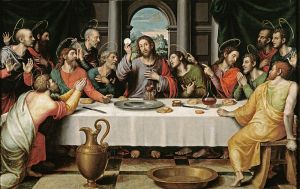
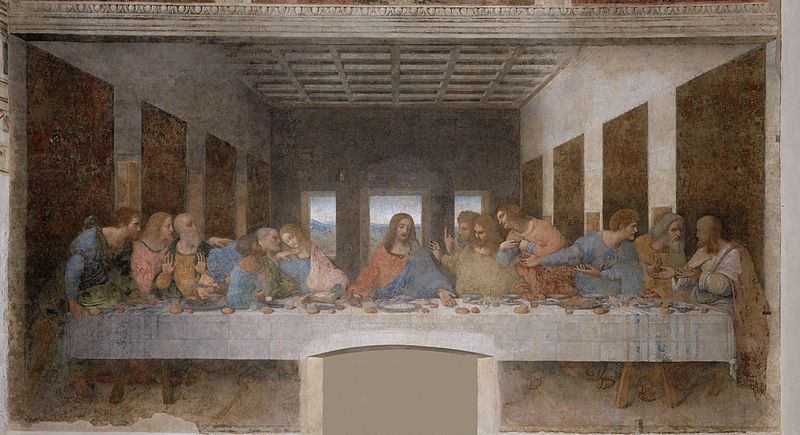
Communion, or the Eucharist, is a ritual meal based on the Jewish Passover. According to the Gospels, it was during the “last supper,” a Passover seder, that Jesus instituted the ritual. Early Christians ate together, and, recalling the symbolism, gave special prominence to the bread and wine. Bread, however, produces crumbs. When theology got ahold of bread it became a sacred object, after it was properly consecrated. It was believed (is still believed by some) to be very powerful in that state since it had become the actual body of Christ during the ritual. Wafers, technically unleavened bread, had many advantages to the emerging theological sensitivities. Portion control, symmetry, and virtually no crumbs. I’ve attended many masses, and the extreme care for particle control is everywhere from ciborium to patten to sacred linens that cover the altar like a liturgical table cloth. They are all accessories to the containment of broken bread.

Última_Cena_-_Da_Vinci_5

Communion wafers, however, when unconsecrated are just bread (if even that). They are not made palatable as snacks, but are more easily available online than basic gears or recordings of your favorite musical. Heavy metal has always enjoyed its blasphemous image as one of the most in-your-face counter-cultures possible. It is also profoundly religious. (Note, I am not saying that heavy metal is Christian or even Judeo-Christian, but it does participate deeply in religious symbolism.) If robbed of its shock-value, it is just loud noise. By association, however, many people mistake the wafer itself for what it represents. Without the added ingredient of consecrations, however, the liturgical churches tend to say it’s just bread. If you’ve ever eaten it, you’ll know that that assertion requires faith sufficient to move a Big Mac.


Hoax Folks

The internet bores me sometimes. I can’t keep up with the pace of blogs that chug away like a neverending newsfeed. Information comes at me so fast I want to cower in a corner and start constructing my own printing press from scraps of lumber and bits of broken screws and bent nails. Slow things down a bit. Write something of substance. Of course, electronic information has its advantages – I frequent online dictionaries and thesauri where looking up words is much quicker than flipping countless pages. While hovering on the thesaurus.com page this morning, I noticed one of the blog entries entitled “Relax, Bill Cosby isn’t dead — it was a hoax. Is it true that the origin of ‘hoax’ mocks Christianity?” I’m glad for Bill Cosby’s sake, but what really caught my attention was the subtitle. We are all subjected to hoaxes almost as regularly as we are fed real news. Was this blurb suggesting that Christianity originated hoaxes or had given us the word “hoax”? Okay, too much information, but I had to find out.

The blog post states, in part, “The Eucharist, a central Christian prayer, contains the Latin ‘hoc est enim corpus meum,’ meaning ‘for this is my body.’ Jesus is said to have spoken these words at the Last Supper. The British clergy John Tillotson speculates in 1694 that hocus pocus is not only a corruption of this key Latin phrase, but a parody in keeping with the occasionally vulgar humor of prestidigitators.” Having taught for more than a decade at the avowed queen of “Anglo-Catholic” seminaries, I’d heard the gist of this before. For a blog on a website supporting grammar, however, I winced at “a central Christian prayer” and “The British clergy John…” phrasing. The Eucharist is not a prayer, but a sacrament, part of which is the Eucharistic prayer. Clergy is a collective, not an individual. Not to mention that if one was speculating in 1694 it ought to have been in the past tense.

In any case, the story as I received it was that Protestants coined the phrase “hocus pocus” to abjure the idea that anything “magical” was happening at the Eucharist. Protestants generally held communion to have been symbolic rather than a literal act of changing bread to flesh and wine to blood. So it seems that from a Protestant point of view the Eucharistic prayer was a hoax, but from a Catholic viewpoint it was salvation. As with most things religious, it is a matter of perspective. The word “hoax,” it turns out, likely derives from “hocus.” Having found this gem nestled in among so many grammatical errors, however, shakes my confidence a bit. That, however, is just my perspective.

A hoax or Dagon's sister?


Mythology Gone to the Dogs

Today’s New Jersey Star-Ledger reports an inter-species religious scandal that highlights the vast difference between god and dog. Last month a Canadian Anglican priest fed a dog a communion wafer. The gesture, a spur-of-the-moment reaction to a visitor who brought his dog to church (somewhat of a rarity in itself) was likely just a reflex to seeing that inevitable lolling tongue at the communion rail. Priests see lots of lolling tongues, mostly human.

In my long years at Nashotah House, where daily communion was a requirement of all faculty and students, I’m sure I consumed several pounds of communion wafer. I also received many stern warnings that this particular food item – if communion wafers can really be considered food – was unlike any other and must be treated with the utmost sanctity. Ironically, more than once I was handed a wafer by a priest with an out-of-control head-cold who’d clearly just contaminated an entire paten full of the sacrament with an eager virus. Within a week most of the student body would be hacking up an holy phlegm, not dissuaded from sharing the common cup. Despite the obvious fact that the ritual had become a disease vector, the mythology of its sanctity lived on.

The history of Christian ritual is a specialized field with experts who know the minutiae of each subtle gesture and the history of each preposition in the Anaphora. The ritual itself has become an object of worship. For some the fate of the wafer has become the fate of the world. This is mythology in action. Nevertheless, I have often received unbelievable hostility from those crowned with righteousness. As long as the right words are pronounced in the right order with the appropriate gestures, it is perfectly acceptable to stab another human being in the back.

I grew up with dogs. With the rare exception of the occasional biter, canines have treated me very well. Some on the verge of worship. If it comes down to choices, I’ll take my chances with the dog with a lolling tongue rather than with the priest with the magical bread.

Belief in dog is not a bad thing