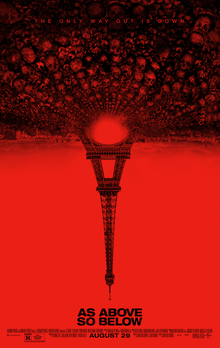
Going Below

Indiana Jones in National Treasure, in found-footage horror format.  That’s the feel of As Above, So Below.  Only Jones is a woman.  There’s plenty of religious imagery in this movie, but the story’s not that great.  One of the reasons is that it’s too difficult to swallow, although it does score serious points on the claustrophobia scale.  At the beginning I wondered if I was going to make it through since Dr. Dr. Scarlett Marlowe’s cell phone is constantly moving as she continues her father’s search for the philosopher’s stone.  Surviving the situation in Iran, the remainder of the film takes place in Paris, especially the catacombs.  My level of impressedness went up when I learned that the movie really was shot in the catacombs.  Unfortunately it didn’t really help the story.

Alchemy, as part of esoterica, is purposefully difficult to understand.  Marlowe is continuing her dead father’s search for the philosopher’s stone that can change things into gold.  Her friend George (who repairs the clockwork for the bells at Notre Dame) is forced into the catacombs with her and her cameraman Benji.  They’re led by three Parisian cataphiles and some shots look like they were lifted directly from Indiana Jones and the Last Crusade, including the use of her father’s notebook.  Instead, the group enters the gates of Hell.  There are lots of scary things down there, many of them unexplained.  Some reflection reveals that they are all having to confront their pasts—or at least some of them are.  One of the cataphiles is killed before we learn her secrets.  And one of the survivors has no real backstory.  Six go in and three come out.

The movie plays with some interesting ideas, but it’s hard to swallow that an actual bona fide archaeologist would go on an illegal treasure hunt.  And that she knows of a secret chamber in the catacombs that has remained undetected by specialists.  I began scratching my head.  And when the group (or some of them, anyway) begin finding artifacts from their personal pasts in the catacombs, credibility is strained even further.  The idea that it’s important to come to terms with your past is a good one.  But once the young people begin dying and the rest have to keep going deeper and deeper to get out, the illusion is broken by Marlowe just dashing back to get a different stone to save George.  If it were just a matter of popping back, wouldn’t they have tried that earlier?  There are some Bible quotes, making this a candidate for the also unlikely Holy Sequel.


Castle Dreams

It’s a real problem.  If you’re a passionate collector you eventually run up against the space issue.  A New York Times piece tells how a couple that collects puzzles had to buy an Italian castle to house their collection.  I appreciate their passion, but I operate on a more modest budget.  We bought our house going on six years ago.  Like many people raised in poverty, I’m a bit of a packrat.  When you’ve experienced a life of not being able to afford things, you tend to keep everything.  That’s an economic reality.  You spent money on this and you don’t want to waste it.  Add to that the passion of a collector and you could have a real problem.  Castle-sized.

When we were searching for houses the market was poor.  It still is.  Although a recent trip to Somerville, where we used to live, revealed massive amounts of new apartments—we were literally stunned—buying a house remains difficult.  (But all those apartments!  When we moved to Somerville in 2006 there were only a few units available, so I guess that was before it became popular.)  And we specifically needed a house where you could keep books.  (I do periodic purges and end up feeling full of regret afterwards.)  Our house has a large garage with storage space.  Not an Italian castle, but the principle is the same.  Only our garage has been taken over by aggressive squirrels.  We can’t yet afford to have the roof rebuilt (with solar panels because we have beautifully unimpeded southern exposure); we can’t lay up books where squirrel and mildew doth corrupt, so I guess we might have to consider a castle down the road.

My escape fantasy would probably be Ireland, however.  They speak English there and they have castles.  And Scotland’s just across the way.  Although I spent my doctoral years in Edinburgh, my ancestry leans more toward Ireland.  And Germany, but although they have castles I’m not sure I can revive my German well enough to get along there.  No, Ireland might be the best choice for my castle-buying dreams.  Of course, those of us who grow up poor do dream of castles.  I read about them in books.  And books beget books—this seems to be an inescapable law of nature.  I do wonder if Irish castles have problems with squirrels, though.  If I’m going to make this work it’s going to require quite a bit more money.  And thought.  It’s a real puzzle.

Photo by Reid Naaykens on Unsplash

Layers

I’m all for not offending anyone. I became P.C. in principal just as soon as my consciousness was raised that the very basics of English grammar caused distress to others (often women), based on its androcentric orientation. It does seem, however, that God is even more easily offended than humans. This raises some tricky questions when it involves the highest perceived authority within or outside of the universe, the font of all morality. Some of the things that offend God, if the sources are to be believed, are most unusual. Last night I attended one of those you-should-send-your-child-to-Europe-while-in-high-school seminars that remind you that being a good parent always involves a touch of poverty. The trip is a very expensive bargain, giving your daughter or son a lasting set of life-changing memories. So far I’m on board. And, what is a trip to Europe without visiting some of the great cathedrals that exhausted local, medieval economies but left modern companions to Stonehenge all around the continent? Okay. Having seen my fair share of European cathedrals, that’s perfectly understandable. Then the kicker: since these are religious places, there is a dress code.

Anyone familiar with mainstream culture even in America is aware of this idea. To attend a place where God is supposed to be present, you must dress for the occasion. The Simpsons can throw around the phrase “Sunday clothes” and everyone knows what they mean. Attend a religious service dressed down and you’ll immediately discover it. Some traditions raise this to a high sartorial art—some Episcopalians I know are so fastidious that the very statues of Jesus seem decidedly underdressed. Since your child will be in Europe and be in cathedrals, you mustn’t offend God in a foreign land. No jeans. As the parent of a teen that means buying a whole new wardrobe to add to the pricetag. Apparently the Levi-Strauss tribe is not the same one in the Pentateuch. I spent some time in Israel a number of years back. The dress code is very strict around sacred spots. No shorts or visible shoulders. In the hot climate of the Middle East wearing excessive layers, well, it’s no wonder some folks get a little irritable. God’s standards are high. Celestial even.

Nowhere is God’s discriminating taste more evident in the required “modesty” of women. Nobody told me, but apparently women are quite a turn-on to gods. Read Genesis 6 and see if you don’t agree. The burden of public hiding beneath cloth falls on them. A man’s calf doesn’t excite God nearly so much as a lady’s. In Jerusalem they used to hand our hooded cloaks to wear over your street clothes for visiting holy places, just in case. Lord knows we wouldn’t want any unrest in the Middle East!

Having lived in Europe for three years, I know about and despise ugly Americans. At home I find our culture and manner of dress fascinating. Most of us don’t think what it says about our religion. If you ever catch a priest in church wearing jeans you’ll have your own local, mini culture-shock. I’d like to figure out why God is so easily offended by human fashion, but there is no time. I’m off to the street corner with my tin cup to try to raise money to buy clothes so my child won’t offend God in Europe.

No shoes, no shirt, no salvation.