Final Flight

Back in the day before CD players, let alone MP3 files, my mom had a squat, boxy rectangle of a cassette-tape player. (Remember, I am a student of ancient history.) The cassettes we had were home recorded, scratching and hissing like a disgruntled cat, but they were the latest in technology. And, of course, they were religious in nature. One particular tape I still remember with terror. Narrated by a optimistically doleful bass male voice, it recorded the events surrounding those climbing aboard a plane bound for heaven, along with authentic jet noises. It was, of course, a thinly disguised metaphor for death, something I realized even as a child. As the passengers climbed aboard, anticipating that meeting with Jesus, I trembled in fear. They were all about to die.
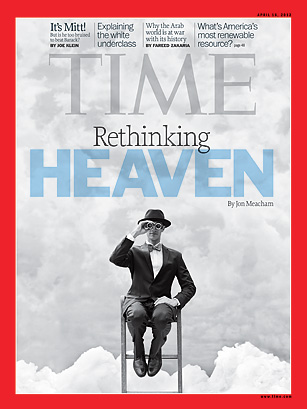
I have never been particularly afraid of death. Not that I’m in a hurry to go there, but I have always sensed it as inevitable and therefore not worth worrying over excessively. I was one of those who grew up thinking quite a lot about it, viewing it from different angles, trying to make sense of it. I still do. While I was in England, Time magazine ran a cover story on Heaven. Now that my feet are back on the ground, I have been reading the story with interest since I’ve just been spending several hours on a jet in the sky. One of the most surprising elements in the story is the fact that some evangelical preachers are beginning to inform their flocks that heaven is what we make it here on earth.

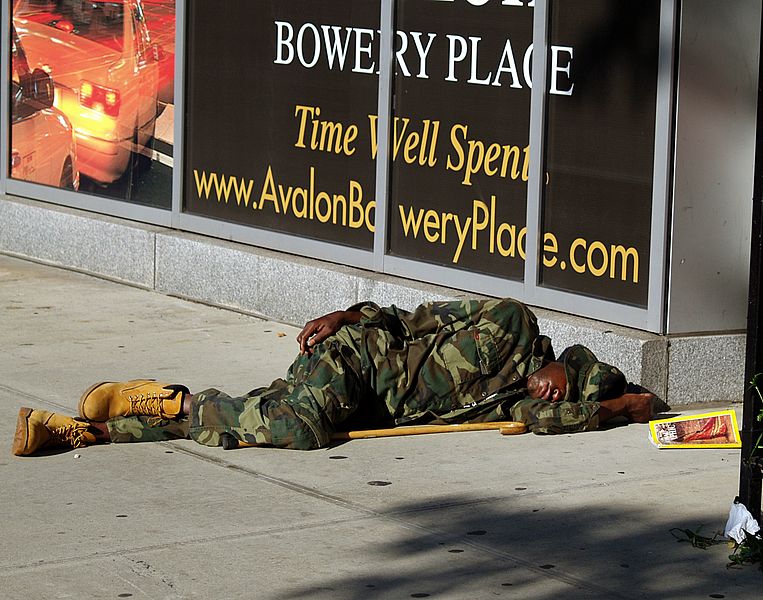
This may not sound shocking to you, but having grown up evangelical I knew that the only reason we behaved so well all the time was so that we could get into Heaven when we died. This was the economic basis of salvation—you paid for Heaven in good deeds and correct belief. Not that you exactly earned it, but you did invest in it. This was the defining characteristic of Christianity. The suffering that is so obvious in the world (I saw three homeless men curled up together inside the Port Authority Bus Terminal just this morning) can harsh anyone’s paradise. The traditional “Christian” response has been to look past that to a shimmering, if imaginary, kingdom in the clouds. I am very surprised that some evangelical pastors are willing to risk their entire campaigning platform in order to help those in need. It’s getting so that it is hard to tell which way is up any more. Maybe that’s what happens when you spend too long on a plane bound for a mythical destination.


I Pledge Allegiance

It would only be with the most tentative and hesitant of reservations that a person might call her or himself an intellectual. The denotation carries with it such possibilities and potentialities of arrogance that even being seen reading Richard Hofstadter’s Pulitzer Prize-winning Anti-Intellectualism in American Life in public could be cause for considerable timidity. The end result, however, is so rewarding that it is worth the risk. Seldom have I read a single book that explained so much of what continues to define our society. As an historian, Hofstadter was acutely aware of American self-perception—so much so that it seems foolhardy to distrust him. Although the book was published in 1962, it seems as though the five decades of my life haven’t had time to transpire—things are shockingly similar to the myth of the 1950s that still drives the Religious Right. Hofstadter could be lurking in the corner with his pen even now. I turned to this book because I had grown weary of having felt set upon by a society I have only ever wanted to improve. In tracing the roots of anti-intellectualism Hofstadter clearly demonstrates that the distrust is felt on both sides of the divide. Having not had the dubious benefits of an affluent rearing, I simply followed where my limited talents led. What future is there for a poor boy who likes to read and write? My earliest and most honest aspirations were to become a janitor. At least in that job you can see the filth being scrubbed away.

Expecting an objective historical account of intellectual history, I was surprised to discover that the first section of the book dealt with the privileged place of evangelicalism in early America. I’m not so obtuse as to have overlooked the obvious mockery that the intellect receives so freely from the coffers of Christendom; one need only glimpse the headlines or listen to street-corner evangelists for a fraction of a minute to learn that. I had supposed that my limited experience had made me naïve in assuming religion stonewalls free inquiry. The problem, it seems, is endemic. Those who would suggest that brains are actually meant to be taken out of the box and played with incur the wrath of the almighty.

Hofstadter resisted keeping the gaze too long upon the faithful, for there are clearly other forces at work. The rugged, self-made individualism of a nation that consisted of frontier until comparatively recent times also plays into this suspicion against the self-proclaimed sages. We have all had the displeasure of knowing the self-impressed, and their sticky indulgence in immodesty clings to many who simply can’t turn off the motor in their heads. Instead of walking away from the book feeling justified, I instead felt reflective. My own perceptions have led me down the path of trusting the guidance of the soul (whatever it may be), but the perceptions of others raised in different circumstances lead to materialistic assumptions, or the hunger for power. Deep down inside, though, I know that I shifted perceptions by the slow, steady influence of education. There is no unlearning that. And education has brought us this far. And a little intemperance in appreciating intellectual life may be the most venial of sins.


Divorced from Doctrine

Spirituality and religion have never been so far apart while being so close together. While many people describe themselves as non-spiritual in any sense, whether it be for materialist, humanist, or atheist sensibilities—a great number of people still feel the compulsion to believe in something more than the everyday world we all know. In Sunday’s New Jersey Star-Ledger columnist John Farmer laments the disparity that continues to persist between women’s opportunities to benefit from religious dictates while religious leadership continues to remain a male preserve. As Farmer notes, it is a thinly disguised case of men determining what options are open to women. He notes the recent government about-face exempting religious organizations from the new health plan as a case in point. Does the mewling. special pleading of Catholics oh so concerned about the rights of unborn males outweigh the right of women to unfettered healthcare? You betcha!

Election-year politics are among the most ripe for those who wish to keep women “in their place.” Appear too progressive and you’ll lose the Catholic vote for sure. Of course, despite officially teaching that evangelicals are not real Christians, Catholics will be glad to glom onto their votes, taking advantage of their Hell-bound compatriots in order to keep women from ever truly enjoying freedom. The theology behind their reasoning is late and based on such convoluted logic that a layman can’t hope to follow it. Isn’t it just easier to accept that Rome declares it so? One gets the sense that longing for the old Roman Empire isn’t as rare as good-old human compassion.

Does it not seem ironic that anytime a bill comes forward to promote true equality among humankind the first to stand it line to bring it down are the religious? Christianity likes to trace itself back to Jesus who never intimated that women were inferior and who never spoke a word about homosexuality. He did, however, advocate free health care. Church leaders long since discovered that the first stone is easy to throw, and after that the others come with even more celerity. The cost to spirituality, however, has never been calculated. The same church that consistently declares sexuality is only for reproduction has never made a public outcry against Viagra. After all, we must leave some room for miracles.

These keys were made for lockin'


And Then There Were None

Whatever happened to evil? There was a time—when I was being reared in a conservative, evangelical, Republican household—that certain kinds of behavior were considered evil. And not all of them took place in the bedroom. Some of the most blatant acts of evil included using others for your own advantage, putting yourself first, and valuing things above people. Somewhere in the decades that I’ve been alive, all of that has changed—from a politician’s eye-view, anyway. Now that we’re in what’s passing for winter, some days are decidedly chilly. Seeing the homeless hunkered down in the Port Authority Bus Terminal (where there is even an organized, charitable group that tries to help them out), or sitting on subway vents to catch some of the warm air, or shivering on a street corner day after day, I wonder where the evil has gone.

In the neo-evangelical world of cheap prosperity and cheap family values, the name of Jesus gets bandied about like an over-inflated beach-ball. Many who utter his name obviously don’t read his life story. According to the Gospels, Jesus spent his adult life as a homeless wanderer who was particularly sympathetic to the poor. He doesn’t refer to them as evil, but he does have very harsh words for the privileged establishment. Such words harsh the euphoria built upon our own self-importance. As I see the homeless in the winter’s chill, it occurs to me that their lifestyle is much closer to that of Jesus than is the that of the executive who works 33 floors above them. Their demands on life are minimal. Their stares should make us uncomfortable.

And yet, look at those running for office. The amount of money they spend to make each other look bad is obscene. They try to make themselves look righteous for the Tea Party crowd, but their assets weigh them down. I shiver for the homeless. I shiver when I see the news about the ultra-wealthy bragging about who can dig up the most mud. Most of them would have no idea which end of the shovel to use. I’m afraid that having grown up in a modest setting has forever biased me against posers and average guy wannabes. I’ve had jobs that have involved shovels, sledgehammers, and hard scrubbing. The average person struggles and shivers sometimes. The average person spends some time on his or her knees and sometimes ends up on the ground. And even though the average person falls down more than our shining leaders, we never get quite so dirty. Politicians don’t sling the mud at us. To be honest, I think they don’t even see us.

The son of man has no place to lay his head


Best Prayer in the Air

With my current job I travel quite a bit. With all the attendant time hanging around airports, I have time to think back to pre-deregulation days when flying meant some kind of care in the air. It has been in the news the last few days that Alaska Airlines is removing the prayer cards from its trays during meals. When I saw that, the real surprise to me was—airlines serving meals? When did they start doing that? A couple years back I flew coast to coast on Alaska Airlines with nothing more than a sack of peanuts. I would have been happy to have had a prayer card to eat. I agree with those who pointed out to the airline, when it served these alleged meals, that paying customers shouldn’t be proselytized. You can get enough of that by watching GOP debates. And I certainly hope the message wasn’t that the plane only flew on a miracle.

I’m sure that some people will say there’s no harm in a little non-invasive sermonizing. Therefore I must make my own confession; I was a teenage evangelical. Although I never actually did tracts myself, I hung out with kids who did. Once, on the way home from a youth meeting, a carload of us stopped to get a bite to eat in a diner. Now, we were high school kids, not flush with money, but even I knew it was right to tip—waitresses have to put up with a lot for little pay. One of my friends told us that if we really wanted to help the young lady out, we should leave a tract as a tip. What reward could be better than salvation? Surely that would help to feed her family or buy her kids a new pair of shoes. Indoctrinated as I was (and I hadn’t even been to college yet, Mr. Santorum), it seemed like a good idea. Still, I felt bad when we left.

These two situations are not dissimilar. In both cases someone would rather print cheap words on cheap paper with free sentiments rather than giving a person sustenance. It’s been a few years since I’ve darkened a pulpit, but I do seem to recall Jesus insisting that the hungry be fed. I don’t recall what he said about tracts and prayer cards.

Religions have a way of focusing on the forgettable minutiae while overlooking the real need right in front of them. In November I flew from New York to San Francisco, subsisting on a tiny bag of peanuts and some airline orange juice. If old Deutero-Isaiah were sitting next to me he might have said, “why spend money on what is not bread?” But I was thinking that maybe the karma of that tipless waitress was simply coming back full circle.


Moosechief

The moose, depending upon which standard you use, is either the largest or second largest known land animal in North America. This aspect of the moose, as well as its general docility, has often spurred me to the northwoods in search of the elusive beast. Those of us with few tracking skills, however, often must be approached by the greater party rather than finding it. My trips to Maine have seldom yielded moose, but in my periodic forays to Idaho the creature sometimes makes an appearance. This past summer I spotted two of them in the west. In their ungainly way they are beautiful animals. Large they may be, but intelligence is not a necessary corollary to size.

Moosing around.

From about the 1840s, up to its formal passing into law in 1919, prohibition ranked high in the list of evangelical Christian concerns. A distinctly Protestant issue—Catholics still recognized that any tipple good enough for Jesus was good enough for them—the outlawing of alcohol was understood to be in keeping with the Gospels. Some groups even suggested that Jesus had been quaffing Welch’s, or the first century equivalent thereof, rather than Mogen David (the shield of David, after all). Latest research seems to indicate that fermentation was known before the Sumerians ever appeared, and we all know what happens when cavemen have too much to drink. Strangely, this became a religious issue along about the time Fundamentalism began to appear. But Fundamentalists considered neither the practices of Jesus nor the moose.

A story in today’s New Jersey Star-Ledger concerns a moose in Sweden. Known for their liberal social values, the inhabitants of Sweden are often presented as champions of free lifestyles. A moose near Gothenburg apparently had trouble steering herself after eating several fermented apples that had fallen from a tree. The inebriated moose lodged herself in a tree fork. The rescue involved bringing a crane to the scene to release the trapped, and slightly disorderly, animal. Such a story makes me wonder if prohibition should not be among the laws of the jungle. After all, the observation of nature often calls the certitude of many religious doctrines into question. If God prohibits alcohol, we might rightly wonder, why are there moose in Sweden sleeping off a hangover?


Right by the Numbers

Reading about ancient religions helps to focus the long view. I’m brushing up on ancient Egyptian gods for my Ancient Near Eastern Religions class. Seeing how various gods rose to prominence with the fortunes of their patron kings or priesthoods suddenly struck a chord for modern-day religions as well. Many of society’s most conservative like to think that this is the day of Yahweh (or, not to put too fine a point on it, Jesus). This pre-biblical god has come into his own with the rise of the Catholic Church, following on from the conversion of Constantine, into the post-Reformation development of Evangelicalism. With the superiority of numbers and fiscal wealth, there is no disputing the one true god, is there?

What happens when the ultra-selfish free market consumes itself to a point that other cultures rise above it? Already outnumbered in souls by China and India what will Americans say when Buddhism or Hinduism outstrips Christianity? Is religion proven correct purely by the numbers? Cultural dominance has become inseparable from religious truth for many brands of Christianity. If in doubt, check out Andrew Schlafly’s Conservapedia (if any state would like to take him off New Jersey’s hands, you are certainly welcome). Being the right religion means being the might religion. Somewhere along the way it seems that the message of Christianity has become equated with bullying others around. I think Jesus must have gotten pushed around quite a bit as a kid on the playground.

What's behind that self-satisfied smile, Akhenaten?

When Amenhotep IV became king of Egypt, the priesthood of Amun had grown very strong. Probably in an effort to suppress this powerful rival, the king changed his name to Akhenaten and promulgated the sole worship of Aton. Some like to give Akenaten credit for being a monotheist. To me it seems more likely that the old pharaoh was attempting to show intolerant bullies the way to behave: use religion to political advantage. If the opposition disagrees, shut them down. Problem is, this doesn’t work well over the long term. As soon as the unpopular king died, the former religion reasserted itself and things went back to the way they had been. Tut, tut. Seems like religious bullies never learn.


Budget Bombs

Budgets are measures of what we value. For a nation that likes to tag itself repeatedly as “Christian,” our priorities belie that claim as surely as the lives of our leaders. Over the past few months, those of us involved in education have watched in horror as governor after governor has attacked education as a pork-belly society simply can’t afford. Considering the salary differences between politicians, CEOs, and teachers, there is no comparison. Many teachers I know must work second jobs to make ends meet: they too have kids to send to college. The problem, however, is not endemically a Republican one. My political leanings are well known to those who read this blog, but a colleague at Montclair State University recently sent me this quote from a 1953 address of Dwight Eisenhower that makes the point clearly:

An unlikely prophet

“Every gun that is made, every warship launched, every rocket fired signifies, in the final sense, a theft from those who hunger and are not fed, those who are cold and are not clothed. This world in arms is not spending money alone. It is spending the sweat of its laborers, the genius of its scientists, the hopes of its children. The cost of one modern heavy bomber is this: a modern brick school in more than 30 cities. It is two electric power plants, each serving a town of 60,000 population. It is two fine, fully equipped hospitals. It is some fifty miles of concrete pavement. We pay for a single fighter plane with a half million bushels of wheat. We pay for a single destroyer with new homes that could have housed more than 8,000 people. This is, I repeat, the best way of life to be found on the road the world has been taking. This is not a way of life at all, in any true sense.” (President Eisenhower’s address “The Chance for Peace,” Delivered Before the American Society of Newspaper Editors, 4/16/53)

The largest slice of our national budget goes toward military spending. Christianity teaches that we need not fear death – that’s what Easter’s all about, is it not? – and yet we pay astronomical amounts to keep ourselves safe. Do we really practice what we preach?

Since Eisenhower’s day we’ve seen an increasing inflation of self-centered motivation and self-importance taking precedence in politics. Republican politics allied itself with extreme right-wing evangelicalism and soon we were being told that Jesus was a free-market economist. The values of one sect hijacked a political party, and indeed, a nation. The force of this movement is so strong that, with some obvious differences, the policies of President Obama are not so far from those of Bush. No forward progress is to be made: backward, Christian soldiers! Our nation is in full retreat from facing square-on the very real problems of social injustice, unemployment, and lack of adequate schooling for many of our children. Those who know no better sit by and say, “well, the Christians are in charge, everything will be fine.” I don’t believe in a divine apocalypse, but then again, I don’t believe we will need one. Unless people wise up, we will be perfectly capable of creating a home-grown apocalypse all on our own.


Bell’s Hell

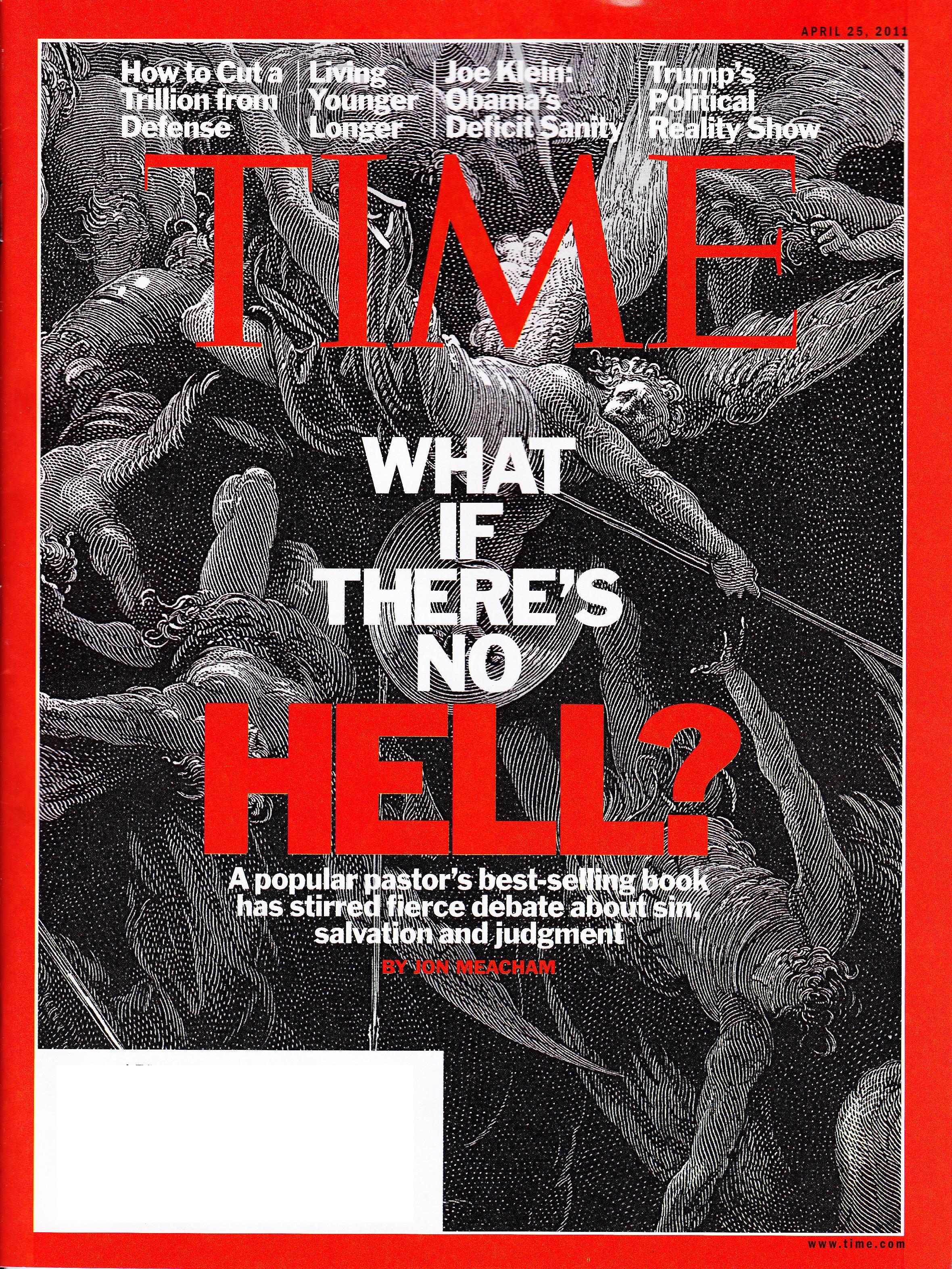
Hell makes the cover of Time. Or at least its absence does. For those of us who’ve delved deeply into the Bible for many years, it is no surprise. In fact, the uproar, as Time confesses, is among Evangelicals. So why Hell? Why now? The Evangelical pastor of Mars Hill Bible Church, Rob Bell, has just published a book questioning the existence of Hell and his fellow Evangelicals are in a conflagration about the loss of the sacred icon of God’s omnipotent stick that threatens them all into Heaven. It is a sad day when love cannot encourage enough that hatred becomes religion’s motivating factor.

The loss of Hell, however, represents so much more than just the loss of the scariest place under the earth. It represents the loss of control. Without Hell to wield and Hell to pay, many of the faithful may wonder what they might get away with. Neo-cons have been eager to court the Hell-mongers because the issue is making others lock-step in their own pattern. Diversity is not encouraged or appreciated. Lawns must be cut to the same height, trees carefully trimmed, shirts must be conservative and cookie-cutter, and one must wear that blessed smile that proclaims “Hell-dodger.” Cast any doubt into this fabled world and the results might be, well, realistic.

The Hebrew Bible knows no Hell but the one we make for ourselves. We hardly need a Devil to tutor us in the ways of evil. Human history reveals that we’ve had it in us all along. Instead of celebrating the death of Hell, several Evangelical pastors are simply adding Bell to its numbers. Time’s news is not news for many of us, but for those who haven’t considered seriously the implications of their faith as Holy Week rolls around, this may be a good time to take stock of options for eternity. What do we gain by fabricating an eternal torment devised by the most loving deity ever conceived? Hell can now claim its rightful place as a metaphor for the wickedness Homo sapiens devise for each other and for their planet.


Dating Daniel

Last semester one of my students had an encounter with a literalist. This is not uncommon, but the issue raised ran counter to what we were covering in class, namely, the book of Daniel. Apocalyptically minded literalists use Daniel and Revelation as a two-tiered roadmap to the future, supposing that these books are predictions of the end of time. Scholars who’ve studied apocalyptic literature, however, know that such interpretations misrepresent a fascinating genre of ancient writing that says more about its own time than some unforeseen future (our time). Nevertheless, the myth of Daniel’s foresight persists.

Long ago biblical scholars noted that although set in the period of the Babylonian Empire, the book of Daniel makes several basic errors about that time period. On the other hand, Daniel knows the period of the Seleucid Empire (when it was actually written) in relatively precise detail. We think nothing of it when an author today sets a story in the past, but somehow this is dirty pool in the composition of an evangelical Bible. Apocalyptic was intended to provide encouragement to those under persecution, not to give them a Google-mapped future. It is in the nature of apocalyptic to present the author as a seer, but the future age is a Zoroastrian contribution that gives books like Daniel and Revelation their edge.

Misunderstanding genre is a large concern among literary scholars. A document like the Bible, which contains several distinct genres, must be handled carefully if it isn’t to be misrepresented. I used to point out that if the passages intended to be read ironically were understood literally many Bible-quoters would be in trouble. After all, doesn’t Amos declare, “Go to Bethel and sin; go to Gilgal and sin yet more” (4.4)? Learning to place biblical genres within their proper context makes a world of difference. Instead of Daniel telling us to hold tight because the end is near, he is found to be encouraging those who were suffering in his own day. We have no biblical roadmaps for the end times because the end of the story has not yet been written.

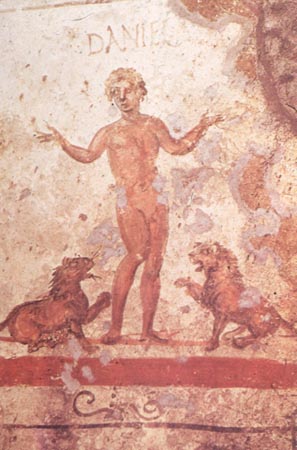
Daniel tells the lions a story about the future


From Bragg to Phelps

Religious freedom is proving to be a two-way street. The news is rife with stories of religious groups pushing the limits beyond their right to state an opinion into arguably unconstitutional behaviors. At Fort Bragg, the Army is sponsoring Rock the Fort, a Christian rock concert promoted by the Billy Graham Evangelical Association. Although Christian bands are spiritually minded, they do not perform for free, raising the question whether military (government) money is being spent to promote a particular religion, a particular strain of Evangelical Christianity. In offering this concert, is the government endorsing this one religion? Statements that other religions are free to send their rock groups to Army bases rings hollow when, with rare exceptions, such groups simply do not exist.

Meanwhile, Time magazine brings the curious Westboro Baptist Church of Topeka, Kansas back to the headlines now that Supreme Court has been called in to argue whether their outspoken condemnation of the military is constitutional. Fred Phelps, the founder of the church, has led divine hate campaigns across the country. It is his protests at the funerals of soldiers killed in action that has forced the question of whether his group has the right to condemn indiscriminately. The question of good taste need not even be asked.

What these Evangelical groups are pointing out is that God apparently suffers from schizophrenia. Simultaneously the great general upstairs loves soldiers and wishes to convert them and also hates them and condemns them to hell. The jury, it seems, should be the taxpayers. We are the ones footing the bill for Christian concerts and paying the not-insubstantial salaries for Supreme Court justices to argue about the legality of religious hatemongering. In these days when many feel that Islam is a threat (as Christian clergy threaten to burn the Quran), it might be worth asking where the real threat to religious freedom comes from. Religious zealots often make excellent soldiers, no matter what the religion.

These guys love God, but is the feeling mutual?


Under God

As one of the more flamboyant of national holidays in the United States nears, there is a whiff of discontent in the air. The North Carolina Secular Association has been sponsoring billboards that provocatively read, “One Nation Indivisible.” Those who, since 1954, have grown accustomed to reciting the “pledge of allegiance” with the words “under God” inserted after the “one nation” bit, grumble that one more icon of civil religion has come under fire. I first became aware of civil religion as a student in a self-identified Evangelical Christian college. I was astonished that the religion faculty, all believers, suggested that civil religion was not true religion at all. True religion was an inner commitment, not social bravado – often in the service of political aims. I was pointed to the writings of Richard Niebuhr and Dietrich Bonhoeffer and told to think for myself.

Since that time, I have kept a wary eye on civil religion. It is a dangerous force in society since few people think deeply or seriously about their religion. It fosters knee-jerk mob mentality. Civil religion is a slurry of a variety of religious outlooks, mostly Christian, predominantly Protestant, but now gaining a dose of conservative Catholicism. No one denomination would accept all its tenets as true faith, but weighed against the “godless alternatives” most conservative believers would much prefer the shallow public display of religiosity to “one nation indivisible.”

The Pledge of Allegiance was first composed in 1892. It read, “I pledge allegiance to my flag and the republic for which it stands: one nation indivisible with liberty and justice for all.” (That flag didn’t have 50 stars.) The North Carolina Secular Association has, arguably, simply reverted to the original formulation. In 1954, with Cold War concerns heating up and decent Americans associating themselves with Evangelical Protestant values, the phrase “under God” was added – take that you godless Communists! That other great icon of civil religion, the United States motto, “In God we trust,” was placed on currency during the battle-torn era of the Civil War. Once again, the Cold War brought it into prominence. In 1956 the Congressional Record noted that “In God we trust” should be designated as the United States motto. With the collapse of many of the Cold War threats, the fully charged civil religion front had to find a new outlet for its excessive energy. One needs only a casual glance at the American political scene to see where this insipid, lukewarm version of civil religion has resurfaced. One nation indivisible?

Does it really stand for freedom of religion?


Misappropriated Prophets

There seems to be a can of worms lying open on my desk, released by the comments yesterday’s post engendered. I thank all my readers and commentators. The issue most pointedly thrust among the worms appears to be that of prophecy. Teaching about prophecy constitutes a large part of my meager income. And since prophecy plays a large role in many Evangelical associations not only with the Deepwater Horizon disaster, but also Hurricane Katrina, 9/11 and just about any other major catastrophe, it is worth exposing. In the Bible prophecy is not about predicting the future.

Prophecy was a widespread phenomenon long before Israel appeared on the scene. One of the roles prophets shared in ancient times was the declaration of outcomes to momentous events. Unfortunately that aspect of their duty easily became equated with predicting the future. Its actual milieu, however, was that ancient people believed prophets to be “effective speakers.” When a prediction came true it was not because a prophet could “see the future,” but because the spoken word of the prophet participated in the reality of the world. The belief was that the effective word came from God/a god, and therefore would be true by definition.

Apocalyptic, the familiar literary form of Daniel and Revelation, is not prophecy. Zoroastrianism, the religion of ancient Persia, had influenced many ancient religions, including Judaism. Apocalyptic, like prophecy, has a predictive element. Like prophecy, however, apocalyptic has a different purpose. The books most heavily farmed for future predictions by Evangelicals, Daniel and Revelation, are both thinly veiled accounts of contemporary events of the authors’ own days. Daniel consoles Jews persecuted by Antiochus IV Epiphanes and Revelation consoles Christians persecuted by one of the early Roman emperors (the jury is still out on precisely which one). Neither book predicts the end of the world. Both, however, declare the comeuppance of the arrogant oppressor. It is here, perhaps, that the true relevance of the Bible speaks to the scars human beings inflict on their own planet and on each other.

sic semper tyrannis


Casting the First Stone

I’m not overly nostalgic for a guy interested in ancient history. I tend to look at the more recent past as a via negativa for the young who might make a difference today. Very occasionally, however, aspects of society were handled better back in the 1960s and early 70s. One of the most obvious instances of a more sane society was the segregation of politics and religion. Prior to the rise of the “Religious Right” as a political machine the religious convictions, or lack thereof, of politicians played little role in their campaigns and American culture itself was much more open. A story from today’s MCT News Service illustrates this all too well.

In an article entitled “In S.C., religion colors gubernatorial race,” Gina Smith reports on the various religious slurs that now pass for political campaigning in that state. “Raghead” (for a former Sikh), Buddhist, Catholic, and “anti-Christian Jewish Democrats” are among the aspersions freely cast by those without the sin of a non-evangelical upbringing. As if only Fundamentalists are capable of making the right political decisions. As if Fundamentalists ever make the right political decisions. Fundamentalism is a blinding force on the human psyche, and those who are misled by religious leaders who claim unique access to the truth are to be seriously pitied. Conviction that those most like you are to be trusted most may be natural, but dogged belief that pristine morals accompany any religion is glaringly naïve.

The American capacity for belief in fantasy worlds is in the ascendant. No matter how many times Fundamentalists or Evangelical politicians are arrested or forced from office for the very sins they rant against, their overly forgiving constituencies come flocking back to them. Commit the sin of being born Sikh, Hindu, Buddhist, Muslim, Jewish, or Catholic and no quarter will ever be offered. No, I have no desire to go back to the 1960s, but I sure wish politics would.


Smile, You’re Condemned

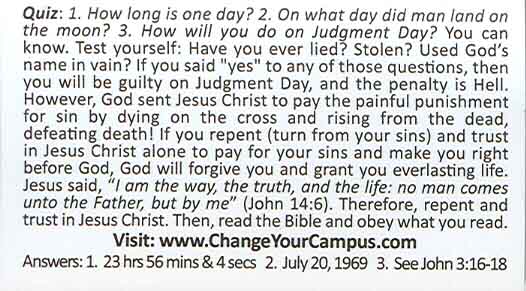
Yesterday at Montclair State University, I was sitting in the hallway (my office) prior to class. (Office hours are required, but space is limited for adjuncts such as myself.) While I was reading my book a student walked up and handed me a business card. “For you, sir,” she said politely. The card had a smiley face on it, and was designed to bring cheer.

Then I flipped the card over and found out I was going to Hell. A bit of a downer when you’re about to start class!

It isn’t the first time people have attempted to convert me without bothering to find out what I believe. It seems that if you already hold the zealot’s view you’ll appreciate the gesture of being condemned just to make sure your soul is saved. It is the thought that counts, after all.

The book I was reading was Joseph Campbell’s The Hero with a Thousand Faces – a book I’ve known since college but from which I have only taken a tipple until this year. Many scholars of mythology fault Campbell on being too much of a generalist and looking too much for connections where they are not obvious. His language can be florid and mystical, verging on “believer,” for those uncomfortable with any kind of faith. I find Campbell to be a welcome guide, although, as for any guide, I do not believe all he says! One nugget in particular stuck out at me: “Wherever the poetry of myth is interpreted as biography, history, or science, it is killed.” As we find ourselves on Good Friday, only those with eyes firmly shut will disregard Campbell’s wisdom.

I still remember my shock when I first learned that gods, centuries before Jesus, had been dying and rising. What had always been presented to me as a unique historical event actually had a long and venerable prehistory. It suddenly seemed as if the ministers I’d known hadn’t done their homework. Or perhaps they lacked the cognitive finesse to understand Orpheus, Adonis, Baal, Osiris, and even Ishtar, as types of either blatant or obscure resurrection. It is the Campbellian, or nearly universal hope: life prevails over death. As the young lady walked away, I sincerely wished her happiness in the quest she’s only beginning.