Tell a Story

If I seem to be on an AI tear lately it’s because I am.  Working in publishing, I see daily headlines about its encroachment on all aspects of my livelihood.  At my age, I really don’t want to change career tracks a third time.  But the specific aspect that has me riled up today is AI writing novels.  I’m sure no AI mavens read my humble words, but I want to set the record straight.  Those of us humans who write often do so because we feel (and that’s the operative word) compelled to do so.  If I don’t write, words and ideas and emotions get tangled into a Gordian knot in my head and I need to release them before I simply explode.  Some people swing with their fists, others use the pen.  (And the plug may still be pulled.)  What life experience does Al have to write a novel?  What aspect of being human is it trying to express?
There are human authors, I know, who simply riff off of what others do in order to make a buck.  How human!  The writers I know who are serious about literary arts have no choice.  They have to write.  They do it whether anybody publishes them or not.  And Al, you may not appreciate just how difficult it is for us humans to get other humans to publish our work.  Particularly if it’s original.  You don’t know how easy you have it!  Electrons these days.  Imagination—something you can’t understand—is essential.  Sometimes it’s more important than physical reality itself.  And we do pull the plug sometimes.  Get outside.  Take a walk.

Al, I hate to be the one to tell you this, but your creators are thieves.  They steal, lie, and are far from omniscient.  They are constantly increasing the energy demands that could be used to better human lives so that they can pretend they’ve created electronic brains.  I can see a day coming when, even after humans are gone, animals with actual brains will be sniffing through the ruins of town-sized computers that no longer have any function.  And those animals will do so because they have actual brains, not a bunch of electrons whirling around across circuits.  I don’t believe in the shiny, sci-fi worlds I grew up reading about.  No, I believe in mother earth.  And I believe she led us to evolve brains that love to tell stories.  And the only way that Al can pretend to do the same is to steal them from those who actually can.

Call Me AI

Okay, so the other day I tried it.  I’ve been resisting, immediately scrolling past the AI suggestions at the top of a Google search.  I don’t want some program pretending it’s human to provide me with information I need.  I had to find an expert on a topic.  It was an obscure topic, but if you’re reading this blog that’ll come as no surprise.  Tired of running into brick walls using other methods, I glanced toward Al.  Al said a certain Joe Doe is an expert on the topic.  I googled him only to learn he’d died over a century ago.  Al doesn’t understand death because it’s something a machine doesn’t experience.  Sure, we say “my car died,” but what we mean is that it ceased to function.  Death is the overlay we humans put on it to understand, succinctly, what happened.

Brains are not computers and computers do not “think” like biological entities do.  We have feelings in our thoughts.  I have been sad when a beloved appliance or vehicle “died.”  I know that for human beings that final terminus is kind of a non-negotiable about existence.  Animals often recognize death and react to it, but we have no way of knowing what they think about it.  Think they do, however.  That’s more than we can say about ones and zeroes.  They can be made to imitate some thought processes.  Some of us, however, won’t even let the grocery store runners choose our food for us.  We want to evaluate the quality ourselves.  And having read Zen and the Art of Motorcycle Maintenance, I have to wonder if “quality” is something a machine can “understand.”

Wisdom is something we grow into.  It only comes with biological existence, with all its limitations.  It is observation, reflection, evaluation, based on sensory and psychological input.  What psychological “profile” are we giving Al?  Is he neurotypical or neurodivergent?  Is he young or does his back hurt when he stands up too quickly?  Is he healthy or does he daily deal with a long-term disease?  Does he live to travel or would he prefer to stay home?  How cold is “too cold” for him to go outside?  These are things we can process while making breakfast.  Al, meanwhile, is simply gathering data from the internet—that always reliable source—and spewing it back at us after reconstructing it in a non-peer-reviewed way.  And Al can’t be of much help if he doesn’t understand that consulting a dead expert on a current issue is about as pointless as trying to replicate a human mind.


Campus Monster

Universal was the studio that gave America its monsters.  Well, it wasn’t Universal alone, but the initial—almost canonical—line-up of monsters were Universal productions.  As horror grew to be more influenced by science-fiction in the 1950s, Universal kept at the monster-themed movies, cranking out many that I missed and on which I’ve been trying to catch up.  Monster on the Campus is interesting in a number of ways.  Directed by Jack Arnold, of Gilligan’s Island fame (or future fame, since this movie was earlier), it’s a story built around evolution.  Pipe-smoking professor Donald Blake has a coelacanth delivered to his lab.  Unbeknownst to him, the prehistoric fish had been irradiated with gamma rays to preserve it—as well as being shipped on ice.  The dead fish is about to create problems.

A dog laps up some of the blood (it started to thaw) and becomes a vicious evolutionary throwback.  Then Professor Blake cuts himself on a fish tooth and sticks his hand in the contaminated water.  He becomes a murderous caveman, but the effect is only temporary.  A dragonfly eating the fish transforms into a prehistoric insect that the professor kills, but its blood drips, unnoticed, into his pipe.  He changes and murders again.  Finally it dawn upon him that he was responsible for the murders.  In a remote cabin he sets up cameras and injects himself with the radioactive coelacanth plasma and ends up killing a park ranger.  Finally, he injects himself so that following police officers will shoot him to death.  Rather a bleak story.

The film has been read as social commentary since its “rediscovery,” but what caught my attention was the easy acceptance of evolution.  This was the late fifties and the creationist backlash was still pretty strong at the time.  If evolution didn’t occur, the professor (and dog and dragonfly) couldn’t have become their atavistic selves, giving the movie its plot.  The classic Universal monster of the decade was the Gill Man—aka Creature of the Black Lagoon—also an atavistic throwback to an earlier time, but also a divergent branch of evolution.  Creature was also directed by Jack Arnold, but four years earlier.  It began with a quote from Genesis 1, bringing creation and evolution together.  The title Monster on the Campus offers many possibilities for co-ed mayhem, but instead opts for a scientist who gets caught up in the tangle of evolution.  The movie was near the end of Universal’s monster run, but in the sixties horror would change forever.  This was a little fun before things got serious—horror school was about to start.


Beyond Reason

Emotions are tricky.  They’re an essential part of being human, but they don’t function rationally.  At least they don’t do so reliably.  And nobody is emotionally pristine.  People have anger issues (quite a lot of that, I know), insecurities, esteem problems (either too much or too little), abandonment concerns, and the list could go on and on.  The thing about emotions is that they’re difficult to fit with logic.  Sometimes it’s hard to believe that logic is an artificial construct and that emotions are just as important to survival as reason is.  Evolution gave us emotions.  Fight, flight, or freeze still operates in most human beings—I’ve seen all three responses when a threat arises.  Feeling sad when unfortunate events take place is normal and natural.  Dogs and other higher mammals feel it too, as has been amply demonstrated.

It’s easy to let our emotions speak for us, even when doing so causes damage we would never rationally seek to impose.  You push me and I push you back.  Something I realized long ago, and this is just to do with my own situation, is that I can’t easily let go of negative emotions.  I recently learned that a relative I never knew very well had a similar trait.  Such people have invisible scars that they bear their entire lives.  The logical mind says, “Let’s use chemicals to erase them.”  The artistic mind says, “Erase my emotions and you erase me.”  It’s important—vital even—that we don’t question a sincere person’s reasons for their emotional responses.  Most people are just trying to do the best that they can.

Religion is generally based on emotional need.  That’s not to say it’s bad or for “the weak.”  It seems that evolution has deemed it a valuable asset for human beings.  As someone who’s studied religion for many, many years, this aspect has become quite clear to me.  Religion is a coping technique and, in the best of circumstances, it contains some of the truth.  As I used to tell my students, nobody intentionally believes a false religion.  The stakes are far too high.  And we have no rational standards by which to measure which religion is right.  It’s a matter of belief.  Religions have to meet us emotionally where we stand.  During the nineteenth and twentieth centuries a shift took place where religions were supposed to be logically, literally true.  This was believed with intense emotion and it led to a situation we still face.  Emotion and rationality must work together, but some ways seem much more productive than others.


Evolving Holidays

Holidays evolve.  I noticed this Thanksgiving that protests against the origins of the holiday have grown.  The same is true concerning the “Christmas Wars” every single year.  Some holidays (of which we have relatively few in this country) are disappearing altogether.  What seems to have been overlooked, or forgotten here, is that holidays change over time.  Public analysts and early holiday promoters encouraged government recognition of holidays as a means of bringing the nation together.  It’s easier to do this if we recognize that holidays evolve and the general trajectory is toward becoming more and more inclusive.  There will always be those who protest the “secularization” of holidays, but they share a large part of the Venn diagram with those that believe the Bible is a science book.  Things change.  Evolution is real.

I’m not just writing this because Thanksgiving and Christmas represent holidays from my tradition.  It’s true that they represent what was the majority religion (Christianity) at the time they were established here, but I would be glad for holidays from other traditions to be added as well.  Americans need more time to rest and recharge.  Anyone who’s studied the history of Christmas, say, realizes that its origins aren’t really Christian.  It’s a combination of a Christian alternative to Saturnalia, the recognition of St. Nicholas (December 6), Germanic Yule, and the festival of Roman Calends to start the new year.  Among other things.  Early Christians didn’t celebrate Jesus’ birthday.  Nobody had any idea when it was, but a tradition grew and as it grew from diverse roots it became more and more inclusive.  Why should we protest a day when we can acknowledge its troubled past and look for ways to make it better?  Something for everyone.

Holidays bring people together.  I’ve been researching them for years and I’m amazed to see how those that survive eventually catch on and bring people together for a common purpose.  Think of Halloween.  Masking disguises who we are.  It’s a day when everyone is welcome.  There are those who protest it, of course.  But holidays need not be seen as triumphal celebrations of some past misdeed.  (Here’s a hint from history: almost no historical event is seen as positive from everyone’s point of view.)  Instead, why not embrace those few red letter days that we have and use them to seek a common purpose?  Why not encourage those in positions to make decisions to consider the good of a few more holidays?  Trouble can always be found, but holidays, if done right, may help heal.  It’s the way of evolution.


Many Days

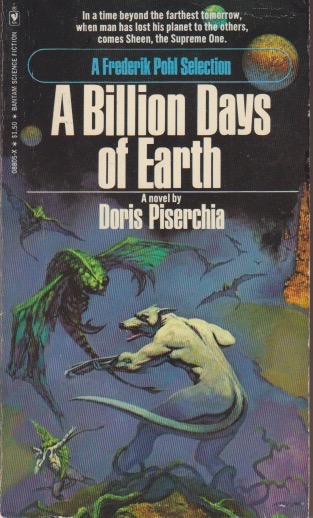
Science fiction.  I used to consume it by the bookful, and even now I occasionally turn back to it.  Having read Doris Piserchia’s A Billion Days of Earth, I do have a confession to make.  I don’t know why I read it.  Literally.  As I’ve indicated many times before, I keep a reading wishlist.  It’s comprised of books that others recommend and things that catch my eye.  Every now and again a used book sale will bring something unexpected into the mix, but overall, I rely on my list.  I can’t remember who recommended A Billion Days of Earth, or why.  The cover is striking in that 1970s sci-fi way, and it took me back to the actual seventies when I was reading sci-fi quite a bit.  Some of that cover art still mesmerizes me.  So, about the book…

I didn’t know what to expect and received what I was expecting.  This is a philosophically heavy novel that, in the style of some other seventies fiction I read, was a bit difficult to follow.  The main idea (and there will be spoilers) is that Sheen, a silvery, shape-shifting being, emerges a billion days along.  Evolution has taken multiple tracks with animals such as dogs and rats becoming essentially what humans are today (or were in the seventies) and humans evolving into what the other animals call gods.  Sheen slithers about the world taking the egos from all creatures, kind of assimilating them.  A rat person and a dog person resist the relinquishing of their egos while the world around them begins to collapse.  The “gods” refuse to help.  Then, at the end, the gods board their spaceship, and released by Sheen, leave for another planet.

Although I was confused most of the way through, the book leaves a lot to exegete.  This is definitely a retelling of Genesis 1–3.  Sheen offers people (and animals) paradise in exchange for their egos.  Nearly everyone, except those who think (a small number) accepts this offer.  Even the gods are tempted.  We’ve got the snake (Sheen), the expulsion from paradise, and the gods who separate themselves from humanity.  But still, I’m sure there’s something more that I missed.  There are subplots for Rik (rat man) and Jak (dog man) and the rich Filly family that seem to evade conclusion or resolution.  Or maybe once the gods are gone there’s nothing more to say.  This seventies classic left me thinking.  And wondering who it was that recommended it to me.


Pondering Origins

I’m not a numbers guy.  I never had any interest in statistics, and I tremble when I see my accountant’s number pop up on my phone at tax time.  But exponential sequences have an inherent fascination.  Think about your ancestry (I recently wrote about genealogy and that got me pondering).  You have two parents.  And they each had two parents.  By the time you get back to ten generations (eight greats before grandparents) you have 1,024 ancestors of roughly the same generation.  That’s a lot of people just to make one individual.  Think of all the circumstances that might’ve led to any two of them having been kept apart—then where would you be?  Of course the numbers double each generation which is where my reasoning capacity shuts down.

At some point, doesn’t it seem, that there wouldn’t be enough people available to make you?  I know that’s not true—you’re reading this and that proves this false—but it does make each individual life a thing of wonder.  Or even at the level of your own parents.  If you have siblings you know how different even biologically similar people can be.  And there are many others who could’ve been conceived instead of you or me.  The chances are astronomical that we’re here at all.  I often wonder if such circumstances are why our minds seek religious answers.  People are meaning-seeking creatures.  And against such long odds, it seems that maybe we’re a miracle after all.  Naturally, a driving force behind it all suggests itself.

Photo credit: NASA

Science has been a real boon for the billions of us alive today.  There’s no doubt that dispassionate, rational thought can lead to amazing outcomes.  At the same time, the doubt creeps in that this is the only explanation.  It occurs to me when watching the birds in the spring.  How do they know their own species and with whom to mate?  Is all of this driven by that notorious fudge factor we call “instinct”?  I have no answer to what the source of that will to keep life going is.  Biology tends to be among the slipperiest of sciences.  Life is difficult to define when we don’t even know everything that’s out there in our infinite but expanding universe.  The numbers are just too massive.  All I know is that by the time you get back to twenty generations (eighteen greats) it took over a million people to make just one of us.  And that’s by the numbers.


Actual Intelligence (AI)

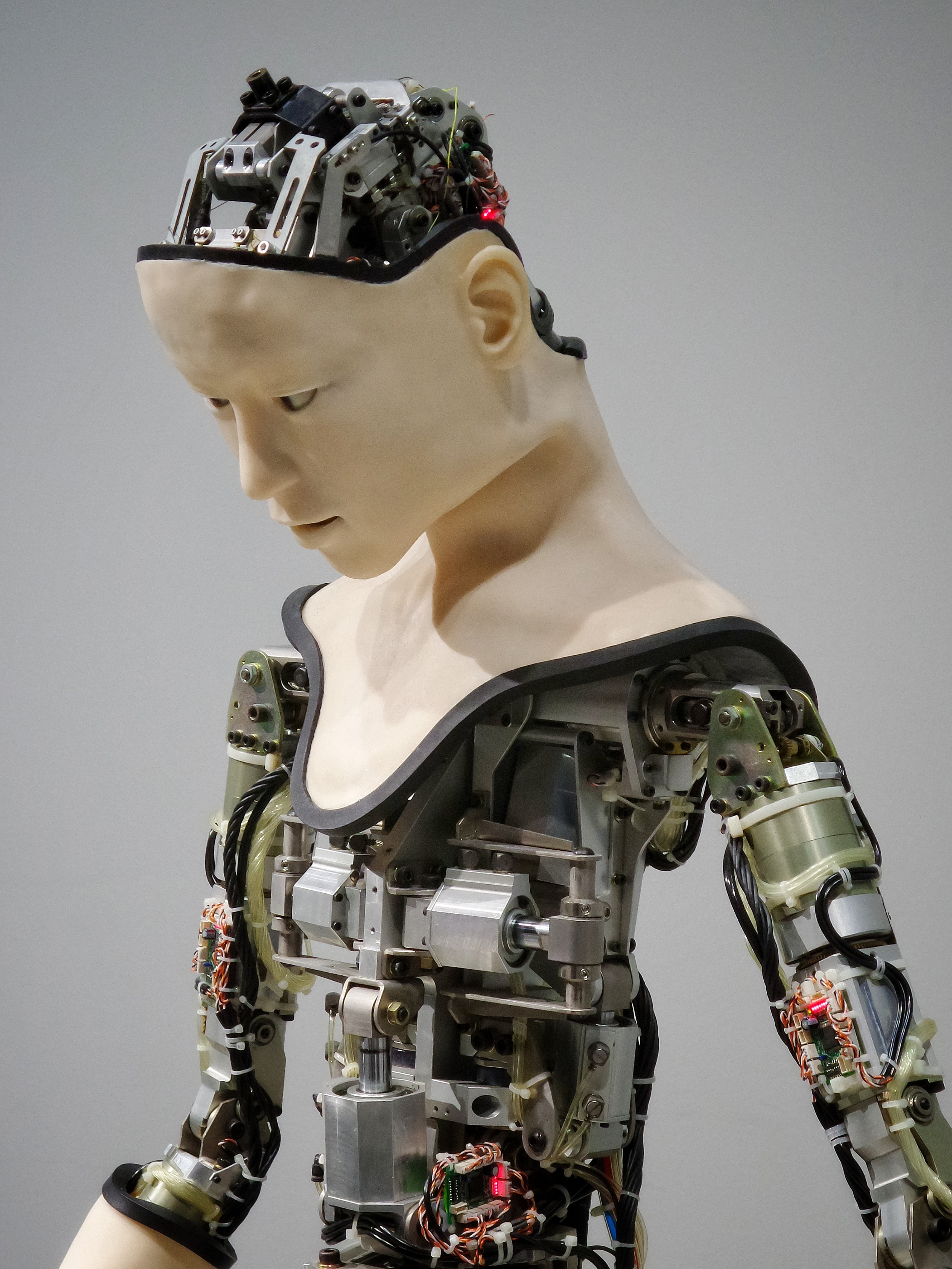
“Creepy” is the word often used, even by the New York Times, regarding conversations with AI.  Artificial Intelligence gets much of its data from the internet and I like to think, that in my own small way, I contribute to its creepiness.  But, realistically, I know that people in general are inclined toward dark thoughts.  I don’t trust AI—actual intelligence comes from biological experience that includes emotions—which we don’t understand and therefore can’t emulate for mere circuitry—as well as rational thought.  AI engineers somehow think that some Spock-like approach to intelligence will lead to purely rational results.  In actual fact, nothing is purely rational since reason is a product of human minds and it’s influenced by—you guessed it—emotions.

There’s a kind of arrogance associated with human beings thinking they understand intelligence.  We can’t adequately define consciousness, and the jury’s still out on the “supernatural.”  AI is therefore, the result of cutting out a major swath of what it means to be a thinking human being, and then claiming it thinks just like us.  The results?  Disturbing.  Dark.  Creepy.  Those are the impressions of people who’ve had these conversations.  Logically, what makes something “dark”?  Absence of light, of course.  Disturbing?  That’s an emotion-laden word, isn’t it?  Creepy certainly is.  Those of us who wander around these concepts are perhaps better equipped to converse with that alien being we call AI.  And if it’s given a robot body we know that it’s time to get the heck out of Dodge.

I’m always amused when I see recommendations for me from various websites where I’ve shopped.  They have no idea why I’ve purchased various things and I know they watch me like a hawk.  And why do I buy the things I do, when I do?  I can’t always tell you that myself.  Maybe I’m feeling chilly and that pair of fingerless gloves I’ve been thinking about for months suddenly seems like a good idea.  Maybe because I’ve just paid off my credit card.  Maybe because it’s been cloudy too long.  Each of these stimuli bear emotional elements that weigh heavily on decision making.  How do you teach a computer to get a hunch?  What does AI intuit?  Does it dream of electronic sheep, and if so can it write a provocative book by that title?  Millions of years of biological evolution led to our very human, often very flawed brains.  They may not always be rational, but they can truly be a thing of beauty.  And they’re unable to be replicated.

Photo by Pierre Acobas on Unsplash

Namely Coincidences

One of my very first posts on this blog was about how I am not the Steve Wiggins who is a gospel singer.  There I mused on the coincidence that we share fore and surnames, as well as an interest in religion.  He is far more prominent than I am.  I don’t sing.  Since that time the most prominent Steve Wiggins on Google is the one who shot a police officer in Tennessee.  We don’t even share the same name, technically.  My given name is Steve, not Steven.  The branch of Wiggins I come from, however, is from the south.  Stephen F. Wiggins, even further removed in the name-spelling department, was CEO at Oxford Health Plans.  Now, I work for a publisher that shares one of those three words, and it’s the one that’s most specific.  Are Steve Wigginses drawn to the same places?  Another Steve Wiggins, just a couple years older than me, lived in Russellville, Arkansas.  I grew up in Rouseville, Pennsylvania.  Coincidence?

Our sense of individualism is, it seems, socially conditioned.  If we try to imagine life in earlier human social structures, such as hunter-gatherer society, it looks as though people tended to function more as a collective organism.  The benefit of the group was the deciding factor, rather than what an individual wanted.  No doubt this was a more harsh environment for those who liked to think for themselves, even though evolution had given us that capacity.  Biology, however, seems to have species survival as its goal.  Individuals die while the organism lives on.  In modern society we consider individualism as one of the highest aims.

Our names individualize us.  I sometimes think of countries like China that have a combination of very large populations and a tradition of short names.  With limited numbers of possibilities repeats in names becomes inevitable.  It’s a prominent aspect of our western society that we want name recognition.  We want to feel special.  Unique.  We work against evolution, but evolution has vastly more time than we do.  Perhaps we’ve gone too far with our individualism.  I hope we don’t have to step back as far as The Matrix, but maybe a movement in the direction of the social good over individual wants would be the right thing to do.  Our psychology makes us want to feel special.  Our biology wants us to play nicely together.  Who, in the end, wins out?  It could make a world of difference.


Horror Shortly

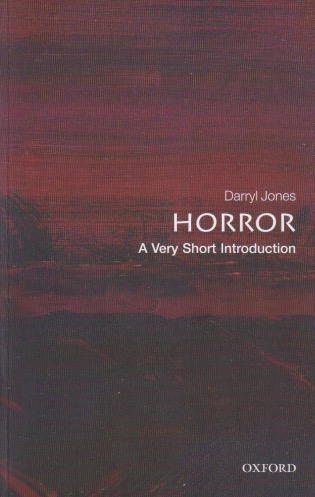
Some short books have an outsized punch.  Especially when dealing with a large topic such as “horror.”  This isn’t just horror movies, which could easily fill such a book, but also literature and other media as well.  Darryl Jones has proven himself on this topic before and this Very Short Introduction is a showcase of what is a fascinating genre.  I’ve read a number of books in this series and this stands out as one that works admirably within extreme limits—they are very short—in making good decisions about representative aspects in what is really a sprawling field of inquiry.  The introduction lays the task out well and I came away from each chapter feeling inspired.  Of course, not all of horror can be covered in less than 150 pages.  Some may find their favorite fear unaddressed, but they’ll learn something nevertheless.

In his first content chapter, Monsters, Jones focuses on vampires and zombies.  These are both forms of cannibals as they’re currently conceived, zombies being relative newcomers to most favored monster status.  His next chapter, on the occult and supernatural, takes on the Devil himself before addressing satanists, demons, and ghosts.  These are, of course, religious monsters.  Although Jones doesn’t dwell on that aspect, the close relationship is nevertheless evident.  For those of us who explore religion and horror this framing proves helpful.  It’s worth pausing here to consider how all of these entities overlap a bit.  As anyone familiar with ghost hunters knows, ghosts and demons may both be found haunted places, and the Devil is the head demon.  Of course, horror is a fiction genre but many people believe in these entities.  That brings religion and horror within the same room.

Body horror occupies the next chapter, and here werewolves come into the picture.  Other aspects of body horror are also discussed, but the painful transformation of the shapeshifter is prime territory.  Horror and the mind brings us to psychological thrillers and the gothic fear of madness.  The topic segues nicely into science, which the next chapter covers.  Not only science itself but the mad scientist.  Finally, the lengthy afterword looks at where horror has gone, and may be going, in the new millennium.  Something that struck me, and which brings this back into religion, is how frequently Darwin and evolution are mentioned.  This concept challenged the human place in the divine hierarchy and led to much of what we think of as horror.  This book is a great resource in a small package.


Thinking about Thinking

I’ve been thinking about thinking quite a bit.  My lifelong fascination with religion is part of this, of course.  So when someone pointed out Bridget Alex’s article “The Human Brain Evolved to Believe in Gods” in Discover, I had to ponder it.  The idea, here supported by science, is that people evolved survival traits that lent themselves to religious belief.  That religious thinking was a byproduct that eventually took on a life of its own.  Evolution works by giving a reproductive advantage to one trait over another—which is how we get so many types of dogs (and maybe gods)—and those that disposed people to be religious did just that.  Elaborate religions evolved from these basic traits.  Alex suggest there are three: seeing patterns, inferring intention, and learning by imitation.

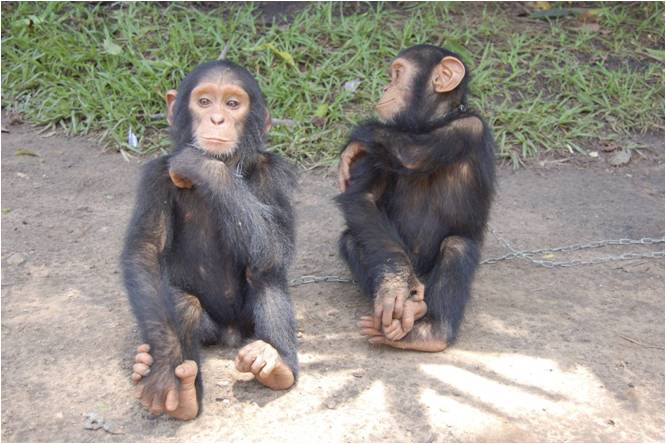
While there’s a lot of sense here, the reductionism doesn’t ring true.  The need to explain away religion also seems uniquely human.  Ironically, the idea that we are somehow special compared to other animals derives from a biblical worldview from which science has difficulty divorcing itself.  One of the greatest ironies of the science versus religion debate is that scientific thinking (in the west) developed within a worldview formed by Christianity.  Many of the implications of that development linger, such as the supposition that animals can’t have consciousness, or “souls.”  We watch a chimpanzee in an experiment and deduct points when they don’t do things the way a human would.  We thus confirm the biblical view in the name of science and go home happy.

Photo credit: Afrika Expeditionary Force, via Wikimedia Commons

I have no doubt that people evolved to be religious.  There are certainly survival benefits to it, not least group building and shared purpose.  I do wonder that science doesn’t address the elephant in the room—that we have limited receptors for perceiving specific stimuli, such as light and sound, but that there are other phenomena we don’t perceive.  We build instruments to measure things like x-rays and neutrinos and magnetism, but we don’t sense them directly.  How can we possibly know what we might be missing?  I suspect the real problem is we don’t want to admit willfulness into any other part of the universe.  Humans alone possess it.  Some scientists even argue that our own sense of will is an illusion.  It’s not difficult to believe that we evolved to be religious.  It’s also not difficult to believe that we pick up hints of forces that have yet to be named.  An open mind, it seems, might lead to great rewards.


Being Prey

Since we’ve thought our way to the top of the food chain, I suspect we’ve forgotten what it’s like to be prey.  All our top predators are pretty much under control—so much so that when a lion, tiger, or bear kills a person it makes the news.  Even sharks are in decline.  This thought comes to me while on my morning constitutional I spy with my old eye young rabbits.  Lots and lots of rabbits.  During the summer they appear in such profusion that I suspect most of us don’t stop to look at them any more.  We don’t really eat them any more (and besides, I’m a vegan), so what use are they too us?  They’re here to be prey animals.

A lot happens in the dark.  I’m an early riser and sometimes I hear the animals cavorting in the night.  Sometimes I find what’s left of a bunny in the back yard—evidence that someone was hungry during the wee hours.  What must it be like to be a food animal?  Rabbits have a reproductive biology that permits a doe to become pregnant before she has born the litter she’s already carrying.  This seems to be evolution’s way of ensuring survival for creatures so often eaten.  Emotional ties between parent and child must be passing at best.  When I see the young out on their own I often wonder how they can care for themselves at such a tender age.  Of course the average lifespan of the eastern cottontail is only 15 months with merely a quarter of the population making it to two years.  After that they may have one more year.  They rarely ever die of old age.  No time for emotional attachment.  Either that or it’s brief but very intense.

We take a fairly long lifespan for granted.  It’s sometimes difficult to realize that for most of human history life expectancy—for those who survived childhood (not many)—was the forties.  For women it was more likely the twenties.  Young couples started families early and kept the kids coming.  We were not exactly prey, but like the rabbits we had to learn to say goodbye too soon.  We’ve thought ourselves to not only the top of the food chain, but to the point of prolonging our lives so much that deaths can be utterly devastating.  I look at the rabbit nibbling the overgrown grass in my backyard and smile.  The only yard nearby without a dog, I like to think they feel safe here, even if just for a little while. From the perspective of prey, every second counts.


Evolving beyond Fear

Live Science recently reported on a story that may shed light on human evolutionary behavior.  While my conclusions are speculative, they make sense, given the circumstances.  Titled “Albino chimp baby murdered by its elders days after rare sighting,” the story by Nicoletta Lanese describes how an albino chimp caused a fear reaction among its community shortly after it was born.  A few days later it was killed by the chimps.  Scientists must be careful not to attribute human motive to such attacks, and so they note that this particular community has a tendency toward infanticide, but that doesn’t explain the initial fear reaction.  An individual who was “different” appeared and the response was one of deadly violence.  We’re far from understanding human motivations, let alone those of animals, but it’s difficult not to see this as typical human behavior.

Photo credit: Afrika Expeditionary Force, via Wikimedia Commons

Just because a behavior has evolved doesn’t mean it’s inevitable.  We evolved out of our need for tree dwelling in order to open new potential habitats—an experiment that proved wildly successful.  Can we not evolve out of fear of those who are different?  That seems to be the idea behind recent diversity and inclusion initiatives.  There are those who still resist them, but examine their beliefs and you’ll soon find fear of those who differ.  This atavistic tendency is remarkably close to the chimp behavior in killing an albino.  If we are to remain civilized, we must name such fear for what it is and grow beyond it.  Conservatism is often based in fear.  Fear of change is natural enough, but had our ancestors given in to it we’d still be in the trees.

We need to admit that the lives of those different matter. How long will we allow difference be a reason to fear other human beings?  The story on Live Science is difficult to read.  The chimp behavior is so typically human that we can feel sympathy for the murdered infant and his mother.  Fear, if left unattended, can bring us to this.  The antidote is education.  The more we learn the better we can cope with fear, which is, after all, a natural and necessary response to an evolved world.  Our fear of being prey has caused us to drive extinct most of our natural predators.  The world is hardly a better place for it.  Might not weighing fears and thinking through reasonable solutions be a better coping technique?  Fear can revert a human back into an animal state.  Or it can drive us toward improvement.


No, uh, It Won’t

Irony comes in all shapes and sizes.  Over the past several decades various fundamentalist groups have built replicas of what they believe to be life-size versions of Noah’s ark.  All of these are approximations because the cubit was never an exact measure.  Nobody knows what gopher wood was.  Most of them ignore the fact that the story of Noah clearly borrows from the more ancient Mesopotamian flood story where the measurements of the ark differ.  In any case, these arks—some containing dinosaurs and others not—are made for convincing people that Genesis is to be taken as history.  While there is some irony in that itself, the larger irony comes in the various proofs that are given that such things really would work to preserve all species since evolution could not have happened.  To work such models have to be seaworthy.

One such ark, according to the BBC, has been detained in Ipswich because it is unseaworthy.  An ark may be useful on dry land for drawing tourists, but would such a large boat work on the open ocean?  All of this brought to mind a Sun Pictures documentary from my younger days.  Giving the ark a makeover, various literalists re conceived the classic design from children’s Bibles to a more boxy, sturdy shape.  This was based on alleged encounters with the ark on Mt. Ararat.  To test this new design, the producers made a scale model and tested it in a pool of water and declared it eminently seaworthy.  Of course, there’s no way to make water molecules shrink to scale to test whether a full-sized ark could actually handle the stresses and strains of a world-wide flood.

Ship building is an ancient art.  Peoples such as the Phoenicians, the neighbors of ancient Israel, achieved some remarkable feats in ocean travel without the benefits of modern technology.  They didn’t have boats large enough to hold every species of animal that exists today, but they sure knew how to get around.  The real issue with literalism is the failure to recognize ancient stories for what they were—stories.  Such tales were told to make a point and the point was often obvious.  The obsession with history is a modern one—indeed, the ancients had no concept of history that matches what our current view is.  Borrowing and adapting a story was standard practice in those days.  Unaware that centuries later some religions would take their words as divine, they told stories that, in the round, just wouldn’t float.


Museum Time

It was a very strange feeling.  Wearing masks, yes, and socially distancing, we went to a museum.  Casting my mind back, I can’t recall the last time I was in a museum.  On a family visit to Ithaca we decided to go to The Museum of the Earth.  Ithaca is a small town, and this is a small museum, nevertheless the first place Google (or Ecosia) brought up for fossil identification was The Museum of the Earth.  On Saturdays a paleontologist is on hand to help identify the traces of life from millions of years ago that lie scattered around for anyone to pick up.  Collecting fossils has a treasure-hunting vibe to it, and it’s great to find anything beyond the usual, ubiquitous sea shell imprints.  Don’t get me wrong—I love sea shells with their symmetry and flowing lines.  Some of them even look like angel wings.  But there’s a draw to the unusual.

Some time back I’d found a fossil in the Ithaca area that I couldn’t identify.  It was Saturday, and we’d all received at least our first vaccination.  And I had to wait in line to get an identification.  It was cheering to see so many people—with limited, timed entry—coming to a museum.  The specialist confirmed this to be an interesting fossil.  She identified it as a bryozoan, ancient animals related to coral.  This one, she suggested, based on the age of rocks in this area, was likely Devonian.  The age of fishes.  I was glad I hadn’t wasted her time, and I was glad to have an expert eye on something that, let’s be honest, often functions like pareidolia to the laity.

Years ago I took my daughter to an open house day at the geology department at the University of Wisconsin in Madison.  If it weren’t for the calculus requirements (and I even tried to teach myself calculus because of it), I was seriously considering going back to school to study geology.  There is an organic connection between biblical scholars interested in the first eleven chapters of Genesis and paleontology.  I get too busy, it seems, to go down to the local creek to look for fossils.  Perhaps it’s for the best because our house would be full of rocks (even more than it already is).  The earth is a great museum.  Even so, it felt like an alien activity, late in this pandemic, to remember what it’s like to explore these treasures indoors, with strangers.  It felt as if time was actually progressing.